"There are no isolated problems; everything is part of everything else." (1)-Jose Lopez Portillo, 1977Former Mexican President, 1976-1982
"Increasingly there is an understanding that economic growth is not a static process." (2)-Charlene Barashefsky, 1997U.S. Trade Representative
Prior to the 1990s, the possibility of securing a comprehensive free trade agreement between the governments of the United States, Canada and Mexico was considered highly unlikely. (3) For many key actors in the global market system, the primary objective was to protect and strengthen the relationship among developed nations, as opposed to forging an integrated, albeit potentially unstable, agreement with developing countries. However, the 1990s are characterized by the acceleration of regional trade agreements within the context of a larger interdependent market system, which seeks to include all nations. Regional trade agreements, such as NAFTA, are no longer strictly limited to the developed world, as developed nations increasingly discover the advantages of extending economic commitment to less developed countries. Similarly, Developing nations recognize the potential economic advantages achieved through such economic agreements. According to this view, enhanced access to large developed markets, such as the U.S., will provide an impetus for export-led industrialization among the smaller economies. (4)
This global trend towards trade liberalization and greater market integration is part of a much larger phenomenon that emphasizes the market as the primary vehicle for sustained economic prosperity. Theorists, such as Milton Friedman, argue that through the market system, economies of scale will consistently be reached as firms prosper and profits are maximized. As profits are maximized, economic prosperity is enhanced, and by extension economic stability will ultimately enhance the general wellbeing of the global community over the long-term. Bruce Wilkinson, a professor of economics at the University of Alberta, elaborates upon this vision of the market:
The main emphasis of this age is upon "the market" and "the bottom line." Popular buzzwords and phrases in business, government, an the interface between the two are "let the market work," "competitiveness," "globalism," "the global perspective," being "lean and mean," and "maximizing the bottom line."
As Wilkinson later states, ''The market' has been elevated to the status of a god that will, supposedly, administer the affairs of the world in an impartial and appropriate manner. (5) Furthermore, many of these same theorists view the market as a relatively secure institution, responsible for maintaining the economic stability of the global community. (6) To a large extent, the market has fulfilled many of these expectations. The greatest realization of these objectives has perhaps been most pronounced under the guise of regional trade agreements, such as NAFTA.
Following the implementation of NAFTA on January 1, 1994, trade between the United States, Canada, and Mexico has accelerated to record levels, which has seemingly created higher paying jobs and greater social cohesion (an area that will be expanded upon with Molly Scotts chapter). Furthermore, all three-member states have derived some economic benefits from NAFTA. (7) Exports of U.S. goods to Mexico, for example, grew by nearly 37 percent (or $15.2 billion) within the three years following NAFTA's inception to a record high of $56.8 billion. At the same time, the United States effectively widened its lead over its competitors within the Mexican market by increasing its share of Mexico's imports from 69 percent in 1993 to 75 percent in 1996. In addition, U.S. sales to its largest export market, Canada, have increased by $33.8 billion since 1993. The dramatic increase of U.S. exports to both Mexico and Canada supports an estimated 2.3 million U.S. jobs. (8) However, these obvious examples of beneficial trade created through neo-liberal trade agreements needs to be weighed against the tremendous instability that is also a result of the same neo-liberal policies, exemplified by Asia's spiraling financial crisis.
Only a year ago, several East Asian countries were heralded as models of neo-liberal development for other developing countries. Yet today, many of their national economies have collapsed into ruin, and many of those who heralded Asia a year ago now are condemning them for their impracticable economic policies. The crisis, which began in July 1997 following the devaluation of the Thai baht, has instigated an alarming chain of currency devaluations across South East Asia, estimated at roughly 30 to 50 percent. (9) Unfortunately, the crisis has not merely been limited to currency devaluations. Instead, the crisis has resulted in both widespread stock market failures and dramatic losses in capital inflows to South East Asia. Of even more concern are investors' fear that the Asian contagion might spread. (10) Today's world is characterized by increasing interdependence, and at the forefront is the financial interdependence between nations, thus making these fears all the more plausible.
Given that market interdependency is a recent trend, it is difficult for market analysts to gauge the potential effects of market instability. A senior Clinton Administration official lamented this unfortunate and inherent paradox: "We simply don't know where this goes next, and we can't predict it." (11) Yet, if the Asian financial crisis is allowed to continue, the possibility of inflicting massive devastation upon larger and more influential economies, such as that of Japan, becomes more realistic. In which case, if Japan falls into a precipitous decline, its closest trading partner, the U.S., will find it all but impossible to shield itself from the Asian crisis. The United States economy relies heavily upon the Japanese import market as a relatively predictable and significant source of income. Consequently, if the current financial crisis forces the Japanese to reduce its imports, 'the effects would be felt,' as David Sanger, a journalist for The New York Times explains, "from Wall Street to the factory floors of companies that have thrived in America's export boom." (12) Thus, the crisis can no longer be considered entirely remote, nor entirely Asian in its geographical importance.
These side effects associated with free-market interdependency have not been limited to the current Asian crisis, nor has North America remained immune. In fact, this dilemma has been more pronounced in North America, with both the 1982 debt crisis and the 1994 peso devaluation. Despite the lingering potential for a widespread economic crisis, liberalized markets continue to generate significant benefits. (13) The high degree of market volatility and its inherent uncertainty, however, demands programs to ensure sustained economic stability, which are critical to restoring the financial stability of North America. Such programs need to include prudent and transparent policies, particularly sound macroeconomic and structural policies, and effective financial sector regulation.
This chapter will examine the economic stability of North America as impacted by NAFTA. By examining both the 1994 peso devaluation and the 1982 debt crisis, this chapter will demonstrate that economic interdependency, without necessary safeguards, possess the potential to devastate not only a national economy, but also transnational economies that are economically interdependent. Finally, this paper will demonstrate the importance of restoring a degree of governance to the accelerating capital exchanges that underpin the interdependence of North America.
In recent years, the free market system has been embraced as the only viable means towards achieving sustainable economic growth and development. The collapse of the Soviet Union and the subsequent dissolution of the eastern block, in comparison with the overwhelming triumph among the capitalistic states, is considered proof that any economic alternative to the market system is unfavorable. Demands for 'trade not aid' from the developing nations is seen as further proof that the only viable method to ensure lasting economic growth is through increased economic liberalization. Increasingly this trend is embraced by economists and politicians across the globe and its popularity is perhaps most notable among the less developed regions, such as Latin America, as they continually attempt to enhance their position within the global market. (14)
The neoliberal ideology, championed in the 1980s by the governments of Margaret Thatcher in Great Britain, Reagan and Bush in the United States, Mulroney in Canada, and Salinas in Mexico, is based primarily on two assumptions. First, that the Multinational Corporation (MNC), within the context of the market system, is the primary actor for change and the primary method for transferring capital and technology internationally. Thus, according to neo-liberal ideology, as MNCs further expand their operations, economic efficiency will be furthered and product variety and quality will increase, thus, enhancing the general welfare of the global community. (15) This is because, according to neoliberal theorists, political stability and social welfare are directly related to market forces. As economies prosper, political and social institutions will then flourish. Secondly, since economic actors enhance social welfare, the primary role of the government is to remove hindrances that may obstruct the market from expanding. According to this principle, the best government is a severely limited government. NAFTA and the Uruguay Round of General Agreement on Tariffs and Trade (GATT) negotiations, are both embodiments of neoliberal ideology.
Both the neoliberal ideology and the forces of global capitalism within North America were further strengthened through the implementation of the NAFTA on January 1, 1994. However, an unfortunate side effect of NAFTA indicates that a severe downturn in the economy of any one of the member-states will significantly dampen the economic growth and development of the other partners. Throughout history, economic crises within one state have negatively effected the growth of its neighboring economies. Due to the recent increased economic integration between the United States, Canada, and Mexico, however, these crises will have far greater implications. This is because capital controls that once were in place have been removed, which, although it has increased investment inflows to Mexico, the largest portion has been in liquid securities. Thus, increased economic integration has effectively become increased economic interdependency. Within the context of currency markets, this type of interdependency carries the potential to create a highly volatile situation, as evidenced by the 1994 peso devaluation. When this devastation is waged against the market under the existing market structure, the objectives outlined within NAFTA's preamble are jeopardized: sustained economic growth, regional market stability, and a general improvement in living standards.
The initial weeks of the Zedillo Presidency appeared to signal the beginning of dramatic progress with the promise of early institutional reforms. On December 8, Jaime Serra Puche, Mexico's Secretary of Finance, predicted that Mexico would enjoy real GDP growth of four percent and an inflation rate of approximately five percent in the coming year. (16) In this generally optimistic atmosphere, questions concerning the wisdom of Mexico's international financial policies were largely dismissed and any reservations regarding a possible devaluation of the peso were suspended. Serra Puche further rejected any reservations about the Mexican economy circulating throughout the international community by pledging, "The exchange rate policy will maintain the established flotation band, which gives the financial authorities a maneuvering margin to confront transitory problems." (17) In other words, Serra Puche guaranteed the international community that Mexico would not alter its monetary policy given the recognized instability of the peso.
On 21 December 1994, only twelve days after Serra Puche's initial announcement, the government abandoned its efforts to defend the peso and announced that it would allow the currency to float against the dollar, which hurled Mexico's economy into a major crisis. "The financial authorities," as Serra Puche explained, "have decided that supply and demand will freely determine the rate of exchange until the currency markets show conditions of stability." (18) At a minimum, market analysts expected the move would bring about not only a sharp and immediate devaluation of the peso, but also a marked rise in inflation with major losses for Mexican banks. (19) Additionally, Tim Golden, in an article following the crisis, explained that "Stockbrokers and financial-market analysts predicted that the currency could quickly fall by 30 percent or more of its value . . . against the dollar, and they warned of a possible run on the banks by Mexicans desperate to change their money." (20) Unfortunately, the controversial management of this unexpected move, which went against the advice of many international investment analysts, exacerbated pre-existing fears among investors and resulted almost immediately in the further uncontrolled fall of the peso.
The unexpected devaluation of the Mexican peso triggered a massive shockwave throughout global financial circles. Legions of investors that had relied upon the promises of the Mexican government just weeks before to defend the peso, frantically liquidated their investments within Mexico. Within two days, five billion dollars in capital had been pulled out of Mexico and by March, the Mexican stock market had lost over half of its value as investors sought to convert holdings to more secure dollar investments. (21) Those holding less liquid assets, however, simply watched the market consume potential future dividends. Furthermore, as the peso continued to plunge against the dollar, its devastation rippled throughout the markets of North and South America, demonstrating the inherent risks of market interdependency. Argentina further exemplifies the power of interdependency, where capital flight during the first five months following the crisis resulted in a five billion-dollar loss in the capital bank's reserves, from $16 billion to $11 billion. In Brazil, the Bovespa index fell 6.33 percent. (22) In the United States and Canada, criticisms concerning the absurdity of entering into a trade agreement with a nation as economically unstable as Mexico coincided with the decline of the dollar against the Japanese yen and the German deutchmark to its lowest post-war levels. (23) What was originally intended to be a simple currency adjustment devastated the Mexican economy and threatened the stability of emerging markets across the globe.
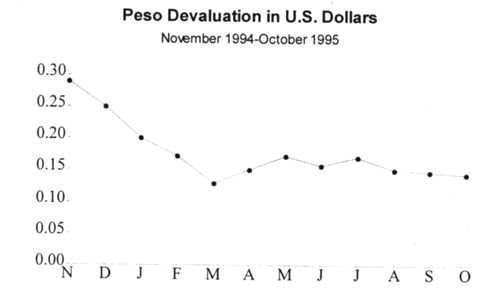
The then-recently inaugurated administration of President Ernesto Zedillo Ponce de Leon was largely unable to convince the markets and the international community that it would be able to control a difficult, albeit not entirely unusual, financial situation. Since the principle qualifications promoted by Zedillo during the campaign had been his capacity to effectively resolve economic problems, the peso crisis considerably eroded his prestige and credibility on both the domestic and international fronts. On 14 March 1994, the President admitted to The New York Times that "a few days after we devalued, I became convinced that we did not have a current-account adjustment problem." For many, a suspicion was confirmed: the new administration did not fully understand the complexities of Mexico's dire economic situation. (24) Yet by the time of the confession, the peso had lost over half of its original value, as the following graph clearly demonstrates, forcing Zedillo to solicit external assistance. (25)
Increased integration of markets under the auspices of economic programs such as NAFTA heightened the seriousness of the peso crisis and will undoubtedly continue to contribute to future instability under the current structure of the international market. Although the currency decline had clearly devastated the market, a full fledged default carried the potential to incite a second, more alarming and damaging, financial shock that would ripple throughout the market. Moreover, the costs to the United States of simply abandoning the peso to market uncertainties would have been extremely high, for several reasons. First, the large amounts of investment held by U.S. investors within Mexico would clearly devastate their holdings. Secondly, recognizing that economic stability and social cohesion are related, social instability within Mexico posed an alarming threat to U.S.-Mexico border region. Given the shared geographical proximity between the United States and Mexico, a border region that spans almost 2000 miles, this fear was not entirely unreasonable. In addition, failing to protect the peso would only support the arguments of NAFTA's most adamant critics. The situation at the time can be described as similar to that immediately following a major earthquake: while the initial disaster would perhaps cause the most glaring damage, the after-shocks would certainly inflict further damage upon an already unsteady region, calling for precautionary measures. Consequently, given the dire risks at hand, the Clinton Administration took the lead by allocating the necessary monetary reserves to bolster the peso and to prevent the market from collapsing.
However, The Clinton Administration would have to accommodate growing domestic opposition, before it would be able to aid the ailing Mexican economy. The President had staked a great deal politically upon his support of NAFTA. Yet, the peso devaluation confirmed many of the prophecies of NAFTA's most adamant critics. Former Presidential candidate Ross Perot, for example, in testimony before a House panel eight months before the crisis, warned that, "These guys are just playing poker with us, and they are going to have to devalue the peso." (26) In fact, throughout his campaign, Perot suggested that the Mexican government would have to devalue the peso by 20 percent to 30 percent soon after implementing NAFTA. Furthermore, Perot suggested that devaluation would unleash a flood of low priced goods into the United States, thus effectively altering the balance of trade. (27) Both Bush and Clinton, however, failed to consider that devaluation might lead to a market imbalance. Yet, as the peso collapsed further and as these predictions materialized, the Clinton Administration carefully constructed a strategic sales pitch that incorporated the opposition's criticisms. In other words, President Clinton, realizing that the devaluation would in fact favor Mexican imports and limit the flow of U.S. exports to Mexico, presented the aid package as the only means to reverse this process and shelter the U.S. market from further instability.
Prior to accepting U.S. assistance, the Zedillo Administration attempted to defend the market from further collapse through policies of wage and price constraints, privatization of government entities, and substitute financing from international investors. These efforts, however, failed to revitalize the Mexican economy. Thus, by the time the $50 billion U.S.-led aid package was announced the peso had plummeted to less than 50 percent of its original value, real income had declined considerably, and short-term interest rates skyrocketed to over 80 percent. In addition, despite President Zedillo's efforts to do otherwise, inflation mounted and recession re-established itself in a country that could least afford it. Economic hardship, however, was not limited to Mexico as it precipitated throughout the more developed Markets of the United States and Canada, forcing the Clinton Administration to act.
Thus, consumer advocate Ralph Nader was not entirely mistaken by arguing that "NAFTA was supposed to be about two-way trade not U.S. taxpayer welfare to prop up the Mexican peso and the Mexican oligarchs," Yet, the United States, in order to defend the future economic stability of the North American region, was faced with no other option than to support the ailing Mexican economy. (28) In late December 1994, the United States led an effort to produce an international aid package of $18 billion in currency swaps that would allow Mexico to defend the peso from further devaluation. Under these currency swap agreements, Mexico could exchange pesos for dollars without bearing any additional exchange rate risks. President Clinton defended his aid package and reassured Americans that the Mexican economy was not beyond repair by explaining that "We have a strong interest in prosperity and stability in Mexico. What we have is a short-term liquidity crisis. There was inevitably going to be some correction in the Mexican currency value because they had run a rather high budget deficit." (29) Yet, additional efforts by the Clinton Administration to secure loan guarantees for Mexico failed and, forcing the IMF to endorse a $2.5 billion to $3.5 billion loan, which would further revitalize the ailing Mexican economy.
The 1994 peso devaluation was not an isolated misstep in Mexico's economic history, but rather the culmination of a decade of tumultuous economic hardships. These hardships were not merely confined to Mexico, even shocking the more developed markets of the U.S. and Canada. Although the 1980s followed a decade marked by extreme optimism and economic achievement, patterns that were expected to persist, by August 1982 the Lopez Portillo Administration announced that it would be unable to repay its foreign debts. Both the 1982 debt crisis and the peso devaluation were precipitated by poor economic planning and general fluctuations in the global market. Alarming interest rates, large external debts, and high government deficits marked both periods. The Mexican inflation rate escalated to dangerously high levels, achieving a record 115 percent in 1981. Foreign investment also fell sharply during this period as instability largely characterized the international market place. Moreover, historians and economists alike have termed the 1980s as 'the lost decade' in Mexico. (30) Unfortunately, any economic recovery achieved in the 1990s was severely reversed with the advent of the 1994 peso crisis.
Prior to 'the lost decade', however, Mexico had enjoyed a sustained period of economic growth. Average real growth was close to five percent annually. Mexico's terms of trade were relatively favorable, while low interest rates and substantial inflows of foreign investment spurred development. In fact, during the 1970s, Latin America was one of the fastest growing regions in the world. (31) Real growth, for example, was estimated at over six percent and living standards rose significantly each year, while inflation remained relatively constant at five to seven percent. Greater wealth, however, was used to increase consumption rather than to introduce the much needed structural reforms. During this period of sustained growth, the Mexican government borrowed billions of dollars at extremely high interest rates in anticipation of increased oil revenues. When oil prices dropped sharply in the early 1980s, Mexico's oil revenues plummeted as well. The decline in oil revenue lead to increased foreign indebtedness forcing Mexico to fall behind on its loan payments. Thus, the 1982 debt crisis can be viewed as a legacy of earlier economic interdependency between world markets and Mexican development projects.
The 1982 debt crisis surprised the international community and consequently, many of the major powers were not prepared to intervene and restore stability. In addition, Mexico was initially unaware of the magnitude of defaulting on its loans. By late December of 1982, however, the IMF had announced a comprehensive aid package. The program was oriented not only to tackle short-term difficulties, but also to deal with several structural problems. Its main objectives were to restore equilibrium in Mexico's balance of payments and fiscal accounts, reduce inflation, and to establish a better basis for sustained growth. The efforts of the IMF, however, were met with little success. At the same time, the Mexican government was compelled to reconsider their model of economic nationalism, a policy that protected domestic industries through high import taxes, and debated the possibility to replace it with a more liberal model. Eventually, in 1986, the de la Madrid Administration, with its entry into GATT, announced an extensive effort towards liberalization and privatization.
The massive amounts of energy and capital employed towards rebuilding the Mexican economy and the subsequent efforts to shelter other economies from collapse reaffirmed the concept of global interdependence. As economists examine both the debt crisis and the peso devaluation in an attempt to understand what went wrong so as to prevent similar crisis in the future, the following question frequently arises: Who should bear responsibility for Mexico's recent economic hardships and the subsequent market instability? While the Mexican government, under the presidencies of Lopez Portillo, de la Madrid, Salinas, and finally Zedillo, bears some responsibility for the 1982 debt crisis and the failed performance of the peso in 1994, both events were also precipitated by the practices of major international lending institutions and an ineffective market structure. (32)
Historically, banks have had an overwhelming propensity to flood newly emerging markets with foreign capital. As witnessed in the past, an overflow of foreign capital can quickly cripple a developing economy by creating a current-account deficit - the difference between what is taken in from exports and what is paid for in imports and interest on foreign debts. A second risk of heavy foreign capital inflows is that foreign investors tend to pull their money out in a crisis, which further destabilizes the economy by leaving the government with little monetary reserves to draw on to prevent a complete collapse. During the 1982 debt crisis, for example, capital flight reached enormous proportions, as high as $300 million per day, during the initial months of the crisis. (33) Consequently, Mexico was ultimately forced to solicit external aid to replace the disappearing foreign capital reserves.
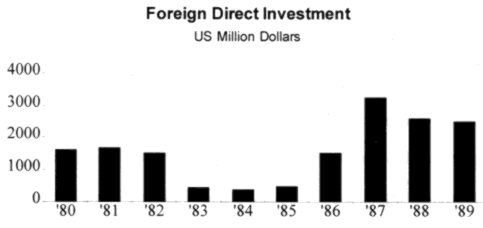
Financial security, which heavy inflows of foreign capital appear to provide, have also contributed to the general relaxation of credit constraints on domestic borrowing. This trend towards less restrictive lending practices in effect has caused Mexicans to consume more and to borrow less. This concept is evidenced by the overwhelming decease in the rate of personal saving, which fell from approximately 15 percent of GDP in 1988 to roughly 7.5 percent in 1994. Over-consumption spurred domestic prices to rise, thus, contributing to the overvaluation of the peso. While it is true that the Mexican government must bear some of the burden for over-borrowing and thus over-spending, international banks are also at fault for being so eager to over-lend, as will be examined in Nisha Thirumurthy chapter... In this respect, international banks tend to identify newly emerging economies as potential sources for future dividends and these economies, faced with tremendous international pressure to develop, further, often regard foreign capital as the means towards achieving greater economic advantage. Ultimately, these pressures create a situation strictly at odds with Wilkinson's definition of 'the market' as a relatively secure institution able to distribute global transactions in an equitable manner.
Thus with some degree of understanding of the forces behind Mexico's economic hardships, it is important to determine how to prevent similar future economic crises. President Clinton's initial effort to secure an emergency line of credit to stabilize the peso within the international market is necessary, both because Mexico is a partner whose economy is inextricably linked to our own, and also to atone for the destabilizing behavior of U.S. banks and mutual funds. In future crises, emergency credit, however, will not be sufficient alone. Mexico is currently responsible for a $28 billion dollar debt that is held mostly in tesobono bonds--bonds that must be paid back in pesos but are pegged to the value of the dollar. Thus, given these considerations amidst the backdrop of the peso devaluation, it is not difficult to understand that Mexico's debt is actually much larger when valued in U.S. dollars. The United States, since it has been the major player in Mexico's revitalization should, through the guidance of the IMF, assist Mexico in refinancing its international debts. In return, the Mexican government should agree to limit the future use of foreign capital by setting limits on the amount that foreign banks may invest or by taxing larger investments. Mexico could also prevent the massive exodus of foreign capital during crises by adopting a policy similar to Chile's that limits the liquidity of foreign-held assets. These efforts, if combined, would help stabilize Mexico's domestic market, which would also reassure investors' nerves.
Putting limits on foreign investment, however, runs the risk of halting economic growth. The Mexican government could rectify this risk in the short-term by limiting all forms of consumer credit until equilibrium is restored. In the longer run, the government could require their citizenry to put a specified fraction of their income into a privatized social security fund to finance investment programs, as Chile and Singapore do.
The destabilizing practices of international banks and the potential volatility of capital flows will be explored further in the following chapter.
Although the preamble of NAFTA stipulates that the trilateral agreement is dedicated towards improving living standards and promoting sustainable development, the current market system often undermines these intentions. According to the NAFTA treaty, all partners will be better off by opening their markets to others in a quid pro quo relationship. Yet, this is rarely realized in a market system where one participant generally grows at the expense, politically, economically, and socially, of another. The sharp interdependency between a clearly recognized hegemon and another less developed states, exemplified by the current market system, creates an environment of vast inequality, which perpetuates market instability.
In the context of North America, the effects of market instability not only have lasting impacts on the long-term development prospects for Mexico, but also will hinder further long-term growth in the economies of the United States and Canada. NAFTA's objectives to increase economic growth among all partners and to strengthen the region's global competitiveness is severely undermined the consequences of allowing a free trade agreement to operate freely under this type of market structure becomes apparent. According to the basic tenants of NAFTA, it is in the best interests of both the United States and Canada for Mexico's economy to achieve sustained growth and development. Under this assumption, with sustained economic growth, Mexico will ultimately be able to import more North American goods, which will further stimulate the economies of the United Sates and Canada in the long-term. A strong sustained Mexican economy would possess the potential to decrease poverty, improve health care, and improve education for many Mexican citizens that currently only live at or below a subsistence level. The challenge confronting politicians in the future will be to maintain economic growth in Mexico and to ensure that Mexican goods are competitive in the global market. Consequently, both Mexico's economic policies and the market will have to be revised.
One possibility for revitalizing Mexico's economy, and thus assuring the stability of the market, is through export-led growth. The policy of export-led growth, however, has been a source of contention among many economists who condemn the as actually inhibiting growth rather than aiding it. Still, despite claims that it will fail to produce sustained development and ultimately lead to an increased concentration of wealth, it is a worthwhile policy to consider. Steve Globerman, an economist at Western Washington University, argues that export-led growth is a successful model for sustained development. He argues in The Economics of NAFTA, using the recent economic success of many Asian countries as evidence, that:
Although the evidence is less clear-cut for Mexico where concerns have been expressed that NAFTA will lead to increased concentrations of income; however, the experience of Asian countries has been that export-led growth has contributed to increased equality in the distribution of income, and it seems plausible to conjecture that the same will be true in the long-run for Mexico. (34)
Given the current Asian financial crisis, however, Globerman's argument is unconvincing. Still, many economists, such as Lawrence Summers, sympathize with Globerman's argument. Summers contends that Mexico's success within the neoliberal market is dependent upon whether it is able to export its way out of economic hardships.
There is nothing going on in the world today that is as hopeful for humanity as the trend towards market institutions in the developing world. It will be tested by more financial crises in the future. Countries will have to export their way out of financial difficulties. If the momentum of market driven growth is to be maintained, it is important that the march towards lower trade barriers - unilaterally, regionally, and multilaterally - continues. (35)
Unfortunately, as Globerman suggests, the ability of Mexico to export its way out of financial difficulties is uncertain. Although textbook economics explains that by devaluing one's currency, countries will have a competitive advantage over other countries for their exports, this outcome has been inconsistent with the structure of developing economies. This is due to developing nations reliance upon raw resources as their primary export. Supply and demand for these goods usually remains relatively constant, even during periodic market fluctuations. While currency devaluation causes these products to become less expensive, this does not necessarily correlate with an increase in demand. Historically, countries have not been able to export their way out of economic crises, as was evidenced by both the 1982 debt crisis and the peso devaluation of 1994. (36) Instead, countries have increasingly relied upon foreign creditors to rescue them from economic crises. Given the overwhelming degree of domestic opposition behind the Clinton Administration's aid package during the 1994 crisis, however, the willingness of foreign nations to aid their ailing neighbors appears to be diminishing. Thus, this discredits Summers' claim that developing nations will increasingly export their way out of financial crises as the market attempts to correct from the initial instabilities associated with policies aimed at greater liberalization.
Yet, to a limited extent, Mexico was successful at exporting itself out of economic disaster following the peso devaluation. In this case, like the 'Four Tigers' in Southeast Asia, Mexico followed a systematic program of valued added exportation. This program advocated the exportation of goods that were beyond the primary, or raw product stage. During this period the Mexican economy rebounded slightly, but whether this can be attributed a policy of export-led development is uncertain; in fact, it may simply be too soon to determine both whether these effects will be sustainable over the long-term and if they are the result of an export-led economic policy. Imports rose and the economy appeared to be expanding, primarily because the markets of the United States and Canada were able to purchase inexpensive Mexican products. Mexico, however, could not afford either American or Canadian products, which produced, for the first time since the implementation of NAFTA, a trade surplus in Mexico's favor. This situation further underscores the argument against neoliberalism, which asserts that one's economy continually grows at the expense of others. In the long term, it will be counterproductive for Mexico to maintain a trade surplus under such unfavorable conditions. Furthermore, given the United States' unique ability to push and pull the market in its favor, it may prove impossible for Mexico to sustain a trade surplus. Finally, export-led development does not appear sustainable over the long-term given the glaring failure of the 'Four Asian Tigers'.
Another problem with the current market structure, as mentioned earlier, is the high degree of capital liquidity. Although liquid capital flows are extremely attractive to investors, they are not conducive to long-term economic development. High levels of capital liquidity enable investors to prevent profit loss in times of economic crises. However, high levels of capital liquidity also prevent governmental officials from drawing upon these reserves to bolster ailing economies. Furthermore, when the interest rates of a domestic economy rise, particularly if the economic outlook is more secure, investors are apt to liquidate their holdings in less secure regions. This scenario played itself out in 1995 when Federal Reserve Chairman Alan Greenspan raised the interest rates in America and effectively wreaked havoc on several Latin American markets. (37) This situation also prevents developing economies from drawing on these reserves to fund development projects.
In order for Mexico to attract real and sustained development, investments in ventures of real production are necessary. With current market volatility, these types of investments are extremely unattractive to foreign investors. Yet, foreign capital must be committed to production investments in the long term to achieve any measure of real growth. Foreign capital, due to its high degree of market volatility, is rarely committed to long-term development. Rather, investors interested in long term investment programs often concentrate their holdings within the more stable markets of the United States or Canada. Thus, market fluctuations have the net effect of deterring investment and retarding development in developing nations.
This phenomenon creates a paradox. Participation in NAFTA, under the current market structure, is actually damaging to Mexico's economy. Consequently, under the auspices of NAFTA's enhanced interdependency, the economies of the United States and Canada are also negatively impacted. NAFTA's liberalization of financial markets allows capital to move freely to enhance individual returns. Unfortunately, as illustrated, economic crises accelerate capital flows. These large capital flows carry the potential to topple investments and developing economies as they flood the market. These apparent instabilities call for prudent policies aimed at both restoring financial stability and ensuring sustained economic growth.
The three member-states of NAFTA pursued an economic policy of market liberalization under the guise of free trade without significantly adjusting the financial structures that would govern this action. The present economic structure leaves all three countries extremely vulnerable to market fluctuations, as was evidenced through both the 1982 debt crisis and the 1994 peso devaluation. In the process of moving towards enhanced market liberalization, the United States, Canada, and Mexico should take the initiative to develop comprehensive policies to ensure that liberalization does not destabilize their collective economies.
Following World War II, the U.S. dollar served as the international store of value. As the undisputed international hegemon, the United States provided many of the public goods that helped to stabilize a devastated international market system. These responsibilities endowed the United States with tremendous advantages, in that the U.S. was able to draft its economic policies with little consideration of the interests of the global community. Yet, the US was forced to defend this system at considerable expense, creating a reversal for the U.S. in the economic system from being the world's net creditor to the largest net debtor nation. Furthermore, the U.S. is no longer able to dictate its economic prerogatives without consequence. As a result, the U.S. will no longer be able to maintain its economic hegemony, nor will the American public continue to support seemingly unrestrained aid to reverse market instabilities. This situation thus calls for a collective effort that must extend beyond national, and even regional boundaries to ensure market stability and to promote further economic development. However, these initiatives will not meet success unless they are predicated by domestic reforms.
Before member states can begin to consider extending NAFTA further southward, they must first address its weaknesses. The North American market system faces two primary obstacles impeding market stability. First, the large degree of capital liquidity promoted under market liberalization, while attractive to investors, impairs sustainable development. This phenomenon is especially pronounced within developing countries. The economic stability of NAFTA's three member-states would be enhanced if the more secure states, the U.S. and Canada, would assist Mexican policy makers in limiting capital liquidity. Chile, for example, by limiting capital liquidity has generated significant development over the past few decades and has averted economic disaster without relying upon foreign assistance. Mexican economic policies, however, have proven detrimental as they have contributed to rapid domestic capital outflow and uncommitted foreign investment. The second obstacle impeding market stability is the apparent lack of a sizable development fund. In this case, developing nations should again follow the Chilean example. The Chilean government has created a privatized social security tax, which is in turn invested in the stock market and then utilized to fund development programs. The fund has also been used to prevent a reliance upon foreign aid during periods marked by economic crisis.
NAFTA's security depends upon private investment flows. At the same time, private investors demand increased liberalized trade agreements and institutional reforms, which together create the legal infrastructure that will induce money managers to send their capital southward to Latin America, instead of to competing markets in Asia or Eastern Europe. Without these necessary investments to ensure market stability and to promote further economic development, NAFTA, and any extension of it, will consistently fail to realize its expectations. This is largely because the Latin America countries need to entice the dollars they are spending in the U.S. and Canada back into their own respective domestic economies. Thus, the current NAFTA partners must collectively revise their economic policies in an effort to ensure lasting predictable capital inflows.
By adopting the economic objectives outlined in NATFA, the United States has effectively dedicated itself to the promotion of neoliberal market principles. It will prove difficult for successive political regimes in any one of NAFTA's member-states to deviate from this commitment. Thus, it is now increasingly imperative that the U.S. dedicate itself to the promotion of institutions and policies that will minimize the negative side effects associated with market liberalization.
The benefits believed to be derived from the regional interdependency forged under the guise of NAFTA will achieve a greater realization if accompanied by market reconstruction. North America, as integrated trading partners, can either simply wait for the 'invisible hand' to stabilize a volatile market system in a process of 'self correction', or the U.S. can take the initiative to develop prudent policies dedicated towards restoring market stability.