
February 26, 1942
The Bainbridge Review

February 5, 1942
March 5, 1942
April 2, 1942

April 9, 1942

April 16, 1942
Northwest Enterprise
December 12, 1941
Japanese American Courier
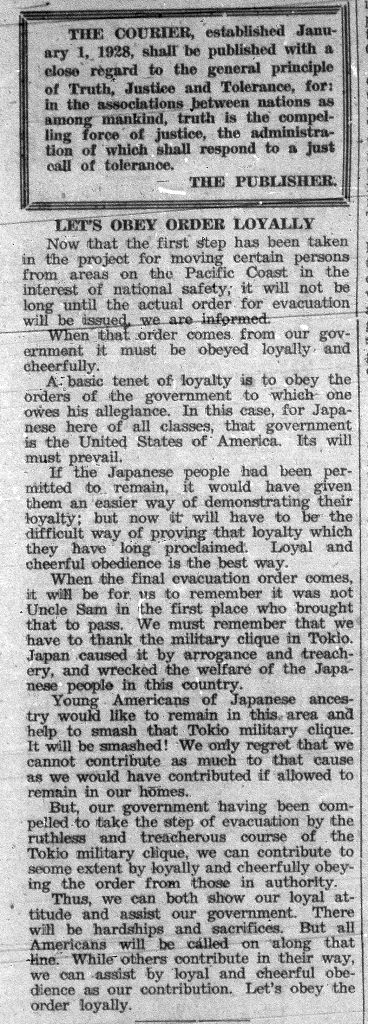
March 6, 1942
April 24, 1942
Jennifer Speidel helped with image digitalization for this essay.
On December 7, 1941 Japan bombed Pearl Harbor, thrusting the United States into both war and a state of hysteria. By the dawn of Monday December 8th, the FBI had arrested hundreds of Japanese immigrants, many of whom would spend the duration of the war in jail. These arrests would foreshadow the plight of Japanese Americans on the West Coast for the next five years.
Almost over night the country had taken on a new sense of patriotism and a belief in contributing to an all out war effort. Along the West Coast, the supposed threat of Japanese dive bombers appearing in the sky at any minute was palpable. Night-time black outs up and down the coast were being enforced by the military. Soon all “enemy aliens,” any Japanese, German, or Italian immigrants, would be locked out of areas that were deemed necessary to defense along the West Coast. The hysteria would finally culminate in President Roosevelt signing executive order 9102, which established the War Relocation Authority on March 18, 1942. This order authorized the military to designate areas along the coast from which all enemy aliens, both immigrants and native born, were to be moved inland to relocation camps. On March 24, 1942, the first civilian exclusion order was issued for Bainbridge Island, where forty five families were given one week to be evacuated by the military.
Seattle area newspapers closely covered the evacuation. Their editorials fell into three categories: some were for evacuation, some were against evacuation, and some were ambivalent. This essay examines some of the smaller newspapers in the region, weekly newspapers that served specialized communities: the Seattle Argus, West Seattle Herald, Bainbridge Review, Northwest Enterprise, and Japanese American Courier.
Argus
The Argus newspaper was a weekly publication edited by H. D. Chadwick. The paper gave a general outline of issues from week to week, highlighting areas such as business, courts, and city hall. The columns were a mixture of reporting and opinion, making the whole paper seem like an editorial. Though the Argus was for the evacuation order; the editor took an unconventional approach to justifying his beliefs. In a December 27, 1941 story entitled “Racial Prejudice”, the Argus reported that there were reports of young Japanese Americans being beaten by white “hoodlums” and that these actions were outrageous. The article then made a distinction between Japanese and Japanese Americans: “socially and commercially ostracized, the Japanese nationals in this country face a bleak future, and for them we make no appeal at this time. The American born Japanese, however, are deserving of exactly the same tolerance that is enjoyed by, say, the American born Swedes. They are Americans too, they are not enemy aliens.” The Argus drew a distinction between being an immigrant and being second generation Japanese American by arguing that only the latter was worthy of trust. The editor showed a respect for the American born Japanese, and although the issue of evacuation was not fully relevant at the time of this story, the implication is that only Japanese nationals would have to be evacuated.
By February, the Argus had changed its mind. In a Feb. 14, 1942 article titled “Young Japanese Americans,” the Argus no longer made any distinction between American born and Japanese nationals:
This paper has taken a pretty tolerant view of the young American Japanese in its discussion of enemies in our midst. A news story this week inspires us to repudiate every generous thought we have held toward these people. It is now revealed that there are more Japanese students than white studying German at Broadway high school, and that many of them took up the study of German after the war began. (Argus, February 14, 1942 p.1)
The story went on to condemn the government for allowing “American born Japs” and nationals alike to “remain at large.” Finally, the story concluded that not all Japanese and Japanese Americans may be guilty, but it was better to be safe than sorry: “if the innocent are interned with the guilty, it will not be a very serious matter. If any japs are allowed to remain at large in this country, it might spell the greatest disaster in history.”( Argus, February 14, 1942 p.1)
Almost three months into the war, the hysteria along the west coast was beginning to shift direction. In the days following the bombing of Pearl Harbor, the perceived threat was supposed to come from the skies in the form of bombs and dive-bombing planes. As that threat seemed to be less immediate, an idea of a fifth column at work in the country started to take its place. Months earlier in December, Frank Knox, the Secretary of the Navy, told the press that he believed a fifth column of saboteurs was present in Hawaii before Dec. 7th. The fifth column was supposed to include both Japanese immigrants and American born Japanese, lending support to Japan in the form of spying, sending reports of American actions to Japan, or even sabotage. The Argus applied these ideas to local experience in its story, “The Fifth Column at Work,” which stressed that “japs are employed at Harborview hospital. Japs are living in, and even operating, hotels on the western slopes of Seattle’s hills. A jap stationed at Harborview, another at west Seattle and a third at a point in the white river valley could, by pre-arranged light flashes, establish a perfect triangulation for the guidance of enemy planes to the Boeing plant…and still we allow the japs to roam at will in this vital area.” (Argus, February 28, 1942 p.1) The tone of this story is almost a plea for something to finally be done, and it is right around this time that the idea of evacuation is becoming more imminent. In fact, the February 28th issue is the last time the Argus makes such pointed opinionated stories against the Japanese Americans. There are a few stories in the next couple of weeks, mainly stating facts about what the evacuations will look like, and when they will happen. Once the issue of evacuation became formal federal policy, the staff of the Argus did not devote more time to the subject.
West Seattle Herald
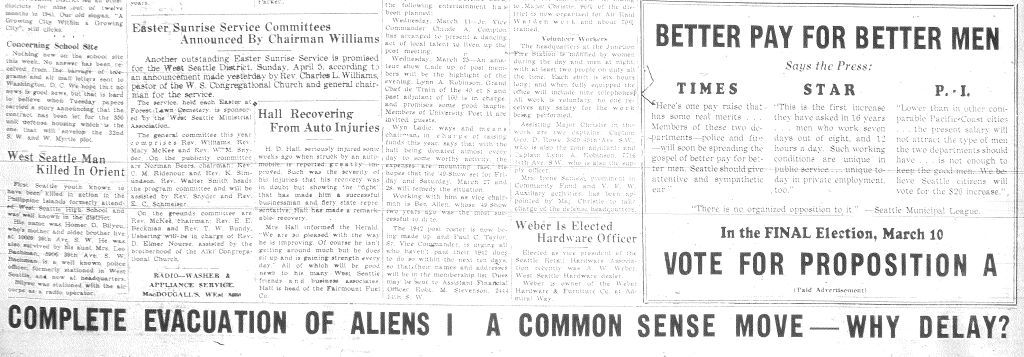
The West Seattle Herald was another weekly publication. Its columns were very general; the front page had articles about one to two major national or local stories, then the rest of the paper and articles were specific to the west Seattle neighborhood which was almost completely segregated through informal and formal prohibitions against non-white homeownership or apartment renting. In the days following Pearl Harbor up until mid February, there was no mention of the evacuation of the Japanese Americans, nor any mention as to the way the paper felt about Japanese Americans. Almost out of the blue, on February 26, 1942 along the bottom of the front page read, “Complete evacuation of aliens – a common sense move – why delay?” There was no article on the front page that would tie this statement into it. On page seven of the same issue there was an editorial entitled “GET ‘EM OUT!” The piece opens by sighting an incident in California where an enemy submarine was supposedly guided by lights on a hill near Santa Barbara which triggered the firing of anti-aircraft guns by the U.S. military. From this event, the editorial states complained: “And yet we are still soft pedaling on the issue of wholesale internment of alien enemies. When are we going to get tough?….so long as we permit alien enemies to remain in our midst we are playing with fire…the government should initiate instant and drastic orders sweeping all aliens, foreign or native born, so far inland that we can forget them for the duration.”(February 26, 1942 p.7) Although this is the only issue in which the paper or editor speaks to the internment issue, it is a clear example of being fiercely in favor of the government acting against the Japanese Americans.
The Bainbridge Review
On Bainbridge Island, there were a considerable number of Japanese American families—most of them connected to various kinds of farming. The _Review_’s reaction to internment suggested that the Island’s Japanese American population was deeply tied into every part of the community. Bainbridge Island was the first place in the United States from which all civilians of Japanese decent were evacuated by the military. This fact makes the _Review_’s response to internment stand out. This was one of the few newspapers in the country to take an editorial position against internment. The publishers of the Review were Walter C. Woodward and Mildred Logg Woodward.
In an editorial entitled “More Plain Talk,” the Review lets its readers know where they stood:
We spoke of an American recoil to Japanese treachery and wrote: and in such recoil of sentiment there is danger of a blind, wild, hysterical hatred of all persons who can trace ancestry to Japan…who can say that the big majority of our Japanese Americans are not loyal…their record bespeaks nothing but loyalty: their sons are in our army…it [the Review] will not dispute the federal government if it, in its considered wisdom, calls for the removal of all Japanese. Such orders… will be based on necessity and not hatred. (February 5, 1942 p.4)
The Bainbridge Review is the only area newspaper that spoke this way. This piece makes the connection between the Japanese Americans and how integrated they are in the society. The article ended by trying to reason that the hysteria that allowed people to consider internment should not lead to the taking away of the rights of so many loyal citizens, rights that are constitutionally guaranteed.
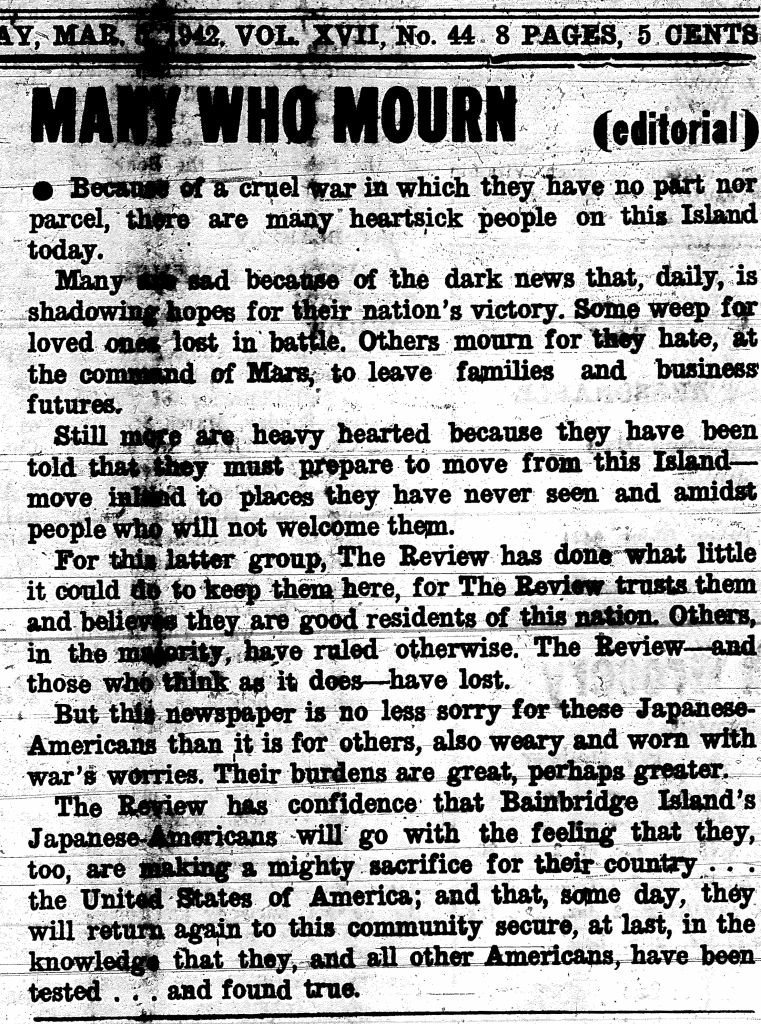
Although no official word of an exact date for evacuation would come until the end of March, the March 5, 1942 issue of the Review made clear the fact that residents on the Island knew that the Japanese Americans would be leaving. In an editorial on the front page entitled, “Many Who Mourn,” the Review put the issue into a very personal tone by reminding everyone of the bigotry involved in the evacuations. The review pointed out that the Japanese Americans would be shipped off to unknown parts where they would not be welcomed. All but one governor from the inland states opposed the relocation of the Japanese Americans to their states. This same editorial brought with it an apology to the Japanese American residents for not being able to do enough to have them stay, and expressed a sense of failure: “The review— and those who think as it does—have lost.”(March 5, 1942 p.1)
Then on March 23 came the order for the evacuation of all Japanese Americans from Bainbridge Island. The orders were now directed at the Review’s own back yard, and from the articles and editorials in the March 26th issue, it seems as though the Review had a new position to fight for. In a front-page editorial entitled “Not Enough Time” in the March 26th issue, the Review shed light on many of the underlying problems with the evacuation orders. First, the _Review_emphasized the Constitutional rights of Japanese Americans by calling them citizens and putting “not aliens” in parentheses. Even if the law of the land discriminated against Japanese immigrants from becoming naturalized citizens, their children, the American born Japanese, were supposed to be afforded the same rights as all other Americans under the Constitution. Second, the Review noted that there were three months between Pearl Harbor and the evacuation orders, and in that time there wasn’t any of the devious sabotage that people feared. It asked why, if the FBI had been investigating and arresting all those who were suspicious, everyone else have to suffer evacuation. The FBI, the Review noted, had already been to Bainbridge Island specifically to search homes and make arrests. The _Review_’s blamed the government for giving the order but added that “we say this on our own accord. It is not an echo of anything we have heard a single Japanese say. They are taking this treatment without a single bitter word. At least we have heard none.” This closing statement by the _Review_suggests that by enduring these orders, Japanese Americans once again proved their loyalty, even when the orders themselves were unjust.
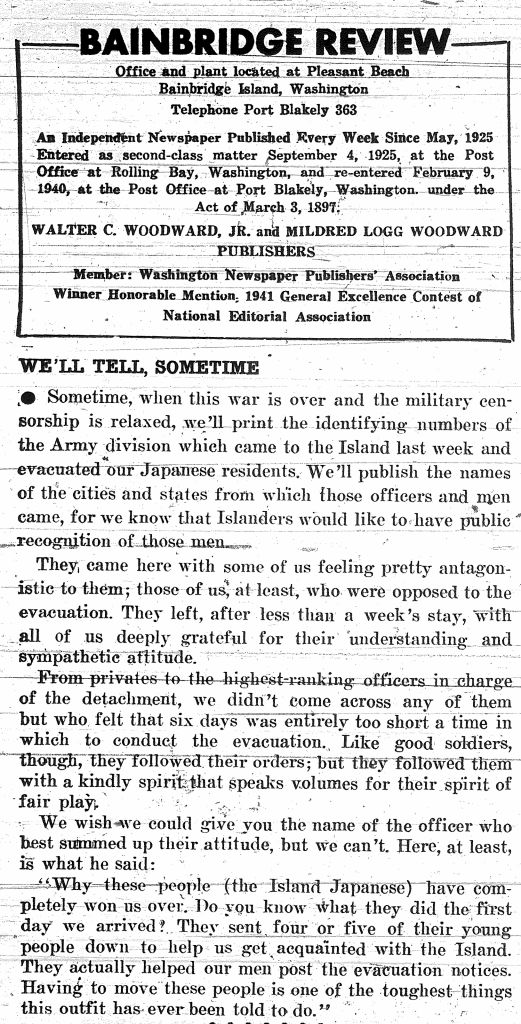
The evacuation of the Bainbridge Island Japanese Americans took one short week. However, one of the most heartfelt editorials would come out of that week. In the April 2nd issue, the Review published a story about the soldiers who evacuated the Japanese Americans. The editors begin by explaining that because of the war, it would not be appropriate to give the names and locations of the soldiers. It is promised that when the time is right, the review will publish all of the names of the soldiers and commend them for the humane way in which they conducted themselves in carrying out such difficult orders. The story goes on to quote one of the unnamed soldiers as saying that the island’s Japanese Americans had shown the soldiers such kindness and hospitality that this was the hardest job he and his men had ever done.
The Review did not speak for everyone on Bainbridge Island. Every couple of issues, it published a column entitled “The Open Forum” to give its readers a voice. In the April 2nd issue, J.J McRee criticized the editors as puerile, complained that it was not the place of the Review to question the actions of the government, he then ended by asking to stop his subscription. The following week brought a letter from Orville Robertson, in which he explained that he would find a new subscriber for the Review to make up for the loss of the gentleman the week before. He goes on to say that “by perusing an attitude of sympathetic understanding and fairness toward our citizens of Japanese ancestry, and our friendly aliens who have for many years chosen the American way of life, you are making an important contribution.” (April 9, 1942 p.4) Among the readers of the Review who chose to write in, the majority agreed that the Japanese Americans deserved to be trusted as loyal Americans just as those who were not of Japanese ancestry. Also among the letters to the editor was testimony from evacuees who described their evacuation to and incarceration in California. The April 16, 1942 (p.4) issue published a letter from Nob. Koura, an evacuee, that thanked the Review for the stance that it took and for the help that it gave toward making the evacuation easier.
The evacuations would continue in other parts of the area around Bainbridge Island; however the fight had been taken out of the Review. Once the Bainbridge citizens were gone, the Review turned back to the weekly happenings of Island life.
Northwest Enterprise
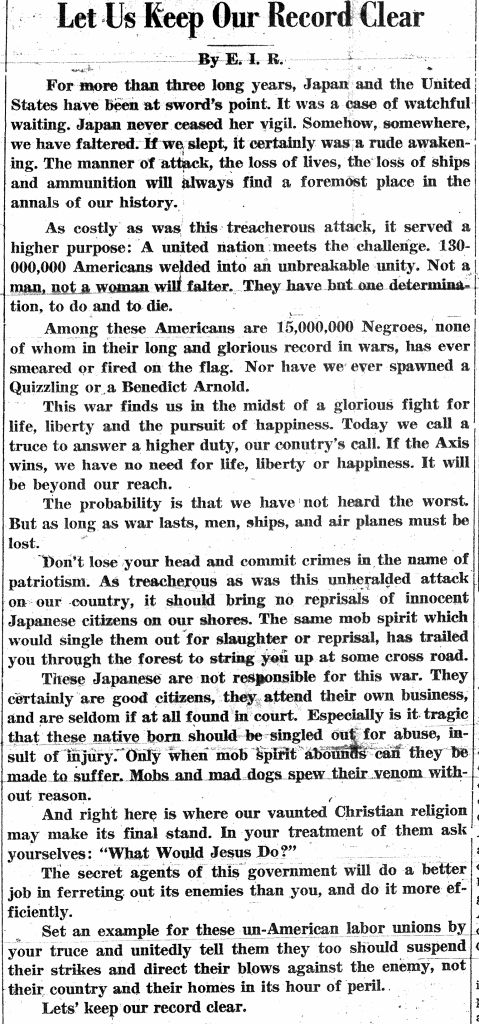
The Northwest Enterprise was a weekly publication and the region’s most prominent African American newspaper. On Friday, December 12, 1941 the Enterprise published an editorial by E. I. Robinson titled “Let Us Keep Our Record Clear_._” In it, the editor spoke about how there was no need to lose one’s head or commit crimes in the name of patriotism. He described the Japanese Americans as good citizens who tend to their own business. But while this piece was the only one of its kind to appear so close to December 7th and argued against harming Japanese Americans just because of their ancestry, the Northwest Enterprise did nothing to oppose internment, and did not mention the plight of the Japanese Americans again.
Japanese American Courier
The Japanese American Courier was a weekly newspaper published and written by Japanese Americans. James Y. Sakamoto was the paper’s founder, its editor, its publisher, and its main voice. Under a microscope of suspicion after Pearl Harbor, and already marginalized by racism, Sakamoto and others at the Courier sought to assure the nation of Japanese American worthiness of citizenship rights and showed as many outward signs of their loyalty as they could.
On December 12, 1941, in its first issue since war broke out; the Courier published a page 2 editorial by Sakamoto that spoke of meeting a common enemy. The common enemy was a way for Sakamoto to tell his readers that those Japanese Americans who chose to stay in the U.S. were now expected to do their part to help win the war against Japan. He pointedly wrote that if there were any ties of support to Japan, those ties were cut when Japan decided on war. This, along with other articles in the December 12th issue, very clearly state that the Japanese American people denounce Japan, and put their full support behind the United States.
For the next several months after Pearl Harbor, the Courier was the one area newspaper that focused on the issue of what fate lay ahead for the Japanese American people in World War II. Editorially, the paper did not deviate from being loyal and patriotic at all costs. On Friday, March 6th, the title of Sakamoto’s editorial spoke for itself: “Let’s Obey Order Loyally_._” In this article, Sakamoto wrote that if Japanese Americans were allowed to stay, then they would be able to help and smash Japan in war, which he adds is what they would like to do. He also explains what must happen, whether they want to or not, “When that order comes from our government it must be obeyed loyally and cheerfully. A basic tenet of loyalty is to obey the orders of the government to which one owes his allegiance.”(March 6, 1942 p.2)
For Sakamoto, whether the evacuation orders were right or wrong was less important than how Japanese American conducted themselves… Sakamoto was also a founding member of the Japanese American Citizens League (JACL), another group through which Japanese Americans stressed loyalty and obedience to the United States. In his March 13th editorial, Sakamoto publicized and applauded the support the JACL offered the government to help with evacuations. He quotes the JACL as explaining to the government that whatever needs to be done will be done cheerfully and smilingly. Sakamoto goes on to say that the cooperation is splendid and that the young Japanese Americans should accept the evacuation cheerfully and smilingly.
Sakamoto’s writing in his own newspaper contrasted sharply with his public pronouncements about internment. Though his editorials eventually embraced internment, he also publicly protested in a January 21, 1942 community meeting that internment “would destroy all that we have built for more than one-half century”1
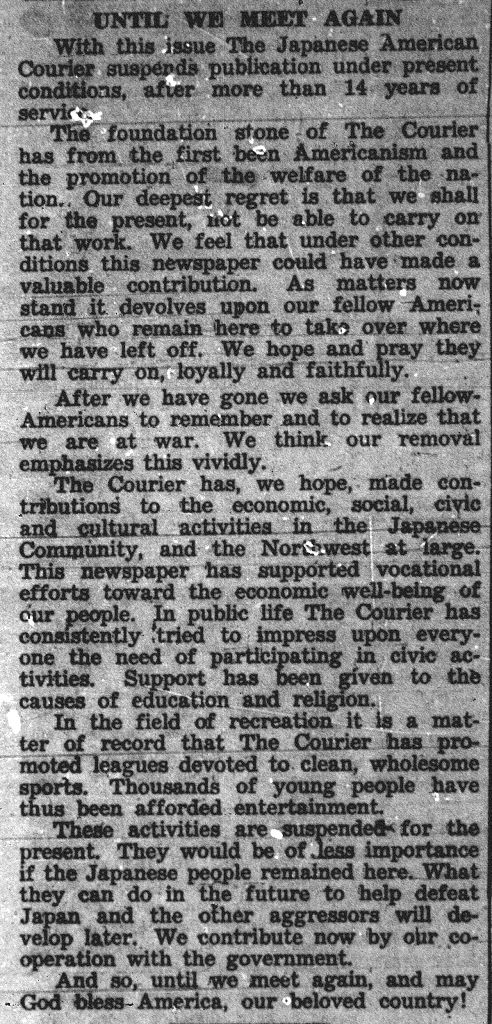
Sakamoto must have felt this loss keenly when the evacuation orders also brought an end to the newspaper he had founded to combat xenophobia, embrace what he saw as best in America, and promote the citizenship claims of Japanese Americans. In the final, April 24th issue, Sakamoto gave a farewell address entitled “Until We Meet Again”:
With this present issue the _Japanese American Courier_suspends publication under present conditions, after 14 years of service. The foundation stone of the Courier has from the first been Americanism and the promotion of the welfare of the nation. Our deepest regret is that we shall for the present, not be able to carry on that work…after we have gone we ask our fellow Americans to remember and to realize that we are at war. We think our removal emphasizes this vividly…we contribute now with our cooperation with the government. And so, until we meet again, and may God bless America, our beloved country!
Sakamoto returned to Seattle in 1945, but without the financial resources necessary to restart his newspaper. According to David Takami’s historylink.org essay, Sakamoto and his wife “lived on government assistance until he found a job conducting a telephone solicitation campaign for the St. Vincent de Paul thrift store. He died on December 3, 1955, after being struck by an automobile on his way to work.”
© Copyright Luke Colasurdo 2005
HSTAA 353 Spring 2005
1 Richard Berner. Seattle Transformed: World War II to the Cold War. Seattle, WA: Charles Press, 1999. p. 29 Unclear citation for original source.