Entrepreneurship

Enliken: putting an end to surreptitious data

Monday, April 1st, 2013

Avniel Dravid2Have you noticed that since you clicked that YouTube link for Nora the Piano Cat, you’ve been seeing significantly more online ads for pet food? Or that after you googled “cheap airline tickets,” every site you’ve visited seems to be advertising them? Or that once you bought 50 Shades of Gray, Amazon started suggesting products like . . . well, you get the idea.

Every day, online advertisers target internet users with ads for specific products and interests based on information they glean from our search data—the websites we visit, the amount of time we spend on a specific page, the links we click on, the content of our inboxes.

For most of us, this “behavioral targeting” feels like an invasion of privacy. According to Avniel Dravid (UW MBA 2007), cofounder of Enliken, a Seattle- and New York-based start-up that aims to give consumers control of their internet search data, it’s also inaccurate. Dravid explains that when you visit a website, that company can take what you’re browsing and sell the information to a third party. “Advertisers then buy that information and use it to advertise to you,” he says. But these advertisers can’t measure the accuracy of the search data they purchase, which is why they think you’re in the market for a blender, when really you just wanted to watch a Blendtec puree that iPhone 4s. As Dravid puts it, “You may think I like Nike shoes, but really I like Reeboks. I’m just looking at Nike shoes. It’s not great data. It’s almost garbage in, garbage out data.”

Enliken addresses this problem by giving consumers a way to inform advertisers of their preferences. As the company’s website states: “We believe a small amount of information shared willingly is worth more than a mountain of data gathered surreptitiously.”

Enliken’s model is fairly straightforward. By installing a free plugin, users can view the search data being collected about them, deciding which data they want to share with advertisers and which they want to keep private. In exchange for sharing that information, consumers will collect reward points, which they can use to pay for digital content from online retailers or publishers.

Enliken is free for consumers. Revenue will come from advertisers. Dravid explains advertisers want their online advertising to be more relevant, and he believes that advertisers will pay to receive quality data about their customers, straight from the source.

In the meantime, Enliken has already released its first product, Enliken Discover, built by Dravid and cofounder Marc Guldimann during a summer spent traveling around Europe. It’s a teaser as to what the company will offer once they’ve built partnerships with consumers, online retailers, and publishers. The two cofounders have also secured $250,000 in angel investments and plan to raise another $250,000, all to keep you safe from advertisers who target you with ads for the latest BMW, just because you bought some turtle wax for your Tercel.

Zulily and Maveron: Building a successful company

Tuesday, March 19th, 2013

Guest post by Emilia Griswold, Foster MBA 2014

Darrell Cavens, CEO of Zulily

Darrell Cavens, CEO of Zulily

Foster students were recently treated to a discussion of “What Makes a Successful Company” with Darrell Cavens, CEO of Zulily.com, and Dan Levitan, co-founder of venture capital firm Maveron. Maveron led the initial funding for Zulily, and this was a rare opportunity to see a founder and investor speak candidly about their partnership. Cavens and Levitan, along with moderator Emer Dooley of the Buerk Center for Entrepreneurship discussed start-ups, venture capital, and building high-performing teams.

The recent $1 billion valuation of Zulily prompted several questions about how a billion dollar company gets started. The answer, from both Cavens and Levitan, was hard work. Zulily was started by Cavens and former Blue Nile CEO Mark Vadon with little more than a spreadsheet and whiteboard. Although they didn’t have much of a business plan, Maveron believed in the team. The people, Levitan pointed out, are what a company is all about. With the Zulily team, Maveron saw leaders with the ability and vision to bring others along for the ride and a staunch dedication to constant improvement. Cavens and Levitan agreed that Zulily never thought of itself as a billion dollar company, but as a company focused on doing and growing. And fast.

By creating a culture with an “iterate and grow” mindset, they could run on Zulily Time: twice as fast as anyone would think is doable. To illustrate Zulily Time, Cavens told the story of getting the first fulfillment center up and running in 10 weeks—instead of the 7-12 months that was originally estimated. That lesson of maintaining focus and going after what everyone thinks is impossible certainly resonates with many students. And Levitan had more advice for those just starting out and lacking Cavens’ pedigree: be comfortable thinking on your feet, surround yourself with entrepreneurial people, and take time in school to figure out who you are, what you’re passionate about, and what you excel at.

Dan Levitan

Dan Levitan, Co-founder of Maveron

Cavens emphasized that part of developing yourself is developing a team that compliments your skills. When he was building the initial Zulily team, he looked for people that would not only add value, but also take risks and thrive in ambiguous situations. Cavens advised taking time to find investors with whom you really click, because they are also part of the team. Funders can add networks and resources as well as validation of your idea. Because Maveron knew Cavens and his capabilities, they were even willing to let Zulily write their own term sheet tied to a specific set of milestones. And unlike many start-ups, Cavens knew that if this idea didn’t work out he wasn’t going to pivot, he would just give the investment back and go do something else.

Ultimately, Levitan noted, it’s great entrepreneurs and their teams that build an amazing company—not venture capital firms. But no one, Zulily in particular, can deny the importance of money and resources to get a company off the ground. Zulily is proof that incredible things can happen when driven founders and the right investors come together.

This event was organized by Foster’s Entrepreneurship & Venture Capital Club.

The Buerk Center for Entrepreneurship awards $170,000 to eight student-led start-ups

Friday, February 22nd, 2013
Haiti Babi Blanket

Haiti Babi

When Katlin Jackson returned from her second trip to Haiti in January 2012, she was a woman on a mission. After spending time in a Haitian orphanage, she’d discovered that a good number of the children there weren’t orphans at all. Their parents were simply too poor to care for them. Within months, Katlin, along with UW junior Kari Davidson, cofounded Haiti Babi and entered the 2012 Business Plan Competition.

Haiti Babi now employs four Haitian mothers to knit and crochet high-quality, incredibly soft baby blankets and accessories that are sold to moms in the United States. In 12 months, Katlin and Kari have taken an idea, defined a mission (Moms helping Moms), and created a start-up company that is making real headway. They have a well-thought-out brand, fashionable products, and a detailed operations plan. Their Indiegogo campaign brought in double their fund-raising goal, pre-orders for their first blankets surpassed all expectations, and Haiti Babi has been featured in Seattle Magazine, Social Good Moms, and Disney Baby.

Much of Haiti Babi’s success can be attributed to the intelligence, drive, and dedication of its founders, but they’ve also had great help along the way. They were admitted into the Jones Milestones/Foster Accelerator in July 2012.

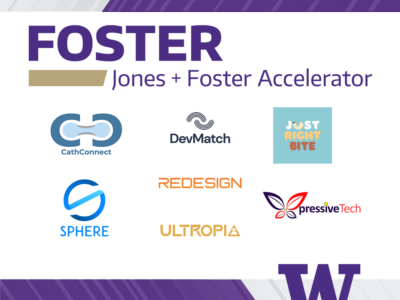
The JM/FA at the Foster School’s Buerk Center for Entrepreneurship is a TechStars-like program that provides a milestones-based framework, monthly coaching from Seattle entrepreneurs and investors, and connections that help student teams make the transition to start-up companies.  From July 2012 to February 2013, 10 teams worked to recreate their teams, develop their technologies or get product to market, and raise early-stage funding. On February 13, eight teams were awarded between $10,000 and $25,000 for their efforts.

  • PatientStream, a cloud-based electronic patient-tracking system for hospitals, licensed its technology from the University of Washington and secured a $500,000 investment from the W Fund.  Ben Anderson (TMMBA 2012) is the founder, and brought in Keith Streckenbach as COO and co-founder to drive sales. Anderson quit his day job at UW Medicine/Harborview in October.
  • Haiti Babi provides mothers in Haiti with employment to keep their children out of orphanages. As part of their “Moms helping Moms” mission, Haiti Babi’s mothers knit and crochet high-quality, incredibly soft baby blankets that are sold in the United States. Co-founders Katlin Jackson and Kari Davidson (BFA 2014) raised funding through an Indiegogo campaign, pre-orders for blankets surpassed all expectations, and Haiti Babi has been featured in Seattle Magazine and Disney Baby.
  • LumiSands was awarded a $150,000 National Science Foundation SBIR Phase-I Grant and a $50,000 gift from the Washington Research Foundation for the development and manufacture of its silicon-based alternative to rare-earth phosphors used in LED lighting. Co-founders Ji-Hao Hoo (PhD 2013) and Chang-Ching Tu have negotiated an agreement with the University of Washington, and are still in the technology development phase.
  • JoeyBra, “the first sexy and comfortable fashion bra with a pocket,” closed a successful angel investment round, produced a new, quality sports bra with a waterproof pocket in a full range of sizes, and has been featured by Forbes, MSNBC, and CNN.  Mariah Gentry (BA 2013) and Kyle Bartlow (BA 2013), the co-founders, have contracted with a former Miss America as a spokesmodel and will launch their product nationwide in April 2013.
  • Microryza, a KickStarter-type site for smaller science and research projects,was admitted into Y-Combinator in October and moved to the Bay Area. Cindy Wu (BS 2011) and Denny Luan (BS 2011) have raised more than $170,000 and their site has funded projects from tracking Magellanic penguins to sustaining native bees and student-designed electric racecars.
    Update: March 28, 2013 – Microryza was named one of the top 5 Y-Combinator start-ups to watch by Inc. Magazine.
  • Strideline sold more than 60,000 pairs of their signature city skyline crew socks in 2012. Co- founders Jake Director (BA 2013) and Riley Goodman (BA 2013) have organized a national sales team, are now selling in Nordstrom and Zumiez, and were the subject of a UW TV short feature
  • SuperCritical Technologies has designed and will build compact modular power plants that provide up to 5MW of clean, reliable electricity for heating and/or cooling. Chal Davidson (MBA 2012) is the CEO, with Max Effgen (MBA 2012) as a co-founder. The company raised $200,000 in angel funding to complete the conceptual design and establish supplier relationships, and is currently fundraising to build the prototype.
  • UrbanHarvest is an urban farming company that grows high-value hydroponic lettuces and herbs within feet of where they’ll be consumed. The brainchild of Chris Bajuk (MBA 2011) and Chris Sheppard (MBA/JD 2012), UrbanHarvest is currently negotiating with a large SoDo corporation to build a rooftop greenhouse.

So what’s next? The work certainly doesn’t stop here. As any entrepreneur knows, it takes more than six months to grow a thriving business. And that’s what the JM/FA ultimately provides at the end:  additional runway.  This follow-on funding is a testament to the companies’ hard work so far, and an investment in what we know they can become.

The Jones Milestones/Foster Accelerator is funded by the Herbert B. Jones Foundation and additional private donors who, like us, believe in the ability of student entrepreneurs.

Paradigm shifts and P4 Medicine

Wednesday, February 20th, 2013

Dr. Leroy Hood, a pioneer in the systems approach to biology and medicine, spoke at UW Foster School in January 2013 about innovation, complexity, P4 Medicine—predictive, preventative, personalized, and participatory—and much more.

Dr. Hood has played a role in founding more than fourteen biotechnology companies, including Amgen, Applied Biosystems, Darwin, and The Accelerator and Integrated Diagnostics. He is a member of the National Academy of Sciences, the National Academy of Engineering, and the Institute of Medicine. Of the 6,000+ scientists world-wide who belong to one or more of these academies, Dr. Hood is one of only fifteen people accepted to all three. Additionally, Dr. Hood has published more than 700 peer reviewed articles and currently holds 36 patents.

In a career of dramatic innovation, Dr. Hood has seen a number of paradigm shifts. He identified four common traits. Each paradigm change:

  1. Fundamentally altered how, in his case, scientists think about biology and the practice of biology.
  2. Faced enormous initial skepticism and, in some cases, actual hostility because there were perceived threats to the traditional way of getting things done.
  3. Forced the creation of new organizational structures—the bureaucracy that comes from existing organizational structures hurts the ability to change the way you think about something.
  4. Required enormous risk taking.

Watch the video below for more highlights from his talk, including how the Human Genome Project transformed biology, implications of P4 Medicine, and his thoughts on the future of systems biology.

Dr. Leroy Hood from Foster School of Business on Vimeo.

Leroy Hood was one of UW Foster School of Business Dean Jim Jiambalvo’s guest speakers at the annual Leaders to Legends Breakfast Lecture Series, which include notable leaders in an array of industries from greater Seattle and around the country.

Can vending machines be innovative? Definitely.

Wednesday, February 13th, 2013

Paul DavisPaul Davis, CEO of Coinstar, spoke at the Foster School of Business’s Leaders to Legends Breakfast Series in November 2012. His talk focused on how Coinstar has reinvented itself to become a leader in the automated retail space—otherwise known as kiosks—through innovation.

One of the largest and best-known parts of Coinstar’s business is Redbox, the popular automated movie DVD kiosk business. Redbox comprises more than 80 percent of Coinstar’s revenue. Redbox’s business model centers on value, simplicity and convenience, and it’s been highly successful. It’s a $2 billion business and there are over 42,000 Redbox kiosks in the U.S.

In addition to Redbox, Coinstar is involved in eight other companies. These companies, like Redbox, embody value, simplicity, and convenience. A perfect example is Rubi, a new twist on vending machine coffee. Coinstar is launching this in partnership with Seattle’s Best Coffee, which is owned by Starbucks. Rubi utilizes French press technology and offers single cup brewing—beans are ground on the spot—that starts at $1 a cup. It offers affordable, high quality coffee from a vending machine.

Other Coinstar properties include Alula, which allows you to turn gift cards into cash at 70-85 percent of the value of the card, and Eco ATM, which allows you to get cash for your cell phone on the spot. They’re looking at expanding this to all electronics.

Coinstar looks for innovative opportunities in the automated retail space in myriad places. It holds big-idea competitions within the company, talks to venture capitalists and private equity firms, holds white-board competitions at universities, and utilizes a nation-wide innovator network.

Coinstar has also developed criteria and a process for finding new companies. It only considers businesses that can scale or expand outside of the U.S. and that are capable of $100 million in revenue. All of the ideas are also consumer-tested before being seriously pursued. And once an idea is vetted, Coinstar hires an entrepreneur with deep domain expertise to launch and grow the company. The entrepreneur is given four years to do this and his or her compensation is tied to the success of the company. This systematic approach is paying off. All but one of the ideas Coinstar has pursued have succeeded; industry standard is typically a 25 percent success rate.

Coinstar has been steadily rising on Fortune’s “Fastest-Growing Companies” list for the past few years. Despite critics, they are successfully reinventing—or rather inventing—the automated retail space. Look for Coinstar products in all kinds of kiosks near you.

Since giving this talk, Paul Davis announced he will retire from Coinstar. Scott Di Valerio, currently CFO of Coinstar, will become CEO in early April.

Paul Davis was one of UW Foster School of Business Dean Jim Jiambalvo’s guest speakers at the annual Leaders to Legends Breakfast Lecture Series, which include notable leaders in an array of industries from greater Seattle and around the country.

Foster announces $5.2 million naming gift for CIE

Thursday, January 10th, 2013

Guest post by Connie Bourassa-Shaw, Director of the Arthur W. Buerk Center for Entrepreneurship at the University of Washington Foster School of Business

Artie Buerk

Artie Buerk

You know this story: an entrepreneur with a vision, a ridiculously small but adept team, a set of core advisors who are devoted to the cause, initial customers who come on board early and stay loyal, gaining traction, finding investors, creating products/services—and enormous fun along the way.

No, I’m not talking about a UW student start-up or any other start-up for that matter. I’m talking about CIE and the vision we developed back in 1997 for creating an entrepreneurship center that not only teaches the essentials of entrepreneurship, but gives students myriad opportunities to follow their passion. Not that long ago, CIE was a start-up.

We developed the core curriculum and added electives that built on that core. We launched the Business Plan Competition in 1998, and we’ve awarded $1.3 million in seed funding to student-led companies, including NanoString, Contour, Gravity Payments, Cadence Biomedical, Impel NeuroPharma, JoeyBra, PatientStream, MicroGreen, etc. We started the Lavin Entrepreneurship Program for incoming freshmen in 2007, began the Environmental Innovation Challenge in 2008, and the Jones Milestones/Foster Accelerator in 2010.

In those early days of creating an entrepreneurship center, I got tremendous assistance and guidance from the CIE Advisory Board, including sage personal advice from Artie Buerk. Artie’s a Husky—practical but not dogmatic, enthusiastic but perceptive. And today the Foster School of Business announced that with a $5.2 million gift, CIE is becoming the Arthur W. Buerk Center for Entrepreneurship.

Naming gifts are the Holy Grail for university centers. It’s the longed-for vote of confidence. It says, I so believe in you that I’m proud to have my name associated with you for decades to come. It says, I’m betting money on your future. It says, I trust the center to do the right thing for students, for the UW, for Seattle.

I just wish you all could see the GIGANTIC smile on my face today. Thank you, Artie, for your belief in the CIE vision. No, I mean, the Buerk Center for Entrepreneurship vision.