Comparing machine learning and physics-based nanoparticle geometry determinations using far-field spectral properties
Abstract
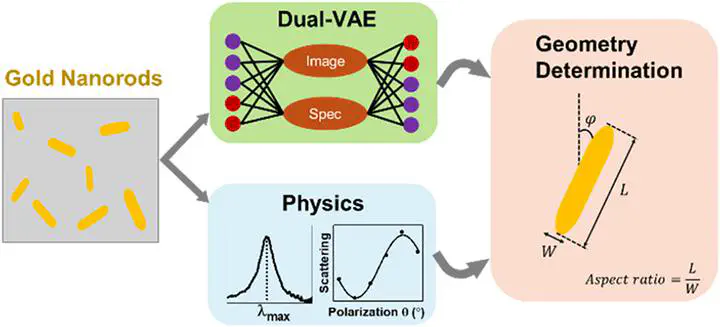
Anisotropic metal nanostructures exhibit polarization-dependent light scattering. This property has been widely exploited to determine the geometries of subwavelength structures using far-field microscopy. Here, we explore the use of variational autoencoders (VAEs) to determine the geometries of gold nanorods (NRs) such as in-plane orientation and aspect ratio under linearly polarized dark-field illumination in an optical microscope. We input polarized dark-field scattering spectra and electron microscopy images into a dual-branch multimodal VAE with a single shared latent space trained on paired spectra-image data using a learnable linear adapter. We achieve prediction of Au NRs using only polarized dark-field scattering spectra input. We determine geometrical parameters of orientational angle and aspect ratio quantitatively via both dual-VAE and physics-based analysis. We show that orientational angle prediction by dual-VAE performs well with only a small (∼300 particle) training set, yielding a mean absolute error (MAE) of 14.4° and a concordance correlation coefficient (CCC) of 0.95. This performance is only marginally worse than the physics-based cos(2θ) fitting approach between the scattering intensity and the polarizing angle, which achieves an MAE of 8.78° and a CCC of 0.99. Aspect ratio determination is also similar for the dual-VAE and physics-based fitting comparison (MAE of 0.21 vs 0.23 and a CCC of 0.53 vs 0.68). We show that the spectra-to-structure inference route of dual-VAE achieves high reconstruction accuracy when referenced against well-established physics approach and effectively handles images and spectral data sets, suggesting a general recipe for inverse nano-optical problems requiring both structure and optical information.

Mengqi (Will) Sun
Postdoctoral Researcher

Zixu Huang
PhD Student

David Ginger
B. Seymour Rabinovitch Endowed Chair in Chemistry
David Ginger is the the B. Seymour Rabinovitch Endowed Chair in Chemistry at the University of Washington, and the PI of the ginger group