 ResearchResearch
The majority of species of the Juan Fernández Archipelago remain poorly understood. Basic life-history characteristics of native flora and fauna are unknown, and there exists minimal knowledge of their ecology (interactions between species or relationships between species and their resources). In addition, the ecology of native species is complicated, biologically speaking, by a multitude of threats from introduced flora and fauna.
Basic scientific research at the species, population, and ecosystem level is critical to conservation and restoration efforts in the Juan Fernández Islands. In order for these efforts to be successful, we first need to understand requirements of, and threats to, the native biota. However, effective conservation requires more than scientific knowledge alone. We believe that promoting an understanding of interactions between nature and culture is essential to create sustainable and lasting change.
The seabird community of the Juan Fernández Islands may serve as an excellent indicator of ecosystem health. The success of these pelagic birds relies heavily on marine systems, where they forage and face potential risks from fisheries. Also, the seabirds’ time spent nesting on the islands requires safe, intact and suitable terrestrial habitat, which is threatened by introduced mammals directly (predators, competitors for burrows) and indirectly (herbivores causing erosion, compacted soils, compromised nesting habitat), thereby affecting the reproductive success and even survival of breeding birds.
We have begun a research program focused on four pelagic seabird species, the pink-footed shearwater (vulnerable), Juan Fernández petrel (vulnerable), Stejneger’s petrel (vulnerable), and Kermadec petrel (currently not listed), investigating their basic ecology and factors potentially important for future conservation measures.
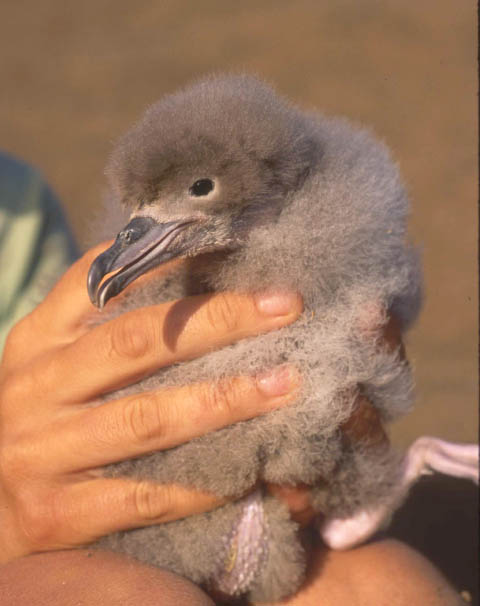 Pink-footed
shearwater (Puffinus creatopus)
Pink-footed
shearwater (Puffinus creatopus)
Juan Fernández petrel (Pterodroma externa)
Stejneger’s petrel (Pterodroma longirostris)
These three species breed in aggregations of burrows on Robinson Crusoe and
Santa Clara (P. creatopus) and Alexander Selkirk (P. externa
and P. longirostris). The accessibility of colonies allows us to investigate
various ecological parameters simultaneously (click below to see photos of what
we do):
1) population biology
2) breeding biology and behavior
3) foraging ecology
4) migratory behavior (pink-footed shearwater
only)
5) competition with, and predation by, introduced mammals
Kermadec petrel (Pterodroma neglecta)
This species nests on small islets and rock outcrops offshore of Robinson Crusoe.
Due to the difficulty of access for this species, we target the colony on a
single outcrop, Morro Juanango, with the following objectives:
1) monitor basic breeding biology parameters (laying effort and breeding success)
2) monitor size of breeding population
3) monitor aspects of foraging ecology
Although this species is not currently listed by the IUCN, the limited information
available on the distribution and abundance of this species suggests that the
species should be listed as “vulnerable” (based on IUCN criteria).
Therefore, the long-term monitoring program on Morro Juanango begun in 2002
takes on additional importance and relevance.
For more on our methodology and what we’ve discovered so far, please view our reports or contact us.
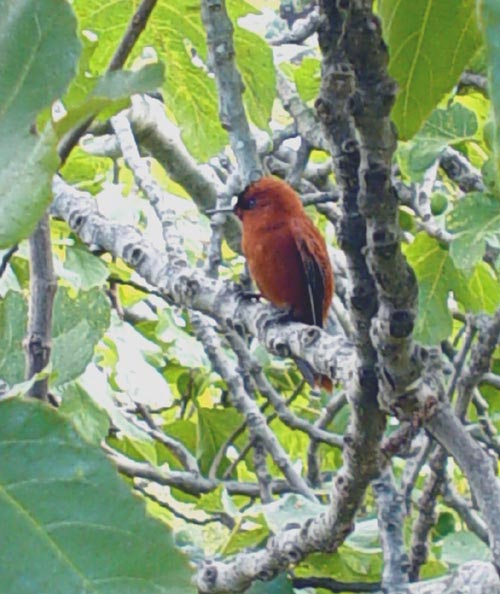 The
hummingbird community of Robinson Crusoe includes two species: the endemic Juan
Fernández firecrown (Sephanoides fernandensis) and the Chilean
native green-backed firecrown (Sephanoides galeritus). These hummingbird
species are the only two known to reside on oceanic islands (1). The endemic
Juan Fernández firecrown is found only on Isla Robinson Crusoe, and is
a highly visible species in the town of San Juan Bautista. However, the species
has a restricted breeding range; its population appears to have declined from
800 to 400 individuals in just the past three years (park officials, personal
communication), and cats and rats have been implicated in the decline.
The
hummingbird community of Robinson Crusoe includes two species: the endemic Juan
Fernández firecrown (Sephanoides fernandensis) and the Chilean
native green-backed firecrown (Sephanoides galeritus). These hummingbird
species are the only two known to reside on oceanic islands (1). The endemic
Juan Fernández firecrown is found only on Isla Robinson Crusoe, and is
a highly visible species in the town of San Juan Bautista. However, the species
has a restricted breeding range; its population appears to have declined from
800 to 400 individuals in just the past three years (park officials, personal
communication), and cats and rats have been implicated in the decline.
The Juan Fernández firecrown may also serve as an indicator species – research efforts are aimed at understanding how changes in habitat (replacement of important native flora used for foraging and nesting by introduced flora) and local fauna (introduced predators, possible competitors) affect the endemic hummingbird and signal ecosystem decay.
We currently support a collaborative research and conservation project on the Juan Fernández firecrown with F. Johow (UNORCH, CODEFF), as well as CONAF. A team of Chilean students and volunteers has been monitoring firecrown nests during the breeding season, and a brief cat spay/neuter program initiated in 2002 was successful. In the near future we hope to assist with efforts to protect prime firecrown breeding habitat on Robinson Crusoe.
(1)Colwell, R.K. Ibis 131:548-566.