Collecting And Germinating Seeds From Soil Seed Banks
EHUF490b TERM PROJECT, GROUP 4, SPRING 2003
June 10, 2003
Seed banks of freshwater marshes
Due
to the effects of wetland hydrology and soil properties, both wetland
vegetation and its seed bank are significantly different from upland
ecosystems. Recent studies of freshwater wetland seed banks mainly focus
on characterizing the seed bank size and diversity and determining the
relationship to wetland surface vegetation (Van Der Valk and Davis, 1976,
1978, 1979; Leck and Graveline, 1979; Pederson, 1981; Keddy and Reznicek,
1982, 1985; Smith and Kadlec, 1983; Parker and Leck, 1985). These studies
are designed to aid in wetland management and restoration.
As a means of aiding restoration projects, seed bank
characteristics can be used to predict vegetation composition and
succession (Van Der Valk, 1981). Information
from these studies can also assist in the propagation of wetland species
through the seedbank.
Compared
with other ecosystems, the seed banks of freshwater wetlands show some
different characteristics. Many studies show the tendency of seed numbers
to decrease with depth (e.g. Chippindale and Milton, 1934; Roberts and
Feast, 1972). Leck and Simpson (1987) showed that more than a third of the
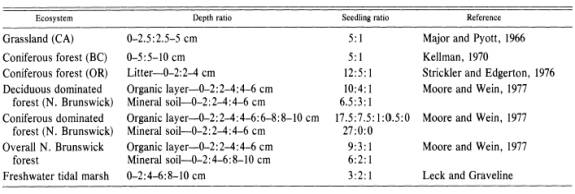
species occurred only in surface (0-2cm) layer samples. But in contrast to
the soil profile of other ecosystems, which tend to show a sharper decline
in the seed number with depth, marsh soils contain comparatively more
seeds below the surface layer (Table 1).
Table
1. Relationship of seed bank to soil depth in various ecosystems (Leck
and Graveline, 1979)
While
salt marsh seed banks are dominated by perennials, in freshwater marshes
annuals are an important component of the seed bank and of the vegetation
where perennials are less important species (Whigham and Simpson, 1976).
The reason for this seed bank characteristic is still not understood.
Studies are under way to compare germination requirements and
seedling survival of the dominant annuals and perennials (Leck and
Graveline, 1979). Although they are an important part of the freshwater marsh
seed bank, most of the annuals appear not to have long-lived seeds and
cannot accumulate over time (Leck and Simpson, 1987).
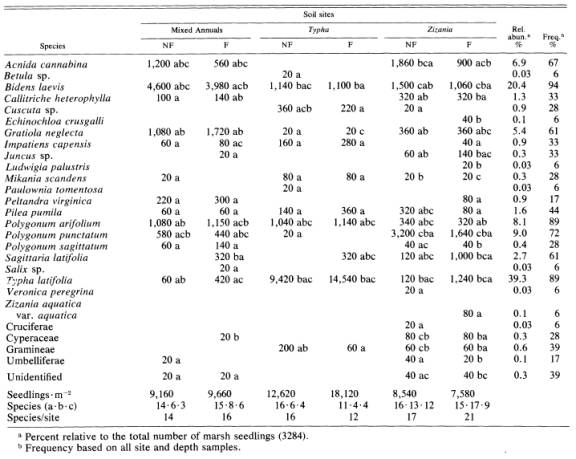
For all aquatic species, flooding may be an important consideration that greatly effects seed germination. Van der Valk and Davis (1978) found that standing water of 2 cm had a significant effect on seeds which germinated in prairie marsh soils. Table 2 below shows the results of a germination study conducted by Leck and Graveline (1979). The three soil collection sites in the table are a high marsh dominated by mixed annuals, a high marsh dominated by Typha, and a mild slope dominated by Zizania.
Table. 2. Numbers of seedlings per m2 and species emerging in the greenhouse under non-flooded and flooded conditions. (F) in soils colleted at tree tidal freshwater marsh sites in March 1997. Data for three depths (0-2, 4-6, and 8-10 cm) were totaled. Presence of a species in a layer is indicated by the letters a, b, or c for 0-2, 4-6, and 8-10 cm, respectively; the sequence of letters represents a ranking of layers as to its number of seedlings from high to low.
The
table shows that under flooded conditions Acnida canabina, Bidens
leavis, Polygonum arifolium and Polygonum punctatum had
reduced germination while Polygonum sagittatum, Typha latifolia,
Gratiola neglecta, Impatiens capesis, Peltandra virginica and Juncus
sp. had increased germination.
Some species in such wetlands only germinated in flooded
conditions. Cuscuta sp., Peltandra virginica and Zizania
aquatica only germinated under flooding. Juncus sp., Cyperaceae
and Salix sp. only germinated under flooded conditions at the mixed
annuals site. Sagittaria latifolia only germinated under flooded
conditions at the mixed annuals site and the Typha site.
At the Zizania site it geminated much more under flooded
than un-flooded conditions (1000:120).
The
timing for marsh soil collection is critical for properly estimating both
the size and composition of the seed bank and for relating the seed bank
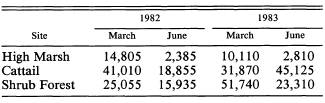
to the aboveground vegetation (Leck and Robert, 1987). Leck and Robert’s
study in 1987 compared the seed bank collected from three different
freshwater wetlands (high marsh, cattail and shrub forest) in March and
June. The results show that species occurred in the March samples
significantly more than in the June samples (Table 2).
Table
3. (Leck and Robert, 1987) Estimated seed bank (seeds per m2)
in the top 10cm of soil in three wetland sites based on 1982 and 1983 soil
samples collected in March and June. Values were obtained by extrapolation
of depth data for 0-2, 4-6, and 8-10 cm.
Eighteen
of twenty-six species germinated only in the March samples. For example,
the June high marsh seed bank contained no Impatiens capensis or Polygonum
arifolium, but each of these species was 37-38% of the vegetative
cover in July. This is because the annual plants contribute greatly to
seed bank, but are severely depleted after spring germination. But the
results also show improved germination at 4-6 and 8-12 cm in the June
samples when compared with the March samples (Fig. 1). This may be due to
a decrease in seed dormancy with time and the influence of various other
processes.
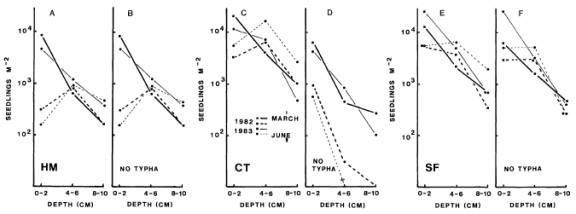
Fig.
1. (Leck and Robert, 1987) Decline in seed bank (seedlings m-2)
with depth for soil samples obtained at HM (high marsh), CT (cattail), and
SF (shrub forest) sites in March and June 1982 and 1983.
Other factors also affect the seed dormancy of wetland species.
Strict primary dormancy was found to be common in some wetland species (Schutz,
1997). When tested over a range of temperatures, Cyperus flavicomus
(Michxl.), Leptochloa panicoedes (Presl.) Hitchcl., Leucospora
multifida (Michx.) Nutt., Hottonia inflata Elliot, Scirpus
lineatus Michx., and Gratiola viscidula Penell were strictly
dormant at maturity, and Penthorum sedoides L., Cyperus odoratus
L., Fimbristylis autumnalis (L.) R. and S., F. vahlii (Lam.) Link
and Cyperus erythrorhizos Muhl. were concluded to be conditionally
dormant since they germinated at high temperatures in the light (Baskin et
al., 1989). Baskin et al.
(1989) showed eight out of nine wetland annuals and two out of four
perennials absolutely or almost absolutely required light for germination.
This darkness dormancy, combined with low seed mortality, may be
one of the reasons why wetland seed banks show less of a decrease in
viable seed with depth than other ecosystems.
Seed
bank collection and propagation methods were also described in these
studies. For example, the method Leck and Graveline used in 1979 was
removing soil sediment blocks (10 by 10 by 10 cm) with a long knife or a
machete preventing the soil from being compacted. Ten blocks one meter
apart were removed along two transects which bisected one another (six
blocks along one transect and four along the other). In the laboratory
each block was divided horizontally to provide three layers: 0-2 cm, 4-6
cm, and 8-10 cm. Each layer was then cut in half vertically, and combined
with nine others from the same depth. Rhizomes, sticks, and other
extraneous materials were removed. The samples were placed in plastic bags
and stored at 5°C
until planting. At the planting time, the samples were carefully mixed and
placed on a 2-cm layer of moistened perlite in aluminum flats, which had
been perforated to allow for drainage. The flats were watered daily and
received natural photoperiod and lighting.
A procedure such as this can be emulated when collecting and
germinating wetland soil seed banks for restoration purposes.
The characteristics of freshwater marsh seed banks and the seed germination requirements of wetland species can be used as guidelines for seed bank collection and propagation for restoration projects. The time, depth, and location of collection, and the timing and technique of propagation should be based on studies in the literature. In addition, other factors such as invasive plants and undesirable seeds in the soil seed bank should be considered.
