
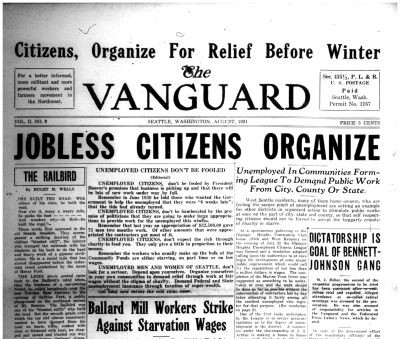
The Vanguard was published weekly by the Seattle Labor Council from 1930-1933. In this January 1931 edition, it announced the formation of the Unemployed Citizens League
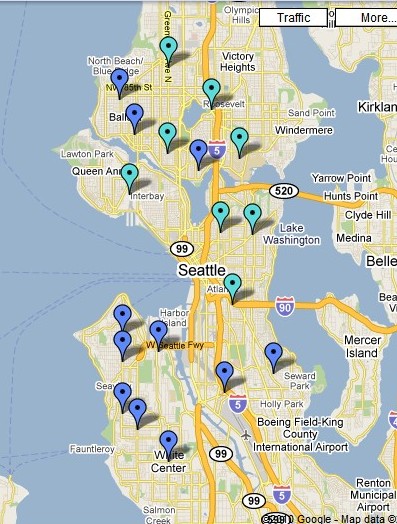
Locations of UCL branches in Seattle in 1932. For details about each branch see "Self-Help Activists: The Seattle Branches of the Unemployed Citizen’s League."
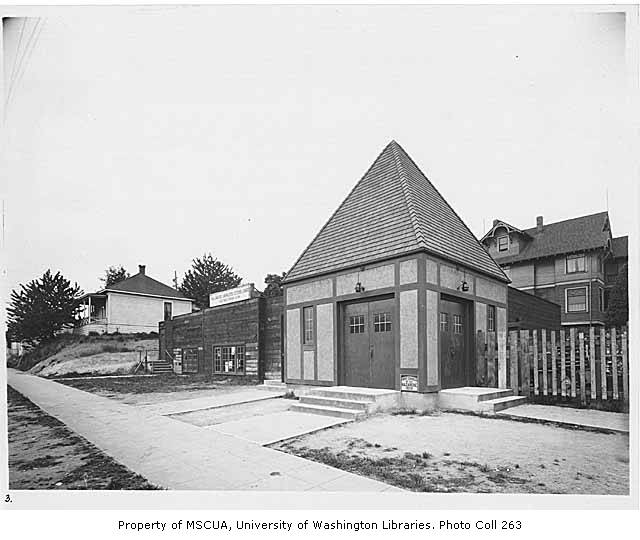
Wallingford neighborhood UCL commissary and meeting hall, 1822 N. 57th Street, Seattle. Photo: UW Liraries Special Collections FER0221.
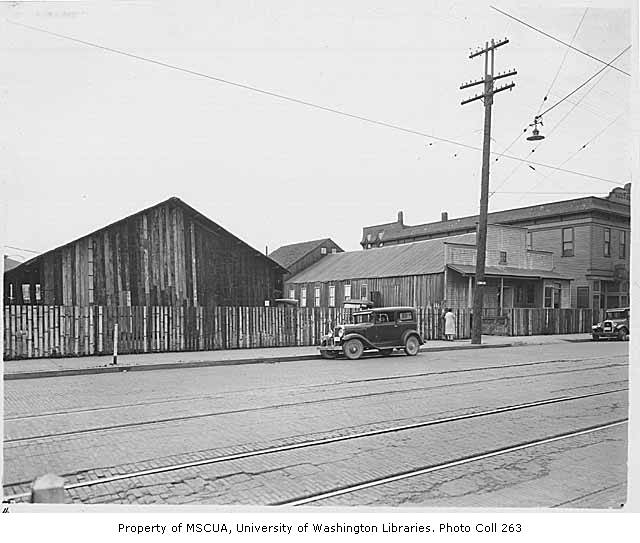
Georgetown UCL commissary and meeting hall, 5515 Airport Way, Seattle. Photo: UW Liraries Special Collections FEER0256.
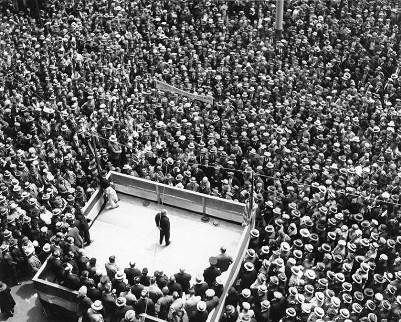
Newly elected mayor John Dore addressing a rally of UCL members and other supporters at city hall, June 6, 1932. Photo: UW Liraries Special Collections Lee263_401
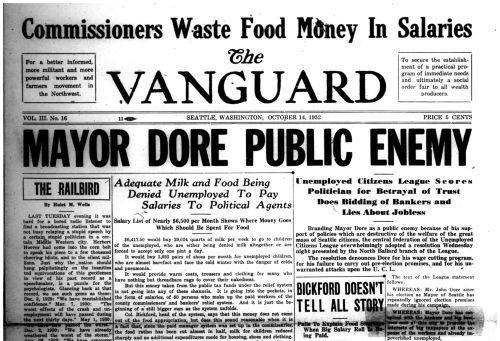
The relationship with Mayor Dore and local governments soon soured. In this October 1932 edition, Vanguard editors denounced Dore for breaking promises and ending the agreement that allowed UCL commissaries to distribute public relief.
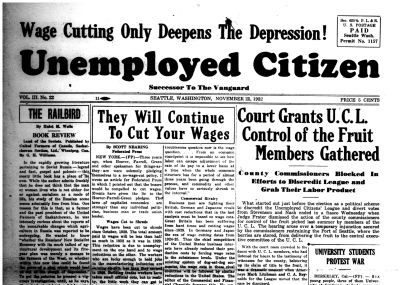
At the end of 1932, the weekly Vanguard was retitled as the Unemployed Citizen and would use both titles in the year that followed.
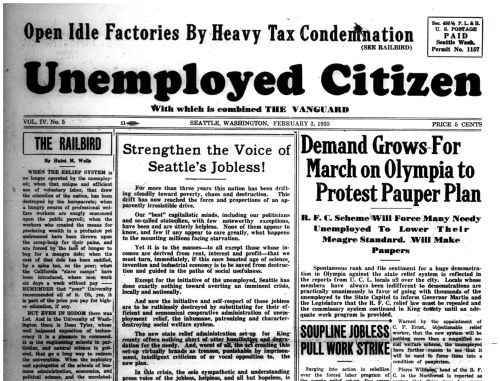
In early 1933, the UCL and the Communist-linked Unemployed Council cooperated in organizing a Hunger March to Olympia to demonstrate demands for comprehensive unemployment relief. This headline announces that the march will take place March 1. A caravan of nearly 200 cars made its way from Seattle and upwards of 3,000 protesters marched to the Capital.
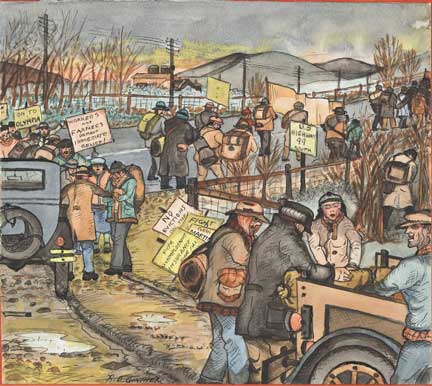
The artist Ray Ginther was active in the Unemployed Council and painted this Hunger March scene decades later. See "Ronald Ginther Watercolors." Image courtesy Washington State Historical Society
Beginning in 1929, unemployed workers across the United States mobilized en masse to demand comprehensive public relief. Many of these movements were affiliated with the Socialist or Communist parties, notably the CP-sponsored Unemployed Councils, but in Seattle an independent organization called the Unemployed Citizen’s League (UCL) took the lead and for a time became a powerful force in local and state politics.
This essay situates Seattle as a case study of radical organization within the crisis of Depression-era mass unemployment. It compares the lackluster performance of Communist-led unemployed agitation in the city with the rise of the Unemployed Citizens’ League, which in 1932 claimed nearly 20,000 members and dozens of UCL Clubs that served as commissaries distributing food and sharing services. During this period, the UCL became politically active, mobilizing in local elections while simultaneously enjoying institutional support from city and county authorities, who directed much of the public relief effort through UCL commissaries. How did the UCL gain so much influence and why was its success short-lived? In addition to utilizing detailed research of local and contemporary sources, this report draws some of its insights from two formulations of social movement theory: Piven and Cloward’s argument about the power of disruption in Poor People’s Movements and the resource mobilization framework initially developed by McCarthy andZald.[1]
Challenges of Organizing the Unemployed
The Great Depression produced unprecedented levels of unemployment. By March 1933, more than 25 percent of the workforce was unemployed.[2] Virtually no community or industry escaped these ravages, though disproportionately burdened were the young, poor, foreign-born, people of color, and the unskilled.[3] At the same time, the economic collapse presented new opportunities for radical organizations that had been weakened by the postwar Red Scare and the political lethargy of the 1920s.[4] As strikes failed, unions struggled and conventional efforts to organize employed workers became increasingly difficult, the unemployed represented a new constituency that might respond to radical calls for action.
Yet organizing the unemployed posed unique difficulties. For one, the unemployed could not generally be depended on for continuity. Where industrial workers were tied to a single workplace with a regular site of social interaction, the unemployed were dispersed and often transient. Moreover, joblessness itself was cyclical; the number of unemployed fluctuated with changing conditions. In practical terms, this meant that unemployed organizers contended with high turnover. When traditional work opportunities returned, participants could retreat from political activity altogether.
A second challenge emerged from the differing priorities of the unemployed themselves. While radical organizers might have viewed unemployment as the product of an exploitative system ripe for fundamental transformation, rank and file people out of work commonly sought immediate objectives such as food, relief payments, employment or shelter. This meant that those unemployed who were not true converts to radicalism might fade from the movement when their own conditions improved. Mobilizing the unemployed was therefore, in many ways, a race against recovery.
Who Organized the Unemployed?
With these and other challenges afoot, different radical organizations developed competing strategies and organizing philosophies. The three organizations principally responsible at a national level were the Communist Party (CP), the Socialist Party (SP), and the Conference for Progressive Labor Action (CPLA).[5] The Unemployed Citizens’ League of Seattle was nominally associated with the CPLA in its infancy but operated largely independently of any of the major national organizations. All of these factions sometimes shared policy goals, like unemployment relief, but frequently opposed one another in the public sphere.
Because the Communists were the Unemployed Citizens’ League’s principal competition in Seattle, it is worth briefly detailing the Party’s position. While there was friction between all of the unemployed factions, the Communist Party was the most openly antagonistic and confrontational. After the Communist International (Comintern) proclaimed its “Third Period” in 1928, Communist affiliates worldwide became aggressively sectarian and anti-reformist. There would no longer be cooperation with socialists, social democrats, or non-Communist labor organizations. In place of coalition-building, the Party adopted a strategy of dual unionism: it would create its own unions and movement organizations, rather than participate in existing organizations.[6]
This strategy materialized in the United States in August 1929, two months before the Wall Street crash. A new Communist labor subsidiary known as the Trade Union Unity League (TUUL) was formed in Cleveland, Ohio.[7] Under TUUL leadership, Communist organizers rapidly established what they termed Unemployed Councils in major American cities. Hunger marches, anti-eviction campaigns, militant demonstrations and direct confrontation with authorities became their strategy to mobilize, and, in their hope, radicalize the unemployed.[8]
Washington in the Early Depression
In some cities and states, such as New York, Detroit, and Chicago, Communists rallied considerable support. But in Seattle, the CP faced different challenges. Because Washington’s economy depended heavily upon extractive industries such as timber, fishing and agriculture, the effects of the Depression developed differently than in the industrial manufacturing centers where Communist unemployed organizations initially found success.[9] However, Washington, and by extension Seattle, was just as ill-prepared to meet impending public relief needs. There was no institutional capacity to address unemployment once economic conditions deteriorated. No unemployment insurance existed, and relief depended on volunteer networks and charity organizations whose resources were quickly depleted. As unemployment increased between 1930 and 1931, municipal authorities faced mounting pressures to address unemployment amidst shrinking public revenue.[10]
Seattle entered the Depression with a long history of labor militancy, exemplified by the 1919 General Strike.[11] Despite this history, socialist and Communist organizations had withered in the 1920s as pro-business Republicans dominated state and local governments. Nevertheless, radical networks remained active in the city’s labor movement. In late 1929 and early 1930, two important developments reflected renewed attempts to mobilize workers amidst worsening conditions.
Firstly, operating at Party directive, members of the Communist Party’s 12th District, which encompassed the Pacific Northwest, began attempting to organize the jobless through militant demonstration. In the same period, The Vanguard, a Seattle newspaper founded by socialist Carl Brannin and published by the Seattle Labor College, began advocating for a comprehensive anti-capitalist platform that included unemployment insurance, higher wages, workman’s compensation, and militant unionism on industrial lines.
Seattle Represses its Communists
By 1930, unemployment in Seattle had intensified. According to The Vanguard, there were between 20,000 and 30,000 unemployed in the city, while best historical estimates place the unemployment rate at 11% by April.[12] The Communists had already been mobilizing the unemployed, having demonstrated in November 1929 on Armistice Day, which resulted in 31 arrests. Continuing their agitation, the organizers rallied 500 of the jobless on February 26 for a demonstration.[13] Seattle police ordered the crowd dispersed, and, when the unemployed did not yield, enforced their order with club and fist.[14] Eleven were arrested, and several others were injured. Afterwards, Mayor Frank Edwards, a staunch anti-Communist, praised the Chief of Police’s actions and declared, “You must not tolerate any such demonstrations, parades or gathering of this kind in Seattle, but break them up immediately before any trouble starts.”[15]
This gathering was a precursor to the day that would cement the unemployed movements nationally. Prior to the February 27 demonstration, the Comintern had declared March 6, 1930, to be International Unemployment Day. That day was when the movements truly erupted, surprising even the Communists with their breadth and scale. While exact figures are impossible to calculate, Party estimates—which were inflated—claimed 1.25 million unemployed mobilized across the country.[16] While Seattle’s Communists participated in this campaign, the results displayed the limits of demonstration in the city’s political environment. On March 6, approximately 500 participants gathered once more, but police rapidly dispersed the assembly and arrested 12 demonstrators.[17] Five Communists were later found guilty of unlawful assemblage.[18] Unlike New York or Detroit, where the scale of protest occasionally overwhelmed the authorities or generated moderate concessions, Seattle officials, particularly Mayor Edwards, remained politically willing and capable of repressing Communist agitation during the early years of the Depression.
The Vanguardand Rise of the UCL
The newspaper known as The Vanguard, later The Unemployed Citizen, would eventually become the erudite media arm of the Unemployed Citizens’ League. At its founding, however, it was an extension of the Seattle Labor College, which remained its publisher throughout its lifespan. The College was a radical workers’ education program that, by the time of the release of the paper’s first edition in January 1930, was directed by long-time labor activists Carl Brannin and Hulet M. Wells.[19] The Vanguard echoed the College’s platform and that of the New York-based Conference for Progressive Labor Action (CPLA), which among other things advocated for unemployment insurance; a five-day work week; a six-hour workday; higher wages; old age pensions; and the building of a true labor party.[20]
The CPLA, like The Vanguard, was a new organization founded by the radical pacifist and director of the Brookwood Labor College A.J Muste. Muste believed that the Socialist and Communist parties were missing opportunities to work within and radicalize the unions of the American Federation of Labor. The Seattle Labor College and The Vanguard were particularly shaped by this affiliation in their early days. In October 1930, it was reported that an “unemployed insurance committee”, staffed by union leaders, community members and future UCL relief liaison C.W Gilbreath were seconding the CPLA’s move to petition for unemployment insurance.[21] And in the winter of 1931, A.J Muste himself traveled to Seattle and lectured for four days, castigating Hooverism and capitalism before audiences of Seattle radicals.[22]
This affiliation, however, soon became secondary. In the summer of 1931, Brannin, Wells, and other Seattle Labor College affiliates began working to establish the first chapters of the Unemployed Citizens’ League. By this point, many unemployed had lost their housing and built clusters of shacks along the waterfront and elsewhere, which were mockingly christened “Hoovervilles” for the Hoover Administration’s policy blunders.[23] Craftspeople were idle, food products were wasted, fields were untended, and the need for food and clothing was widespread. Amidst growing disillusionment, the UCL provided a pathway for the unemployed to participate in the relief effort.
Organizational Structure of the UCL
Though self-help became the credo that eventually brought the UCL significant attention, the first resolution of the first local of the UCL, established in the Olympic Heights neighborhood in July 1931, “called upon authorities to initiate a major public works project” to provide wages as opposed to charity to the unemployed.[24] Thereafter, locals began compiling their own neighborhood-by-neighborhood statistics of the unemployed and canvassing for membership house-to-house. By September 1931, the number of UCL locals had risen to 20, and a central federation had been organized.[25] Familiar figures populated the ranks of officers: among others, Brannin was appointed executive secretary, Labor College associate J.F Cronin elected president, and C.W Gilbreath made city relief liaison.
One of the key challenges of organizing the unemployed previously discussed was transience and rotating membership. The UCL partly overcame this challenge by fundamentally being rooted in the neighborhoods. League locals became new neighborhood centers, not only for relief but for recreation, frequently hosting dances, social gatherings, and fundraisers in coordination with the College.[26] In this, it strengthened community bonds and also fostered a sense of altruistic collaboration; many members gave more than the two weekly days of labor the UCL asked from its members.[27]
While changing personnel, leadership and institutional relationships would modulate the strategies of the UCL, the essential characteristics of the organization were enshrined in its first constitution. Its program, ordered by priority, consisted of employment; self-help; unemployment insurance; and direct relief.[28] Distinctive of the UCL’s philosophy was a principled, unreserved condemnation of private charity. If direct relief payments were necessary, the UCL held that it should be public entities that provision it; in their constitution, they declared that “the state owes its citizens the opportunity to earn a livelihood, and that every man who stands ready to work is entitled to maintenance as a civic right.”[29]
The initial resolutions adopted at the federation’s first meeting ambitiously followed this philosophy. The League called for a “$1 million city wage fund to be expended on public improvements; a $500,000 county wage fund for the same purpose and an additional $500,000 for direct relief; a $4.50 per day minimum wage; no eviction of unemployed for failure to pay taxes, assessment and back rent.” They additionally demanded that all work was to be done by the city and county without the intervention of contractors and rotated fairly among the unemployed.[30]
This political maneuvering found early success—Seattle’s city council instituted a public works program at the requested wage the next month—but more relevant were the UCL’s so-called self-help programs. Relief committees, which had been established in the locals, began directing food acquisition. Wood, housing and child welfare committees were also established. Members coordinated with local farmers to exchange labor for produce; cut fuel from unsaleable timber; obtained and distributed fish that could not be sold; and operated barber shops, tailors, shoe repairs, and kitchens. Landlords of houses in need of repairs credited tenants with the value of labor performed by League members. In totality during the fall and winter, the unemployed gathered for themselves “120,000 pounds of fish, 10,000 cords of firewood, and eight carloads of potatoes, pears and apples.”[31]
What the League actually practiced was cooperative mutual aid, not self-help. The language of self-help, however, was politically and socially important. By framing its relief efforts as independent and productive labor, the League appealed to unemployed persons who were wary, even contemptuous, of dependency. Thus, unlike the Communists that espoused rigid class ideology, the UCL was attractive not only for the goods they provisioned to its members but the rhetoric underpinning them. American workers that retained a sense of individual responsibility could still take pride in their work. The Vanguard of August 1931 so stated: “Unemployed men and women of Seattle, don’t look for a savior. Depend upon yourselves.”
Here it is worthwhile to pause and note that the rank-and-file membership of the UCL was not, at any point, composed largely of radicals. While leadership were undoubtedly socialist and a radical element was always present, a large portion of the unemployed were less political.[32] This is not to deny that some members were radicalized by participation in the League, but instead to remark that the UCL's ideological gains were not as far-reaching as its relief efforts.
Beginning of Cooperation with Municipal Authorities
While the UCL was establishing itself, the City was simultaneously expanding its own relief efforts. Mayor Edwards was recalled in July 1931, generally understood to have resulted from his firing of a popular City Light superintendent.[33] The Vanguard supplemented this reasoning with a rebuke of Edwards’ continuous suppression of the unemployed movement.[34] Afterwards, the City Council appointed Robert H. Harlin to serve the remainder of his term.[35] Harlin soon established what was formally called the Mayor’s Commission for Improved Employment, but colloquially became known as the Dix Commission.[36] The Dix Commission was so named for its chairman, I.F Dix, a local civic and business leader who served as president of Seattle’s Chamber of Commerce and the Seattle Community Fund.
The Commission’s first mandate was to coordinate and supplement private and public relief efforts. It began establishing donation depots for food and clothing where the distribution of these resources was handled by relief agencies.[37] Meanwhile, the UCL was opening commissaries in garages and wherever else they could to distribute relief in each local, while continuing its “self-help” program. Quickly, it became apparent that the UCL was outpacing the Mayor’s Commission in its relief efforts. But city relief money was sparse, and as winter approached, the UCL’s self-help activities slowed. Eventually, authorities recognized that more public funds were required to meet the growing relief needs.[38] As such, an increasingly cooperative relationship developed between the Commission and the League out of necessity.
At first, this cooperation was modest. The Mayor’s Commission would sometimes supply resources such as tools or gas to League members. In November 1931, the two groups joined with the Seattle School Board to use the lunchroom of Franklin High School to feed the unemployed for Thanksgiving.[39] By December, however, plans were being made to fully join the relief efforts of the two organizations: I.F Dix and representatives of the UCL conferred with King County commissioners to request financial aid,[40] and by 1932, the Commission and the UCL had merged into a new entity called the Local District Relief Organization.[41]
The cooperative relationship that eventually emerged between the UCL and municipal authorities was neither inevitable nor straightforward. It developed because the League demonstrated a capacity that the city lacked at the time: the ability to organize and stabilize the unemployed while directing a sophisticated neighborhood-level relief effort. Simultaneously, the commissaries and barter systems the UCL had developed could not sustain the people amid the unabating unemployment crisis without public funds. Mutual benefit toward a common cause was the binding agent of their partnership.
Furthermore, and somewhat counterintuitively, the UCL benefitted from the actions of its direct competitor, of which it had been wary: the Unemployed Councils and its Communist organizers. The Edwards administration was swift to repress the Communists, but their militant efforts continued to alarm local and national political elites. In comparison to the Communists, Seattle’s business and political class perceived the UCL as a helpful intermediary. In other words, the League was channeling the dangerous discontent of the unemployed into responsible relief efforts that were civically acceptable.
More than mere conjecture, this viewpoint was echoed by officials themselves. I.F Dix, reflecting on the Local District Relief Organization, said that the merger between the Mayor’s Commission and the UCL “was deliberately designed as a buffer to prevent direct contact of the unemployed with the government. As large a group as the unemployed would be a political threat if they were dealt with collectively by the county commissioners.”[42]
Theoretical Framework
The emergence of new social movements during the 1960s prompted reconsideration of earlier assumptions about how protest movements form and sustain themselves.[43] Scholars increasingly focused on the organizational and political dynamics that shape collective action. By no means an exhaustive selection, two influential contributions during this period were Piven and Cloward’s Poor People’s Movements and the resource mobilization framework developed by McCarthy and Zald. These works are centered in this analysis because although they are conventionally opposed, synthesizing them produces a valuable insight into the influence of Seattle radicals.
Piven and Cloward argue lower-class social movements’ efficacy depends primarily on their capacity to generate disruptive pressure on institutions during periods of structural vulnerability.[44] Institutions, they contend, rely upon conformity to established social roles.[45] When subordinated groups withdraw that cooperation, they generate instabilities that prompt responses from political elites. In their words, the “most useful way to think about the effectiveness of protest is to assess the disruptive effects on institutions and then analyze the political reverberations resulting from that disruption.”[46]
Piven and Cloward also contend that formal organization undermines insurgent movements. As movements become institutionalized, the leaders prioritize stability and organizational maintenance over disruption. What begins as defiance is channeled into routines that are compatible with existing political structures. Importantly, Piven and Cloward point specifically to the progression and collapse of the unemployed movements of the 1930s as strong empirical evidence for this pattern.[47] I argue that the case of Seattle’s Unemployed Citizens’ League complicates the relationship Piven and Cloward suggest between organization and political effectiveness.
In contrast to Poor People’s Movements, resource mobilization theory developed by McCarthy and Zald conceptualizes social movements as organized actors whose effectiveness depends on their ability to acquire and deploy a broad range of resources. These resources include labor, legitimacy, material support, and access to external networks. From this perspective, grievances are assumed to be widespread and relatively constant features of society. Treating grievances as a constant in this fashion emphasizes the ability of organizational structure to create and sustain protest activity, rather than inherently weakening it. [48]
Though often framed as competing, these theories can illuminate different dimensions of Depression-era unemployed political action. Piven and Cloward correctly emphasize the leverage protestors generate through disruption, while resource mobilization crucially stresses which organizational capacities protestors need to sustain collective action. The case of the UCL illustrates how these tendencies are not mutually exclusive.
As Piven and Cloward argue, institutions tend to respond in three different ways to a lower-class disruption. They “may ignore it; they may employ punitive measures against the disruptors; or they may attempt to conciliate them.”[49] How elites respond is highly dependent on the political moment. In moments of instability when lower classes have a higher level of political leverage, they are more likely to conciliate. In 1929 and onward, Seattle authorities largely chose punitive measures against Communists, and the Unemployed Councils therefore did not obtain any substantial concessions. It may have been that the unemployed numbers, which were moderate compared to Eastern industrial centers, worked against the organizers, who simply had fewer displaced people to mobilize than their counterparts across the country.
Still, it was clear that Seattle elites were perturbed by unemployed militancy. The swift repression of the Communist Unemployed Councils limited their early organizational efforts, but if the crisis continued, the Communists could present a substantial threat to public order. As conditions worsened, however, a rival organization pursued a markedly different strategy, and one that claimed appeal with both the unemployed and a local government dubious of the radicals.
Returning to Piven and Cloward’s thesis, it can be seen that the authorities’ cooperation with the UCL was a means for constraining the disruptive power of the unemployed. Government officials sought to coopt the movement by bureaucratizing the League’s activities. And yet, when we confront what actually transpired with a resource mobilization framework, it is clear that this dynamic allowed the UCL to scale its relief efforts and increase its membership base by mobilizing the external support of the city authorities. Cooperation therefore reduced the immediate threat of disorder while simultaneously granting the UCL access to resources, legitimacy and influence that dramatically expanded its reach.
But cooperation was unstable. To some in the League, it signified an opportunity for the unemployed to play a direct role in the relief effort. To the municipal elites that collaborated with them, the UCL was merely an auxiliary organization that would no longer be necessary once the urgency of the crisis fell away.
Height of Cooperation and Political Leverage
The first half of 1932 marked the zenith of the League’s political and social capacity. The total number of families receiving relief increased by 27.5% between March 10 and May 5, while the self-help activities peaked in May with “6,000 men working 104,000 hours.”[50] The UCL’s commissaries accounted for most of this relief effort and remained under direct League control. From January 1 to July 30, among other activities, 11,000 cords of wood were cut; six shoe repair shops repaired 42,000 pairs of shoes; 25 houses had been repaired in exchange for rent; and 450 acres of ground were under cultivation for the growing and canning of berries.[51] The League continued to be an unimpeachable asset to its communities, and its commissaries became a unique intersection of direct action and public authority.
As its membership and collective self-help activities expanded, so did its reputation and political influence. Far away in Massachusetts, the Daily Boston Globe of July 1932 wrote, “Seattle has borne the major part of the state’s burdens, and only through the leadership in the Unemployed Citizens’ League has this community withstood the strain of its public treasury.” The growing legitimacy and reputation translated into political potential. The first opportunity came in February and March of 1932, when the mayor’s office and three city council seats were up for election.[52]
It’s here that the decentralized nature of the UCL becomes crucial. In general, the central committee of the League had very little control over its locals. While it acted as the League’s mediator and public voice, it retained little direct authority. With respect to politics, the central body’s constitutional bylaws forbade the discussion of any particular candidate in either the executive meetings or the locals. This became moot, however, when candidates such as mayoral hopeful John Dore began appearing and giving speeches at locals. The attempts of the executive board of the UCL to slow down the political machine of the unemployed were fruitless.
Dore, to his credit, was an able politician and a charismatic speaker, and he saw the opportunity that the unemployed presented. While it’s debatable whether he was appealing to the unemployed generally or the UCL as an organization, it cannot be denied that the UCL locals were where he was able to effectively rally support. In his speeches, he made sweeping and often extravagant pro-labor claims. His lobbying paid off, and in March 1932, The Vanguard declared the League’s endorsement.[53]
Dore swept the primary and the election. Two candidates which had been endorsed by the League for the City Council, Frank F. Fitts and Roy B. Misener, were also elected. Whether or not the candidates could have won without UCL backing was a matter of opinion even at the time. With that said, the UCL was flush with a sense of perceived political power.[54] At the same time, public support for the League was growing further: in March 1932, the Seattle Daily Times reported a unanimous endorsement by 80 business and civic leaders for the joint relief program.[55]
Internal Changes in the League
While the UCL assisted in sweeping Dore into office, internal changes began to disrupt the League itself. As unemployment remained severe and relief increasingly flowed through League-controlled commissaries, struggles emerged over who would control the relief apparatus and how militant the organization ought to become. In the summer and fall of 1932, these tensions destabilized the alliance between the UCL and city officials and contributed to the gradual collapse of the League’s cooperative position.
Although the central federation was the primary intermediary between the unemployed and the public authorities, the autonomy of the neighborhood branches once again disrupted the vision of the executive board. As before, when locals became outright dissident, it was difficult for the League to discipline them. By mid-1932, radical factions had begun consolidating influence in several branches. The Unemployed Councils, still operating in the city and feuding with the League, began to exert influence in locals. The South Ballard, Columbia City and Capitol Hill locals increasingly fell under the control of militant elements; two of them were openly Communist in orientation,[56] while the Capitol Hill local had roots from syndicalists of the Industrial Workers of the World.[57]
These internal conflicts emerged precisely as the League’s public influence appeared strongest, and as Dore came to power. At first, the prospects were encouraging. In June 1932, Mayor Dore requested a $5,000 appropriation from the city council to assist UCL members in harvesting and preserving strawberries and other produce that would have otherwise gone to waste.[58] The League also continued to receive favorable coverage in the business-friendly Seattle Times. In July 1932, Dore publicly defended the organization against accusations of misconduct, stating that investigations had found no evidence to sustain the charges and noting that the League was helping feed approximately 55,000 at minimal public cost.[59]
Beneath these endorsements, however, conflict over the control of relief was intensifying. The League’s commissaries had become central to food distribution throughout Seattle. Through unpaid labor and neighborhood administration, unemployed workers themselves played a major role in organizing relief. And to many members, it represented not only an efficient effort to help communities, but a preservation of a dignified and democratic participation of the unemployed. Increasingly, however, and in light of increased radicalism in the locals, county officials viewed the UCL’s control over the commissaries as politically dangerous.
Conflict in the Commissaries
The first major rupture emerged in July 1932. After both the Colombia City and South Ballard delegations apparently refused to cooperate with the central federation, they were expelled from the League altogether. Consequently, the South Ballard commissary was no longer recognized and would no longer receive shipments of supplies.[60] Shortly after this expulsion, conflict erupted when unemployed residents attempted to redirect bread and milk deliveries from a Dix Commission depot to the now-disbarred commissary. Police were summoned and Dore himself arrived to pacify the crowd. Ultimately, the police did not intervene or make any arrests, even at the request of the depot manager. Regardless, the incident had revealed that the distribution of relief had become intertwined with the growing factionalism within the League.[61]
County officials soon moved aggressively to curtail the League’s autonomy. In August 1932, county commissioners proposed removing control of the commissaries and relief investigations from direct unemployed management and instead replacing them with paid county employees.[62]The proposal triggered immediate resistance from the UCL. League publications denounced the measure as a “pauper plan” intended to transform relief into a political machine controlled by county authorities. At a meeting between commissioners, businessmen and the League’s executive committee, county commissioner Don Evans acknowledged that officials had little criticism of the commissaries’ actual operation but insisted that the county would intervene if the League could no longer maintain order.[63]
This growing hostility reflected more than just administrative concerns. County officials increasingly feared that radical elements were gaining influence within the unemployed movement. In September 1932, several commissaries refused shipments of meat distributed through county channels. Although the immediate dispute centered on the quality of the meat, officials accused the commissaries of acting out of labor solidarity against the provider, Frye & Company.[64] Commissioner Evans then stated that the commissioners would operate the commissaries as they saw fit and “would not take orders” from them. Still, shortly thereafter, Evans praised the original self-help operation of the UCL, while warning that a “radical element has crept into the commissary management.”[65]
Hostilities Boil Over in Georgetown
In September 1932, at the Georgetown commissary, county commissioners attempted to impose direct county control over the depot despite mass opposition from unemployed workers. Approximately 900 unemployed gathered at the commissary to resist the seizure.[66] The scale of the crowd reflected how deeply the commissaries had become embedded in the identity of the unemployed movement. County officials regarded the step as mere administrative restructuring, but to the unemployed, the seizure of the commissaries would be the destruction of one of the few institutions they directly controlled. Mayor Dore and Commissioner Evans, nevertheless, threatened to take possession of the commissary by force. Dore warned the crowd, “Anyone looking for trouble is going to get it—plenty of it—today, even if some of you are dead before it’s over.” With this statement, the cooperative relationship between the League and the authorities was destroyed. County officials placed their own padlock on the commissary doors and excluded the unemployed managers,[67] and in October, Dore publicly declared that Seattle would be better off without the UCL.[68]
The Georgetown crisis revealed the inherent instability in the UCL’s cooperative strategy. Officials had tolerated, even encouraged, unemployed self-organization because it stabilized relief and helped contain unrest. But once radical factions appeared capable of influencing the League, authorities interpreted self-management as a political threat rather than a civic asset.
For their part, the League’s rhetoric became increasingly militant. Articles in The Vanguard condemned the county’s efforts to replace unpaid commissary labor with salaried supervisors and framed the struggle as a battle over whether the unemployed would retain democratic control over relief. The Vanguard warned that commissaries were being dismantled altogether and argued that only a renewed “militant spirit” among the unemployed could preserve self-help relief systems.[69]
Later Activities and Decline
After the commissaries were taken over, the organization was demoralized. Between August and December 1932, self-help activities declined by 50%.[70] Some hope was rekindled during the 1932 elections, when, along with a general realignment to Democratic dominance, UCL-endorsed candidates Louis Nash and John C. Stevenson were elected as county commissioners. Upon taking office, Nash and Stevenson, who had partly campaigned on this promise, began moving toward returning the commissaries to the unpaid management by the unemployed.[71]
By this point, the League’s factionalism had split the organization. C.W Gilbreath, founding member and former UCL relief liaison, disavowed the League and formed a competing unemployment organization known as the Economic Security League. Gilbreath’s organization opposed the new militancy and the commissary method of relief, promoting a return to the UCL’s roots as a “self-help” organization.[72] Gilbreath successfully convinced Louis Nash not to support handing control of the commissaries directly back to the UCL on the grounds that the organization no longer represented the majority of the unemployed.[73] Stevenson, for his part, did not support giving control to any particular organization. However, the policy ultimately allowed the UCL to regain some semblance of control over the relief effort.[74]
Any revival of the League’s influence proved temporary, however. By early 1933, the institutional conditions that had initially sustained the UCL were rapidly disappearing. The State Emergency Relief Administration centralized the relief authority to the state level,[75] while New Deal programs soon expanded federal involvement in unemployment relief on an unprecedented scale. In February, the commissaries were closed. The neighborhood-based cooperative systems that once made the UCL a critical part of the relief effort were quickly becoming obsolete. Though the UCL did not immediately shrivel and continued to conduct protest activities, including a largely unsuccessful hunger march in March 1933, the League never reached the same level of influence as it did in 1932.
Conclusion
The experience of Seattle’s Unemployed Citizens’ League complicates a conventional interpretation of the unemployed protest movements. Typical analyses center the progression of New Deal federal relief as the agent of their decline, but this account shows that the UCL was unstable prior to the Roosevelt relief effort. The League derived influence because of the relationship established with the municipal authorities in the context of sparse, inadequate relief mechanisms. Communist agitation, both nationally and locally, had heightened elite fears of disorder, while the UCL simultaneously presented itself as a disciplined alternative capable of stabilizing the neighborhoods through mutual aid and self-administered relief.
The League’s success therefore rested on a fragile balance. The commissaries, barter systems and relief committees channeled unemployed workers into an unpaid labor force of great utility to authorities. Those authorities granted public support to the League that enabled it to grow in scale. But as the commissaries became increasingly central to relief distribution, political conflicts over labor and administration emerged. What city and county officials initially tolerated as a useful mechanism for buffering the disaffected unemployed began to appear as an independent political power, capable of threatening the public order.
The League’s growing militancy emerged from these tensions. The unemployed leaders recognized that their power over relief distribution was, in itself, a source of political power. After the collapse of the commissary system, the League continued to adopt protest tactics functionally identical to the Unemployed Councils. But these demonstrations lacked the institutional leverage that previously made the UCL influential and were less broadly appealing to the jobless. The organization’s earlier strength rested in its ability to mediate between unemployed workers and the local administrators, not in protest activity alone.
Finally, this paper does not claim that this case was representative of the unemployed movements nationally. The city’s delayed reaction to the Depression and its distinctive labor history created conditions that differed from other industrial centers. Nor is it possible to precisely estimate the electoral influence of the UCL, particularly in the context of the 1932 political realignment. Rather, Seattle illustrates how the unemployed could derive influence beyond disruption or formal organization, instead growing in power through a shifting combination of both under particular institutional constraints.
© Copyright Matthew Mangum 2026
HSTAA 353 Spring 2026
[1] Terry R. Willis, Unemployed Citizens of Seattle 1900-1933: Hulet Wells, Seattle Labor, and the Struggle for Economic Security (PhD dissertation, University of Washington, 1997) is the most important secondary source. Like that work, this report relies heavily on the observational study by sociologist Arthur Hillman, The Unemployed Citizens’ League of Seattle, (PhD dissertation, University of Washington, 1934) and weekly editions of the Vanguard and Unemployed Citizen newspaper. Frances Fox Piven and Richard A. Cloward, Poor People’s Movements: Why They Succeed, How They Fail (New York, 1979). John D. McCarthy, and Mayer N. Zald. “Resource Mobilization and Social Movements: A Partial Theory.” American Journal of Sociology 82, no. 6 (1977): 1212–41.
[2] Roy Rosenzweig and Paul Buhle, “Organizing the Unemployed: The Early Years of the Great Depression, 1929–1933,” In Workers’ Struggles, Past and Present, edited by James Green, Philadelphia: Temple University Press, 1983. 169
[3] Ibid.
[4] Steve Valocchi, “External Resources and the Unemployed Councils of the 1930s: Evaluating Six Propositions from Social Movement Theory,” Sociological Forum 8, no. 3 (1993): 451–70, JSTOR.
[5] Rosenzweig and Buhle, “Organizing the Unemployed,” 170.
[6] Ibid., 169–71.
[7] Victor Devinatz, “A Reevaluation of the Trade Union Unity League, 1929–1934” (Faculty Publication, Illinois State University, 2007).
[8] Rosenzweig and Buhle, “Organizing the Unemployed,” 170.
[9] Arthur Hillman, “The Unemployed Citizens’ League of Seattle,” (PhD diss., University of Washington, 1934), 250
[10] Hillman, “Unemployed Citizens’ League,” 185
[11] Ibid., 249.
[12] City of Seattle, “Hoovervilles in Seattle,” Seattle City Archives, accessed May 17, 2026.
[13] Contemporary estimates vary sharply. The Seattle Daily Times notes 500, while The Vanguard states 5,000.
[14] Seattle Daily Times, “Clubs, Fists Used To End March Over Yesler Way,” February 26, 1930.
[15] The Vanguard, March 3, 1930.
[16] Rosenzweig, “Organizing the Unemployed.” 170-172
[17] Seattle Daily Times. “Agitators Cause New Disorder in South End,” March 6, 1930.
[18] The Vanguard, “Leaders of Jobless Get Farce Trial,” May 6, 1930.
[19]Hillman, “Unemployed Citizens’ League,” 260–61.
[20] The Vanguard, February 1931.
[21] The Vanguard, November 1930.
[22] The Vanguard, February 1931.
[23] City of Seattle, “Unemployment and the WPA in Seattle,” Seattle City Archives, accessed May 17, 2026.
[24] Hillman, “Unemployed Citizens’ League,” 185.
[25] Ibid., 187
[26] Jasmine Kelly, “UCL Branch Activities,” (Great Depression in Washington State, University of Washington), accessed May 20, 2026.
[27] Hillman, “Unemployed Citizens’ League,” 200.
[28] Ibid., 188.
[29] Ibid., 187
[30] Ibid., 186
[31] Ibid., 191
[32] Ibid., 193
[33] City of Seattle, “Mayors, 1890–1948,” Seattle City Archives, accessed May 19, 2026.
[34] The Vanguard, March 1931
[35] City of Seattle, “Mayors, 1840-1948”
[36] Hillman, “Unemployed Citizens’ League,” 188.
[37] Ibid.
[38] Ibid., 191-192
[39] Seattle Daily Times, “Franklin’s High Given for Needy Dinner,” November 23, 1931.
[40] Seattle Daily Times, “Relief Board Will Listen to League’s Pleas,” December 16, 1931
[41] Hillman, “Unemployed Citizens’ League,” 195.
[42] Ibid., 199
[43] J. Craig Jenkins, “Resource Mobilization Theory and the Study of Social Movements,” Annual Review of Sociology 9 (1983): 527–53, JSTOR.
[44] Frances Fox Piven and Richard A. Cloward, Poor People’s Movements: Why They Succeed, How They Fail (New York: Vintage Books, 1979).
[45] Piven and Cloward, Poor People’s Movements, 24.
[46] Ibid.
[47] Ibid., 41-96
[48] John D. McCarthy, and Mayer N. Zald. “Resource Mobilization and Social Movements: A Partial Theory.” American Journal of Sociology 82, no. 6 (1977): 1212–41.
[49] Piven & Cloward, Poor People’s Movements. 27
[50] Ibid., 201-202
[51] Ibid., 203
[52] Ibid., 207
[53] Ibid., 207-208.
[54] Ibid., 207-209
[55] Seattle Daily Times, “Unemployed Get New Hope from Relief Program,” March 3, 1932
[56] Hillman, “Unemployed Citizens League,” 203-205
[57] Ibid.
[58] Seattle Daily Times, “Appropriation to Help Unemployed Pack and Store Strawberries Now Wasting.” June 13, 1932.
[59] Seattle Daily Times, “Unemployed League Upheld,” July 13, 1932.
[60] Hillman, “Unemployed Citizens’ League,” 216.
[61] Seattle Daily Times, “County Board to Discuss General Relief Questions.” July 18, 1932.
[62] Hillman, “Unemployed Citizens’ League,” 216-218
[63] The Vanguard, “Bosses 'Pauper Plan' Blocked.” August 12, 1932.
[64] Seattle Daily Times, “6 More Food Depots Send Cuts Back as Inferior,” September 1, 1932.
[65] Seattle Daily Times, “League Complimented,” September 6, 1932.
[66] Seattle Daily Times, “Police Back Evans’ Move to Operate Food Depot,” September 8, 1932.
[67] Ibid.
[68] Seattle Daily Times, “Dore is at Odds with Jobless on Need of League,” October 10, 1932.
[69] The Vanguard, January 27, 1933
[70] Hillman, “Unemployed Citizens’ League,” 227.
[71] Seattle Daily Times, “Movement Launched to Liberalize Relief Work,” January 5, 1933.
[72]Ibid.
[73] Seattle Daily Times, “Nash Fights UCL Plan in Food Dole,” January 7, 1933.
[74] Hillman, “Unemployed Citizens’ League,” 227
[75] Ibid., 228