Sample questions for exam 3 -- from 1997

If this set of questions takes you more than an hour to do, DON'T PANIC! I've included more than one exam's worth of questions here. Also, don't read too much into what's included or not included -- this set should in no way be treated as in indicator of what will or will not be on the final. These are just questions I had available from 1997.

1.

You have a diploid fungus with the genotype:

y+/y, ala+/ala, hyg+/hyg, kno+/kno; where

y is a recessive yellow color
ala is a recessive allele that causes alanine requirement
hyg is a recessive allele conferring resistance to the drug hygromycin
kno is recessive allele causing knobs at the ends of hyphae

All four loci are on the same chromosome . You plate the fungus on hygromycin so that only hyphae that are hygromycin-resistant can grow. 200 hygromycin-resistant colonies are obtained. Further analysis shows that:

none of the hygromycin-resistant colonies requires alanine
40 of the hygromycin-resistant colonies are yellow but don't have knobs
60 are yellow and have knobs
(i) How did these recessive phenotypes arise? (Only a two-word answer needed!)
(ii) Where is the centromere in relation to these loci? Show all the loci.
(iii) Where possible, show the relative map distances between the loci (including the centromere). (Show your work!)

2. You are a poor, overworked grad student whose project involves looking for mutant flies that have an extended life span. You grow up an age-matched group of mutagenized flies in a bottle. At a certain time after the expected life span has passed, you examine each fly and pick out the ones that are still living.
(i)

Is this a screen or a selection?

Screen _____

Selection ______ (check one)

Explain briefly:


(ii)

Mutant m1 m2 m3 m4 m5 m6
m1 - + + - + +
m2 - + + + +
m3 - + + -
m4 - + +
m5 - +
m6 -
After doing the appropriate back-crosses, you have obtained six true-breeding lines of long-lived mutant flies (m1 through m6, each with a single mutation). You do pairwise crosses between these mutant lines, and note the phenotypes of the progeny ("+" = wildtype, "-" = mutant, long-lived) as shown.

Group the mutations into complementation groups. Name the complementation groups A, B, C, etc.; assume that the mutations are all recessive.

3. In the course of your research, you isolate two pure breeding strains of mice. One has an average tail length of 1 inch while the other has an average length of 7 inches. When these two strains are crossed, the F1 progeny all have a tail length of 4 inches.
(i) We have talked about two modes of inheritance in class that could explain these results: incomplete dominance at a single locus, versus quantitative inheritance involving multiple loci . What crosses could you perform that may distinguish between the two?
(ii) What would your experimental results look like for incomplete dominance? (State the expected phenotypes and give the proportions in which they are expected.)
(iii)

What would your experimental results look like for continuous variation due to three unlinked genes? (State the expected phenotypes and give the proportions in which they are expected.

Workspace

Expected phenotypes:

Proportions:

4. Genes X and Y are structural genes required for the breakdown of altrose (a sugar) by a certain bacterium, and are transcribed as a polycistronic mRNA. X and Y proteins are present at low level in the absence of altrose, and at a 30-fold higher level in the presence of altrose. A mutation in a third gene (Z) causes expression of X and Y at constitutively high levels.
(i)

Assuming that gene Z makes a protein that regulates X and Y gene transcription, suggest two possible models (explanaations) for the induction of X and Y transcription by altrose. Your models should explain the function of Z, the effect of altrose, and the nature of the mutation in Z.

Model 1:

Model 2:


(ii)

Outline a genetic experiment that you would do to distinguish between your two models, and state the outcome you would expect for each model.

Experiment:

Prediction for Model 1:

Prediction for Model 2:


(iii) A frame-shift mutation in X has an x- phenotype (no detectable X protein, normal level of Y protein) but a frameshift mutation in Y has an x-y- phenotype (no detectable level of either X or Y protein). Which gene is closer to the promoter, X or Y?

5. In a Caucasian population of 9000 individuals, the frequency of the allele for male pattern baldness is 0.3.
(i)

What are the expected genotypes and their frequencies in the population? (Assume Hardy-Weinberg conditions.)

Frequency of baldness allele = p = 0.3

Frequency of wildtype allele = q = _____

Expected genotypes and frequencies:


(ii)

The baldness allele is recessive in females (only BbBb females are bald) but dominant in males (BbBb and BbBh males are bald). What are the expected phenotype frequencies in males and females?

Males

Bald =

Non-bald =

Females

Bald =

Non-bald =


(iii) A group of 1000 new individuals joins the population. If p = 0.1 in the incoming group, what will be the frequency of heterozygotes in the population after one generation? (Assume random mating.)

6.

Claws on the forelegs of Great Northwestern Arboreal frogs are pigmented, while claws on the hind legs are unpigmented. You are interested in the regulation of this pigmentation, and you have narrowed it down to the two models shown below. In both models, Gene B is needed for pigment production; in Model 1, Gene A is an activator of B and only functions in forelegs, while in Model 2, Gene A is a repressor of B and acts only in hind legs.
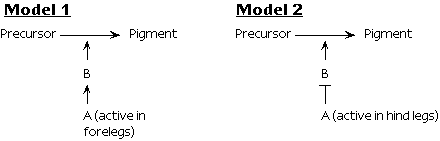
(i)

What phenotype would you expect for each of the following strains in each model? (Upper case alleles = wildtype; lower case = null mutations)

Model Strain Phenotype
Model 1 aaBB  
Model 1 AAbb  
Model 2 aaBB  
Model 2 AAbb  

(ii) Unfortunately for you, before you can score the single mutant phenotypes, the lab pet (python) gets into the frog cages and snacks on your entire collection of single mutants, leaving behind only a cage of AaBb males and and a cage of AaBb females. However, being an accomplished geneticist, you know that you can still distinguish between the two models by mating the survivors and examining the phenotypes of the progeny. What phenotypes of progeny would you predict, and in what proportions, for Model 1 vs. Model 2? (Assume that a and b are null alleles of unlinked genes.)

.. Color