Articles, podcasts and videos on environmental gardening focused on regions on the Pacific Ocean: including Alaska, Baja California, British Columbia, California, Hawaii, Oregon, Washington.
RHS Find a Plant
The RHS Plant Finder and RHS Plant Selector combined into a single Find a Plant service, searching over 250.000 plant records. RHS Find a Plant is the standard bearer of the plant source genre published by the Royal Horticultural Society in Britain. Considered an authority for nomenclature, the Plant Finder also relates additional information such as if a plant won an award, has doubled flowers or which classification the plant belongs to within its type (e.g. a damask rose is designated with a “D”). Also available in print, this resource is useful simply for its reference value, even if you don’t plan to start importing plants.
In the Garden: Essays on Nature and Growing
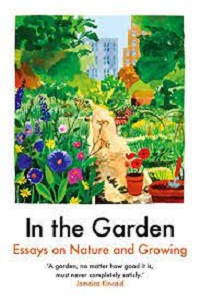
In the Garden: Essays on Nature and Growing is a slim volume that covers a lot of ground. There are essays by well-known writers like Penelope Fitzgerald and Jamaica Kincaid, but American readers will likely be unfamiliar with most of the other contributors. The book is divided in thematic sections: The Garden Remembered, The Collective Garden, The Language of the Garden, and The Sustainable Garden. Fitzgerald writes of a long life in gardens (a childhood garden in Egypt with eucalyptus, lantana, and banyan; large gardens in Oxfordshire full of educational trial and error, and now a much smaller London garden). Like several of the essayists, she reflects on the importance of having a green space during the pandemic in which to find solace.
Several essays are by writers who are descendants of immigrants. I found Paul Mendez’s “The Earth I Inherit” especially poignant. His grandparents came to the industrial West Midlands of England from Jamaica in the 1950s, where they faced racial prejudice on a personal and national scale. They tried to coast beneath the notice of their neighbors by fitting in—planting fragrant plants to conceal ‘strange’ cooking smells that might incite ire, growing plants found in typical urban front gardens (roses, lavender, daffodils, herbs, and vegetables), avoiding anything that might seem outlandish or ostentatious. Still, they derived great pleasure from having even this small patch of earth to nurture and remind them of the home and heritage they left behind.
The communal experience of gardens is the subject of several writers, from a brief history of London’s squares, to the conversion of an abandoned cricket pitch in East London into a thriving community garden where the plants are as diverse as the gardeners, growing what reminds them of their own roots (in Bangladesh, the West Indies, and elsewhere).
Gardens are places where several of the essayists find common ground with their parents. Niellah Arboine and her mother spent many happy days wandering around Kew, but it is their time in the allotment plot that felt like paradise for the author as a child. She abandoned these visits as a teenager, but later reconnected with green spaces and growing things through a gardening group for women of color. During the pandemic, she returned to the allotment with her mother after a long absence; it was the only place they could safely spend time together during lockdown.
Another persistent thread in the essays is the therapeutic and restorative potential of gardens and gardening. Singapore-born Zing Tsjeng’s mother suffers from depression, but has always been an enthusiastic gardener, from tending orchids (which she nourishes with steeped banana peels) and lemongrass to the Japanese maple languishing in her daughter’s garden which she restores to good health. Although her mother has returned to Singapore, she continues to send gardening advice to her daughter, who is gradually becoming more of a gardener.
Poet Victoria Adukwei Bulley’s “What We Know, What We Grow at the End of the World” is philosophical and prompts thoughts of the garden as metaphor: “In a time during which it is necessary to ask what structures must be dismantled in order for all peoples to live freely and well, thoughts about what will need to be abolished come in tandem with those asking what we will need to learn to grow.”
Published in the Leaflet, Volume 8, Issue 12, December 2021
BugGuide.Net
The site includes guide to identifying insects, discussion forums, and a vast collection of images. “We are an online community of naturalists who enjoy learning about and sharing our observations of insects, spiders, and other related creatures.”
The Multifarious Mr. Banks : from Botany Bay to Kew, the Natural Historian Who Shaped the World
![[The Multifarious Mr. Banks] cover](https://depts.washington.edu/hortlib/graphix/multifariousmrbanks300.jpg)
Joseph Banks was indeed multifarious. Webster defines the term as “having or occurring in great varieties.” Garden lovers might know that Banks became famous after collecting plants on a round-the-world voyage with Captain Cook on the Endeavour in 1768-71, and that he developed and guided Kew Gardens for decades. Toby Musgrave does justice to these huge accomplishments. What he adds is the astonishing range of other ways that Banks influenced the horticultural world – and often other worlds – in late 18th and early 19th century England and beyond.
The book is organized chronologically through the account of Banks’s Endeavour voyage and a smaller one to Iceland, but then proceeds by subject through other areas of Banks’s activities.
Banks was very wealthy. He was endlessly curious. He apparently knew everyone of any importance in England and many others on the Continent and in America. He had an outgoing and friendly personality. James Boswell describes him as “an elephant, quite placid and gentle, allowing you to get upon his back or play with his proboscis,” (p. 187), as opposed to another world traveler (Scottish explorer James Bruce) who was “a tiger that growled whenever you approached him.”
Banks was also a firm believer in progress and in empire (which 21st century readers might be less enthusiastic about). Musgrave shows us Banks’s close relationship with King George III, that nemesis of the American Revolution. “Farmer George,” as the king was called, loved Kew Gardens and walked in it with Banks regularly. In Banks’s decades-long efforts finding new plants and acquiring them for Kew, he remained focused on how plants could be used as crops or resources to aid the empire.
Banks belonged to more that 70 clubs and societies. It’s hard to imagine how he did all this and still managed his own multiple properties, regularly updating them with new planting plans. The most prominent society activity for him was his position as president of the Royal Society, a title he held for 41½ years beginning in 1778. In all these activities Banks assisted other scientists in a multiplicity of areas, giving counsel, offering connections, and sometimes providing cash.
When England needed a new site for prisoners, after Georgia was no longer available due to American independence, Banks weighed in on proposing Botany Bay in Australia as an appropriate location. He also pulled strings and even arranged smuggling a prize breed of Merino sheep from Spain, to the benefit of Australia as well as England.
Through his connections and frequent correspondence with members of the Lunar Society of Birmingham (which included Erasmus Darwin, Benjamin Franklin, and Joseph Priestly), with a great many others, and through his own study, “Banks became an acknowledged expert in a wide range of subjects including agriculture, botanic gardens, canals, cartography, coinage, colonization, currency, drainage, earthquakes, economic botany, exploration, farming, leather tanning, Merino sheep, plant pathology, and even the plucking of geese” (p. 281). Multifarious indeed.
This is a real biography, based on copious research. Musgrave avoids fictional conversations and mostly stays away from suggesting what Banks “must have thought.” Fortunately, the author is not afraid to express an opinion, such as that Banks behaved very badly in breaking his engagement to Harriet Blosset. Mostly the story Musgrave tells is one of amazing positives, ending with his justified assessment of Banks as a “great and remarkable man”(p. 332).
Published in the Leaflet, November 2021, Volume 8, Issue 11.
Ponderosa : People, Fire, and the West’s Most Iconic Tree
![[Ponderosa] cover](https://depts.washington.edu/hortlib/graphix/Ponderosa300.jpg)
For many years, I would travel to eastern Washington for Thanksgiving. On these trips, I was always struck by the seemingly sudden appearance of ponderosa pine trees (Pinus ponderosa) when crossing the Spokane County line, after many miles of agricultural fields or grasslands. These stately trees created a park-like setting as they were well-spaced, with little undergrowth. It seemed idyllic.
Ponderosa: People, Fire, and the West’s Most Iconic Tree by Carl E. Fiedler and Stephen F. Arno helped me to understand this ecosystem better. These ponderosa-dominated forests are found in places of “climatic moderation,” typically sharing “boundaries with drier grasslands below and moister, mixed conifer forests above.”
Several of these forests can be found throughout the western United States. In addition to Spokane, other cities in Oregon, Nevada, northern Arizona, and even as far east as South Dakota have similar settings. Prior to Euro-American settlements, these were desirable places for indigenous peoples and for the animal life that often sustained them.
The recent story of the ponderosa pine is closely linked to the timber industry, starting about the time of the California gold rush in the mid-1800s, and ongoing to the present. The authors chronicle in great detail the evolving practices and debates about managing forest lands, especially fires. Should all fires be extinguished at all costs? Should fire be used as a tool? What are the best practices to prevent catastrophic damage to human settlements? These questions have been long debated, and this book’s history is useful in understanding the elements of this debate.
The end of the book includes descriptions of several prominent ponderosa forests listed by state. In Washington, this includes the White Pass Scenic Byway and, surprisingly, the area around Fort Lewis near Tacoma. Ponderosas generally don’t compete well with other conifers in the more humid, western side of the Cascades, but this may be a remnant from a warmer and drier time.
This book was published in 2015. The same authors teamed up for a book in 2020 about another iconic tree: Douglas Fir: The Story of the West’s Most Remarkable Tree. I recommend both for a better understanding of the history and ecology of the forest lands in the western North America.
Published in Leaflet for Scholars, November 2021, Volume 8, Issue 11.
The Cactus Family
Edward Anderson was for 30 years a biology professor at Whitman College in Walla Walla before finishing his career at the Desert Botanical Garden in Phoenix. The Cactus Family is the culmination of his life’s work as, sadly, he died shortly after publication, but more importantly because it will be a long-time standard reference for these popular plants.
While not a gardener’s book–a chapter on cultivation is included but is by a different author–this provides a superb view of the remarkable diversity of cacti, well captured by excellent photographs, most by the author and many in situ. Highly recommend, too, are the chapters on ethnobotany and conservation of cacti, which illustrate how important these plants have been and continue to be throughout their range in North and South America.
Excerpted from the Summer 2012 Arboretum Bulletin.
Urban Forestry & Urban Greening
![[Urban Forestry & Urban Greening] cover](https://depts.washington.edu/hortlib/graphix/UrbanForestry&UrbanGreeningontheshelf.jpg)
One of the more popular periodical publications in the Miller Library is Urban Forestry & Urban Greening, a peer-reviewed, internationally-focused journal published 10 times per year. The publisher (Elsevier) describes the focus as “urban and peri-urban woody and non-woody vegetation and its use, planning, design, establishment and management.”
The editors accept submissions on a wide range of topics under the urban umbrella, including everything from the expected arboriculture and horticulture to urban planning and design, public health, and even environmental psychology. The intended audience includes academics but also policymakers and landscape professionals.
The current and upcoming issues demonstrate this breadth of topics. One report discusses stormwater infrastructure designs, showing that the preferences of professionals and laypeople are often quite different. Another article outlines the challenges of developing “an effective forest therapy program to manage academic stress in conservative societies,” using Malaysia as the model. Closer to home, researchers from the University of British Columbia study “urban green equity on the ground” using Portland (Oregon), Phoenix, and New York City as their models to compare.
Many of the articles are available to download from the journal’s website (linked from the Miller Library’s catalog entry); however, the library maintains a print collection dating from the release of volume 1 in 2002. Visit the library and browse through this impressive journal.
Published in Leaflet for Scholars, Volume 6, Issue 11, November 2019
An Illustrated History of the Herbals
![[book title] cover](https://depts.washington.edu/hortlib/graphix/anillustratedhistoryoftheherbals.jpg)
While researching the oldest books in the Miller Library’s collection, I discovered a much more recent gem. An Illustrated History of the Herbals by Frank Anderson quickly became a valuable resource in my study of our rare books.
I say recent – but that is relative. Anderson’s book dates from 1977, when he was honorary curator of rare books and manuscripts for the New York Botanical Garden. Honorary, because this was his retirement career after many years working for the U.S. Postal Service. According to his obituary in the New York Times (August 20, 1994), he “had his first official link with the garden’s library in 1968 when he answered an ad seeking a ‘mature’ person to serve as book shelver.”
Although it was his second career, Anderson proved a talented student of ancient writings on botany. He was also a superb writer. I have read several other such histories; he often clarifies topics that I struggled to understand as presented by other authors. This is an easy book to read from cover to cover and along the way you’ll learn the history of plants and their uses from 70 to 1700 C.E.
He had great wit, too. In describing one book in the Miller collection: “The title page of the Theater of Plants, to use its English name, proclaims it as ‘An Herball of Large Extent.’ It is, for there are 1,755 folio sized pages…if a reader should happen to drop it on his foot he would be well advised to consult the passages on comfrey or other plants good for mending broken bones.”
Published in the Leaflet, Volume 6, Number 11, November 2019.
Oregon Flora Project
Resource for the vascular plants of Oregon that grow without cultivation, includes a plant distribution mapping program and a tool for plant identification.