Skip to content

Wisteria: the Complete Guide

When I was nine, our family moved to a new home in the Sammamish Valley that included a wonderful, if somewhat overgrown, garden that fostered my interest in horticulture.  Near the back door, plopped in the middle of the lawn, was a strange, dense thicket of a plant that was a perfect place to hide, mere feet from where my mother was calling for me.
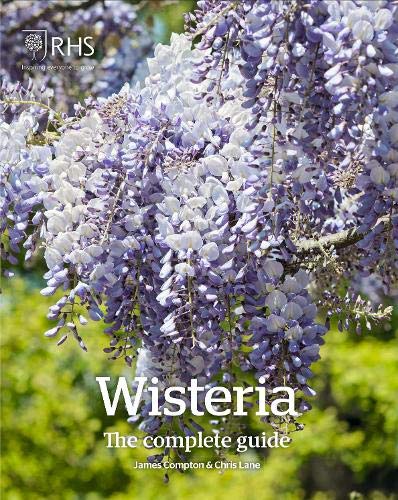
It was some time before I learned this monstrous green blob was a wisteria, left to its own devices with nothing to climb up.  The new book, “Wisteria: The Complete Guide” by James Compton and Chris Lane, has enlightened me that wisteria can indeed be grown in a pleasing, shrubby form, but only with careful pruning that the specimen of my childhood never received.

Of course, wisteria are much better known as climbing vines magnificently draping from buildings, arbors, or even large trees.  This book walks you through the many selections available, with excellent photographs to distinguish the many close shades of blue, lavender, and purple, and will help you manage one of these labor intensive but oh-so-spectacular prima donnas.

This is the third in a series of excellent Royal Horticultural Society monographs on garden worthy genera and like the others titles the natural history and environmental niche of the plants are extensively examined.  “As befits a vigorous and twining climber, Wisteria has a rather tortuous taxonomic history” and includes as principle players the great Swedish naturalist Carl Linnaeus and Thomas Nuttall after whom Cornus nuttallii, the Pacific dogwood, is named.

The cultural history of wisteria, especially in China and Japan, is another highlight while other chapters profile spectacular specimens – they can live for hundreds of years – from around the world.  There is one notable example in Sierra Madre, California.  Planted in 1894, it “took over the house it was originally planted on and now spreads through the gardens of two neighbouring houses.”  It covers about 1.25 acres and “has entered the Guinness Book of World Records as the largest blossoming plant.”  I never realized the peril that threatened my childhood home!


Published in Garden Notes: Northwest Horticultural Society, Fall 2020

Greenwood: A Novel

[Greenwood: A Novel] cover

In the year 2038 Jake Greenwood works as a tour guide at the Cathedral eco-resort on Greenwood Island near Vancouver, British Columbia. It’s one of the last stands of living trees to survive after the Withering killed off most forests around the world, leaving a dusty, grim environment. Jake’s choices in life are limited: mired in suffocating student debt, she’s a dendrologist in a world without trees. So a job at the Cathedral suits her even if it is operated for profit by the soulless HoltCorp. When a former flame suggests she might be a direct descendant of the timber baron Harris Greenwood or even possibly the heir to J.R. Holt, founder of HoltCorp, an incredulous Jake wonders what difference it could make.

Four generations of Greenwoods, all troubled in some way, emotionally, financially, or faced with difficult choices, are united by the theme of trees. In 20th century Canada that means forests, timber, sugar maple tapping, radical tree advocacy, fine woodworking, and dendrology. Author Michael Christie slowly unveils the Greenwood family history one generation at a time, going backward for most of the novel to 1908 and then forward again to 2038.

The plot is complicated with mysteries of birth and circumstance revealed bit by bit as we delve deeper into each character’s relationships with brothers, parents and lovers. The complex story is never confusing, although one wonders what motivated some characters to make relationship-ending decisions. Overall, it was a diverting and thought-provoking summer read.

Published in the Leaflet, September 2020, volume 7, issue 9.

Northwest Coalition for Alternatives to Pesticides

The NCAP published the Journal of Pesticide Reform and works to educate the public about the dangers of pesticides. Go to their Publications section to download information on alternative solutions to pest problems, pesticide fact sheets, and special reports about issues of pesticide reform.

Index Nominum Supragenericorum Plantarum Vascularium

“A joint effort between the International Association for Plant Taxonomy, the University of Maryland and Cornell University. The purpose of the project is to capture all valid and legitimate extant vascular plants names, as defined by the International Code of Botanical Nomenclature, proposed above the rank of genus. These data are dynamic and constantly being updated. At any one time, the listing of a name means only that it is the earliest, valid place of publication found.”

GRIN Taxonomy for Plants

“In GRIN Taxonomy all families and genera of vascular plants and over 40,000 species from throughout the world are represented, especially economic plants and their relatives. Information on scientific and common names, classification, distribution, references, and economic impacts are provided.”