ECB Bailout of Sweden/Latvia

Today the Swedish Central bank was forced to take out an emergency loan from the European Central Bank (ECB). The ECB is not in the habit of issuing such loans to non-members (or members alike). The Guardian reports that the Swedish central bank borrowed €3bn from the ECB as the Latvian emergency causedripple effects.

What on earth could Latvia have to do with foreign currency troubles at the Swedish Central Bank?  Here is a possible answer: the very same day, the very same newspaper (Financial Times) reports that 

a) The ECB intervened to avert a Baltic financial crisis, since Swedish banks dominate the the Baltic financial sector. 

and 

b) Swedish banking shares rose sharply after the Swedish Central Bank announced that the nation's banks would be able to weather "extreme" pressures domestically and abroad.

Nouriel Roubini provides his assessment of the Lativan crisis and solution.  Mary Stokes focusses on contageon.

1) Outline how the Latvian Crisis is undermining the Swedish Economy 

2) Discuss why either the term "extreme" or "abroad" seems to be inconsistent with the message. 

3) Use the Mundell Flemming model to trace Roubini's fear of overshooting. 

4) Why would contageon justify the ECB's intervention to aid Swedish banks that are overexposed in Latvia?



Text in Latvian:
[EU driver] Hop in! We are taking the same route!

[Latvian cyclist] No! Can do it myself! 

Cartoon: Gatis Šļūka 
Self Fulfilling Expecations?

Pegged to the Euro, Latvia is teetering

Questions:

1) Without any knowledge of the Latvian economy, give two reasons why the country may have to devalue.

2) Relate the analyst's quote that "expectations of a devaluation can sometimes be self-fulfilling" to Krugman's model of speculative attacks (Chapter 23)

3) Explain the relationship between "look-alike issues" and "contagion".  

Here are two additional pieces to provide additional background information for those interested in the Baltic Blues.   

Frozen Finance

More applications of Large Open Economy interactions, this time from the WTO.

The collapse of world trade is partly due to insufficient trade credit financing. The global market for trade finance (credit and insurance) represents approximately 80% of 2008 trade flows, valued at $15 trillion. The World Bank estimates that the fall in the supply of trade finance has contributed some 10% to 15% of the decrease in world trade since the second half of 2008.  

This would imply a $2.25 trillion (15% of $15 trillion) decline in trade since June 08.

There are green shoots, however, which can be confirmed using the Baltic Dry Index. The WTO writes

The most recent information indicates that the situation seems to have eased a bit in Asia, particularly in China, although some countries see their access to finance still very restricted (Philippines, Vietnam). In Africa, the situation remains tense, and active banks are seeking support from international financial institutions. In Latin America, credit rates have somewhat eased up since the fall of 2008, but are still higher than usual both in small Latin American states, and increasingly in larger countries such as Mexico and Argentina. 

China’s New Economic Spokesman

From the WSJ Journal-in-Education Program:  
 
SUMMARY: Geithner said he believed Chinese leaders are confident in the U.S. economy, and praised China's own stimulus measures.
CLASSROOM APPLICATION: This article highlights the relationship between the Chinese and U.S. economies. If China looses confidence in the U.S. economy it may curtail purchasing U.S. government debt which would lead to higher interest rates. Another interesting point for discussion is China's currency policy. Why is the U.S. urging China to adopt a more market-determined currency policy? How would movement toward a freely-floating currency impact the U.S. and Chinese economies?
QUESTIONS:
1. Why does it matter that Beijing has confidence in the U.S.?
2. How would the Chinese economy be affected if the Fed fails to keep inflation low and Congress fails to bring budget deficits down over time? Use the Large open Economy Mundell Fleming Model
3. What is China's role in (de)stabilizing the international financial system?
4. What is China's current currency policy? What changes is the U.S. urging China to make to its currency policy? What impact would those changes have on the U.S. and Chinese economies?

Strong Support For An Overvalued Dollar

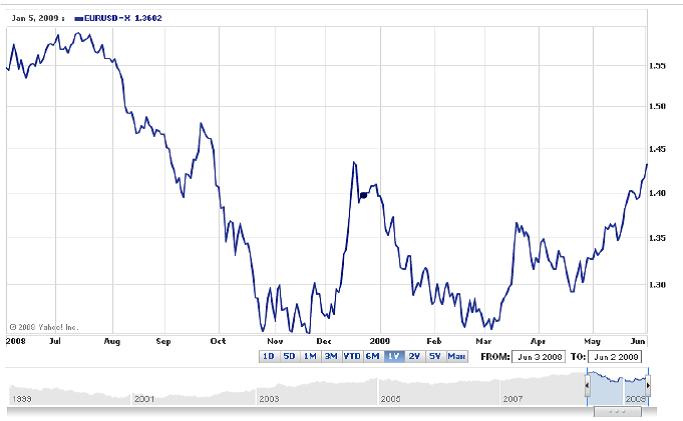
On June 2, 2009, the dollar fell to 1.42 against the euro, which represents a 14% depreciation in the past 3 months, after it had risen to 1.25 on March 5. (BTW, the dollar tested 1.25 about 5 times in the last 8 months — how is that for a strong support level! (See Chapter 16). 


Nevertheless, the Institute for International Economics judged the dollar to be still substantially overvalued. They expect the dollar at 1.53. The institute bases its findings on fundamentals — and we know how irrelevant those are to exchange rates… I cannot find one technical analysis that is willing to predicting more than a week out (althought there seems to be uniformity among analysis that there is an "upward bias the dollar, see the attached file) 


USD.pdf (69.85 kb)

Geithner in Beijing

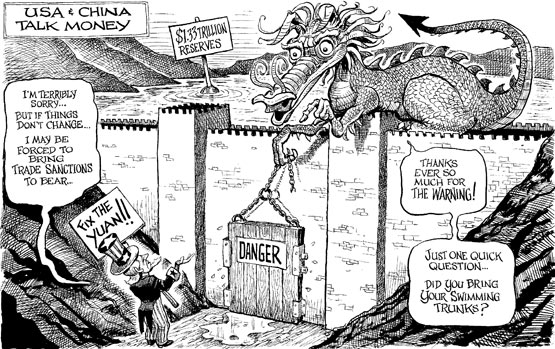
As a general proposition, it is somewhat obtuse to make strident demands on one’s biggest creditor without taking any consideration of the change in the power relationship that debtor status entails. It is astoundingly obtuse to make the demand that the Chinese stop buying dollars, at the same time as we depend on them continuing to buy dollars to finance our deficits. But demanding that they stop buying dollars is precisely what we have been doing for six years, every time we respond to trade concerns by demanding that they stop intervening to prevent the RMB from rising.

From Jeff Frankel's "Telling China to stop buying dollars now would be even more foolish than before".


 [Source: KAL’s cartoon From The Economist print edition – Aug 9th 2007 – Illustration by Kevin Kallaugher 

http://media.economist.com/images/20070811/D3207WW0.jpg] 

China Is Back On The Dollar

China's move towards a revaluation of the yuan were announced with much fanfare in 2005. Just as the People's Daily declared that reform towards a market based exchange rate had been successful, Jeff Frankel identifies that the Chinese exchange rate has returned to a full fledged dollar peg again (starting September 2008, see this link is to the technical paper, and this link is for the updated estimates). Did the Chinese Monetary Authority worry that the appreciation of the yuan might be  too strong as the global crisis spread and the move was to protects Chinese exports? 

Crowding Out?

The US treasury will be financing an epic fiscal deficit of about $1.8 trillion in 2009. The large fiscal deficit has cause a slight panic in some circles that the US may not be able to raise all this money (which would lead to higher interest rates). Perhaps.

Brad Sester provides an insightful discussion based on the national income and national savings identities discussed in Chapter 14 (the derivation of eq. 14.1a). His point is that if you use the relationship between the trade balance (TB) and the national savings gap (SN-1), it becomes apparent that the US as a whole is actually borrowing a lot less than in the past: 

The United States is borrowing less from the rest of the world than it was. That is true even though the US Treasury is borrowing more from everyone, including more from the rest of the world. The amount the US borrows from the world is the gap between the amount that Americans save and the amount that Americans invest at home. That turns out to be equal to the current account deficit. And for the US, it so happens that the current account deficit is about equal to the (goods and services) trade deficit. The trade deficit — at least in the first quarter of 2009 — was way down. In dollar terms, it was about half as big as it was in the first quarter of 2008. That implies that the US is borrowing far less from the world now than at this time last year.

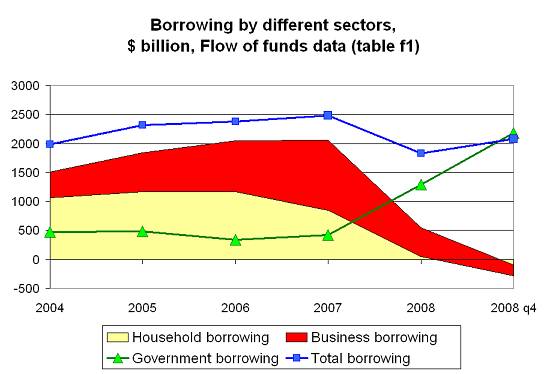
Why hasn’t the expansion of the fiscal deficit pushed the amount the US borrows from the world up? Simple. American households and businesses are borrowing a lot less, so the total amount of money that Americans are borrowing isn’t rising. A picture is generally more effective than words. The following chart shows borrowing by various sectors of the economy — households, firms and the government.** All data comes from the Fed’s flow of funds, table F1

As the chartshows, the rise in government borrowing came even as other sectors of theeconomy were borrowing a lot less. Household borrowing peaked in 2006.Borrowing by firms actually peaked in 2007 — remember all the leveraged buyoutsthen. Borrowing by both households and firms fell precipitously in 2008. As aresult, total borrowing by households, firms and the government fell in 2008.