New World Order Part II

Part I of the New World Order was concerned with the chasm between the policies that rich countries prescribe to others vs. themselves to weather the great recession.

Part II in this saga is a sad example from the European Commission. It has gotten into the IMF's business of handing out short term loans to countries with balance of payment crises, specifically "Non-Euro Currency EU Countries." The Memorandum of Understanding is another testimony prescribe bitter medicine that they themselves are smart enough not to drink: specifically

"The disbursement of each further installment shall be made on the basis of a satisfactory implementation of the economic programme of the Romanian Government. Specific economic policy criteria for each disbursement are specified in Annex 1. The overall objectives of the programme are the following : a. Fiscal consolidation is a cornerstone of the adjustment programme… a gradual reduction of the fiscal deficit is envisaged, from 5.4% of GDP in 2008 to 5.1% of GDP in 2009, 4.1% of GDP in 2010 and below 3% of GDP in 2011 [emphasis added]. The adjustment will be mainly expenditure-driven, by reducing the public sector wage bill, cutting expenditure on goods and services…"

Ok, and now lets look what other major countries have done to weather the crisis. To quote Christina Romer (Head of the US Council of Economic Advisors) "Virtually every major country has enacted fiscal expansions during the current crisis. They have done so … because it works."  Here are the numbers:


So while all major nations benefit from the stimulus, Romania will have to cut expenditures dramatically to get the EU funds.
 
How does a reduction in G generate an improvement in the Balance of Payments for a country with high capital mobility and fixed exchange rates? That can be worked out using the Mundell Fleming model in Chapter 17.  

Case Study: NS-I / The Savings Paradox.

Just Say No To Say's Law

Jean Baptiste Say's notion that "supply creates its own demand" (A Treatise on Political Economy, Book I Chapter XVwas first disputed by J. M. Robertson in "The Fallacy of Saving" (New York, 1892). John Maynard Keynes and Paul Samuelson later fleshed out the argument that underconsumption is detrimental in recessions. Here is how Paul Krugman reworks the argument: 

The paradox of thrift is one of those Keynesian insights that largely dropped out of economic discourse as economists grew increasingly (and wrongly) confident that central bankers could always stabilize the economy. Now it’s back as a concept. But is it actually visible in the data? 

The story behind the paradox of thrift goes like this. Suppose a large group of people decides to save more. You might think that this would necessarily mean a rise in national savings. But if falling consumption causes the economy to fall into a recession, incomes will fall, and so will savings, other things equal. This induced fall in savings can largely or completely offset the initial rise.

Which way it goes depends on what happens to investment, since savings are always equal to investment. If the central bank can cut interest rates, investment and hence savings may rise. But if the central bank can’t cut rates — say, because they’re already zero — investment is likely to fall, not rise, because of lower capacity utilization. And this means that GDP and hence incomes have to fall so much that when people try to save more, the nation actually ends up saving less. If you add in imports and exports, the paradox of thrift becomes less likely, because you country’s reduced consumption comes partly at the expense of imports rather than domestic GDP. So I wasn’t sure what it would look like for the United States.

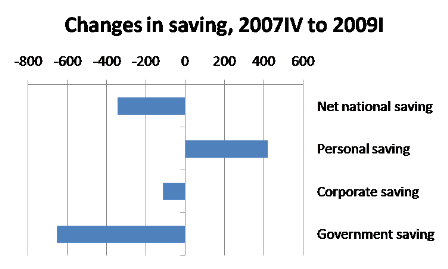
 Sure enough, the sharp increase in personal saving has been accompanied by a decline in overall national saving — partly via reduced corporate savings, largely via increased public deficits… One key implication of the fact that we’re living in a paradox of thrift world is the folly of demands that we reduce budget deficits in the near term. 

Use the basic open economy model in chapter 14 to predict the change in the US trade deficit (and correlate your answer with actual data from the US Bureau of Economic Analysis. Does the model fit the data? Now extend the model the large open economy in chapter 15, assuming that the US recession is actually a global phenomenon. Does the model help explain the data?