Dollar Appreciation: Time to Cover Your Shorts?

The technical analysis site Fxstreet surmises that the reason for the recent dollar appreciation is that

Investors this week have been covering shorts and closing down losing positions ahead of the New Year. A short position is one which you have sold the asset, and look to profit by buying back the asset at a later date, for a lower price than you sold it. Thin markets and low volumes make balancing books difficult for market players and liquidity providers, and as such wide spreads and enhanced swings in prices can often result. 

It remains to be see in the new year if the dollar can maintain its strength, of if January will see a return to carry trading that will lower the value of the dollar. 

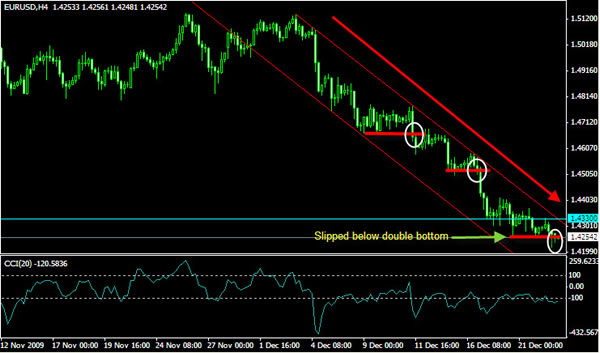
Daily Technical Analysis shows that the depreciation of the Euro has been incredibly orderly, following exactly within the boundaries of a simple channel.  
 

Stimulus 2.0: The Details – Part I

House Approves Next Stimulus by 

Note: This is just the House. The Senate votes early next year.

From Reuters: U.S. House approves $155 billion jobs bill

This includes:

  •  More infrastructure spending

    The bill would provide $48.3 billion for infrastructure projects that promise to get workers back on job sites by April. Highway construction projects would get $27.5 billion, while subway, bus and other transit systems would get $8.4 billion.

  •  Extends COBRA subsidy to 15 months
  •  Extends unemployment benefits for six months (that expire at the end of the year).
  •  Aid to states:

    States would get $23 billion to pay 250,000 teacher salaries and repair school buildings, and $1.2 billion to pay for 5,500 police officers … $23.5 billion to help pay their share of federal healthcare programs for the poor.

    The bill doesn't include:

  •  Proposed hiring tax credit
  •  Cash-for-caulkers.
  • The Banana War is Over!

    Now here is a beautiful story of Trade Creation and Trade Diversion:

    Brent Borrell  has the story how Bananarama started; the UN CONFERENCE ON TRADE AND DEVELOPMENT (UNCTAD) has its own report on the Banana Split, an the  BBC supplies the video documenting the happy end. 


    That's how I came to grow up in Germany without ever eating a really good banana. That (and the artificially higher cost of European bananas) was the cost of trade diversion. When the EU was formed, a common tariff was imposed to favor consumption of bananas from southern European EU members, rather than Africa and Latin American. The justification was (I am not making this up) EU officials have conceded that their banana program violates free-trade rules, but have defended it as the by-product of historical and moral obligations to struggling nations dependent on access to the European market."  

    This line of reasoning is always a slippery slope – one can easily rewrite the above sentence and replace the term "EU" with the name of any other country in the world, if that argument stuck (and the WTO agreedmanymany times).  Sanctions were imposed (on French handbags, British bed linens !??), to no avail. But then again, the WTO is quite busy investigating all the other free trade infractions (I was stunned to find this website that provides an index of all WTO disputes). 

    Crisis 2.0? Next Up: Sovereign Debt

    First Dubai, now Greece. Just as the last US bank repays its TARP money, bail out funds that tax payers provided to avoid the insolvency of the US financial sector, it seems that trust is wavering in the debt obligations of sovereign countries. For good reasons: financial markets do not look kindly on a country that lies about the size of of its fiscal deficit – for x years!   It turns out the Greeks are not alone with their problems, which raise questions regarding the Eurozone's future. A) Currently all other countries that have adopted the Euro are implicit grantors of Greeks debt – will they officially bail out the Greek government?  B) could this be the end of the Eurozone – if one country leaves, several others are vulnerable. C) Is this the start of a full blown sovereign debt crisis?

    Where did all the MBS Go

    Although the Federal Reserve is undertaking extraordinary measures to pump money into the system to get out of the liquidity trap, few are aware what the FED is buying in exchange for the cash it is handing out to increase the liquidity in the system.  The Atlanta Fed analyzes the Fed balance sheet, but Calculated Risk is driving the point home. Is there a downside to the Fed buying Mortgage Backed Securities (MBS) to increase the money supply?

    Global Trade Alert

    Global Trade Alert doesn't actually cover global trade but global trade restrictions. Its an incredibly informative database

    on anything and everything that could impede trade.

    Its most recent report documents that the global recession not only decreased demand for imports but also increased the supply of trade restrictions. "Since the first G20 crisis-related summit in November 2008, the governments of world have together implemented 297 beggar-thy-neighbour policy measures; that is, more than one for every working day of the year. Add another 56 implemented measures that are likely to have harmed some foreign commercial interests, the total reaches 353." 

    and

    "During the past three months the number of state measures announced which–if implemented would likely harm foreign commercial interests–has expanded from 134 to 188. The protectionism in the pipeline keeps growing–there is no respite here. This protectionist overhang could limit the contribution of exports to economic recovery. "


    Greece as California

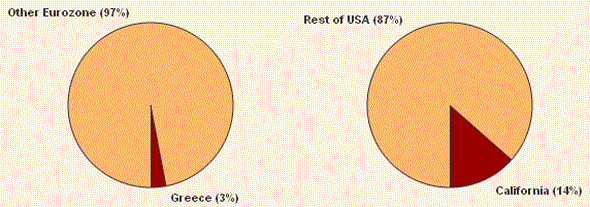
    Greece and California do share some similarities: Sun and Deficits. Why is Greece such a big problem for the eurozone when the arguably far-worse financial plight of California is not raising similar concerns about the US or the dollar?


    The question seems pertinent given the relative insignificance of the Greek economy – it accounts for less than 3 per cent of eurozone GDP (California provides about 13.5 per cent of US GDP). Could it be that the California is treated differently because the US  allows fiscal transfers between states, to help the weakest, while the eurozone might just let Greece fall into an abyss, whatever the consequences? In effect the Financial Times notices that Not only California is in deep trouble. While the Greek fiscal deficit is "only" 13.8%, some US states can easily beat that number… 

    1) How can we explain why financial markets go wild about Greece, but seem uninterested in the probability of a Californian default? Hint 
    2) What kind of adjustment can you predict for Greece, which is on a fixed exchange rate with the rest of its major trading partners in the the eurozone 

    21st Century Tariffs

    Crude trade measures are tariffs, that are clearly observed and easiest to administer.

    Then come quotas, whose implied tariff equivalent is not always easy to calculate in the real world, but quotas are still in-your-face trade restrictions that are easily picked up by the World Trade Organization

    By the 1970s non-tariff barriers became the trade restriction of choice, the most promising of which are anti dumping measures and countervailing duties. Simply accusing foreign steel exporters to swamp the US market with low priced steel could deliver protection. Technically, dumping occurs only if the foreign producer sells below cost and engages in predatory pricing – but what are the foreign firm's costs, how can they be measured? Since these costs are often difficult to determine, governments often started to impose tariffs (see the 2002 US Steel Tariff) to counter supposed dumping – and then wait years for the WTO to sort out whether dumping actually occurred.  

    The new non-tariff barriers that are in vogue, involve "regulations"Staiger and Sykes provide a graduate level analysis, although the intro is informative. The most prominent example of such regulations is – you guessed it – China. The Chinese government recently introduced a new procurement measure which would give priority preference to products deemed to meet “indigenous innovation accreditation criteria", creating serious market access barriers to a large portion of the China market for foreign firms. Here is the US chamber of commerce news release. Here is the US Information Technology Sector's lobbying piece on the topic.

    Students with a background in open economy macro will appreciate Dani Rodrik's point that China's WTO accession has tied China's hands and it is left with only one effective measure to fuel its export led growth: undervaluing its currency

    1) outline the Chinese policy options to fuel economic growth – use the TB/Y diagram, or the MF model

    2) Show how an appreciation would affect the Chinese economy

    The Logistics of China’s FX Operations

    From the Wall Street Journal in Education (edited) 

    EU Voices Frustration With China's Currency Policy 

    by James Areddy, Wall Street Journal, Nov 28, 2009

    SUMMARY: European finance officials relayed to China's premier and central-bank governor frustration over Chinese currency's rigid exchange rate.

    CLASSROOM APPLICATION: This article can be used to discuss the advantages and disadvantages of fixed versus flexible exchange rates and the mechanics of exchange rate manipulation

    QUESTIONS: 
    1. Why are countries pressuring China to "lift" its currency?

    2. How would China "lift" its currency? What are the mechanics behind exchange rate manipulations?

    Use the FX Market diagram for the Chinese Yuan that shows currency demand and supply, and indicate any changes in reserves.

    3. Explain why the declining value of the dollar relative to the euro affects the exchange rate between the yuan and the euro.

    4. How would a rise in the value of the yuan affect the economies of Europe, China and the United States?

    Reviewed By: Edward Gamber, Lafayette College

    Enjoy 


    Nixon’s Long Nose

    Watch Nixon Ends Bretton Woods (youtube)

     Think about the market for foreign exchange. Provide a list of

    a) Problems Nixon identifies, 

    b) Sources of the problem that Nixon identifies.

    c) Policy actions that Nixon explains he is instituting, and evaluate their effect

    Provide an assessment how truthful Nixon’s statement’s are. Provide additional reasons for the crisis, if you have any. 

     If Nixon’s concern was to stabilize the dollar, what does your study of the balance of payments 472 tell you about appropriate policies that he should have underaken?