Gentlemen, Start Your Engines…

Top US hedge fund managers plot killings from eurowoes at "idea dinner" in Manhattan. See also this descriptions how hedge funds bet against euro.

Use the Mundell Fleming Model, augmented to account for risk and debt,  to analyze why George Soros [aka the man who broke the Bank of England] says: "the euro's construction is patently flawed" as he argued that "a fully fledged currency requires both a central bank and a Treasury."


George Soros at the World Economic ForumAnnual Meeting 2010 

Contagion

Here comes the European version of a financial H1N1: (link requires WSJ subscription).

This may only be the start. There are a few more letters in the term “PIIGS” … It is interesting that it hits Spain first; after all, this is the one country among the PIIGS that has the least of the debt problems. This is a nice way of highlighting that country risk, R = R[debt/GDP], is is a function of both debt and income. So as Spain’s income tanked, its risk rose although its debt accumulation may not have accelerated…

[SPAIN_p1]

Source: WSJ

Given the definition of Risk above, use the Mundell Fleming model with fixed exchange rates to identify the effects of a contraction (assume government expenditures declined) in Spain. Note that not only the IS but also the BP=0 line must shift when R =R[debt/GDP].

Greek Crisis, Mundell Fleming Style

Here is a quick primer how to augment the Mundell Fleming model to tell the tale of Greek deficit deception. There is really no intertemporal dimension to the Mundell Fleming Model, which is a problem if one wants to analyse the effects of successive fiscal deficits and the ensuing debt accumulation of a country. However, there is a simple, ad hoc way to extend the model and analyze the Greek crisis.  

Chapter 17 (specifically equation 17.8 of International Economics), introduces risk as an explicit determinant of capital flows. Eaton and Gersovitz (1981, wonkish)  suggested that a country's debt to GDP ratio may influence capital flows. As a country's debt to GDP ratio rises, investors perceive that country default risk increases. That is, investors start to get worried that the country will not be able to actually repay all the money it borrowed. In response the country is forced to pay a risk premium to maintain its financial account and avoid large capital outflows. To model this, lets say that risk, R, can be proxied by R = R[Debt/Y].

The Greek accumulation of debt thus implies an increase in risk, forcing a shift up in the BP line. Under fixed exchange rates in the Mundell Fleming model, this causes an increase in the interest rate (risk premium) and a reduction in output.* To reduce interest rates again, the country must reduce its government debt. This forces a reduction in government expenditures and shifts the IS curve down, decreasing output further – but it also lowers interest rates.

Greece better brace for a nasty recession. Either because the government undertakes the austerity measures to prevent a full out speculative attack, or because in the absence of such austerity measures, financial markets will simply stop lending to Greece and the government is forced to live within its means. That is not going to be easy, after Greeks have just gotten used to the the good life of living above their means.

Of course there is a third option, the other Eurozone countries might find it in their hearts to help Greece. But that would imply that Greece looses much of its economic sovereignty. The European Central Bank already controls Greece's money supply, and if Eurozone countries do decide to undertake a Greek bailout, it will occur only if these countries have strong supervision over the Greek fiscal budget. And, oh, the Greek statistical office has already been split off from the greek treasury's control so it can no longer cook the numbers. Eurostat will now be responsible for Greece's official statistics from now on…


*Eicher and Turnovsky (1999) show that the reduction in output actually aggravates risk even more since it is likely to increase the Debt/GDP ratio further! The increase interest rates (driving up the value of the debt) also do not help…

Inventory of Greek Transgressions

Hans-Werner Sinn outlines the Greek deceptions and their consequences with his patented clairvoyance.

Here are his highlights in slightly edited format:  

  • At 14% of GDP, Greece’s latest current-account deficit was the largest of the euro-zone countries after Cyprus.

  • The Greek debt-to-GDP ratio stood at 113% by the end of 2009. By the end of 2010 it is projected to soar above 125% (the highest in the Eurozone).

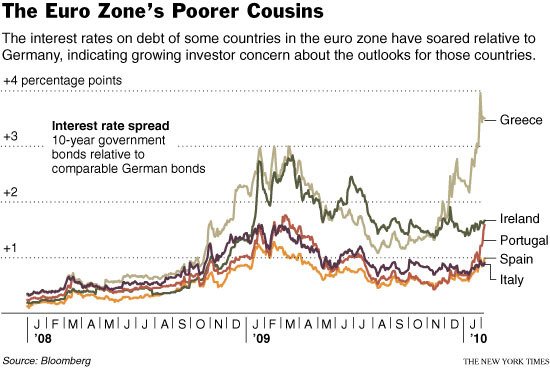
  • To avoid large capital outflows, Greece had to offer investors higher and higher interest rates to stay put.

  • In January, the interest premium was 2.73 percentage points relative to German public debt. This means Greece will have to pay €7.4 billion more in interest per year than it would have to pay if it could finance its deficit at the German interest.

  • The real problem is not the risk premium, but default.  Greece may not be able to find the €53 billion it needs to service its debt that is due in 2010, let alone the estimated additional €30 billion to finance the new debt resulting from its projected 2010 budget deficit. 

  • The Greek disaster became possible when its government deceived its European partners for years with faked statistics. In order to qualify for the euro, the Greek government asserted that its budget deficit stood at 1.8% of GDP in 1999, when it is now believed to have been closer to 12.7% (no one really knows how large the deficits have been…). 

  • So what Greece got exactly is what it sought to avoid with its dodgy data: the rise in interest-rate spreads for Greek state bonds. 

  • How did the deficit explode? Since entering the euro zone in 2001, Greek social-welfare expenditures increased at an annual rate that was 3.6 percentage points higher than that of GDP growth. Pensions in Greece, available after only 15 years of work, reach an incredible 111% of average net incomes. By contrast, in Germany the average pension level is about 61% of average net earnings for people who have worked at least 35 years. 

  • If no support comes from abroad, Greece will have to announce a formal debt moratorium, thereby declaring that it will only service part of its debt, as was done by Mexico and Brazil in 1982 and Germany in 1923 and 1948. 

Good News/Bad News

Cliff Mass, a professor of atmospheric sciences at the University of Washington, has long been worrying about the declining math skills of UW freshmen. He recently drove his point home quite visually with a math assessment of his UW atmospheric sciences 101 class. It turns out his results were largely confirmed by a similar assessment in James Prager's UW earth and space sciences class.

I have had two epiphanies this year.

1) I have come to suspect that Seattle's K12 Every Day Math curriculum is deeply flawed — and I was surprised to find that there are actually ample reviews of the approach out there (Professor Klein's assessment might be the most damning) that could have provided the Seattle school board a heads-up (I guess there are already some regrets…). 

2) The math skills I encounter in my economics classes at the University of Washington seem to have become weaker over the past 16 years. Watching Cliff Mass's video, I started to understand why. So I gave my students Cliff's math assessment test.  

Here is the good news: The results show some positive impact of going to school at the UW. My UW students are mostly upperclassmen (87% are juniors and seniors), while Cliff Mass's class had only 39% upperclassmen. The overall score was significantly higher for my students: 78% vs. 58%. So much for the good news.

Still, a whopping 51% of students could not solve for x from y=x/(1-x); and 55% could not simplify 25*103/(5*10-5) to 5*108. The absence of a good foundation seems to have been addressed by the university's curriculum to some degree; but the 78% average score for my upperclassmen (on what is, after all, a high school level math test) remains cause for concern.

Ok, this was only one test, in one year, which did not involve scientific testing methodology, and it is certainly not appropriate to lay a trend line through one observation. But I am still tempted to think the dismal results do not seem like a failure of the students, but a failure of the system to provide a solid K12 math education.***


***I have also been alerted by one of my colleagues who teaches game theory that, under some circumstances, a student's best strategic response on an ungraded "assessment"  exam may be to pretend to know nothing. This does not explain the declining math scores in the UW assessment test that Cliff describes in his video. Purposely generating low scores in that exam is costly to students because it implies higher tuition costs to cover remedial math courses.

Japan: Greek Tragedy, Second Act?

It is impressive that creditors worry about Greece but Japan's debt to GDP is TWICE as large. In addition, Japan's growth in past 20 years has been anemic, while income in Greece just about doubled…  
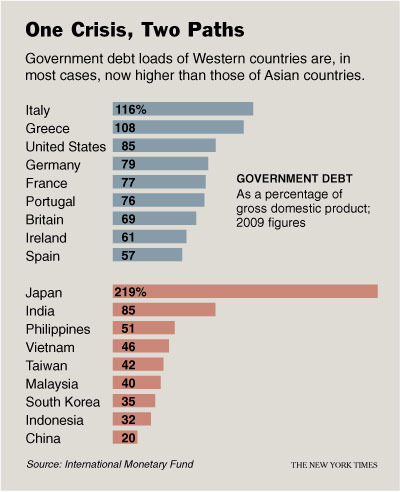

Here is some additional information from Credit Suisse. Their research department crunches the numbers and finds that while private savings might be able to cover the fiscal deficit in the short run, in the long run their simulations suggest: 

a 50% cut in public pensions and healthcare is necessary in the next 45 years, along with a 15% sales tax increase, or a massive public debt monetization (underwriting of government bonds by the Central Bank of Japan)  would be needed.The Bank of Japan would be required to buy almost all of the outstanding public debt (180% of GDP) today to achieve fiscal sustainability. Scary Stuff.

Then Again, You Can’t Put Lipstick on THESE PIGS:


(careful, this is not an apples-to-apples comparison. Below are annual deficits for prominent US states (b
udget gaps as % of total budgets) while the above numbers referred to the total accumulated debt for countries.) 

California: 

22%, or

$22.2 billion

Florida: 19.9%, or $5.1 billion

Arizona: 19.9%, or $2 billion

Nevada: 16%, or $1.2 billion

New York: 9.8%, or $5.5 billion

New Jersey: 7.7%, or $2.5 billion

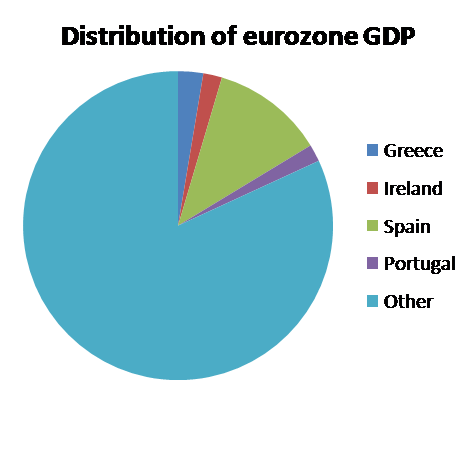
All data for fiscal year 2008, Source BusinessweekBarry Rieholtz points out that 43 (!) states in the US are in some form of financial distress.  All by itself, the insolvent nation-state of California is the 8th largest economy in the world (it is the size of France…) According to the CIA Factbook, Greece is number 34. That is a lot of hyperventilating about a relatively small impact to global GDP. Italy is 11, Spain is 13, Portugal is 50, and Ireland is 56.


Here is the Wall Street Journal's take on the issue (from the The Wall Street Journal Economics: Macro Weekly Review)


by: Yuka Hayashi, Mar 01, 2010

SUMMARY: Bond traders have been relatively sanguine about Tokyo's massive pile of debt, but that attitude could be tested over the next three months.

QUESTIONS:

1. Why is it important to measure debt relative to GDP?

2. What are the potential adverse consequences that Japan will face if its debt continues to increase in size?

3. What fiscal policy measures is Japan considering to reduce the size of its debt? 

4. What difference will it make if Japan decides to increase taxes gradually rather than all at once?

5. What difference does it make that most of Japan's debt is held by domestic rather than foreign investors?

Joe Stiglitz to Speculators: Drop Dead

Joe Stiglitz calls for Europe to "teach the speculators a lesson." He is a principled man, but may his views be blurred by the government that pays for his services? He insists he "Sees No Greek Default as ‘Speculative Attacks Persist". So much for the good news for Greece (that a economics nobel laureate thinks the crisis is overblown).

Now for the bad news: What would have to happen to "teach speculators a lesson?" Here is a hint (from Stiglitz himself – so its not as if the Greek government did not hear that one coming):

 "Economist Joe Stiglitz, who is advising the Greek government, last night denied that the country would require a bail-out, and urged national authorities to intervene in markets to "teach the speculators a lesson". Likening the situation to the Asian financial crisis, in which even healthy economies were targeted as hedge funds and investors withdrew from the region, he told the Sky's Jeff Randall Live show: "The speculators will always look for the weakest link. What they're doing now is a version of the Hong Kong double play in 1997 /1998. "What Hong Kong did in response was to raise interest rates and intervene in the stock market. They burnt the speculators and Europe needs to do the same thing." 

Hong Kong had to raise rates to 500% (!!!!) during the crisis to ward of speculators. Are the Greeks going to do that, too? And what will the ECB have to say about that one?

The Mother Of All Short Sales

The FT leads with the story that speculators have built record large short-positions in the euro, through which they speculate on a fall in the euro-dollar exchange rate. Data from the Chicago Mercantile Exchange as of Feb 2 show 40,000 futures contracts with a total value of $7.6 bn. The paper says this is the largest short position ever built up on any currency.

Marketwatch (aka Calculated Risk) has a story pointing to the spillover of the crisis to the Iberian peninsula. According to CMA DataVision, the spread on five-year Portuguese credit default swaps rose from 227bp late Friday to 244.06bp yesterday. The five-year Spanish CDS spread rose from 166.5 to 172.9bp. And the Greek CDS spread widened further, from 407 to 426.

Anatomy of a Euromess

who can say it better than Paul Krugman… 

Most press coverage of the eurozone troubles has focused on Greece, which is understandable: Greece is up against the wall to a greater extent than anyone else. But the Greek economy is also very small; in economic terms the heart of the crisis is in Spain, which is much bigger. And as I’ve tried to point out in a number of posts, Spain’s troubles are not, despite what you may have read, the result of fiscal irresponsibility. Instead, they reflect “asymmetric shocks” within the eurozone, which were always known to be a problem, but have turned out to be an even worse problem than the euroskeptics feared.

So I thought it might be useful to lay out, in a handful of pictures, how Spain got into its current state. (All of the data come from the IMF World Economic Outlook Database). There’s a kind of classic simplicity about the story — it’s almost like a textbook example. Unfortunately, millions of people are suffering the consequences.

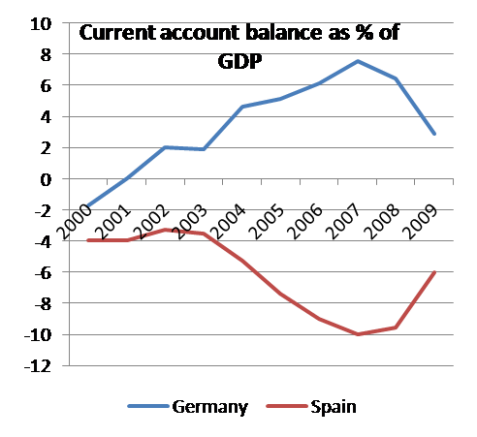
The story begins with the Spanish real estate bubble. In Spain, as in many countries including our own, real estate prices soared after 2000. This brought massive inflows of capital; within Europe, Germany moved into huge current account surplus while Spain and other peripheral countries moved into huge deficit:

DESCRIPTIONIMF

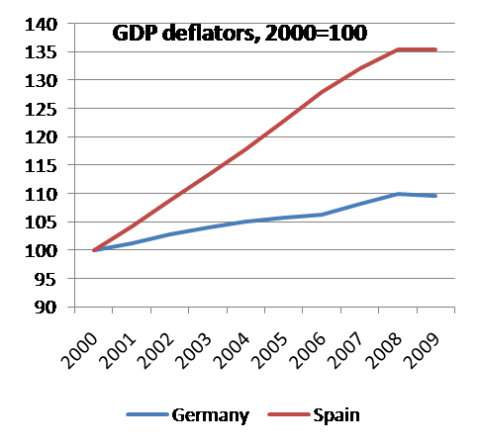
These big capital inflows produced a classic transfer problem: they raised demand for Spanish goods and services, leading to substantially higher inflation in Spain than in Germany and other surplus countries. Here’s a comparison of GDP deflators (remember, both countries are on the euro, so the divergence reflects a rise in Spain’s relative prices):

DESCRIPTIONIMF

But then the bubble burst, leaving Spain with much reduced domestic demand — and highly uncompetitive within the euro area thanks to the rise in its prices and labor costs. If Spain had had its own currency, that currency might have appreciated during the real estate boom, then depreciated when the boom was over. Since it didn’t and doesn’t, however, Spain now seems doomed to suffer years of grinding deflation and high unemployment.

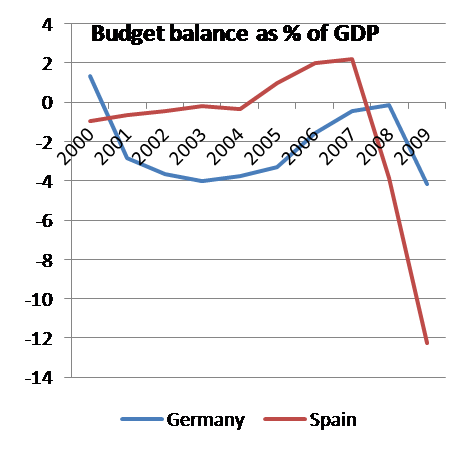
Where are budget deficits in all this? Spain’s budget situation looked very good during the boom years. It is running huge deficits now, but that’s a consequence, not a cause, of the crisis: revenue has plunged, and the government has spent some money trying to alleviate unemployment. Here’s the picture:

DESCRIPTIONIMF

So, whose fault is all this? Nobody’s, in one sense. In another sense, Europe’s policy elite bears the responsibility: it pushed hard for the single currency, brushing off warnings that exactly this sort of thing might happen (although, as I said, even euroskeptics never imagined it would be this bad).

Am I calling, then, for breakup of the euro. No: the costs of undoing the thing would be immense and hugely disruptive. I think Europe is now stuck with this creation, and needs to move as quickly as possible toward the kind of fiscal and labor market integration that would make it more workable.

But oh, what a mess. 

Will the EURO Survive?

Many commentators ask whether the Euro will survive the Ouzo Crisis. I dont think anyone really thinks that Greece can bring down the Euro. Paul Krugman put it well, reminding us that Greece is a sliver of the EU lands market size 

the real issue is contagion. If all the of PIIGS slip into crisis, the EU has to decide if the Union is worth the price (of a bailout of the PIIGS, which would have to be financed by the remaining EU countries). As Ben Franklin said of the colonies that formed the US (via Floyd Norris): “We must hang together, else we shall most assuredly hang separately.”


Ouzo Crisis Timeline

Ever since the "Tequila Crisis" in 1994, when Mexico had to abandon a fixed exchange rate regime to float the peso, financial markets have taken to labeling crises according to the host country's national drink. So we are now witnessing the Ouzo Crisis in Greece.

There are at least 3 teaching points in Greece's crisis and the ensuing contagion.

1) NEVER EVER cook the books. Enron and Worldcom execs learned it the hard way and are no spending time in prison. The elected leaders in Greece were not impressed and apparently lied about the fiscal deficit for years

2) NEVER EVER make promises during a crisis you cannot keep – it makes things only worse. Once the Greek prime minister promised to reduce the deficit drastically, the country was not willing to follow. Immediately public servants, most notably the tax collectors, went on strike. A clear signal that there is little hope that the Greeks will be able to live within their means in the near future.

3) Its deja vu all over again: Ken Rogoff provides some perspective and reminds us (do investors need to be reminded, too?) that "Greece has been in default roughly one out of every two years since it first gained independence in the nineteenth century."

Here is a nice Ouzo Crisis Timeline (requires WSJ subscription). 

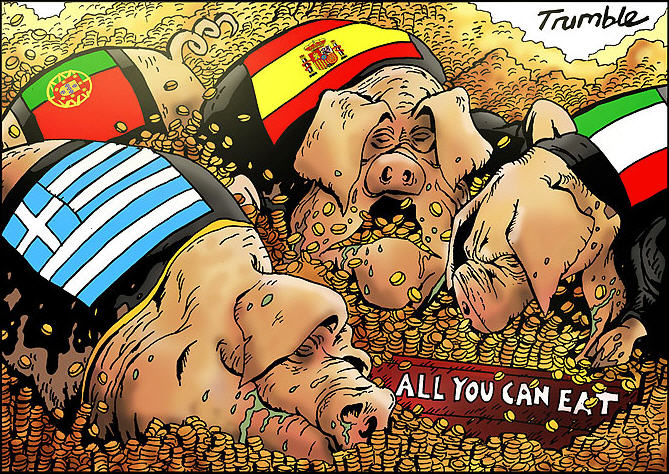
PIGS, PIIGS, PIIIGS, and PIG’D or Politically Correct: GIIIPS

there is some confusion if pigs should have one, two, or three "i"s. The term refers to either 

Portugal

Ireland

Greece,

Spain

or it may also include Italy, Iceland and Dubai (and exclude Spain) – depending on the various authors' assessments how bad the crisis is in the EU, and if it should include Iceland/Dubai as a non EU countries.

In this case, a picture is worth a thousand words. Floyd Norris from the New York Times outlines how the Greek fiscal crisis has led to contagion and a mild currency crisis in EU land.