Greek Deal After All

A deal is better than no deal, but what are the terms? Here is an old surgeon's saying for you: "operation successful, but the patient died." 

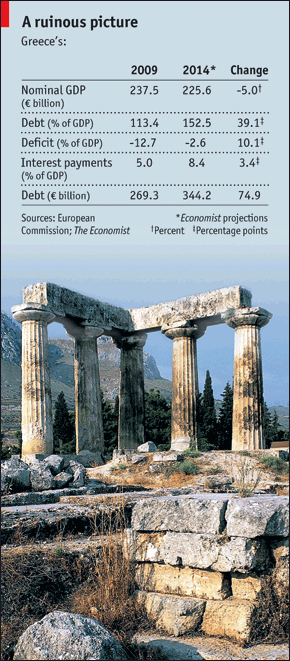
The Eurozone has agreed out package and the Economist Magazine ran the numbers.  The cost of Greek financial survival is negative GDP growth for for the next 5 years, an increase in its Debt/Equity ratio from 113% to 152(!) percent. The Eurozone thinks all that's needed is Euro 25billion, but the Economist Magazine calculates the cost to be at least three times as high. How can estimates differ so sharply? Easy, the assumptions on how markets will react to the deal and how high the Greek interest rates will soar as the Greece's debt to equity ratio explodes.    

The deal is a good exercise to use the Mundell Fleming model with fixed exchange rates to predict interest rates and output in Greece as it reduces its budget deficit from 12% to 2% of GDP. Don't forget about endogenous Risk, R, in the Financial Account! 

Source: Economist 

Triple Whammy

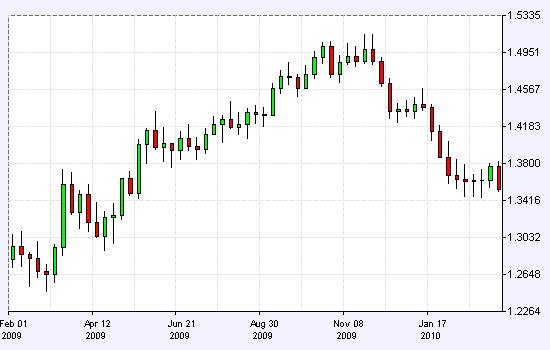
All bad news is packed into one factor: The price of the Euro, which was sent to a 10 month Low

1)  Portugal's credit worthiness has been downgraded, as credit rating agencies worry about the Portuguese government's ability to cut its budget and lower its debt

2) The Eurozone decides not to explicitly support Greece in its debt struggle, which forces Greece into a shotgun wedding with the IMF. Does not look good for Greece, and wont look good for the Eurozone to see one of its members struggle to the international lender of very last resort. 

3) It is now painfully obvious that the Eurozone is deciding to forge ahead without any mechanism for fiscal redistribution, a key ingredient to make a common currency work. Wolfgang Münchau thinks this the beginning of the end of the Euro.


 Euro/Dollar, Weekly Candlesticks

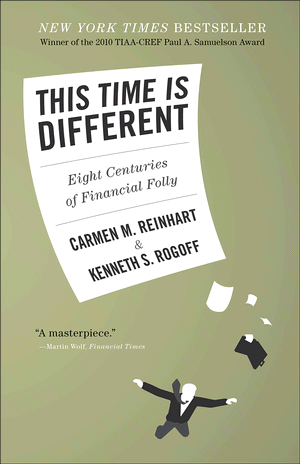
This Time Its Different

I should have posted a link to this book a long time ago. It is first class scholarship, combined with an amazing data collection effort, and peppered with anecdotes to make it both thoroughly enjoyable reading as well as an absolute must for anyone who contemplates writing anything about the crisis of 08- …


Moment of Truth

…For Europe's common currency.

Greece's financial difficulties have exposed numerous weaknesses which threaten Europe's common currency. Now, policy makers and economic experts are trying to find ways to stabilize the euro. SPIEGEL ONLINE takes a look at the proposals. 


Graphic: Euro-zone states in trouble.

 Graphic: Debt coming due in PIIGS states.

Graphic: Difficult times for Europe's common currency.


Greece: A Lost Cause?

There is a lot of discussion if Europe should help Greece, now that Athens has announced a dramatic austerity plan that cuts spending to reduce its deficit and debt accumulation.  

It is shocking to me that none of the discussion actually provides the actual costs of such a bail out, or presents the probabilities associated with the likelihood that the announced Greek reforms will actually be undertaken. 

Marty Feldstein usually does the numbers before he talks. So this is unsettling:

BusinessWeek LogoFeldstein Sees Greek Euro-Exit Pressure as Austerity Plan Fails

Nein…

…says German Chancellor Merkel to at Greek bailout. No bail out of Greece, no bailout of anybody. Greece should go the IMF.


That means the rumors that circulated just a few days ago (and significantly aided the value of the Euro) were false. Oh it will be a record bailout, but it looks like it will be IMF money. 


On the other hand, the IMF option was dismissed by French President Nicolas Sarkozy and European Central Bank President Jean-Claude Trichet, who said it would show the EU can’t solve its own crises. Ahh, the shame of a politician more important to the politicians than the economic plight of millions of Greek citizens who will suffer as the crisis explodes. 


The Eurozone is deeply split over the issue. While an IMF solution would find support with the Netherlands, Finland and Italy, but the majority is still against it. 


The decision (or the lack of resolution) provoked strong reactions and unsettled markets. The euro dropped as much as 1.1 percent to $1.3587,  and the extra yield that investors demand to hold Greek 10year bond rose 18 basis points, CDS rose to 295bp. Bloomberg quotes George Papandreou saying that Greece can’t afford to hold out much longer at current market rates. His government still needs to raise another €20bn to repay bonds maturing on April 20 and May 19. Oh my.


Rebalancing the Yuan

(from the WSJ Macro Weekly Review)

 
by: Kathy Chen and Jason Dean Feb 18, 2010
SUMMARY: The U.S. is expected to press China in the coming months over what officials see as an undervalued
yuan.
CLASSROOM APPLICATION: This article can be used for a discussion of the mechanics of exchange rate intervention
as well as the costs and benefits of maintaining a fixed or managed exchange rate.
QUESTIONS:
1. According to U.S. officials, China's yuan is undervalued. What does it mean for a currency to be undervalued?
2. Describe the mechanism by which the Chinese government maintains an undervalued currency.
3. What are the economic advantages to China of maintaining an undervalued currency? What are the
economic disadvantages?

Sweet Deal

Sugar is cheaper in Canada than the US – but Canada has almost no sugar growers. Which trade theory that focus on factor endowments or technology possibly explain that phenomenon? Easy: add tariffs and quotas, especially when enriched with the political economy of protection (Chapter 7).   The Wall Street Journal details that "the gap between what Americans and the rest of the world pay for sugar has reached its widest level in at least a decade, breathing new life into the battle over import quotas that prop up the price of the sweet stuff in the U.S."
 
The history of sugar quotas since 1816 (to subsidize plantations in the newly acquired Louisiana territory) is detailed in "The Great Sugar Shaft." Curiously, its
another cautionary tale of trade policy hysteresis.  
 
[SUGAR_p1]
Source: WSJ
 
Here are some questions from the WSJ-in-Education program
1. Suppose the world market for sugar is perfectly competitive, and
that the U.S. is insignificant in the world market for sugar. Also suppose that the
U.S. sugar market is perfectly competitive. What is the effect of the introduction
of a U.S. sugar quota on the price of sugar in the U.S. market?
2. What is the effect of a sugar quota on U.S. consumer surplus? Why do
U.S. sugar consumers oppose U.S. sugar quotas?
3. What is the effect of a quota on U.S. producer surplus? Why do U.S.
sugar producers lobby for U.S. sugar quotas?
4. Suppose sugar consumption is a cause of the current U.S. obesity
epidemic, and that obesity is a leading cause of type 2 diabetes. Does sugar U.S.
consumption have a negative externality? If so, is it possible that a U.S. sugar
quota improves economic welfare? Related article: Premier Wen Jiabao had sharp words
for Washington, ceding little ground on China's currency policy and suggesting that
U.S. efforts to boost its exports by weakening the dollar amounted to "a kind of
trade protectionism."
 

Record Bailout

€55 bn for a Greek bailout – but its still secret… 

(via EuroIntelligence)

The Austrian newspaper "Der Kurier" has quite detailed information leaked from the ongoing negotiations for a Greek bailout scenario. According to their sources, Germany and Paris agreed that Greece might need €55bn until the end of the year to prevent insolvency.  The German government would be ready to contribute €20bn, the French €10bn. Other member countries, except those that are themselves in trouble (Spain, Portugal and the UK), will have to contribute according to their shares in the ECB.

How the money will be provided is still open.

Germany prefers to provide half of its share through guarantees and the other half by purchases of Greek bonds through the KfW. Angela Merkel outlined the time frame, with the first intervention around Easter. The plan is strictly confidential (well except for the leaks), no written testimony, and coordinated with the German government and the ECB. (But we should not get too excited about this: Even if there is an agreement on a technical level, at a political level this is not yet a done deal).

How to Spend $878 Billion…

… that depends on what your objectives are… 

Here is the issue: recent jobs and inventory data seems to indicate that the economy is starting to move off the bottom. However, one Oracle, whose business acumen I happen to trust blindly, tells me that the business community is paralyzed — the men and women who create much of the wealth in the US economy lament that an opportunity was squandered to pass tax cuts that could have rivaled the dramatic Kennedy (D) and Reagan (R) cuts.

First: The Facts:

The Kennedy tax cut (actually passed posthumously as The Revenue Act of 1964) was designed to boost the economy long after the April/1960-February/1961 recession. It was an income tax cut designed to reduce the top tax rate from 91 percent to 70 percent and the top corporate rate from 52 percent to 48 percent


The Reagan tax cut, formally known as The Economic Recovery Tax Act of 1981, was enacted in August 1981, at the start of the deep July/1981-November/1982 recession. Its hallmark was a income tax reduction from 70% to 50% for top earners and a reduction from 14% to 11% for low income households. (The 1986 Reagan tax cut subsequently reduced the top tax rate from 50% to 28% while it raised the bottom rate from 11%to 15%. It also increased the (minimum) corporate tax rate).


The 2009 Stimulus, formally known as American Recovery and Reinvestment Act of 2009, was enacted in February 2009, just after financial markets experienced sudden cardiac arrest (or sudden financial arrest, as Ricardo Caballero calls it). The US economy was not only in its worst recession since the Great Depression, but it was also in a liquidity trap, where interest rates are zero and demand is still so anemic that commercial banks deposit funds at Federal Reserve in lieu of lending on projects. The 2009 Stimulus was a one time expenditure package of $878 billion. 37% of the package went to tax cuts ($288 billion), $144 billion (18%) to state/local fiscal relief (mostly Medicaid and education), and $357 billion (45%) to federal social programs and federal spending programs.


Source


Second: The Data


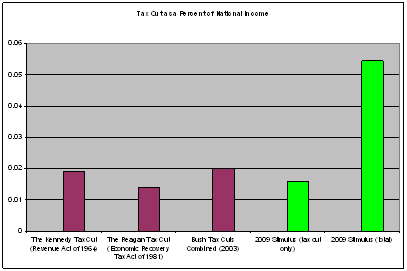
While the Kennedy and Reagan tax cuts were surgically targeted to permanently reduce income taxes, the 2009 Stimulus was designed to deliver a one-time defibrillation to resuscitate the economy. To get an idea of the magnitudes of the various measures, it is helpful to compare apples with apples. Below is a graph that compares the prominent tax cuts and the one-time 2009 stimulus. The graph also adds the recent Bush Tax Cuts (Economic Growth and Tax Reform Reconciliation Act of 2001, Job Creation and Worker Assistance Act of 2002, Jobs and Growth Tax Relief and Reconciliation Act of2003).


Source: Joint Committee on Taxation; TaxFoundation, http://www.recovery.gov/


The magnitude and the focus of these four measures is clearly very different. Also we are comparing the annual effects only – these effects accumulate over time for permanent measures. Reagan and Kennedy tax cuts were smaller per annum, surgically focused on income tax cuts, and permanent. The 2009 Stimulus instead was a one-time hodgepodge of targeted subsidies/pork barrel; The fact that it was not a permanent measure reflects the thoughts of one of the key designers: being timely, targeted, and temporary.


Third: The Theory

Why not provide a corporate tax break or an income tax break as part of the package? Key arguments are related to the type of crisis the US was facing in late 2008, early 2009. The central task of the stimulus was to act quickly and not permanently by stimulating demand. Several members of congress lobbied for permanent tax cuts, but that policy would have missed the mark. While permanent tax cuts may be beneficial for the economy in the long run, they would not serve the purpose of assisting the economy's exit from the liquidity trap. Hence in evaluating policy options, it is important to keep in mind the objective of the 2009 Stimulus.


For a fiscal stimulus to increase growth quickly, the vast majority of economists agree that the policy measure must focus on spending increases and temporary tax rebates for low- and moderate-income families, who are likely to spend the money rather than save it. The alternative of lowering corporate or capital gains tax is often seen as a distant second.

While corporate tax cuts lower the cost of capital and provide incentives to invest, there exists a long literature, starting with noted economist Dale Jorgenson’s work in the 1960s, which consistently documents that the cost of capital plays a much smaller role in determining investment than sales growth. Without prospects for increased sales growth, businesses have no reason to undertake risky investments, no matter how cheap it is. This point is driven home rather decisively by the ineffectiveness of the Fed's latest interest rate cuts in raising investment.

The other argument that economist put forth is that today's corporate tax cuts would largely reward past investments rather than new investments. There may exist good reasons to lower the corporate tax rate (i.e., to remain competitive relative to corporate taxes in other countries, or to eliminate the double taxation because capital pays the tax to the corporation and the profits are again taxed at the corporate level), but it would be an unlikely candidate to jump start the economy out of the liquidity trap. Proponents of lower capital gains tax cuts suggest that it would induce people to invest in riskier assets, such as corporate shares. This lowers the cost of capital and making it easier for companies to obtain financing. The same argument as above, which negated the effectiveness of corporate tax cuts, applies then for capital gains taxation.

There is not much disagreement on the theory among economists. Even Mark Zandi, chief economist of Moody’s Economy.com, and advisor to John McCain’s during the presidential race, rated a corporate tax rate cut as one of the least effective of all tax and spending options to provide the needed jolting stimulus to the economy. He estimates that corporate tax cuts would generate in the short run only 30 cents in economic demand for every dollar spent on the tax cut. So it is certainly true that the tax cuts in the 2009 stimulus do not “pass the supply-side test” as Stephen Entin suggested, but we must keep in mind that the stimulus package was not designed as a supply-side measure. 

This reduces the question to how solid the evidence is that stimulus, not tax cuts are the surest and quickest way to cause the economy to rebound? In terms of aggregate demand and the data that we possess, the effect of spending vis a vis tax cuts can be calculated by the OECD's macroeconomic model. The graphic clarifies why a temporary stimulus should be front loaded with expenditures, but also include tax cuts to maximize the total stimulus effect over time.


Multipliers at horizons of N = {1,2,3,4,5} years after implementation, expressed as the ratio of change in GDP relative to baseline to one percentage point of GDP change in X, where X= {government, consumption spending, wage/salary taxes}. Source:Dalsgard, Andre andRichardson (2001).

Update and Addendum: Conceptually one cannot get away from the fact that comparing a temporary stimulus to permanent policy changes such as tax cuts is is a bit like comparing apples and oranges. So intellectually the interesting question at this stage would be: what permanent changes should President Obama and policy makers undertake today, to foster an economic expansion in the future.

Some economists may think its a bit early to ask that question, since we are still in the liquidity trap (interest rates are still constrained from below at zero and excess reserves are still staggering). This, of course raises the question, whether the past stimulus has not worked (the difibrillation did not work, the patient is still in cardiac arrest), and why.

You guessed it, economists have two options on this: freshwater water economists never saw a liquidity trap and chalked the crisis off to a shift in the population's desire to be voluntarily unemployment (Casey Mulligan's "Great Vacation" hypothesis – this is not a joke). Fresh water economists who think we are still in a liquidity trap do not think the current, second stimulus is nearly large enough (if the first defibrillators 1000 volt shock did not revive the heart, you recharge it and use another 1000 volt jolt, you don't take a 9 volt battery the second time around). 

The 4-Day Week

American observers have always had difficulties following the arguments for a true 4-day work week (not a 4×10 hour work week as in some US firms, but a 4x 8 hour week….).  It is tough to take these arguments seriously given the US work ethic. But hold on! Now some US states are proposing and instituting the 4-day work week FOR SCHOOLS! Here are the links:

Districts Explore Shorter School Week – WSJ.com

How the Four-Day School Week Costs Parents – WSJ

Georgia schools switching to 4-day weeks – USATODAY.com

Four-Day School Week- Good For Budgets But Bad For Kids And Parents

Some U.S. schools move to four-day school week

Hawaii schools to move to four-day week in state cost-cutting measure – The Guardian.co.uk

Source WSJ 

Robert Reich has it right, time to bail out our schools. 


EU, ECB, E-MF

Looks like the "European IMF" is coming soon to a country near you to bail out troubled Eurozone governments. I guess the idea is that this fund would require payments in good times to bail out laggards in times of crises. 

I am still trying to find someone who has in-depth knowledge of the IMF to see why the Washington DC based organization cannot fulfill that role. Also, I cannot help but wonder how the Eurozone plans to capitalize such an institution in order to allow it to have an impact, given the depth of global financial markets. Given that the IMF had to stretch to make a $55 billion reserve loan (its largest ever) to Korea in 1997, it is unclear how an E-MF would generate sufficient funds to counter more than $2 trillion in daily capital market flows – or the leveraged speculative attacks of just a few hedge funds…


Update 3/10/2010: The Chief Economist of the ECB, Juergen Stark, is strongly rejecting the idea of a EMF (see here for those who speak German). Could he seriously thinking that "countries that have committed financial discretions, will not change their behavior," even if an EMF was in place.  I wonder if the IMF agrees that it has been lending money in the last 50 years to countries that never change their ways. But, then Mr Stark adds, "The EMF would be the start of an European Fiscal Rebalancing system, which would be very expensive."  This is in contrast to a voluminous literature which states exactly that a currency union without fiscal transfers mechanisms (as they exist in the US) is exactly at the heart of the problem, and that the costs may be much higher if such a mechanism is absent. 

End Game for Europe

Wage cuts and the battle for exports.

Given fixed exchange rates, or a currency union, currency crises are generated when demand for foreign currency exceeds the demand for the domestic currency. There are really only two ways out, neither are pretty. 1) decrease demand for foreign currency (raising interest rates, and decreasing income and import demand) and increase the demand for domestic currency by becoming more competitive and export more. Rebecca Wilder points out that this generates an interesting problem for the Eurozone:

"Latvia's model: drop wages to increase export income. Greece: drop wages to increase export income. France, Germany, Spain, Portugal, etc., etc. It's impossible that the whole of the Eurozone will drop wages to increase export income. It's especially bad for countries like Latvia or Hungary, where the lion's-share of trade occurs within the boundaries of Europe." 

 [hourly_wage_cuts_chart.png]


The End of a Gospel

Those who have followed the IMF's policy prescription over the years, would have thought that the headline "IMF Suggests Capital Controls" was more likely to have come from The Onion than from Wall Street Journal, or – god forbid – the IMF! 


Click on the listen button to hear the the NPR piece that summarizes it all (here is the transcript). 

There must be a lively debate going on behind closed doors at IMF Headquarters. This after decades of pushing financial openness as a centerpiece of IMF reforms (see also here or here). For a long time the official policy was that "liberalization of restrictions on external and domestic financial transactions would (1) improve financial efficiency by increasing competition in domestic financial systems and (2) to reduce financial risks by allowing domestic residents to hold internationally diversified portfolios." 

Bhagwati's original Foreign Affairs piece is here. The IMF's rejoinder under the pen name for a PR guy (I guess no IMF economist was willing to have his/her name under the statement…) show how difficult it is to adopt new ideas and reject orthodoxy at leviathan institutions.   Here is a longer treatise on the history of capital flows – and their effects. I have a personal interest in this I coauthored a paper (with Steve Turnovsky) in May 1998 that explained and highlighted such capital flow reversals. You guessed it, it was skeptically received and not published until 1999, since it violated the orthodoxy.  

Update 11/11/2011 – from the New York TimesCountries See Hazards in Free Flow of Capital

LONDON — In China and Taiwan, regulators are imposing fresh restrictions on stock market investments by foreigners. In Brazil, officials have twice raised taxes on foreign investors. Even in South Korea, host to this week’s Group of 20 meeting, pressure is building on the government to take similar steps. As the leaders of the 20 major economic powers gather in Seoul, an increasing number of them have either imposed curbs or are in the process of doing so to slow the torrent of hot money into their markets…

But as the sums have compounded and led to more market volatility, fast-growing countries have begun to worry that short-term investment will push up the value of their currencies, make their goods less competitive in the global market, and lead to asset bubbles that will be painful to deflate… “The world has learned about the perils of free market finance — global financial liberalization just does not work as advertised,” said Dani Rodrik, a political economy professor at the John F. Kennedy School of Government at Harvard. “Just as John Maynard Keynes said in 1945 — capital controls are now orthodox.”

Many countries are discussing additional steps because they fear that the Federal Reserve’s latest bid to revive the United States economy by pumping an additional $600 billion into the banking system will further weaken the dollar and send more money into fast-growing markets. The latest restrictions are as various as taxes on bond and equity flows and extended rules on how quickly short-term capital may be repatriated.