Virtues of Flexible Exchange Rates

Why the UK is not Greece 

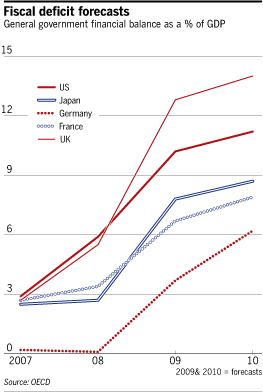
Gordon Brown, the current prime minister in the UK was staunchly against adopting the euro when he served as chancellor of the exchequer. He designed 5 economic tests that the UK would have to pass to even think about adopting the euro. These conditions were, of course, in addition to the Maastricht Criteria, which were the EU's conditions for countries to join the euro. As a result the UK never joined.

This decision seems like a brilliant move now (although its unlikely to help Brown win his upcoming election). The Financial Times  has a great summary of how the ability to depreciate its currency has helped the UK maintain its economic footing. Neil Hume adds his thoughts here, Paul Krugman adds his thoughts here

Of course whenever economists start arguing why a country is NOT going to be hit by contagion, you have to think about why they were contemplating the issue in the first place…

The 13th & 14th Salary

In most countries the year only has 12 months. Not so in Greece. Greek government employees receive a 13th and 14th month salary. Such hand outs are now on the table to reduce the Greek budget deficit. But that's not popular. May 5th will see the closure of all shops and businesses in Greece to protest the austerity measures — even the Journalists will be on strike

If you don't get the 13th and 14th month salary from the government, its seems popular to simply take it. Time Magazine reports

In Greece, doctors, lawyers, accountants and other self-employed professionals are among the worst offenders, says Georgakopoulos, the tax head. To prove the point, the ministry released tax information last November about doctors in the wealthy Athens neighborhood of Kolonaki, where the streets are lined with shops selling brands like Prada and Louis Vuitton. Nearly a third of registered doctors there declared annual incomes of less than $22,000. In all of Greece — a country of 11 million people — only 3,125 people declared incomes more than $280,000. "Everyone who can avoid paying taxes does," says Georgakopoulos. "The only ones who don't are the ones who can't — wage earners and pensioners whose incomes are taxed at source." Widespread evasion feeds the Greek attitude that only the stupid pay taxes. Little wonder that Greece's tax revenue is among the lowest in the European Union, 19.8% of GDP (excluding social security) compared to an E.U. average of 26.1%. (Italy's take is 29.1%, Portugal's 24.5%, Spain's 20.7%). Only a handful of E.U. countries — the Czech Republic, Slovakia and Romania — do worse. And none of them use the euro.

Boulevard of Broken Rules

Here are the key euro convergence criteria (relating to government finance) that must be met for European Union member states to enter the Economic and Monetary Union and adopt the euro as their currency.

Annual government deficit:
The ratio of the annual government deficit to gross domestic product (GDP) must not exceed 3% at the end of the preceding fiscal year. If not, it is at least required to reach a level close to 3%. Only exceptional and temporary excesses would be granted for exceptional cases.
Government Debt:
The ratio of gross government debt to GDP must not exceed 60% at the end of the preceding fiscal year. Even if the target cannot be achieved due to the specific conditions, the ratio must have sufficiently diminished and must be approaching the reference value at a satisfactory pace.
 
No Bail-Out 
And then there is the famous "no bail-out" rule. Article 103, section 1, says that "the community shall not be liable for the debt of governments…"
 
Aside from Greece, just about every other Eurozone country violated the deficit/debt rules


Source 

A New Blueprint For Europe

In a parallel universe, Greece does not default. Willem Buiter (chief economist of Citigroup) provides a compelling scenario:

“the only plausible outcome is where Greece does not default unilaterally but adjusts, most likely with restructuring of its debt, where the euro area offers financial support with tough conditionality”. And a "European Monetary Fund" should provide "fiscal insurance" and "financial recapitalisation" for financial institutions. 

I can see a bailout, but cross border fiscal insurance is going to be a stretch, I think. 

Krugman’s Duck And Cover

He's the "father" of the first model of speculative attacks… Now he is asking whether the Euro is reversible. The unthinkable is getting more thinkable, says Paul Krugman on his blog:

For a long time my view on the euro has been that it may well have been a mistake, but that bygones were bygones — it could not be undone. I was strongly influenced by the view expressed by Barry Eichengreen in a classic 2007 article (although I had heard that argument — maybe from Barry? — long before that piece was published): as Eichengreen argued, any move to leave the euro would require time and preparation, and during the transition period there would be devastating bank runs. So the idea of a euro breakup was a non-starter.

But now I’m reconsidering, for a simple reason: the Eichengreen argument is a reason not to plan on leaving the euro — but what if the bank runs and financial crisis happen anyway? In that case the marginal cost of leaving falls dramatically, and in fact the decision may effectively be taken out of policymakers’ hands.

Actually, Argentina’s departure from the convertibility law had some of that aspect. A deliberate decision to change the law would have triggered a banking crisis; but by 2001 a banking crisis was already in full swing, as were emergency restrictions on bank withdrawals. So the infeasible became feasible.

Think of it this way: the Greek government cannot announce a policy of leaving the euro — and I’m sure it has no intention of doing that. But at this point it’s all too easy to imagine a default on debt, triggering a crisis of confidence, which forces the government to impose a banking holiday — and at that point the logic of hanging on to the common currency come hell or high water becomes a lot less compelling.

And if Greece is in effect forced out of the euro, what happens to other shaky members?

I think I’ll go hide under the table now.

Europe’s Big Fat Greek Default

It seems tough to avoid.

First the facts,

1) The New York Times reports that "Eurostat, the European statistics agency, raised its estimate of the country’s budget deficit for last year to 13.6 percent of gross domestic product, above the Greek government’s recent estimate of 12.9 percent. The ratio of debt to G.D.P. stood at 115.1 percent, compared with the government’s estimate of 113.4 percent."

If the Greeks lost track of their accounts and this was an honest mistake that only Eurostat's forensic accounting uncovered, is is quite an indictment that the Greeks cannot even keep track of their debt. If they actually tried to hide more debts the situation is even worse. Either way, this turn of events does not look good. 

2)  The large debt immediately led to a lower debt rating. The same day "Moody’s Investors Service downgraded its assessment of Greek debt and suggested that more cuts might be on the way." Sure enough, only four days later Greek Bonds were downgraded to junk bond status and warned investors that "bondholders could face losses of up to 50 percent of their holdings" of Greek bonds. Government bonds as junk bonds is a novel concept in Europe. Lets just remind ourselves, a junk bond is a "non-investment grade, speculative grade bond. It has a high risk of default and pays a high interest rate to compensate speculators (not investors) to take on the extra risk. Stage 1 of a sovereign country's default is to have your bonds rated "junk" and be priced out of the normal investment asset market.  

3) Greece desperately needs a cash infusion. But there are two key problems: other countries, or even the IMF, are unwilling to help if they has a sense they'll never see their money again.  On the other hand strikes are shutting down the capital of Greece, as public services, schools and even hospitals were shut down to protest potential budget cuts or tax increases. While the airport is still open, the port near Athens is closed for days now. Not good for trade…

4) that was not the only news, Eurostat also reported that it has to correct its estimate of the Irish government deficit to 14.3 percent, compared with the 11.7 percent figure submitted by Dublin in December… The Spanish deficit for 2009 was projected to be in line with estimates earlier this year, at 11.2 percent of G.D.P., while the forecast for Portugal’s deficit was 9.4 percent. Another New York Times report suggests that "increasingly, investors wonder if Portugal, Spain and even Ireland may not be able to borrow the billions of dollars they need to finance their government spending." "As the European Union and the I.M.F. debate the politics of Greece’s laying off civil servants or persuading its doctors to pay income tax, it is becoming apparent that the international community may need to come up with a much larger sum to backstop not just Greece, but also Portugal and Spain. The number would be huge,” said Piero Ghezzi, an economist at Barclays Capital. “Ninety billion euros for Greece, 40 billion for Portugal and 350 billion for Spain — now we are talking real money. Mr. Rogoff says that the I.M.F. could commit as much as $200 billion to aid Greece, Portugal and Spain, but acknowledges that sum alone would not be enough."

5) Not having enough cash on hand for a bail out would signal the end of the Euro as we know it… 

Update 1: Martin Feldstein is willing to take bets

Update 2: Greek yields are through the roof. Here's the Financial Time quote:

Greece’s two-year borrowing costs are now higher than those of Argentina, at 8.8 per cent, and Venezuela, at 11 per cent, two countries that have been shunned by many international investors because of the mismanagement of their economies.

Investors said that the Greek bond market was now in effect pricing in a government default as two-year bond yields were trading more than 12 percentage points higher than German Bunds, Europe’s benchmark market. 

Industrial Policy Revival

Dani Rodrik has a nice summary of the recent revival of Industrial Policy (aka Infant Industry Protection in Chapter 7) across industrial and developed nations. Much of Paul Krugman's work on "Strategic Trade" for his Nobel Prize emphasizes the role of industrial policy. Economists have never really warmed up to the term and its implications, since everyone agrees that its near impossible to pick winners. Now Rodrik has a new mantra: "the standard rap against industrial policy is that governments cannot pick winners. Of course they can’t, but that is largely irrelevant. What determines success in industrial policy is not the ability to pick winners, but the capacity to let the losers go – a much less demanding requirement." 

Greek Cause and Consequence

The fixed exchange rate does not leave much room for Greece to deal with its debt and budget deficit. 

I summarized the causes of the Greek tragedy in a previous blog, the results are captured by Yahoo's and MSNBC's slideshows.

1) Use the TB/Y diagram to show how Greece got into the crisis.  Refer to specific actions of the Greek government in the past decade

2) Use another TB/Y diagram to show the necessary Greek reforms to get out of the crisis.   


IMF Capital-Control Confusion

Having just reversed its stance on capital controls, the IMF is reversing again. Bob Davis of the WSJ points out that countries facing attendant risks of asset bubbles, use of capital controls “is justified as part of the policy toolkit to manage inflows,” the IMF paper wrote. Even if investors figure out ways around the controls, the restrictions still can be useful, the IMF said because “the cost of circumvention acts as ‘sands in the wheels’” and slows down investment.


Today, the IMF came close to changing its mind again. “Even if capital controls prove useful for individual countries in dealing with capital inflow surges,” the IMF wrote  its semi-annual Global Financial Stability Report, “they may lead to adverse multilateral effects… A widespread reliance on capital controls may delay necessary macroeconomic adjustments in individual countries and, in the current environment, prevent the global rebalancing of demand and thus hinder the recovery of global growth.” It seems the IMF backs controls as short-term measures, but not as long-term solutions, but doesn’t give specific advice how to tell one situation from another. Here’s the IMF’s best shot: “Since the use of capital controls is advisable only to deal with temporary inflows… they can be useful even if their effectiveness diminishes over time,” the GFS report suggests. “However the decision to implement capital controls should consider the distortionary effects” too. Davis summarizes it nicely: IMF to policy makers in developing countries: Good luck making the call.


Clash of the Titans

Here are some alternative titles:

One Equation Economics vs. Two Equation Economics

Or:

Write your op-ed about the area in which you received your Nobel prize…

Read Michael Spence, January 5, 2007,  We are all in it together".

1)     Why did Spence receive the Nobel prize?

2)     Outline why Spence thinks an appreciation of the yuan would not help the US trade deficit.


Read Joseph Stiglitz, April 6, 2010, “No Time for a Trade War.

1)     Why did Stiglitz receive the Nobel prize?

2)     Outline why Stiglitz thinks that the appreciation of the Yuan will not help the US trade deficit.

3)     Relate his key argument (involving savings) to Nicholas Kristof’s Joe Sixpack 

4)     How do the Stiglitz andSpence stories differ?


Read Paul Krugman, April 7, 2010 "More on the Exchange Rate and the Trade Balance" 

5)      Why did Krugman receive the Nobel prize?

6)      Why is the Chinese appreciation actually going to help the trade balance, according to Krugman? Use your own words.

7)      What is the difference between one and two equation economics that Krugman refers to, and how does itrelate to Krugman’s graph?


US Recession Finally Hit Rock Bottom

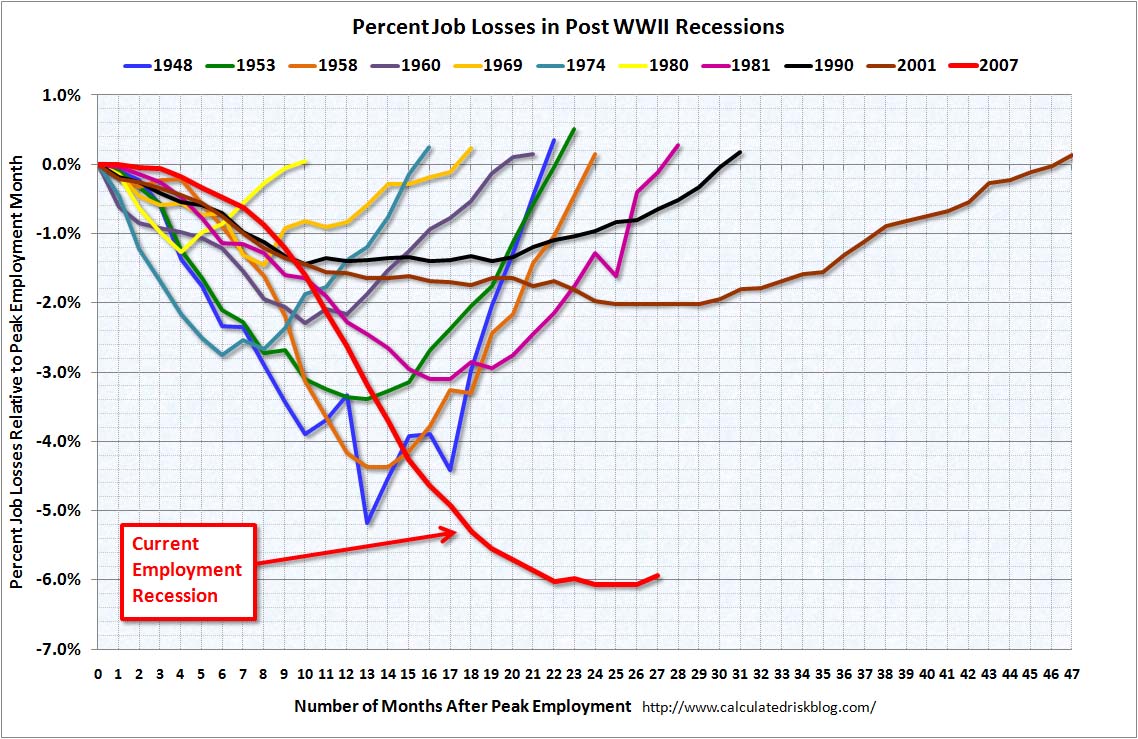
That's good news – because its defined as the end of the recession and the beginning of the recovery. The first graph below indicates what made the Great Recession special: its duration and depth. Lets hope the recovery is faster than the pace the US experienced post 2001. But the odds are its going to be much longer.

Actually, US income has been growing since mid 2009, but as of March 2010, the employment contraction is also over. 


Source