Failure of Burgernomics

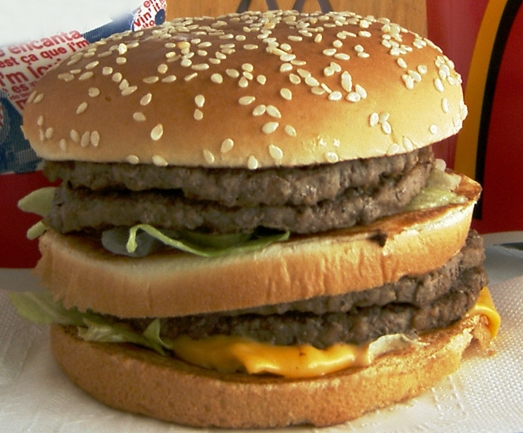
The Economist Magazine has create a whole industry devoted to sizzling the Big Mac Index. Its unhealthy, as the concept has very little to do with the law of one price or purchasing power parity (see chapter 20). Bloomberg's Billy Bookshelf Index is more informative, but it also lacks a crucial arbitrage component, since the item is not freely traded, but only available from one supplier, who might still price discriminate in different markets. A good visualization of the failure of the law of one price is given by a recent Wall Street Journal article that  highlights how the change in the value of the Loonie (the Canadian dollar) is simply not reflected in US/Canadian prices of goods such as DVD players or fridges, causing major headaches for multinational retailers. 

File:MEGA MAC Set-1.jpg

MegaMac. Source 

Euro Collapse, What’s it to the US?

Applications of Expenditure Switching and the Real Effective Exchange Rate changes, via Menzie Chinn

The euro has been depreciating against the dollar over the past few weeks. The implications of this development for the US depend critically on (1) the extent of the depreciation, (2) the duration, and (3) the source of the depreciation. (See Jim's post for other links.)

eurodepn1.gif 
Figure 1: EUR/USD exchange rate, monthly averages (blue line), and value as of 5/14; and trade weighted value of USD against broad basket of currencies (red line), and value as of 5/14. NBER defined recessions shaded gray. Source: Federal Reserve Board via FRED II, NBER.

The euro has depreciated since the 2009M11 average, by about 10.5% in log terms, and about 16.1% versus 2008M07, just before the Lehman bankruptcy. What the graph makes clear is that the first flight-to-safety induced dollar appreciation faded after about a year. This second dollar appreciation might be construed as another flight-to-safety. How lasting will this appreciation be? Much depends upon how and whether the euro area governments resolve the current crisis. It also depends upon the desirability of US dollar denominated assets, including Federal government debt.

Since I am less pessimistic than some others regarding the short to medium term deficit outlook for the US [0], I think that the upward appreciation of the dollar against the euro might be fairly persistent. That being said, Figure 1 also highlights the fact that euro movements do not translate one-for-one into dollar value movements. At the monthly to annual frequency, the elasticity is about 0.4 to 0.45 (calculated as log-changes on log-changes).

It's difficult to evaluate the impact of exchange rate depreciation on GDP, and other variables, without taking a stand on what causes the exchange rate movements. The OECD has recently released documentation on their new macroeconometric model. One of the experiments implemented involves a 10% euro depreciation against a basket of currencies. From Karine Hervé, Nigel Pain, Pete Richardson, Franck Sédillot and Pierre-Olivier Beffy, The OECD's New Global Model, Economics Department Working Papers No. 768 (May 2010) (h/t Torsten Slok):

eurodepn2.gif

The simulations are conducted in the following fashion:

The exchange rate simulations assume sustained 10% nominal effective depreciations, individually for US dollar, yen and euro rates, against all other currencies, assuming that monetary policy follows a standard Taylor rule and that fiscal policy is set by endogenous rule. Following depreciation in the first quarter, the exchange rate is assumed to remain at the new level throughout the simulation period with the sustained shift assumed to be exogenous, coming from unexplained movements in markets expectations, rather than being policy induced or reflecting an identifiable change in economic fundamentals. The possible endogenous influence of simulated changes in interest rates on exchange rates, which might tend to offset the original shock, is therefore not taken into account. For this reason, these shocks are not particularly realistic, but serve rather to illustrate the role and transmission channels of exchange rates in the model.

The key channel is expenditure switching; a depreciation induces more spending on euro area goods, and less on those of the RoW. However, the table indicates the effect of a 10% euro depreciation would only have a modest impact on US GDP — a 0.2 percentage point deviation relative to baseline two years out, if sustained. The historical correlation between the euro/dollar rate and the BIS trade weighted value of the euro is about 0.5 (that is, the elasticity is about 0.5), so the euro depreciation since the April average is only about 5%, and hence the negative impact about half that indicated in the table.

There are other channels incorporated in the model, including valuation effects from exchange rate changes (see this post for discussion).

Part of the reason that the effect on the US is modest is that changes in the euro/dollar exchange rate are not the same as changes in the USD value. This is illustrated in Figure 1. The short run elasticity of (broad) trade weighted exchange rate with respect to the euro/dollar exchange rate is about 0.4-0.45 (at the one month to one year horizon).

The model is fairly conventional in terms of macroeconomics — in the short run output is largely demand determined, while in the long run it is supply determined (in other words, pretty much like in most standard macro textbooks). The key distinction is econometric; the key macro relationships are estimated using error correction models.

One channel that is not included (and would not be included in a open economy RBC [1] or a standardDSGE) is the effect coming from cross-border propagation of equity price declines. For that, one might need to appeal to financial stress indicators, as discussed in this post.

Interesting side point: the government spending multipliers are substantially greater than unity.

eurodepn3.gif

The multiplier, defined as the five year cumulative deviation from baseline for a one percentage point of GDP increase in government spending is 2.0; this multiplier assumes a Taylor rule for monetary policy. Presumably, with interest rates set at zero, the multiplier would be bigger. 

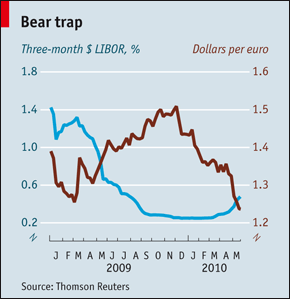
Bear Trap

Is there a problem?

Economist May 20th 2010

Watch it snap… 


IT HASN'T been the best couple of weeks for the global economy. China is officially in a bear equity market. Europe appears to be headed toward financial crisis or years of sluggish growth, or possibly both. America's housing market stalled out right through the first quarter, despite substantial government support (most of which has now been withdrawn). Leading economic indicators in America unexpectedly faltered in April. American stock markets have dropped over 10% in the space of just a few weeks. (On Thursday alone, the Dow fell nearly 4%.) Commodity prices are flashing a growth warning; oil prices have fallen nearly 20% over the last month. And America's labour market stubbornly refuses to right itself. Initial jobless claims rose by 25,000 last week, leaving the picture of filings looking like this:

Meanwhile, we get statements like this from European Central Bank president Jean-Claude Trichet:

The European Central Bank’s present monetary policy stance remains “appropriate” after the ECB’s decision to purchase debt issued by governments in the euro zone, ECB President Jean-Claude Trichet said Thursday.

“Our decisions on May 9 have confirmed it: We are not engaging in any form of quantitative easing,” Trichet said at an event in honor of ECB Vice President Lucas Papademos, who will leave the central bank at the end of May.

This despite the fact that annual core euro zone inflation (excluding energy) was just 0.7% in April, down from 0.8% in March and 1.7% the previous April. And despite the fact that the euro zone is forecast to see growth of just 1% in 2010, and just 1.5% in 2011. And despite the looming catastrophe in southern Europe. One doesn't want to get gloomier than the facts warrant. But the outlook for the economy looks materially worse today than it did just a few weeks ago. Markets seem quite convinced that events in Europe are likely to have a negative effect on global economic activity. It's debatable whether policy positions in Europe and America were appropriate back in April, given persistent signs of weakness. But if they were appropriate then, they're certainly too tight now. Europe has no fiscal room to boost the economy. America has some, but no appetite for new stimulus. The burden of action falls to central bankers. Unfortunately, central bankers seem to be too busy guarding their independence to handle their missions. 

To Bail Or Not To Bail

That is the question. Here are two views from the opposite ends of the spectrum. Avinash Persaud thinks its good policy to bail out banks and bond holders. In the other corner of the ring is John Cochrane, free market gladiator extraordinaire, who tells us of the virtues of inflicting severe pain upon those who speculated. The interesting detail here is that Greece lied about its deficit, so one cannot really talk about fair play, or rational expectations on the part of investors… So punishing those who believed the Greek government seems to be counterproductive to me. 


Another Bottom Line

My trusted colleague Haideh Salehi Esfahani pointed out that instead of dropping wages, Greece could simply increase its productivity. If workers produce more goods per hours worked, prices can also fall, and Greek competitiveness could increase. 
 
It looks like Greece has a long way to go when it comes to productivity levels. 
Productivity Relative To The US


The Bottom Line

Here is the bottom line on the Eurozone crisis. Is it massive government deficits, debt,  political economy of austerity, default risk, or the absence of the promised $ trillion rescue package?

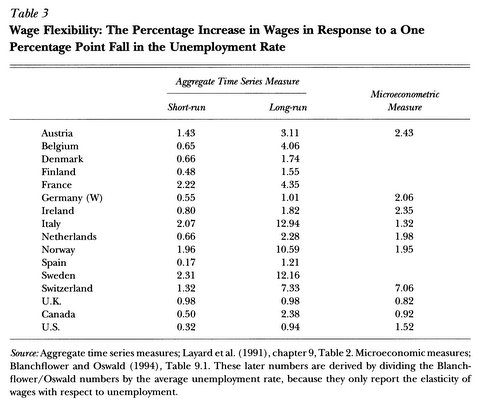
The answer is neither. The scariest prospect of all is that even if none of these issues existed, the crisis countries would have to work their way out of their crisis of competitiveness. Essentially they spent more than they produced, and to align their spending with their income, not only spending has to drop, but income has to rise. This can only happen if goods in crisis countries become more competitive. Here "competitive is simply an euphemism for "lower prices and lower wages." Krugman calls it the Elephant in the Euro and puts concrete numbers to it: wages in crisis countries need to fall 20 to 30 percent relative to Germany.

What does that really mean? Well, no none can really conjure up images of such a wage decline. But we do know that the country with the most draconian austerity adjustments, Latvia, saw its unemployment rise from 6 to 22 percent, causing a decline a meager decline in labor costs of 5.4 percent. One can only hope that European labor markets are more flexible and prices and wages adjust faster than in Latvia – but this is obviously wishful thinking.  


Source:  

China Is Back

China is said to have started again started purchased US treasuries, the first time for the emerging country since September 2009.  The Asian giant is once again the largest holder in US debt, passing Japan who took the title during China’s previous six-month sell off.  Concerns about certain European debt situations in countries like Greece, Spain, and Portugal have caused a net return to purchasing the relative safety and security of good-old-fashion American debt, according to the Wall Street Journal.  In a television interview with Bloomberg TV, the chief Asian strategist for Citigroup said, “The concern [with European debt]… is moving from how much it’s going to cost to the effect on growth.” He continued saying, “In Asia, there are clearly some headwinds.” Concerns of this debt have led the Euro to continue it’s dizzying fall today; The currency is now at a four-year low in comparison to the US dollar.  Despite the amazingly large bailout from the Eurozone (nearly $1 trillion dollars), this decline has gone unimpeded for most of the last month. 

Doomsday Machine Can Now Predict Crises

Every crisis has its heroes: the economists who "correctly" forecast the crash.

Since there are a few economists who forecasts financial armageddon at any given time, the simple test whether the heroes of the last crash were lucky or omniscient is to see if they can repeat. 

Dr. Doom, the hero of the last crash is trying to step into the spotlight again (here).  Not to remind us that he predicted the current crisis, but to announce his book. Crisis Economics, "which covers not only the recent crisis, but also dozens of others throughout history and across both advanced economies and emerging markets – I show that financial crises are, instead, predictable “white swan” events." 

Aside from tall claims of prescience, the articles is a tour de force. It as an excellent working definition to identify a financial crisis:

"An event that forces policy officials to spend a long weekend trying desperately to announce a new bailout package in order to avoid national and global panic before the markets open on Monday. In the past years, such weekend all-nighters dealt with the needed bailouts of private firms – Bear Stearns, Fannie Mae and Freddie Mac, Lehman Brothers, AIG, bank rescues, etc."

and it reminds us of the scale of the "new normal" 

The scale of these bailouts is mushrooming. During the Asian financial crisis of 1997-1998, South Korea – a relatively large emerging-market economy – received what was then considered a very large IMF rescue package – $10 billion. But, after the rescues of Bear Sterns ($40 billion), Fannie Mae and Freddie Mac ($200 billion), AIG (up to $250 billion), the Troubled Asset Relief Program for banks ($700 billion), we now have the mother of all bailouts: the $1 trillion European Union-International Monetary Fund rescue of troubled eurozone members. A billion dollars used to be a lot of money; now one trillion is the “new normal”… Governments that bailed out private firms now are in need of bailouts themselves. But what happens when the political willingness of Germany and other disciplined creditors – many now in emerging markets – to fund such bailouts fizzles? Who will then bail out governments that bailed out private banks and financial institutions? Our global debt mechanics are looking increasingly like a Ponzi scheme.

Absent is, however, a simple, lucid analysis of what we can expect in the future as the Eurozone crisis unfolds. Paul Krugman and Milton Friedman provide that insight succinctly.   

Political Trilemma

Dani Rodrik's fascinating hypothesis:  “the political trilemma of the world economy”: economic globalization, political democracy, and the nation-state are mutually irreconcilable. We can have at most two at one time. Democracy is compatible with national sovereignty only if we restrict globalization. If we push for globalization while retaining the nation-state, we must jettison democracy. And if we want democracy along with globalization, we must shove the nation-state aside and strive for greater international governance. 

The EU Picture That’s Worth A $Trillion

I am amazed how optimistic markets have been as to the success of the EU rescue package. And sure enough the first reports are coming in that "Euphoria ends as investors suspect another shameless EU confidence trick."

This time around the creative accounting is that Less than 10% of the funds actually existed and the rest were plans to establish facilities to raise the rest of the money. Those are a lot of hoops and ifs… Here is the rescue rackage (in euros) in a snapshot (via Econbrowser): 

11assessgfc.jpg 

Graphic from Thomas and Ewing, NYT, May 11, 2010; link here. 


Note: Jean Claude Trichet clarified yesterday how the bond purchasing programme is likely to work. To sterilise the bond purchase, the ECB is considering term deposit, compulsory deposits banks would have to hold at the ECB, which has the effect of withdrawing liquidity from the system. 

Global Arbitrage

The WSJ reports that while bond yields soar across Western Europe, other countries once considered "much riskier" than an industrialized nation in the Eurozone are issuing debt at among their lowest interest rates ever.  Take Russia, for instance. It recently returned to the market for the first time since defaulting on its debt in 1998, to sell 10-year bonds with a yield of 5%. Investors charged Egypt 5.75% on its 10-year bonds. In contrast, Portuguese bonds are yielding 6% and Ireland's are yielding 5.8%.


“All In”: Say Hello To Euro Bonds

European leaders learned their poker lessons. For weeks we have been listening to policy maker agonizing about the size and conditions of a bailout package. This weekend the tide turns. No more hand wringing about the size of the package, as the Eurozone moved from squeezing out 30 billion for Greece in protracted negotiations to providing a whopping $ trillion to countries in need (no details who qualifies and how). The money is to be raised by a "special purpose vehicle to be set up in the coming week." Sounds a bit like a European IMF, and much like the creation of a Eurobond to provides for the missing link in this monetary union: a centralized means to bail out member countries in need. Here are the details (via Calculated Risk):

1) The EU created a €60 billion fund based on article 122 (special circumstances). The IMF will add €30 billion. Press conference archive here (40 minutes)

2) The EU will create a Special Purpose Vehicle (SPV) for 3 years based on inter government agreements. These are potential loan guarantees backed by all Euro Zone countries. This is in addition to €60 billion and will be up to €440 billion – plus a contribution from the IMF up to half of European Union contribution (up to €220 billion). The total of the two is €750 billion.

3) There are apparently agreements from Portugal and Spain to take steps to reduce their deficits.

4) The European Central Bank (ECB) announced "interventions in the euro area public and private debt securities markets (Securities Markets Programme) to ensure depth and liquidity in those market segments which are dysfunctional."

5) The Federal Reserve reopened swap lines to provide dollar liquidity.

Story Links: rom the NY Times: E.U. Details $957 Billion Rescue Package, the WSJ: World Races to Avert Crisis in Europe, Bloomberg: EU Crafts $962 Billion Show of Force to Halt Euro Crisis

Some where awed by the big number, but the real news is that the European Central Bank will start buying government debt and private bonds to avert the crisis. This is the very policy the head of the ECB denied even ever discussing only 2 business days ago. The bank announced that it would sterilise the interventions in order to prevent them from producing broader credit growth, so this is not an expansionary policy. But that sentence is just lip service. By all appearances, the 180 degree policy reversal will most certainly lead to assertions that the ECB's independence has been compromised.  Here is Paul Krugman's customary cocky take "It now seems that [ECB president] Trichet has been dragged kicking and screaming into becoming at least a semi-Bernanke, engaging in much more expansionary policies than before. (Yes, the ECB says that they’re only liquidity operations, and will be sterilized, yada yada — we can only hope that they don’t really mean it.)"  


Euro Endgame

Economists aren't political scientists, but they aren't stupid. They learn quickly from their mistakes. 

The $150 billion program was economically sufficient, but politically untenable.  Now that this is understood, there is talk is of "restructuring" Greek debt, which is nothing other than to say that the Eurozone will allow Greece to default on part of its debt (to reduce the pain of the austerity measures over the next 10 years). The question is, what comes first: the German elections (next week) or the Greek implosion. It's tough for German Chancellor Merkel to "restructure" Greek debt since Germans aren't inclined to pay for Greek transgressions. 

And that is exactly the problem with the Euro, no fiscal mechanism to buffer ideosyncratic shocks, as Joe Stiglitz forcefully explains.

In this instance I have always been with Joe Stiglitz (aka, the Euro was ill designed to work only in good times), and I am with Paul Krugman who highlights that there is really no way around Greece exiting the Euro. What I cannot figure out right now (since I am not a political scientist) is how important it is for EU politicians (especially those in France and Germany) to maintain the Eurozone status quo and how disasterous it will be for Greece to exit the EU in terms of contagion for Portugal and Spain. 

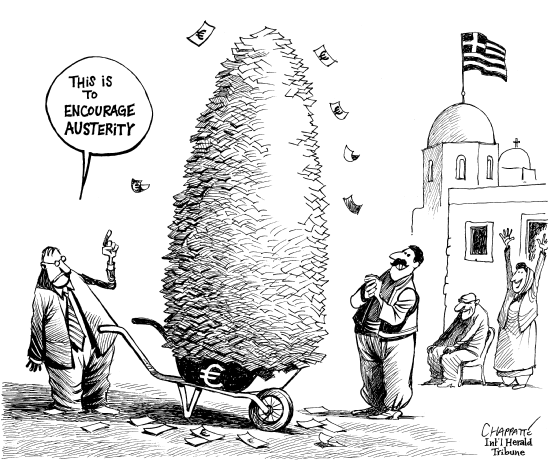
Political Economy of Austerity

Sad news from Greece (via the economist):

Three people died on Wednesday in a blaze triggered by a fire-bomb tossed into an Athens bank during a march by tens of thousands of striking Greek workers, police said.

Earlier, police fired teargas and stun grenades at demonstrators who tried to force their way into parliament on Wednesday ahead of an emergency debate on a harsh three-year austerity package agreed with the European Union and International Monetary Fund.

Angry protesters outside the parliament building raised clenched fists and shouted “thieves, thieves” – a traditional Greek expression for corrupt politicians. 

And Eurointelligence confirms the expected:

Some really bad news from Greece – Opposition decides to vote against the deal

The EU/IMF deal will find a majority in the Greek parliament, but last night’s decision by Antonis Samaras, leader of the opposition New Democracy, to vote against the IMF/EU package destroys any hopes of a lasting consensus for reform. It signals a return to the politics as usual at a rather early stage in the adjustment process, and destroys any hope of a national consensus, which is so critical when it comes to the implementation of long-term adjustment programmes. (Remember the IMF said the whole adjustment would take 10 years!) The decision makes it very likely that Greece will not be able to maintain the commitments it made in its negotiations, except in the very short term. 

Seems like the markets decided the program is not implementable, Greece must default, and the question is only the size of contagion. The Euro is in free fall at 1.28… 

Political Economy of Bailouts

While the economics of the Greek bailout may be sound, political economy realities seem to have been entirely forgotten in the design of the package. Jean-Paul Fitoussi (via the New York times) reminds us of the obvious: Greece is a democracy and the economic policies to not square with political realities. More to the point, Fitoussi said “unfortunately for economists, there is democracy,” Mr. Fitoussi said. “If you impose too strict a program, the population will refuse.”

Our book introduces a parallel example, when England tried to return to the gold standard in the mid 1920s. It is instructive to work out the similarities in the situations that Greece and the UK (then) faced. Maybe the Greek economy survives the austerity measures in the Eurozone, but its government likely won't. 


€110/$146 Billion

Greece agreed on a rescue package, and it is now clear why the IMF needed to be involved. The previous, 25 billion ($40 billion) line of credit just wasn't near enough. What's worse, already the day after, it is becoming clear that the bailout may not be large enough, as it is based on the crucial assumption that starting next (!!!) year Greece will be able to borrow again from international capital markets. That may be too optimistic, say bond-market specialists. 

The Wall Street Journal reports that with the aid come the austerity measures:

The Greek government has promised to slash and then freeze public-sector wages, raise sin taxes, increase value-added taxes, impose a new levy on businesses, cut pension payments and raise retirement ages for some public-sector workers. Greece also promised to meet budget and debt goals:

  • Cut budget deficit by 11% of GDP by 2013, through spending cuts valued at 7% of GDP and revenue increases valued at 4% of GDP.
  • Reduce budget deficit to 'well below' 3% of GDP by 2014.
  • Reduce debt-to-GDP ratio from 2013, with primary budget surpluses of at least 5% of GDP up to 2020.
  • Cut public-sector pay and pensions.
  • Raise average retirement age.
  • Increase value-added taxes and excise duties.
  • Deregulate the labor market and industries.
  • Privatize some state industries.
  • Cut public investment.
  • Crack down on tax evasion.

But even these high drama austerity measures will only save about €30 billion through 2013, meaning the Greek public debt will rise from  115% of GDP to more than  140% by 2014. Part of that is due to the predicted decline in output of – 4% this year

Actually these numbers are no surprise, as I (via The Economist) already laid out these figures 6 weeks ago