Yuan On The Rise?

The picture from the WSJ below looks dramatic. That's when people say lies, damn lies and statistics

What looks like a massive appreciation is really only a 0.4% move against the dollar. 

[yuan0621]

From the WSJ Journal in Education:

SUMMARY: China's central bank allowed the yuan to appreciate to its highest level ever versus the dollar, possibly signaling a new era of exchange rate liberalization in global markets.

CLASSROOM APPLICATION: Student learn how central banks impact a country's currency in a fixed exchange rate regime. They also learn how market forces may affect the value of a country's currency. Finally, they discover how changes in a currency's value affects exports and economic growth.

QUESTIONS:

1. What are two factors that caused the value of the yuan to appreciate to 6.798 yuan per dollar on Monday? Check today's dollar/yuan exchange rate and comment on the size of the appreciation to date

2. What will the effect of the central bank letting the yuan appreciate versus the dollar be on China's exports? On American imports? Why? Use information in the article, and recall the Marshall Lerner condition and the J curve.

3. How does the People's Bank of China (China's central bank) intervene in foreign exchange markets to keep the yuan from fluctuating? 

4. Does the U.S. government want the yuan to appreciate versus the dollar? Why or why not? Do American consumers want the yuan to appreciate versus the dollar? 

Reviewed By: Marc Tomljanovich, Drew University

ECB Sterilization Attempt Flops

Chapter 15 outlines why and when a Central Bank might want to Sterilize the effects of Balance of Payments imbalances.

The case seldom considered is that such sterilization might actually fail, because the public is simply not willing to lend to the central bank at the prevailing interest rates. This just happened in Europe at a grand scale. Perhaps that is not surprising, the markets are clearly predicting an imminent Greek default (aka "restructuring" or "haircut").

CRISIS IS BACK WITH A VENGEANCE AS ECB’S STERILISATION AUCTION FLOPS

After a brief lull, during which the crisis seemed almost forgotten, the financial market reverted to crisis…

One of the reasons for the panic was concern about the state of the European banking system, and the surprising news was that the ECB’s €55bn fixed-term deposit flopped spectacularly, as it managed to managed to raise only €31.866bn at an average interest rate of 0.54%. This means that financial institutions continue to hog liquidity.

The  FT reports on new turbulences in financial markets, as the ECB’s decision not to renew one-year loans to financial institutions spooked investors and prompted concerns about the ability of some eurozone banks to access interbank borrowing markets for funding.  Financial shares dropped 4.5%, European interbank borrowing rates jumped to the highest level for nine months and the euro reached lowest exchange rate level against the yen for the last eight years.

The cost of insuring Greek government debt is now second only to that of Venezuela,Bloomberg reports. Credit swaps signal there’s a more than 67 percent chance Greece won’t meet its commitments within the next five years. Greek government bonds have now overtaken Argentina. Greek debt was 115% of GDP last year, compared to 60% for Argentina when it defaulted. 

Europe widens stress tests

The Wall Street Journal’s Brussels blog reports that some more details on the stress tests for European banks have now been settled. The scope of the tests will be widened from 26 banks to 60-120 banks, including Landesbanken and Cajas. The tests will incorporate banks in all countries. The results will be released on a bank-by-bank basis. The banks will be tested for sovereign default. All tests to be completed by mid-July. Last year’s forecast mistakes will be taken into account.

Fiscal Crises of the States

Output is turning around, employment has high rock bottom, some think the economy is on an inevitable path to recovery.

The anatomy of the fiscal crises in the US (as told by the SF Fed) predicts a different future. Two pictures peak a 1000 words…

As GDP fell, revenue plummeted 

As GDP fell, revenue plummeted

 Spending adjustments failed to match revenue losses

Spending adjustments failed to match revenue losses 

The result?  "Aid to states in the federal economic program is winding down next year and the situation is likely to get worse before it gets better…"

World Bank Data

Data Sets and visualization tools (check out the data visualizer and interactive maps)


Debt Sustainability Model Plus 


WorldDevelopment Indicators

GlobalDevelopment Finance

AfricanDevelopment Indicators

MillenniumDevelopment Indicators

GlobalEconomic Monitor (GEM)

ActionableGovernance Indicators

BulletinBoard on Statistical Capacity (BBSC)

DoingBusiness Database

EducationStatistics

Enterprise Surveys

GenderStatistics

HealthNutrition and Population Statistics

InternationalComparison Program

JointExternal Debt Hub (JEDH)

LogisticsPerformance Index (LPI)

PrivateParticipation in Infrastructure (PPI) database 

QuarterlyExternal Debt Statistics (QEDS/SDDS)

QuarterlyExternal Debt Statistics (QEDS/GDDS)

WorldwideGovernance Indicators (WGI)

Climate Data 

Environment Data

Rural and Urban Development Datasets

Country Environmental Factsheets

Little Green Data Book

World Development Indicators

Indicator 

Yuan On The Move – Or Not

Yesterday China announced it would move to a more flexible exchange rate regime. The move was hailed by those who didn't notice that the statement lacked any details. Sure enough, Monday morning the yuan was unchanged in value. Below are estimates of how much the yuan is undervalued, and Mark Thoma provides a roundup of the responses:

 Is China's announcement that it intends to increase the RMB exchange rate flexibility "more smoke than fire"?:

China Moves. Or Not., by Tim Duy: Futures markets are abuzz with excitement over the Chinese currency proclamation issued this weekend. The announcement was quickly hailed by observers worldwide as a major policy shift, yet I am inclined to side with the analysis provided by Yves Smith – the statement leaves plenty of wiggle room, and never really promises to do much of anything. At the moment, the Chinese announcement feels like more smoke than fire.

The Wall Street Journal's initial reporting was just want the Bejing and Washington wanted you to believe:

China's decision to abandon its currency peg is a victory of pragmatism over divisive politics, the result of careful diplomacy by leaders in Beijing and in Washington, each side vulnerable to powerful domestic lobbies.

In the end, both sides agreed that a more flexible exchange rate was good for China, good for the U.S. and good for the global economy. Yet timing was everything.

The implication is that hard-working policymakers on both sides of the Pacific have risked all to foster the greater good. But what exactly has changed? From the Chinese statement:

It is desirable to proceed further with reform of the RMB exchange rate regime and increase the RMB exchange rate flexibility.

In further proceeding with reform of the RMB exchange rate regime, continued emphasis would be placed to reflecting market supply and demand with reference to a basket of currencies. The exchange rate floating bands will remain the same as previously announced in the inter-bank foreign exchange market

What exactly will be the basket of currencies? On what timetable? Is this really a change? And why not widen the floating bands? I see no commitments here, vague or otherwise. Of course, there are not meant to be. From the Wall Street Journal:

Yet, by returning the yuan to a managed float against a basket of currencies, Beijing won't have to cede too much in the near term when it comes to the bilateral dollar/yuan rate. The euro's weakness-the yuan is up 14% against the euro this year-should mitigate the speed of any yuan appreciation against the dollar.

Looks like China is picking a policy direction that requires little deviation from current policy. Nor do they even admit there is a need for significant change. The Chinese announcement appears to preclude the possibility of meaningful adjustments.

China´s external trade is steadily becoming more balanced. The ratio of current account surplus to GDP, after a notable reduction in 2009, has been declining since the beginning of 2010. With the BOP account moving closer to equilibrium, the basis for large-scale appreciation of the RMB exchange rate does not exist.

Is "large-scale" 5%? 10%? 20%? The tone of subsequent reporting changed as journalists not sourced directly by Washington and Bejing began to realize the thinness of the Chinese announcement. From the Wall Street Journal:

China's announcement that it will let its currency appreciate puts it in a strong position going into a summit of the Group of 20 on Saturday, but does little to ease pressure from the U.S. Congress.

…But China's announcement was short on details about how much it would let the yuan appreciate. In Brazil, the central bank governor, Henrique Meirelles, said he welcomed the Chinese announcement, but wanted to see results. "It is necessary to await further developments," he said in a statement.

Is the Chinese announcement anything more than an effort to buy time ahead of next weekend's G-20 meeting? The yuan was likely to be a primary topic, but the announcement now provides cover for Chinese officials, pushing the attention on fiscal policy in Germany and Japan. A clever diplomatic trick, but will China follow through with anything more than a token rate change? They need to, as Congress will not be held at bay much longer:

In the U.S., New York Democratic Sen. Charles Schumer, who has spent a decade ramping up pressure on China over currency issues, remains skeptical that Beijing's announcement will make an appreciable difference. On Sunday, reacting to Chinese suggestions that change would be gradual, Mr. Schumer said he would move forward on legislation to penalize China for undervaluing its currency.

"Just a day after there was much hoopla about the Chinese finally changing their policy, they are already backing off," he said in a statement.

Schumer's skepticism is justified. Where is the yuan going, and how quickly will it get there? Estimates are all over the map. From Bloomberg:

The yuan’s appreciation may be limited to 1.9 percent against the dollar this year, a survey of economists showed. The currency will climb to 6.7 per dollar by Dec. 31, according to the median estimate of 14 analysts.

Later in the same article:

“We can’t exclude the possibility of yuan depreciation,” said Shen Jianguang, Mizuho Securities Asia Ltd.’s chief economist for Greater China, who said a 2.5 percent drop is possible this year if the dollar-euro rate is unchanged.

From the Wall Street Journal:

U.S. government officials expect a slow, steady increase, similar to the way China boosted the value of the yuan between 2005 and 2008.

Another opinion from the same article:

Eswar Prasad, a Cornell University economist who was formerly the IMF's top China expert, said the size of the increase during the coming month will give a hint at the "trajectory" Beijing is anticipating.

He says that in periods of economic calm, China "is comfortable with" an increase in the value of the yuan of about 10% to 15% a year.

Congress will be closely watching for any signs of foot dragging on the part of China. I am not confident they will tolerate anything less than a 15% move this year. Note too that China is not the only one buying time with this announcement. US Treasury Secretary Timothy Geithner can now release the delayed report on currency practices, which will surely not label China a manipulator. That hot potato can go back into the oven for another six months. Geithner is clearly betting the Chinese will have shown enough results between now and then to placate Congress. If not, Congress will start sharpening the knives; the tolerance for Chinese resistance will be almost negligible of this announcement is revealed to be nothing more than smoke and mirrors.

Bottom Line: On the surface, the Chinese announcement looks like just what the doctor ordered – a step toward a meaningful effort at rebalancing global activity. But the details are thin, very, very thin. Thin enough that one can reasonably look straight through the statement and conclude it is little more than an effort to keep China off the hot seat at the next G20 meeting. Time will tell if China actually intends a substantial change in currency policy. I hope this is in fact their intention, as the probability of a disastrous trade war will skyrocket if Congress believes they have been the victim of a classic bait and switch.

Update: Reality sets in quickly. From the Wall Street Journal:

China kept the yuan's exchange rate unchanged against the dollar Monday, surprising markets after announcing over the weekend it was unhitching its de facto peg.

Underscoring its vow to move gradually in liberalizing its rigid foreign-exchange regime, the central bank set the yuan's central parity rate, an official reference level for daily trading, at 6.8275 yuan to the dollar, exactly the same as Friday's central parity rate. The fixing put the yuan slightly weaker than Friday's close in over-the-counter trading of 6.8262 yuan to the dollar.


The Great Contraction

International Feedback Mechanisms are detailed in Chapter 15. Except here, the locomotive effect is going the wrong direction… 

Extra EU 27 Trade Falls by 20 % In 2009 – and that is before the upcoming EU austerity measures

Source: WSJ


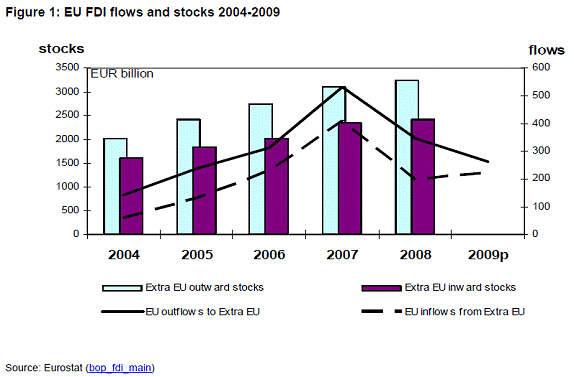
To round out the balance of payment information, here is the news on EU financial flows:

EU Foreign Direct Investment (FDI) flows have been severely affected by the global economic and financial crisis. They …dropped sharply in 2008, for both inward and outward FDI flows (34 % for outflows, 52 % for inflows). 


Monetizing Debt

That has been the fancy catch phrase which describes central banks printing money and using it to purchase government bonds. Just about every text book states that Monetizing Debt will lead to inflationary disaster. 

As the global financial crisis caught the US in a liquidity trap, Ben Bernanke decided to fight it by monetizing debt in astonishingly creative fashion. He instructed the US Central Bank not only to monetize the government's debt (to the tune of $1.2 trillion, but also to purchase another $1.25 trillion of toxic mortgage backed securities that where sloshing in the bond market without any buyers in sight. 

Those unfamiliar with liquidity traps saw the writing on the wall: After deciding to Monetize Debt at a gigantic scale, the US was in for hyperinflation: an "Inflation Bomb". It turns out that these predictions were not true. Prices are still falling in the US.

Now the same discussion is taking place, since the European Central Bank was forced to buy up toxic Greek Government Debt. The WSJ captures the discussion (from the Journal In Education):


QUESTIONS:

1. What is the main reason that the European Central Bank (ECB) is choosing to purchase Greek bonds in the secondary bond markets?

2. Why are critics opposing the ECB's purchase of Greek bonds in secondary bond markets?

3. By buying Greek bonds, how is the ECB influencing the yields on Greek bonds? How in turn does this affect other countries' bond yields (e.g. Spain's)?

4. Explain how the ECB's decision to keep purchasing bonds of distressed European countries can or cannot lead to a) inflation, and b) perpetual fiscal deficits in the long run. 

5. What is the effect of these purchases on the Euro? 

Adam Posen, an external member of the Monetary Policy Committee of the Bank of England,  has a blunt and impatient piece that counters those worrying about "inflation bombs." He does not mince words… Actually, mincing words would be an understatement. This speech must rank high up among the shrillest speeches anyone associated with a central bank has ever given:

When the instrument nominal interest rate is already at de facto zero bound, and the financial transmission mechanism is damaged, buying bonds is the only means central banks have of trying to deliver price stability against deflationary pressures – some form of quantitative or credit easing is the right thing to do. Getting unduly caught up in protecting the appearance of central bank independence is doubly mistaken: first, it will not do any good because it is not that appearance which delivers desirable results; second, it will prevent pursuing the right policy option.

As I indicated at the start, much of the hue and cry about central bank independence in response to the various sorts of bond purchases is awfully shallow. It is adolescent or worse to be so preoccupied with how someone looks, and her supposed reputation among the self-appointed conformists, than with the substance of her actions and values. This holds true whether that someone is a high school student or a monetary policy committee. That has not stopped such preoccupations and nasty name calling from spreading of late regarding central banks. In imagery typical of the preening machismo of financial markets participants and those who report on them, a number of people of late have spoken about the ECB losing its ‘political virginity’ or purity last month.

One is tempted to ignore or dismiss such idle chatter, but let us take it at its vulgar face value to show just how empty these characterizations are. Cultures which make a public fixation of virginal purity, of a stylized maiden’s reputation, tend to be backward superstitious cultures that impede people exercising autonomy and making responsible choices. For society, and arguably for the young persons themselves, what matters is not a young person’s ‘virtue,’ let alone any  reputation for such. What matters for society and for the young person is whether they are promiscuous, engaging in unsafe behavior, or getting pregnant casually, that is whether they behave responsibly.  


Reckoning: The Spanish End Game

It is just uncanny how financial crises always evolve much like soap operas. At each stage you think "who's lying" and "you cannot make this one up." Here is today's news…


Spain angrily denies rumors of a bailout

The Spanish government was yesterday trying to deny German media reports according to which the EU was getting ready to finalize another bailout plan. [Prime Minister] Zapatero was yesterday busying trying to establish the facts behind the story in Berlin and Brussels, but nobody seems to have claimed responsibility. El Pais quoted the spokesman for economic affairs, Amadeu Altafaj, not only as denying that the Commission was negotiating a bailout, but also blaming Germany for inciting the rumors.


and the… in the same edition of the same Spain's national news paper, on the same day, we find:


Spain cut off from international financial markets

The crisis has now reached a new dramatic momentum, as Spain is now effectively cut off from international capital markets. El Pais has some interesting statistics showing the reliance of the Spanish banking system on the ECB. While Spain’s share in the ECB is 9%, Spanish banks now accounts for 16.5% of direct ECB borrowing. The amounts borrowed represent a 26.5% increase over May. The paper quotes the chairman of BBVA Bank as saying that for the majority of companies and financial firms, the international capital market was closed. He said that the country urgently needed to tackle three issues simultaneously: sustainability of public finances, growth, and financial sector reform.

Who is Bailing Whom?

Some German economists think that bailing out foreign countries is not good policy. I wish they'd check the Bank of International Settlements' report on foreign exposures to the contagion countries. Below is the graph. Germany and France have two options: bail out another sovereign country, or bail out their own banks. It is either or -all else is empty rhetoric.


BIS: Exposures to PIGS by Nationality of Banks 

Source BIS and Calculated Risk 

If It Leaks, Get Ready To Bail

The previous post  suggested a leak in the EU containment system. That is, the announcement of a $ trillion bailout fund did not stop interest rates from rising in possible contagion countries. 

Today German papers report that Spain's bail out is imminent.  Here is the scoop via Euro Intelligence 

Frankfurter Allgemeine reports this morning that EU officials will start talks about a bail out for Spain, citing unnamed sourced in Berlin. The paper said the situation had deteriorated so much that they did not want wait until the EU summit on Thursday. It also said neither the European Commission nor the ECB excluded an aid package. The paper quoted Spanish officials as denying that they are about to ask for EU aid, and immediatedly pointed out that Greek officials made the same claims before. The trigger is the freeze in the inter-banking market last week as the markets have lost confidence in the Spanish banking sector.


In a separate news report, Frankfurter Allgemeine writes that Barroso and Trichet were worried about the state of Spanish banks, and pleaded for aid. The paper also cites the latest statistics from the BIS, according to which German banks had given credits to Spain of $202bn, more than half of which to Spanish banks. The exposure of French banks is $248bn – mostly to companies and households. The Spanish central bank estimates the extent of the bad loans to be €166bn, of which only a quarter has been written off so far.  The Spanish bank bailout fund is €99bn. One of the problems now is that Spain has immediate finance needs at a time when market interest rates are rising sharply.


The paper also reports that France is getting nervous about the effect of the crisis on its own liquidity. In a short comment, the paper makes the point that the €750bn rescue umbrella is just another bank bailout package.


There is no whiff of any of this in the Spanish press this morning. El Pais reports on the latest BIS statistics, citing that the total exposure of European banks to Spain is €600bn (enough to bring the house down). Spain has been the beneficiary of intra-EU credit flows to a much larger extent than Greece, Portugal, and Ireland. Last week, the inter-banking market froze again in parts. The articles quotes that BIS as saying that while the single currency brought a greater diversification of risk, it warned of a contagion if any of the countries were facing solvency problems.


Containment Leak

This post is not about the Gulf of Mexico. Calculated Risk alerts us the the Euro crisis is far from over. Something seems to be brewing in the financial markets… Quote of the day via Bloomberg (ht Bob_in_MA):

We do believe the recovery is strong,” Dominique Strauss-Kahn said in an interview with Bloomberg HT television in Istanbul. While rising debt levels are a risk to growth, mainly in Europe, authorities in the region “are now really committed to solve it” and “the problem has been contained,” he said.

And this reminds us of Fed Chairman Bernanke's testimony on March 28, 2007:

"[T]he impact on the broader economy and financial markets of the problems in the subprime market seems likely to be contained."


Uh oh, not another problem "contained"! This just in from the Atlanta Fed:

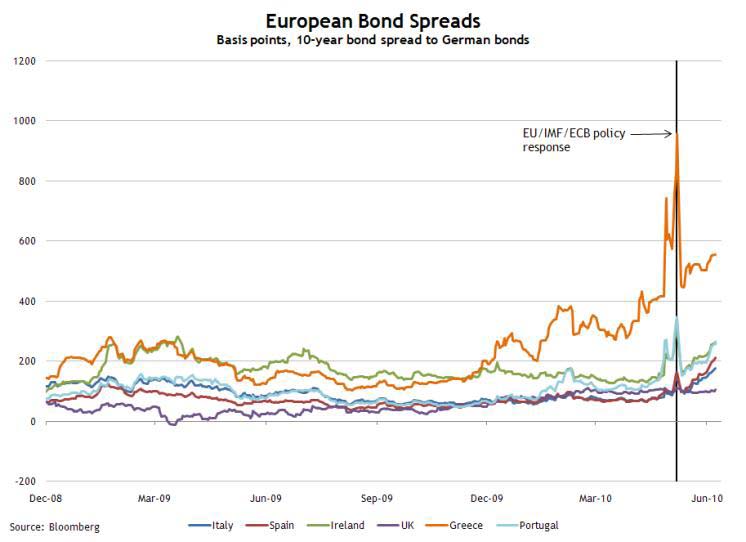
Following a decline after the initial reports of the EU/IMF €750 billion package and ECB bond purchases, peripheral euro area bond spreads (over German bonds) have widened. In particular, the bond spreads for Italy and Spain have widened the most relative to their levels before the rescue package was unveiled.

After initially declining four weeks ago, sovereign debt spreads have begun widening for peripheral euro area countries. As of June 9, the 10-year bond spread stands at 554 basis points (bps) for Greece, 258 bps for Ireland, 265 bps for Portugal, and 211 bps for Spain. 

The spread to Italian bonds has increased 76 bps since May 11, from 1% to 1.75%, while Portuguese bond spreads are 112 bps higher during the same period. U.K. bond spreads are essentially unchanged.

 Euro Bond Spreads June 9, 2010


Real Effective Exchange Rate Data

The Bank for International Settlements maintains a rich time series on real effective exchange rates. Interestingly, Econbrowser uses the data to show that the appreciation of the dollar against the euro is much less pronounced when we look at the broadest exchange rate measure. The answer is of course China holding its exchange rate with the US fixed.

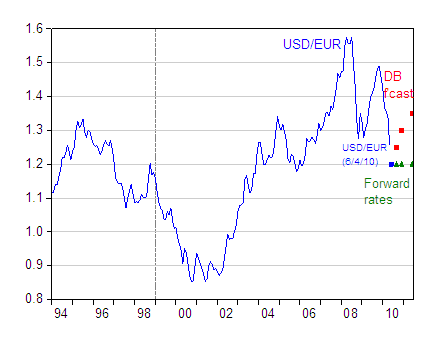
The euro and the dollar. First, here is a graph of the dollar/euro exchange rate expressed in units of USD per EUR.er1.gif

Figure 1: USD/EUR exchange rate, monthly averages (blue line); synthetic euro before 1999M01. USD/EUR exchange rate on 6/4/2010 (blue square), Deutsche Bank forecasts as of 6/4/2010 (red squares) and forward rates (green triangles). Source: Fed via FREDII, Deutsche Bank, Exchange Rate Perspectives, June 8, 2010 [not online].

The euro has declined precipitously since late last year. As of June 4, the USD/EUR rate was 1.2. Forward rates (which have little predictive power, and usually point in the wrong direction [2] ) imply no change. The Deutsche Bank forecast is for strengthening against the dollar, rising to 1.35 USD/EUR in a year’s time.

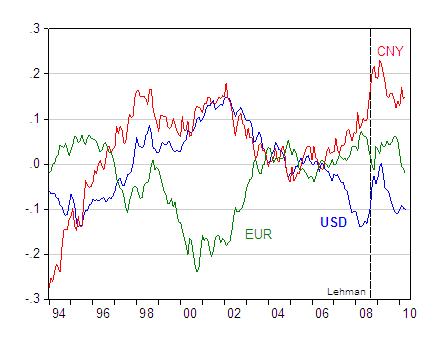
That’s just one forecast, and given the uncertainties regarding the resolution of the euro area’s fiscal problems, there is little reason to put too much credence on this particular forecast. But this brings me to the second point. Despite the euro’s depreciation, the dollar has exhibited much less movement on a real, trade-weighted, basis.er2.gif

Figure 2: Log broad trade weighted real USD (blue bold), CNY (red) and EUR (green). Source: BIS and author’s calculations.

The data on this graph only extend up to 2010M04. The USD in nominal terms, on a broad basis, has appreciated by 2.8% (log terms, not annualized) in May. Still, that puts into perspective the fact that the USD is roughly where it was on the eve of the Lehman collapse.

Global Transmission of European Austerity

Here is a nice application of the large-open-economy Mundell Fleming model. The model is a work horse; there are many more sophisticated theories out there but some basic tenants remain helpful for policy analysis. This example is from Paul Krugman (those who read Chapter 19 can draw the diagram…)

Some thoughts on the fiscal austerity mania now sweeping Europe: is anyone thinking seriously about how this affects the rest of the world, the US included?

We do have a framework for thinking about this issue: the Mundell-Fleming model. And according to that model (does anyone still learn this stuff?), fiscal contraction in one country under floating exchange rates is in fact contractionary for the world as a hole. The reason is that fiscal contraction leads to lower interest rates, which leads to currency depreciation, which improves the trade balance of the contracting country — partly offsetting the fiscal contraction, but also imposing a contraction on the rest of the world. (Rudi Dornbusch’s 1976 Brookings Paper went through all this.)

Now, the situation is complicated by the fact that monetary policy is up against the zero lower bound. Nonetheless, something much like this transmission mechanism seems to be happening right now, with the weakness of the euro turning eurozone fiscal contraction into a global problem.

Folks, this is getting ugly. And the US needs to be thinking about how to insulate itself from European masochism.

Euro Craters. Hungary Also Cooked The Books

Bloomberg breaks the sad news: Hungary also deceived the capital markets: 

Sovereign Credit-Default Swaps Surge on Hungarian Debt Crisis


June 4 (Bloomberg) — Credit-default swaps on sovereign bonds surged to a record on speculation Europe’s debt crisis is worsening after Hungary said it’s in a “very grave situation” because a previous government lied about the economy.

The cost of insuring against losses on Hungarian sovereign debt rose 63 basis points to 371, according to CMA DataVision at 3:30 p.m. in London, after earlier reaching 416 basis points. Swaps on France, Austria, Belgium and Germany also rose, sending the Markit iTraxx SovX Western Europe Index of contracts on 15 governments as high as a record 174.4 basis points.

Hungary’s bonds fell after a spokesman for Prime Minister Viktor Orban said talk of a default is “not an exaggeration” because a previous administration “manipulated” figures. The country was bailed out with a 20 billion-euro ($24 billion) aid package from the European Union and International Monetary Fund in 2008.

The euro dropped below $1.21 for the first time since April 2006, stocks tumbled and the cost of insuring against corporate default rose on speculation Hungary will weaken the EU’s willingness to rescue the region’s indebted nations.

Swaps on Spanish government debt were up 22 basis points at 278, after earlier reaching a record 295.5, according to CMA. Contracts on Portugal were 26 basis points wider at 364.8, while Ireland was up 32 basis points at 292, and Italy climbed 30 basis points to an all-time high of 264, before retreating to 253. Contracts on Greece were 57 basis points higher at 783, down from 798 earlier.

“Are we on the brink of something more serious?” Deutsche Bank AG strategist Jim Reid wrote in a note to clients today. “We’ve little doubt that the authorities have no appetite for imminent peripheral defaults but we do see the situation getting worse before it gets better. This leaves markets vulnerable until there is more certainty surrounding the structure of the peripheral funding bail-out.”

Credit-default swaps pay the buyer face value in exchange for the underlying securities or the cash equivalent should a borrower fail to adhere to its debt agreements. A basis point on a contract protecting $10 million of debt from default for five years is equivalent to $1,000 a year.


Conspiracy Theory Of International Macroeconomics

Ominous signs of weakening Eurozone foundations via Eurointelligence:

The report alleges that French banks, the largest holders of Greek debt, have been dumping their Greek bonds at the ECB, while the German banks have agreed with the finance ministry to hang on to their bonds until 2013.  The article, whose sources are anonymous central bankers in Germany, says the Bundesbank wonders why the ECB was still buying Greek paper at a time when the financial shield is already in place.

The answer is that they [the German Bankers] suspect a French conspiracy, according to the article, a presumption that French banks are using the ECB purchase programme to clean their balance sheet. The article then takes to the thought to its logical conclusion, and calls the ECB a “bad bank” [a term used for a financial institution whose purpose it is to buy toxic assets]. The article goes on to ask, whether and how the ECB can get out of this, because stopping the purchase programme would lead to a collapse in prices – as the ESCB is the only buyer. And if Greece were to restructure (which is what everybody who has looked into the numbers in some detail) knows, then the ECB itself would need to be bailed by the German taxpayer.

We assume that this article is unlikely to win a Franco-German friendship prize. French newspapers have picked up on it, including Le Monde, which said yesterday that “a perfume of divorce floats between the Germans and the ECB” (i.e. Trichet). Please also note that the source of Der Spiegel’s information do not hail from France. They are German central bankers, who voice their suspicions. So do not treat it as fact that French banks are selling, and German banks are not selling. But the article raises an interesting question: how to prevent moral hazard arising in this situation? And if the ECB were to reveal what it bought in its open market operation, we would know a lot more. At present, the only information ordinary Germans have is the Spiegel report.


Brilliant Titbit: Small EU Country 4 Sale

Can I interest you in a small Mediterranean country?

The government will sell 49 percent of the state railroad, list ports and airports on the stock market and privatize the country's casinos, the Finance Ministry said after a cabinet meeting in Athens. The government will also sell stakes in water utilities serving Athens and Thessaloniki, sell 39 percent of the post office, and combine its vast real estate assets into a holding company to be listed on the stock market… The state will maintain its stakes in Hellenic Telecom and the electrical utility Public Power.

This has to be one of the saddest paragraphs I've read in a while:

NATO figures show that Greece spent 2.8 percent of G.D.P. on its armed forces in 2008, or about €6.9 billion. That makes it the most expensive military budget in Europe in per capita terms, and second only to the United States in the alliance. Athens has justified such spending as necessary to keep up with its regional rival, Turkey, also a NATO member.

The military budget would seem to be a bit of low-hanging budget fruit, if only silly regional rivalries could be set aside.

Titbit: Blue/Red States And Public Sector Size

At times I read economic material that is off topic (in terms of the actual International Economics textbook), but I cannot help but share. So I am starting a new category, titbits, referencing the dictionary definition of the term: a tasty small piece of food for thought…

Who'd have thought it (from the New York Times):

Conservative states tend to employ larger shares of state and local government workers in the US

DESCRIPTION

Source: Report on public sector wages, Center for Economic and Policy Research, using Labor Department data; U.S. National Archives and Records Administration

The more dominated a state is by public-sector workers, the less likely that state was to vote for the Democratic presidential candidate. Any theories? Catherine Campell suggests two potential explanation:

1) Liberal states tend to be more urban, and big cities have a lot of private industry that can dwarf the size of state and local governments.

2) Maybe this is not “big government” versus “small government,” but federal vs local government – since these data refer to a very specific segment of the government: non-federal workers. Maybe, Jeffersonian-style, it’s not such a big contradiction for states to be hostile to candidates perceived to be expanding the size of the federal government, and to still employ lots of workers at the state and local levels.