Euro Bond Yield Divergence

 A comparison of real time yields for European Country Debt is now available from Bloomberg. Calculated Risk has the instructions:

Click here for the graph for the Greece 10 year bond yields. Then you can add other bonds for comparison. Where it says "Add a comparison" you can enter the symbols for Germany (GDBR10:IND) and then Ireland (GIGB10YR:IND) to create this graph. Here are the symbols for Portugal (GSPT10YR:IND) and Spain (GSPG10YR:IND)

Did DC Cause The Housing Bubble?

One line of reasoning holds that Fannie Mae and Freddie Mac – the two quasi governmental agencies that are now in receivership and fully owned by the tax payer – caused the housing bubble. It took until now to inform this discussion with actual data. The NYT has the abstract and the entire report can be found here.

Interestingly, the Federal Housing Finance Agency suggests Fannie and Freddie did not cause the housing bubble, since one can think of the money that poured into the housing market as cash that was piled on on top of Fannie and Freddie's regular annual mortgage financing (in blue below). This reduced Fannie and Freddie's share of the US housing finance by about 50% in 4 years. 

DESCRIPTION

Source: Inside Mortgage Finance

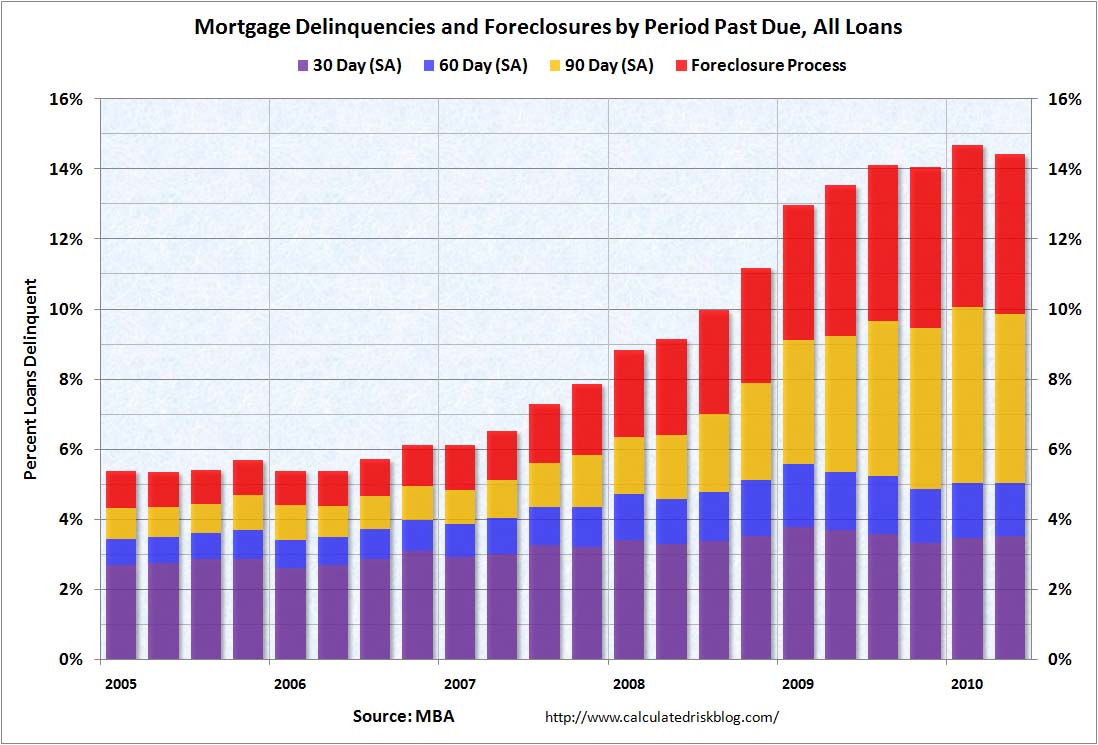
Right now it seems pointless to assign blame, the housing market is getting downright scary. New mortgage delinquencies are still increasing in the US and the decline in overall delinquency (still near all time highs) came only because of some loan modifications that targeted 90+ day delinquent loans.

ZZZ 

See Calculated Risk Post: MBA Q2 2010: 14.42% of Mortgage Loans Delinquent or in Foreclosure

These delinquencies are partly explained by the high unemployment, but also by the negative equity that so many Americans now hold:

 CoreLogic Negative Equity Q2 2010

My plumber in Seattle (making $90/hour) proudly told he stopped paying his mortgage, since he is 20% under water. Scarily, the above chart suggests this level of negative equity is about average for the state.  

Japan as Number 3

In 1979, Professor Vogel shocked the world with the bold title of his book: 

It was a shock, because Japan was exporting cars like this at the time: 


A few years later, the Japanese car makers brought US car makers to their knees – to the degree that Chrysler received its first government bailout in the early 1980s. When the US car industry was threatened by the popularity of cheaper more fuel efficient Japanese cars, the US government threatened car tariffs in 1981. As Japanese manufacturing productivity exploded across all manufacturing sectors, so did its exports, and soon Ezra Vogel's book became the book to read in the 1980s. 

Alas, Japan never became number 1 – and just a few days ago it lost its number 2 status, as China advanced to become the second largest global economy. The Economist points out, however, that the Chinese rise is less about China than about the Japanese decline: 

WHEN China's economy was announced as the world's second-largest earlier this week, the news was spun as a China story, or occasionally as a story about the Chinese challenge to America. But the data that triggered the announcement were Japanese, and China's rapid catch-up to the Japan says as much about the latter economy as the former. 

Five years ago China’s economy was half as big as Japan’s. This year it will probably be bigger (see chart 1). Quarterly figures announced this week showed that China had overtaken its ancient rival. It had previously done so only in the quarter before Christmas, when Chinese GDP is always seasonally high. Since China’s population is ten times greater than Japan’s, this moment always seemed destined to arrive. But it is surprising how quickly it came. For Japan, which only two decades ago aspired to be number one, the slip to third place is a gloomy milestone. Yet worse may follow. Many of the features of Japanese capitalism that contributed to its long malaise still persist: the country is lucky if its economy grows by 1% a year. Although Japan has made substantial reforms in corporate governance, financial openness and deregulation, they are far from enough. Unless dramatic changes take place, Japan may suffer a third lost decade.

Read the entire piece. It's largely about the structural problems in the Japanese economy, and especially in Japan's corporate sector. But one shouldn't overlook the chilling effect of years of deflation.

Pictures Of The Great Recession

Pictures of the Great Recession brought to you by the Center for Budget and Policy Prioritiesnter on Budget and Policy Priorities

Part I: Recovery Began in Mid-2009

The Economy Has Been Growing

Change In Real GDP

The Private Sector Has Begun to Add Jobs

Monthly Change in Non-farm Unemployment

Part II: The Recession Put the Economy in a Deep Hole

GDP Fell Far Below What the Economy Was Capable of Producing

Gross Domestic Product

Job Losses Were Unprecedented

Percent Change in Nonfarm Employment Since Start of Recession

The Unemployment Rate Rose to Near Its Postwar High …

Unemployment Rate

… And Could Stay High for Some Time

Unemployment Rates During Recessions and Recoveries

The Share of the Population with a Job Fell to Levels Not Seen Since the Mid-1980s

Employment Population Ratio

Long-term Unemployment Rose to Historic Highs

Long-term Unemployment

Labor Market Slack Reached a Record High

Total unemployed plus all marginally attached workers

The Number of People Looking for Work Swelled Compared with the Number of Job Openings

Unemployed workers per job opening

Part III: The Great Recession Would Have Been Even Worse without Financial Stabilization and Fiscal Stimulus Policies

GDP Would Have Been Lower Without the Recovery Act …

Gross Domestic Product

… And Unemployment Would Have Been Higher

Unemployment Rate

The Gap Between Actual and Full-Employment GDP Would Have Been Much Larger Without TARP and the Recovery Act

Percent of Potential (Full Employment) GDP


    Wishful Thinking

    January 2010 President Obama announced prominently in his State of the Union address that he wanted to 'double US exports in the coming 5 years." I don't know of many economists who held their breath. There are many nails littering the road to doubling exports, here is now reported by the New York Times (Seattle Times). The Large Open Economy issue is very much in play for the US (see Chapter 14)…

    Final Exit

    In 1998, the financial times reported that the Argentinian finance minister compared the country's peg to the dollar with a marriage to a pretty Hollywood actress:  Foreign investors often ask Argentine officials if they have an exit route from convertibility, the currency board system that links the peso at par to the dollar. "When you are married to Sharon Stone, you do not require an exit route."

    "Plan B" does turn out to be important, in the world of Hollywood divorces as well as in currency markets.  These are important lessons for European nations that are currently contemplating to drop the euro to depreciate (and probably also) deflate their way out of the massive country debt. Bleyer and Levy Yeyati have the story.

    The Fed’s Balance Sheet

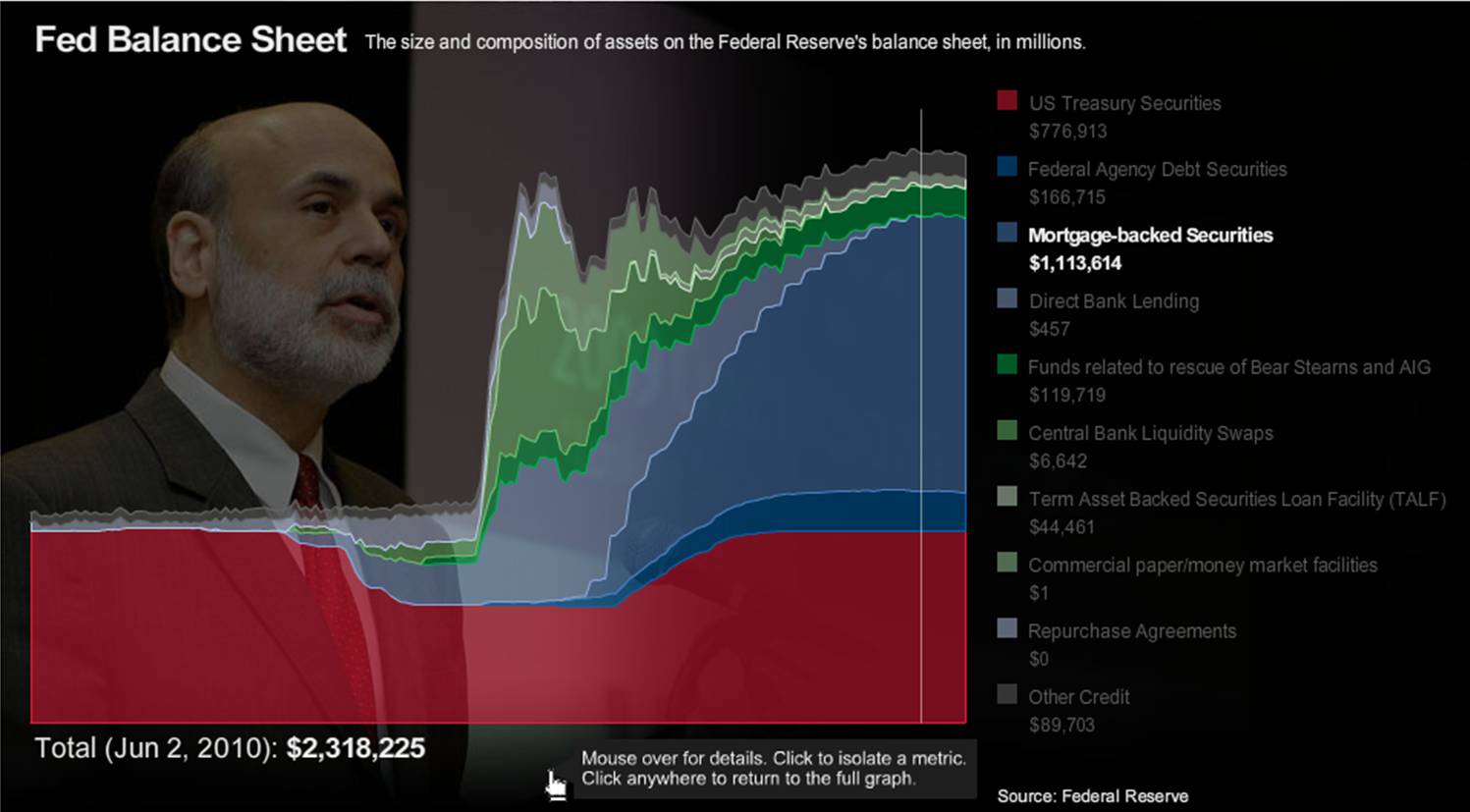
    A fantastic, dynamic graph of the Fed's Balance Sheet, by credit facility

    Joe Stiglitz says it all in a nutshellThe Federal Reserve Board is no longer the lender of last resort, but the lender of first resort. Credit risk in the mortgage market is being assumed by the government, and market risk by the Fed. No one should be surprised at what has now happened: the private market has essentially disappeared.  

    HOW to Stimulate

    The only way you can get behind the massive government stimulus is if you believe that a one-time defibrillation is needed to resuscitate the economy from its liquidity trap. If you do not believe that we are in a liquidity trap, there is no need for stimulus and all the money spent is simply wasted without effect (other than increasing the public debt). 

    There is now ample evidence that the stimulus was large enough to stop the economy from going over the cliff – economic growth has recovered. However, at the same time, the stimulus was not large enough to result in large scale hiring or investment. That's a major problem. The defibrillation returned a heart beat, but the patient is still in a coma. 

    Many had argued that the stimulus was too small at the time. I didn't do the math at the time whether the size was right, but was astonished how unproductive much of the spending actually was. Unproductive in actually putting people to work. Of course,  in his General Theory, Keynes wrote, “To dig holes in the ground, paid for out of savings, will increase, not only employment, but the real national dividend of useful goods and services.” So the take-away was "it does not really matter what the stimulus is being spent on, as long as its spent. But it turns out that out insufficient size or productivity in terms of the # of people put to work matter for a stimulus. Here is how the unusually creative and brilliant Robert Schiller puts it in the NYT (via Mark Thoma). 


    What Would Roosevelt Do?, by Robert J. Shiller, Commentary, NY Times: Across the United States, thousands of federally financed stimulus projects are under way, aimed at bolstering the economy and putting people to work. The results so far have not been spectacular.

    Why not? There’s nothing wrong with the idea of fiscal stimulus itself. We need more stimulus, not less — but we need to focus much more on actually putting people to work.

    Two friends of mine, both economists, came upon a stimulus project … highway … sign that read “Putting America to Work: Project Funded by the American Recovery and Reinvestment Act” and prominently featured a picture of a worker digging with a shovel. Out on the road, there was plenty of equipment, including a gigantic asphalt paver, dump trucks, rollers and service vehicles. But there wasn’t a single laborer with a shovel. That project employed capital, certainly, but not many human beings.

    Like many such stimulus projects, it could be justified if you accept the idea that gross domestic product, not jobs, is central — a misconception…

    So here’s a proposal: Why not use government policy to directly create jobs — labor-intensive service jobs in fields like education, public health and safety, urban infrastructure maintenance, youth programs, elder care, conservation, arts and letters, and scientific research?

    Would this be an effective use of resources? From the standpoint of economic theory, government expenditures in such areas often provide benefits that are not being produced by the market economy. …

    President Franklin D. Roosevelt's New Deal, though no more than partly successful, was much more focused on job creation than our current economic stimulus has been. It seems that the New Deal was also more successful at inspiring the American public.

    Consider one of the most applauded of Roosevelt’s programs, the Civilian Conservation Corps, from 1933 to 1942. … The C.C.C. emphasized labor-intensive projects… Congress has recently set plans for tripling the size of AmeriCorps, the modern counterpart of the C.C.C…. At its peak, the C.C.C. employed 500,000 young men. Under current plans, AmeriCorps would top out at 250,000 people in 2017, even though the nation now is two and a half times larger. We ought to be bolder.

    Big new programs to create jobs need not be expensive. Suppose the cost of hiring a single employee were as high as $30,000 a year, several times typical AmeriCorps living allowances. Hiring a million people would cost $30 billion a year. That’s only 4 percent of the entire federal stimulus program… Why don’t we just do it? 


    This would take care of the necessary income effect to exit the liquidity trap. Appropriately targeted tax cuts could stimulate investment. But a basic result in economic theory is that temporary tax cuts have very limited effects, and the debate about the semi-permanent Bush tax cuts is still raging (see here and here and here)…