While We Have Our Eyes On The European Disaster…

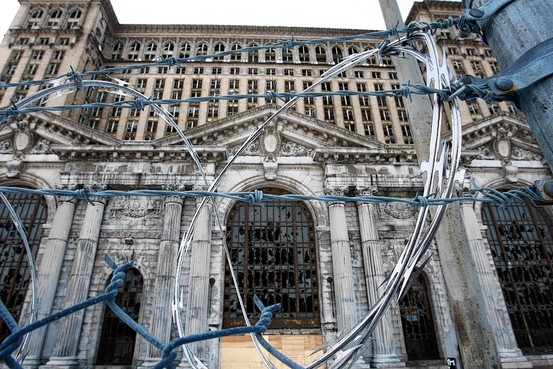
… Mike Shedlock redirects our attention to the fact that only US income but not employment is rising. Not only is the change in income quite diverse and concentrated across the US population but it is also geographically diverse. Some areas gain while others loose (you guessed it largely the geographic gains/losses are correlated with the changes in inequality in the population as a whole)… Here is the sad case of Detroit – unlike Greece it does not have the option to exit a currency union and devalue…:

Please take a look at this link of a 360 degree photo tour of several spots in or around Detroit, including the abandoned Michigan Central Train station. Then there are the images of the Michigan Central Train depot courtesy of the Wall Street Journal article Less Than a Full-Service City

Shedlock has written about Detroit on several occasions:

Staggering Fairy Tales

How much longer will politicians pretend there is a way around restructuring? Mish has the round up:

80
Percent of Greeks Oppose More Austerity; Tens of Thousands Defy Spain's
Protest Ban; Greece, ECB Deny the Obvious; IMF in Denial Regarding
Portugal

The words for today are the same as the words for last week and last month: defy and denial. Let's consider a few examples.

Campers in Spain Defy Protest Ban

The New York Times reports Tens of Thousands in Spain Defy Protest Ban

Tens
of thousands of demonstrators across Spain continued sit-ins and other
protests against the established political parties on Saturday. They did
so in defiance of a ban against such protests and ahead of regional and
municipal elections on Sunday.

About
28,000 people, most of them young, spent Friday night in Puerta del
Sol, a main square in downtown Madrid, the police said. They stayed even
as the protest ban went into effect at midnight under rules that bring
an official end to campaigning before the election in 13 of Spain’s 17
regions and in more than 8,000 municipalities.

Fueling the
demonstrators’ anger is the perceived failure by politicians to
alleviate the hardships imposed on a struggling population. The
unemployment rate in Spain is 21 percent.

Beyond economic
complaints, the protesters’ demands include improving the judiciary,
ending political corruption and overhauling Spain’s electoral structure,
notably by ending the system in which candidates are selected
internally by the parties before an election rather than chosen directly
by voters.

As the campaign ban came into force at midnight, many
of the Madrid protesters stuck tape across their mouths to signal that
they would continue the demonstration, even if ordered to be silent.
“The voice of the people can never be illegal,” read some of the
banners, while others argued, “We are not against the system but the
system is against us.”

Papandreou and ECB Deny Restructuring Under Discussion

No
matter how many times the ECB or the Greek prime minister "reject"
restructuring, the market insists otherwise. Once again, and for the
umpteenth time Greek PM, ECB officials reject debt restructuring with the bond market making fools of both of them every step of the way.

"Debt restructuring is not under discussion," Papandreou said in an interview in Sunday newspaper Ethnos.

Greece
has no other option but to follow through its fiscal plan, ECB
governing council member Ewald Nowotny told Greek newspaper To Vima
Saturday. "For the ECB, the line is one and clear: you have to implement
the commitments you have made."

Greece is considering deeper
cuts in public sector wages and further tax increases on a range of
products and professions to qualify for more aid, Greek newspapers said
Saturday.

The plan may include scrapping bonuses to civil
servants and employees in state-run companies, newspapers Ta Nea and
Isotimia reported, without citing any sources.

The government may
also lower or scrap tax-free thresholds on property holdings and the
self-employed, raise consumption taxes on soft drinks and certain fuel
types or shift a range of products to a higher VAT-bracket, other
newspapers said.

Papandreou vowed Saturday to take any measure
necessary to secure more funding for his country. "Greece must convince
everyone of its determination," he said.

Eighty percent of
respondents told pollster MRB they refused to make any further
sacrifices to get more EU/IMF aid, an MRB poll for paper Realnews
showed.

The same poll shows Papandreou's ruling Socialist PASOK
neck-and-neck with the opposition conservatives, with both parties
scoring 21.5 percent each. In the previous MRB poll in April, PASOK had
an 1.8 point-lead.

But Papandreou warned that any failure to push
through the plan might lead the country straight to default. "At the
moment, it does not seem as if Greece can cover its 2012 borrowing
needs… from the market," he said in the interview.

80 Percent of Greeks Oppose More Austerity

The
party that wins the next Greek election just may be the party that
rejects more austerity measures. Regardless, it is not mathematically
possible for Greece to grow its way out of this problem soon if ever, by
more austerity measures.

Greece is in recession now, Italy is
headed there, and as much as Greece needs serious reforms in it public
service sector, the short-term effect of taking those measures would be
rising unemployment and more capital flight.

Moreover, Greece has
a huge productivity disadvantage with Germany and France and to fix
that disadvantage would require lower wages. To top it off, Papandreou
wants to raise property taxes, consumption taxes, and self-employment
taxes.

Papandreou's 7-Point Proposal

  1. Higher property taxes
  2. Higher value-added (consumption) taxes
  3. Higher taxes on self-employed
  4. Still lower government spending
  5. Still lower wages
  6. Still lower benefits
  7. Selling Greek assets

Bear
in mind Greece is already in recession. Yet somehow that proposal is
supposed to get Greece out of trouble and growing again in 2 years.
Quite frankly it is preposterous to suggest such nonsense and the bond
market knows it.

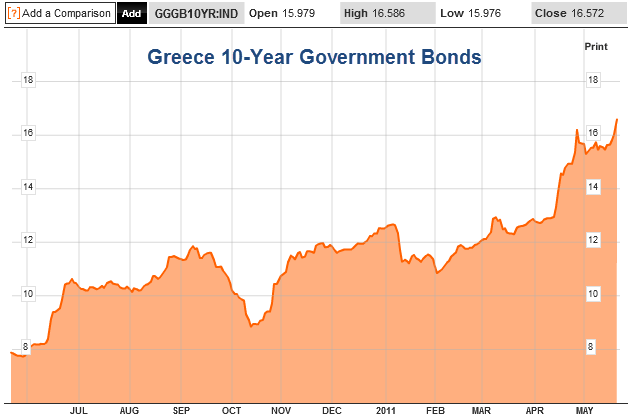
Greece 10-Year Government Bonds

Greek 10-year government bond yield hit a new high on Friday, 16.57%.

 

Exit – again?

The significant event would not be a Greek exit. The significance of a Greek exit is that Germany's bailout stance would thus have changed and Chancellor Merkel closed the Tap probably not only for Greece, but also for Ireland (whose deficit is trice that of Greece), Spain and all other PIIGS

The logo of the European currency Euro stands in front of the European Central Bank in Frankfurt

Euro falls on rumours Greece is to quit the eurozone
Greece has vigorously denied rumours that it is has raised the idea of quitting the euro. The
euro has fallen by more than 1% against the dollar, following a report
that Greece had raised the possibility of leaving the single currency. German magazine Der Spiegel said eurozone finance ministers were holding a crisis meeting in Luxembourg. The report has been denied vigorously by eurozone countries, including Greece and Germany. However, the BBC has learned that ministers from four eurozone countries are indeed meeting in Luxembourg. The countries – France, Germany, Finland and Netherlands –
are said to be discussing EU issues, including the financial situation
of Portugal, Ireland and Greece. "The report about Greece leaving the eurozone is untrue," the Greek deputy finance minister Filippos Sachinidis told Reuters. "Such reports undermine Greece and the euro and serve market speculation games. "For (Greece) to leave the euro is
very complicated. It's not like they can just wake up tomorrow and say
we're not in the euro anymore”Ron Leven
Currency strategist

said

Denials

A source told Reuters that some EU ministers were meeting in
Luxembourg on Friday to review issues such as Portugal, Greece and
European Central Bank leadership, "but nothing more".German Finance Minister Wolfgang Schaeuble and his deputy Joerg Asmussen were at the meeting, according to Reuters.But the head of the Eurogroup, Luxembourg Prime Minister
Jean-Claude Juncker, has denied that crisis eurozone talks were being
staged that could see Greece exit the euro, his spokesman told AFP. "This information is totally false," his spokesman Guy Schueller told AFP. "There is no Eurogroup meeting taking place or planned this weekend," Mr Schueller underlined.Despite dismissals from officials, the story "does seem to be
having a market effect," said Ron Leven, a currency strategist at
Morgan Stanley in New York. But he played down the significance of the report. "For
(Greece) to leave the euro is very complicated. It's not like they can
just wake up tomorrow and say we're not in the euro anymore."

Police secure a street in Athens, 15 December, 2010
Protesters demonstrated in Athens in December 2010 against government austerity measures. 
 

Bailout

Greece became the twelfth country to join the single currency, when it ditched its own currency, the drachma, in 2002. Over the past decade the Greek government borrowed heavily –
public spending soared and money flowed out of the government's coffers. However, the revenues the government generated through tax
were not enough to counterbalance this, mainly as a result of widespread
income tax evasion. The result was a bulging budget deficit, more than four times the limit under eurozone rules. In the end, almost twelve months to the day, Greece was
forced to accept a multi-billion euro bailout, by the EU and the IMF, to
finance its huge deficit. The 110bn-euro ($136bn; £94bn) loan was designed to prevent Greece from defaulting on its massive debt. But despite a programme of government spending cuts and other reforms, its economy has struggled to keep its head above water. In recent weeks, there has been increased speculation that Athens could default and will need to restructure its debts. Yields on Greek government 10-year bonds have leapt to over
15 percent, a sign that investors are becoming increasingly sceptical
that they will be repaid.

Greek Tragedy: Act 2

The Greek rescue package that the EU provided last year required massive cuts, which led many economists to doubt whether the package would actually cure the patient or induce a coma. Coma it is. This years budget shows the effects of the large austerity measures (afterall G is part of Y!), so the fall in Greek national income depressed goverment revenues to jack up the deficit. The ill designed package from a year ago, now leaves Europe where exactly in the same spot it was in last year: negotiating either a Greek exit, or more cash infusions to keep the patient alive. The BBC has the story


Greece budget deficit worse than thought

Greek anti-austerity protestor
Greece's austerity measures have sparked anger in the country. 
 
Greece's budget deficit for 2010 has been revised up to 10.5% of its annual economic output. The figure is even worse than a previous estimate of 9.6%,
and far above the 8% target agreed by Athens as part of the country's
financial rescue. The data comes as Eurostat unveils official debt statistics for the EU. In Greece, debt levels jumped to 142.8% of the country's gross domestic product from 127.1% previously.
 

Select counties' debt statistics


Country

Deficit

Debt

Rep of Ireland

32.4%

96%

Greece

10.5%

143%

UK

10.4%

80%

Spain

9.2%

60%

Portugal

9.1%

93%

France

7.0%

82%

Italy

4.6%

119%

Germany

3.3%

83%

Estonia

surplus: 0.1%

7%

Eurozone

6.0%

85%

EU

6.4%

80%

Data for 2010. Source: Eurostat

The Greek government has brought
in a string of draconian spending cuts and tax rises demanded by
European peers and the International Monetary Fund as part of its
bail-out last year. The measures succeeded in bringing the government's deficit
down from 15.4% of GDP in 2009, but still fell well short of what was
hoped. Greece's two-year cost of borrowing rose further in bond markets to more than 23% per annum following the data release. The level indicates that markets believe the country's debts
are unmanageable and Athens is very likely to impose losses on
bondholders when its existing bail-out loans expire in 2013. The Greek government blamed the excess borrowing on the country's recession, which has proved deeper than expected. "The Greek government remains committed to achieving its deficit targets," said the finance ministry in a statement. "All necessary measures in that direction are accounted for
in the context of the medium-term fiscal strategy which will be
submitted to parliament by 15 May." Many economists point to the vicious circle Greece is caught
in, whereby government austerity is worsening the recession, which in
turn is increasing the government deficit.

Meanwhile, Eurostat data also painted a bleak picture at the
Irish Republic, whose 2010 deficit was confirmed at an unprecedented
32.4% of GDP. The level of new borrowing – double what was recorded the year before – was largely due losses at the nationalised Irish banks. Like Greece, Portugal – which is set to become the third
eurozone member to receive a bail-out – also overshot its 7.3% target,
with a 2010 deficit of 9.1%. Also like Greece, both Portugal and the Irish Republic saw
their borrowing costs increase after deficit data was announced, each
seeing yields on five-year bonds increase to about 11.5%. However, there was good news for Spain, which many see as next in line to become stuck in the eurozone debt quagmire. Madrid succeeded in cutting its deficit to 9.2% of GDP, beating the 9.3% target it had set itself.