McKinsey Quantifies the Benefits of Currency Wars


When and how will the Fed and other central banks wind down
their mammoth asset purchases, also known as quantitative easing (QE)? 
Since the
start of the financial crisis, the Fed, the European Central Bank, the Bank of
England, and the Bank of Japan have used QE to inject more than $4 trillion of
additional liquidity into their economies. When these programs end, governments,
some emerging markets, and some corporations could be vulnerable. They need to
prepare.


  • Research by the McKinsey Global Institute suggests that
    lower interest rates saved the US
    and European governments nearly $1.6 trillion from 2007 to 2012
    . This windfall
    allowed higher government spending and less austerity. If interest rates were
    to return to 2007 levels, interest payments on government debt could rise by 20%,
    other things being equal. 
    Governments in the US and the eurozone are
    particularly vulnerable as interest rates
    rise, governments will need to determine whether higher tax revenue or stricter
    austerity measures will be required to offset the increase in debt-service
    costs.
  • Likewise, QE saved firms $710
    billion from lower debt-service payments,
    thus ultra-low interest rates boosted profits by about 5% in the US
    and the UK,
    and by 3% in the eurozone. This source of profit growth will disappear as
    interest rates rise, and some firms will need to reconsider business models –
    for example, private equity – that rely on cheap capital.
  • Emerging economies have also benefited from access to cheap
    capital.
    Foreign investors’ purchases of emerging-market sovereign and
    corporate bonds almost tripled from 2009 to 2012, reaching $264 billion. As QE programs end, emerging-market countries could see an outflow
    of capital.
  • By contrast, households in the US
    and Europe lost $630 billion in net interest
    income as a result of QE.
    This hurt older households that have significant
    interest-bearing assets, while benefiting younger households that are net
    borrowers. 
  • QE may have also generated NEW asset-price bubbles in
    some sectors,
    especially real estate. The International
    Monetary Fund noted in 2013 that there were already “signs of overheating in
    real-estate markets” in Europe, Canada,
    and some emerging-market economies. 


Of course, QE and ultra-low interest rates served a purpose.
If central banks had not acted decisively to inject liquidity into their
economies, the world could have faced a much worse outcome. Economic activity
and business profits would have been lower, and government deficits would have
been higher. When monetary support is finally withdrawn, this will be an
indicator of the economic recovery’s ability to withstand higher interest rates.

Nevertheless, all players need to understand how the end of QE
will affect them. After more than five years, QE has arguably entrenched
expectations for continued low or even negative real interest rates – acting
more like addictive painkillers than powerful antibiotics, as one commentator
has put it. Governments, companies, investors, and individuals all need to
shake off complacency and take a more disciplined approach to borrowing and
lending to prepare for the end – or continuation – of QE.
Chinese Capital Controls

The recent years have been a frustration for anyone trying to make sense of China’s capital control policies. Capital controls have been an important part the Chinese economic policies since the communist revolution in 1949. At present, the dominant view both among Chinese policy makers and analysts is that at some point the restrictions have to go. They are incompatible with the pursuit of a
free market economy especially for a country with a leadership role in international commerce.

However, as with many other reforms, the chosen model of capital account liberalization has been baby steps. So far, capital account liberalization measures have opened up only new channel for Chinese firms to transfer funds abroad or new channels for foreigners to invest in China. Hong Kong has emerged as a renminbi (RMB) hub, where off-shore Euro-RMB can be deposited and freely traded. After all these developments, are the controls still effective?

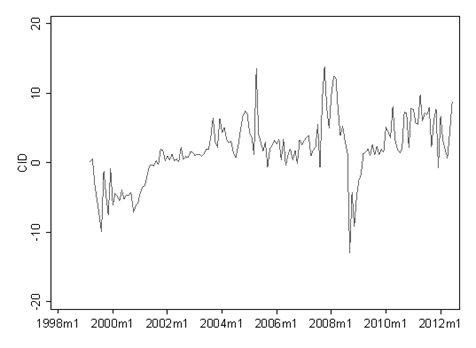
Yin-Wong Cheung and Risto Heralla study the covered interest differential (CID) between onshore and offshore RMB (interest rates on RMB assets in China and outside China). The CID is a much used measure of the effectiveness of capital account restrictions because it vanishes by arbitrage under free capital mobility. So, if the CID is still large (in absolute value), we can be confident that capital account restrictions are still important (“binding”), and the arbitrageurs have not yet been able to arbitrage away the interest differential. Cheung and Heralla find that Chinese Capital Controls are still binding (see graph below) in fact the CID seems to be getting larger over time..

Apparently, China still considers capital control policy to be an indispensable tool to manage and stabilize the economy. However, the use of capital controls to restrict capital inflows and thereby undervalue the RMB comes at high cost: it is at variance with the goal to develop the domestic economy, since it depresses credit
availability within China. 

Covered interest differential (CID) between RMB and Euro-RMB 

Image result for Covered interest differential (CID) between RMB and Euro-RMB

Source:

China Enters Currency War And Carry Trade

In  the Past 7 Days Yuan Devalues Most In 20 Years
By Tyler Durden 2/25/2014 [edited]
 
The last 7 days have seen the end of the unstoppable 'sure-thing', the one-way bet-of-the-decade, – yes Durden is referring to the end of the appreciation of the Chinese Yuan. ince the currency has gained nearly 1%, the largest gain since 1994, suggests the Chinese Central Bank is intervening. 

As for the causes, there is clear evidence of intervention from the People's Bank of China. We think that the recent yuan move is intended to discourage arbitrage inflows. If short-term capital inflows abate, the depreciation will probably halt. 

The yuan appreciated by nearly 3% against the greenback and 7% against in nominal effective exchange rate terms in 2013. Over the same period, China's FX reserves added another $500bn, despite the repeated talk from officials that China has had enough reserves. These seemingly contradictory messages and signs, in our view, suggest that the PBoC never really wants too much yuan appreciation, especially if it is driven by short-term speculative capital inflows.

The recent divergence of Chinese RMB interest rates and off-shore RMB interest rates raise suspicion that the Chinese Central Bank is behind the move. As the Chinese Central Bank buys more USD, it creates natural liquidity in the CNY, leading to much lower interest rates. For the Chinese authorities, this intentional weakening seems to be aimed at trade – specifically exports (and maintained export growth).

The yuan possesses the very two qualities of a carry trade currency: high onshore interest rates and a gradual but steady appreciation trend. The first quality is partly caused by the Fed's easing policy and partly by the Chinese Central Bank's reluctance to ease domestic liquidity conditions out of concerns over debt risk. 

But this certainly will not please the Japanese (trying to devalue and manufacture their own recovery) or any other beggar thy neighbor nation. Welcome to the Currency Wars China… Potential asset deflation is a risk, as the carry trades diminish/unwind.  

The Tanks Are Rolling In Post-Devaluation Kazakhstan

The recent evaluation in Kazakhstan brought citizens to the banks and tanks to the streets (link
 
1) How is contagion related to the Kazak crisis? (short read link)
 
2) Is the reason for the devaluation "to stymie speculators" or are the reasons related to economic fundamentals" (short read link) 
 
3) Why do devaluations lead to bankruns? (short read link
 
4) How may the end of QE3 be related to the Kazak crisis. Use the Large Open Economy MF model. (short read link, and link


The Law of One Price – Stir Fried In The US

Here are entirely unexpected obstacles to the Law of one Price:


US targets buyers of China-bound luxury cars


Wed Feb 12, 2014 6:58AM GMT

US federal prosecutors say the businessmen who re-export luxury cars from the United States to buyers in China are violating customs laws and deceiving auto manufacturers Mercedes-Benz and BMW, which try to keep tight control over sales to domestic dealers and to foreign countries.

In the past three years, the Chinese growing demand for Mercedes, BMW and Range Rover has created a lucrative business in a dozen of US states, where many businessmen sell the luxury cars to the companies which ship them to China, eventually.
According to a report by The New York Times, the cars, which typically retail for $55,000 to $75,000 in the United States, can be sold for as much as three times those prices.

“We’re taking advantage of a legitimate arbitrage situation,” Michael A. Downs, a businessman in Fort Lauderdale, Fla., was quoted by the Times as saying.

But federal prosecutors and agents with the Secret Service and the Department of Homeland Security has begun a broad crackdown on the export business since last yar.

Nearly 35,000 new luxury cars are re-exported to China from the United States each year.

Federal prosecutors in New Hampshire, New Jersey, Ohio, New York, Texas and South Carolina have filed criminal or civil actions seeking to put a halt to the resale of luxury cars to China, the Times said.

According to the newspaper, prosecutors have frozen bank accounts containing the proceeds from auto sales and seized hundreds of cars, some waiting to be shipped from cargo ports in Newark, Staten Island and Long Beach, Calif.

The US authorities have even ordered vehicles already on ships headed to China to be returned to port, the paper said,
The aggressive crackdown has raised concerns among many in the US, who believe the issue should be resolved through private litigation.

Questions: 

Why are FEDERAL prosecutors involved in the crackdown? 

Which laws are being broken and to what is the interest of the US to enforce these laws? 

Don’t Cry For Me Argentina. History Repeats Itself.

In Argentina, it repeats itself just about every decade with currency crises in 1972, 1982, 1990, 2001 and now 2014. Please answer the questions related to the newest crisis installment: 

1) Did the currency fix fail because the Central Bank did not "want" to use its reserves? (short read link)

2) Use the MF diagram to explain why did the Argentinea Central Bank increase the interest rate so dramatically after the devaluation? (short read link)

3) Fixed exchange rates require fiscal discipline. How could this event be related to the crisis? (short read link

4) Use the MF diagram to show the effect of goverment expenditures on the exchange rate. (read link 

Here is what happens when the public looses confidence in the domestic currency (source: FT). The pink line is the offical exchange rate (which few Argentineans were allowed to use recently) and the yellow line is the "blue peso" which is the nickname of the black market peso.


 Here is a long discussion of the causes of the current crisis (voluntary reading link

Mechanics of China’s Sterilization

The BBC tracks the Sterilization of Chinese Foreign Currency Interventions: 

 China removes $8bn from money markets to control lending

 Yuan notes being counted

China's central bank has removed nearly $8bn (£4.7bn) from the money markets in a bid to control the amount of credit in the country's financial system.

According to reports, the People's Bank of China (PBOC) did so by issuing 14-day forward bond repurchase agreements, also known as forward repos.

It is the first time since June the PBOC has used forward repos, and comes after China released unusually strong economic data earlier this year.

Chinese stocks fell in Shanghai.

A trader at a Chinese commercial bank in Shanghai told the Reuters news agency that the move "sent a strong signal to the markets that the central bank is not letting liquidity ease".

"If money market conditions remain sloppy, the central bank could even step up efforts to mop up excess," he said.

China has been looking to suck excess cash from its open-market operations to reduce the risks of shadow banking, or informal lending to businesses.

Shadow banking has been identified as a major risk to China's future growth, because of the possibility of large debts turning sour.

Chinese banks traditionally see a spurt in lending at the beginning of the year, as businesses and consumers borrow money to fund spending in the new year.

In January, new local currency loans nearly tripled from the month before to $218bn.

By reducing the amount of money available, the government makes it harder for banks to borrow and move the money into risky investments.

However, in its attempt to rein in credit, China's money conditions have been volatile over the past six months.

China's seven-day bond repurchase rate – a measure of short-term liquidity – surged to double digit territory last year on concerns there was not enough money in the system.

This caused a sell-off in global markets last year, spurring China's central bank to make a series of short-term capital injections to soothe investors.

In a monetary policy report released in February, the PBOC said volatility in money-market rates is set to persist.

"When the valve of liquidity starts to tame and curb excessive credit expansion, money-market rates, or the cost of liquidity, will reflect that," it said.

"The market needs to tolerate reasonable rate changes so that rates can be effective in allocating resources and modifying the behaviour of market players." 


Spanish Contagion Update: Green Shoots


This is an update to my depressing Spanish recession blog entry from 4 years ago: The WSJ finally announced the

"End of Recession in Spain Fuels Hopes for the  for Euro Zone"

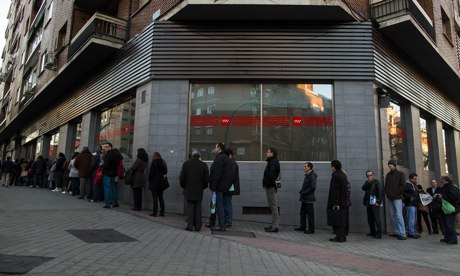
The article neglects to mention that Spanish unemployment is still exceeding 26%. Yes, this is no typo. Youth unemployment (16-24 year olds) has dropped below 55%. But these are good numbers compared to the Spanish economic situation in the past (see the Guardian's analysis)

 Spain unemployment

Why Logs?

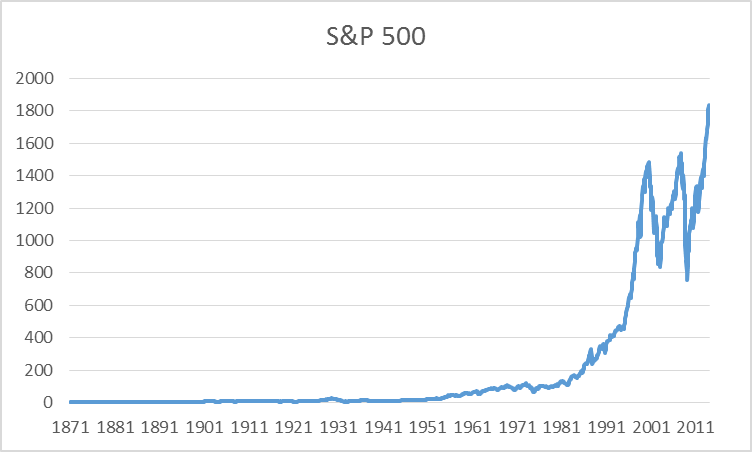
James Hamilton has a great post on why economists use logarithms: S– it’s usually a much more meaningful and robust way to display and examine dataS&P 500 stock price index, 1871:M1 - 2014:M2.  Data source: Robert Shiller.

S&P 500 stock price index, 1871:M1 – 2014:M2. Data source: Robert Shiller.


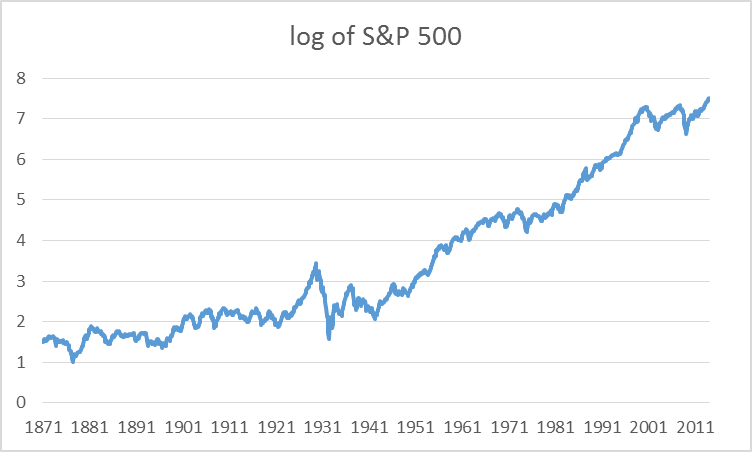
On the other hand, if you plot these same data on a log scale, a vertical move of 0.01 corresponds to a 1% change at any point in the figure. Plotted this way, it’s clear that, in percentage terms, the recent volatility of stock prices is actually modest relative to what happened in the Great Depression in the 1930′s.

Natural log of U.S. stock prices.

Natural log of U.S. stock prices.


other helpful sites are 

http://people.virginia.edu/~rwm3n/pdf/Notes%20on%20logarithms.pdf 

The Egyptian Pound Gets Pounded.

Bloomberg has a great application to practice how the external balance line behaves in times of risk and crisis. 


1. Describe the major thesis,
the central idea, or set of ideas
 in
the reading. 


2. Citing specific lines in the article, quote verbatim a statement
or brief passage that is interesting to you or elicits in you some type of
emotional response.  Then identify your emotional response or why you
found it interesting, describe the meaning(s) that the statement or
passage has for you, and provide actual or possible reasons for your
response.


3. Show how the External Balance line behaves after the first riots, and explain why.