Here is the full story (link 1) (link2) (link 3), (link4 and link4a), and then the result: (link 5)

More Background material can be found here and here and the videos here and here 
In June the European Central Bank decided to induce negative interest rates as version I of quantitative easing in Euroland.
By October 2014, the central bank began buying "covered bonds" which are bonds secured by a pool of loans, such as mortgages. November 2014 it started purchasing "asset-backed securities" injecting a total of about 7 billion Euro into the market (ECB Balance Sheet link).
Why not buy government bonds outright to create a full fledged QE? It turns out that the treaties that founded the modern EU prohibit the ECB from financing governments (aka buying their bonds)! Germany’s Bundesbank, which is always paranoid about inflation (given the sore memories of German Hyperinflation a century ago) is outspoken against expanding the supply of money through government bond purchases. The Bundesbank argument is that aside from risking inflation, the moves reduce the incentives for governments to stop overspending and make their economies more competitive. But ECB president Draghi (who is Italian) suggested that the ECB could add as much as 1 trillion euros ($1.3 trillion) to its balance sheet! A great review can be found here.

Probably one of the most deep seated erronious views is that if "I have to balance my checkbook, so does the country." Paul Krugman highlights that a country is not a company.
The first few sentences are ominous:
Then there is a 2014 addendum that you can read in (here)

A great visual by Infographics detailing Greeks Debt and The lenders to struggling European countries
Recessions, Deflations, and now the wheels are coming off the wagon in Greece:
The View From Greece: Debt Write Off or Euro Exit
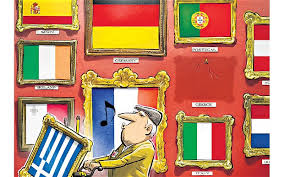
The German View and it will be interesting to see how credible the German bluff is, since Euroland holds 85% of the Greek Debt…
First in Sept (WSJ) 2014, leading the WSJ to declare that King Dollar was about to reign, and interest rates reach lows not seen since the "Black Death" during King Edward III reign in 1346. The Zerohedge Blog chronicles what fraction of bonds is not "paying" negative returns
