Winning The Trade War Part I: S. Korea

The US is finally on its way to win its trade war with the rest of the world. Forbes Magazine reports “Koreans agreed to allow U.S. automakers to export 50,000 cars per year to Korea, up from 25,000.” Finally, victory! But wait there is more: “The Koreans also agreed to limit their annual steel exports to the U.S. to [a self administered quota of] 70% of their average over the last three years.” That’s the stuff that the news cycle loves, as Trump promised, the US “is gonna win so much you may even get tired of winning.”

Then there are the pesky details:

  1. The agreement with S. Korea to “allow 50,000 US car into its market is utterly meaningless, because U.S. automakers have never exported anything close to 25,000 cars to South Korea in any year. They exported 16,400 passenger vehicles there in 2016 and that included golf carts. In 2017, they exported 7,000 cars and golf carts.”
  2. The agreement on self administered steel tariffs is going to be expensive, since World Trade Organization rules expressly forbid voluntary export restraints (VERs)…  Other countries will challenge the agreement at the WTO, which will then result in compensation that has to be paid.
  3. And all this is to reduce the bilateral US – S. Korea Trade deficit, although focusing on bilateral trade deficits is futile. 

White House Mickey Mouse Economics Part II

From hereon out I will refer to intentionally made up numbers that are used to either confuse the public (because until now we believed numbers were real) or to support wishful thinking on the part of the policy makers as “mickey mouse economics.”  Here is an example, from Time Magazine (via Menzie Chinn’s Blog)

Mr. Trump holds forth on how he interacts with other heads-of-state (from TIME):

And by the way, Canada? They negotiate tougher than Mexico. Trudeau came to see me, he’s a good man, he said we have no trade deficit with you, we have none. Donald, please. Nice guy, good looking guy. Comes in. Donald we have no trade deficit. He’s very tough. Everyone else, getting killed or whatever. But he’s tough. I said, well Justin, you do. I didn’t even know. Josh, I had no idea. I just said you’re wrong. You’re wrong. It was so stupid. [LAUGHTER]. I thought it was fine. I said, you’re wrong Justin. He said, nope we have no trade deficit. I said, well in that case I feel differently. I said but I don’t believe it. I sent one of our guys out. His guy, my guy. They said check because I can’t believe it. Well, sir you’re actually right, we have no deficit but that doesn’t include energy and timber. [LAUGHTER]. Well you don’t have timber, and when you do we’ll lost $17 billion. It’s incredible.

USTR notes that the 2016 bilateral trade balance between the US and Canada is +12.9 billion.

US-China-Tariff Part I: Opening Salvo

The WSJ reports that The White House is preparing to crack down on what it says “are improper Chinese trade practices” by making it significantly more difficult for Chinese firms to acquire advanced U.S. technology or invest in American companies. The pro business WSJ’s editorial board has has a different opinion. If there is a trade war, China will of course strike where it hurts most the first round of that conflict started after Trump imposed tariffs on washing machines (?) and solar panels.

1.  Should the U.S. government impose tariffs on imported Chinese goods in
response to perceived improper trade practices by China? If so, on which goods?
2.  Should the U.S. government use a “principle of reciprocity” in response to
perceived improper trade practices by China?
3. Beijing likely to retaliate against tariffs imposed by the U.S. on
imported Chinese goods? How would an anticipated retaliation affect the Trump
administration’s decision whether to impose tariffs?

Interesting is the assertion that the WTO dispute settlement mechanism is ineffective, given the actions of previous US presidents, and the fact that US insisted on the dispute settlement mechanism in the first place.

Steel V: Exemptions & Consulting Periods

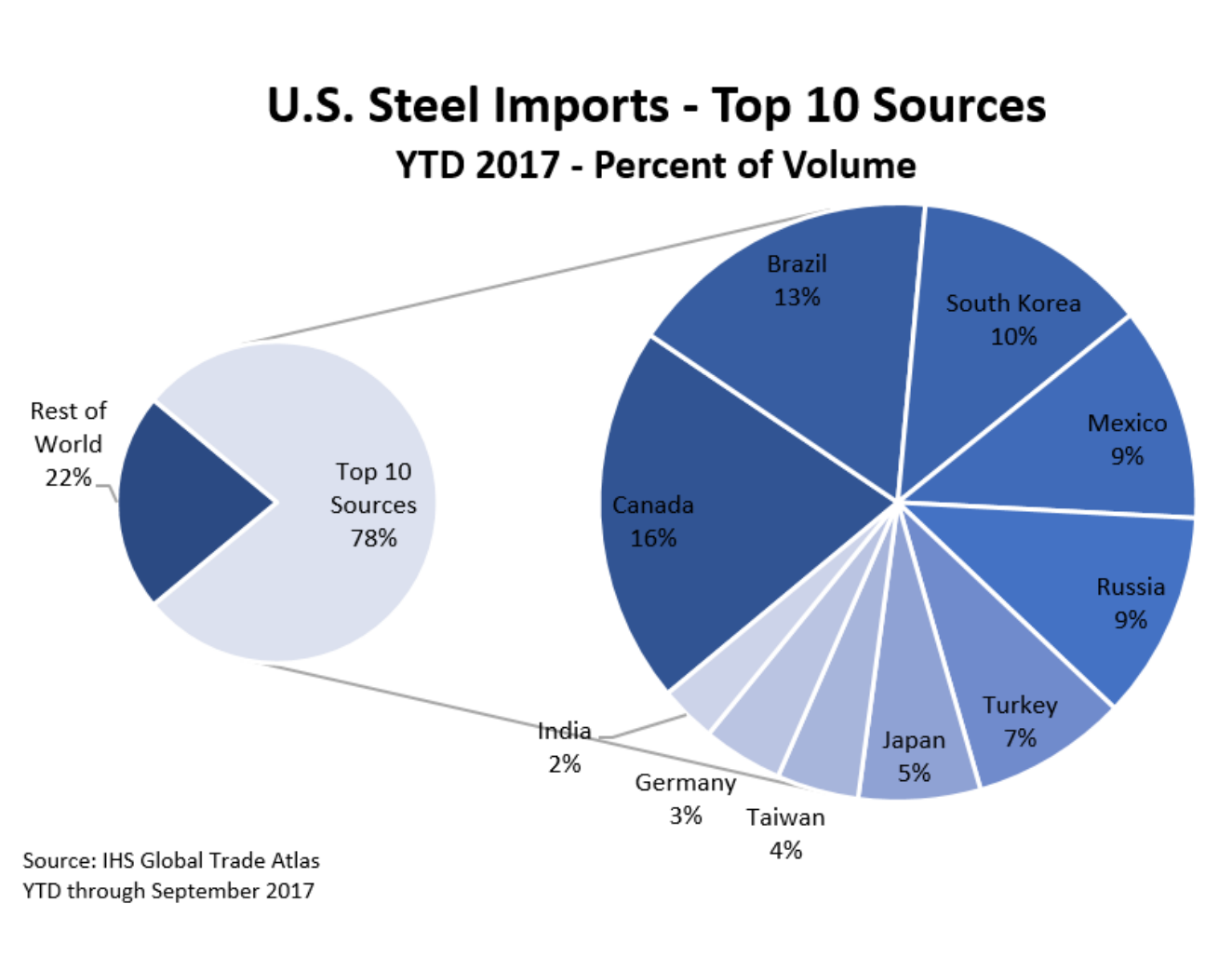
Quick review, the top 10 Exporters of Steel to the US are

  1. Canada 16.7 percent
  2. Brazil 13.2 percent
  3. South Korea 9.7 percent
  4. Mexico 9.4 percent
  5. Russia 8.1 percent
  6. Turkey 5.6 percent
  7. Japan 4.9 percent
  8. Germany 3.7 percent
  9. Taiwan 3.2 percent
  10. China 2.9 percent

Canada and Mexico were exempt the day of the announcement, today a few more countries were also exempt: the entire European Union, Argentina, Australia, Brazil, and South Korea. Maybe the steel tariff was more about a detraction from other news than about steel?

Today Trump also announced a tariffs valued $60 billion on Chinese goods, but these will only take effect after a 60 day consultation period — to give industry lobbyists a chance to water down a proposed target list.

Steel Part IV: Why Steel?

Why Steel? Steel imports from China are not even in the top 10. The biggest steel exporter to the US: Canada, which was exempt from the tariff!??  So why did the administration pick steel as its opening tariff gambit to start a trade war?  Here are the top 10 US steel producers:Image result for to 10 steel producers usa

source

Turns out Nucor provided Trump’s Trade guru Peter Navarro $1 million in hidden payments through a shell company to make a YouTube video about his book. And the other staunch steel tariff pusher in the cabinet, commerce secretary Ross owned International Steel Group Inc., which he sold for $4.5 billion.  He remained on that company’s board until becoming commerce secretary in 2017

Who wins and who looses under tariffs?


CPTPP Signed

As the Britains voted to exist the European Unions common market (which led to a spike in Google.uk searches for “What is the EU?”) and as the US trade policy is run by wishful thinkers, Asia is taking the lead today. The BBC reports [edited]:

Asia-Pacific trade deal signed by 11 nations

Eleven Asia-Pacific countries signed the trade pact formerly known as the Trans-Pacific Partnership. Although the US pulled out last year, the deal was salvaged by the remaining members, who signed it at a ceremony in the Chilean city of Santiago.

Chilean foreign minister Heraldo Munoz said the agreement was a strong signal “against protectionist pressures, in favor of a world open to trade”. The deal covers a market of nearly 500 million people, despite the US pullout. In the absence of the US, it has been renamed the Comprehensive and Progressive Agreement for Trans-Pacific Partnership (CPTPP). Australia, Brunei, Canada, Chile, Japan, Malaysia, Mexico, New Zealand, Peru, Singapore and Vietnam signed the deal with covers

  • tariffs reductions between member countries.
  • reductions in non-tariff measures and harmonized, transparent and fair regulations
  • commitments to enforce minimum labor
  • commitments to enforce and environmental standards
  • an Investor-State Dispute Settlement mechanism, which allows companies to sue governments when they believe a change in law has affected their profits.

President Donald Trump in his efforts to work for american workers and against special interests groups labeled the agreement “a rape of our country.”

Who are the winners and losers?

The Peterson Institute for International Economics says Malaysia, Singapore, Brunei and Vietnam will each receive a bump of more than 2% to their economy by 2030. New Zealand, Japan, Canada, Mexico, Chile and Australia will all grow by an additional 1% or less. The same study says the US could be a big loser, foregoing a boost to its Gross Domestic Product of 0.5% (worth $131bn). The US will also lose an additional $2bn because firms in member countries have an incentive to trade with each other instead of with American companies.

Unions (particularly in wealthier member countries such as Australia and Canada) say the deal could be a job killer or push down wages. Some economists have also suggested that free trade agreements are rigged by special interests, which makes their economic value far more dubious.

Image result for CPTPP

Steel Part III: White House Mickey Mouse Economics

Teaching trade used to be fun. We used to talk about valid positions held on both sides of an issue and weighted pros and cons. All this has gone by the wayside. It is such a sad state of affairs when the country is run by wishful thinking with vacuous content, which leaves no room for pros and cons discussions.

March, 2, 2018. Twitter. The President:

“When a country (USA) is losing many billions of dollars on trade with virtually every country it does business with, trade wars are good, and easy to win,” Trump said on Twitter on Friday March 2, 2018. And later that day, “We must protect our country and our workers. Our steel industry is in bad shape. IF YOU DON’T HAVE STEEL, YOU DON’T HAVE A COUNTRY!”  

Steel Part II: US Protectionism Fact and Fiction

“The United States has the lowest tariffs in the world — the lowest non-tariff barriers — and what do we get for that? We get a half-a-trillion-dollar a year trade deficit, which is draining us dry, taking our jobs, putting them offshore, harming the workers of America, and driving down wages.”
— Peter Navarro, director of White House National Trade Council, interview on Fox News, March 2, 2018

Aside from the fact that anyone with remedial economics knows that the trade deficit has its origins elsewhere, it is interesting to follow up on this statement. The Washington Post does some digging. There is an interesting issue related to the measurement of “non-tariff barriers” but Credit Swiss apparently did a tally:

Here are my favorite non-trade barriers. The Japanese used to be the quite creative until they were outdone by the French:

  • Japan’s used to refuse to import American skis because Japanese snow is different. So, Japan argued, US skis cannot not meet Japanese safety standards.
  •  When Japan refused to lower its quota on American Beef imports in the 1980s, the Japanese argued that they were physically incapable of eating more beef. Mr. Hata, the Japanese agriculture minister, explained that that Japanese people have longer intestines than other people.
  • Foreign pharmaceutical manufacturers often cannot sell their drugs in japan because their exhaustive tests for new drugs are judged inadequate. These tests were conducted on other humans and not Japanese.
  • France then got back at the Japanese and required that all Japanese VCRs be inspected in the city of Poitiers before they could be sold in France. Poitiers is a tiny town in the middle of France far from ports and highway connections to ports.

It is true that average tariffs (which can actually be measured) are low in the US, but certainly not the lowest in the world according to the WTO which spends a fortune monitoring tariff data.

Steel Part I: Top Exporters to the USA

Who is Trump trying to stick it to? The US International Trade Administration reports. Would you have guessed? 

source

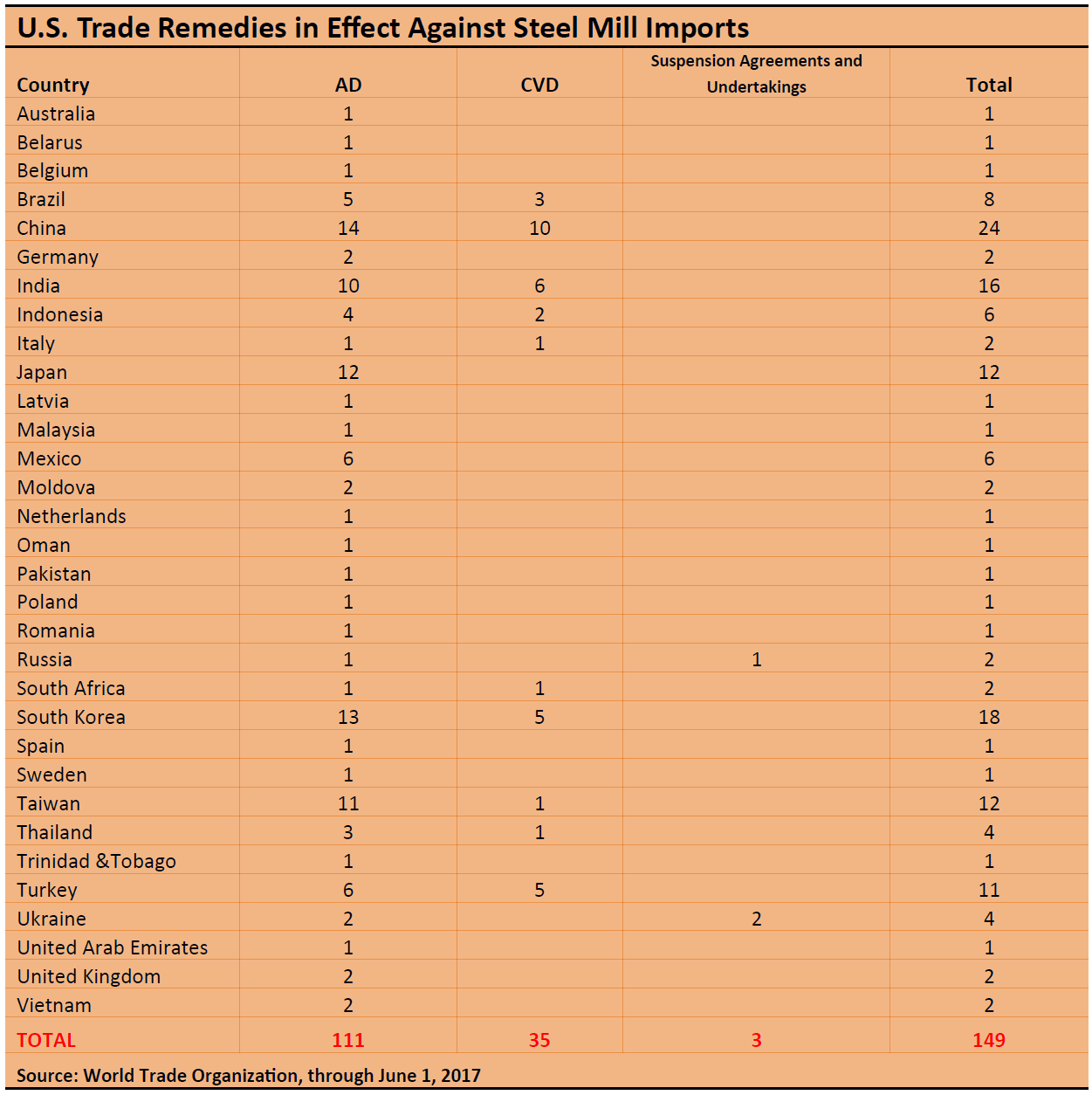
Trade Remedies in the Steel Sector include Antidumping duties (AD), countervailing duties (CVD), and safeguards. These are internationally agreed upon mechanisms to address the market-distorting effects of unfair trade, or serious injury or threat of serious injury caused by a surge in imports. The nice thing about safeguard tariffs is that they do not require to be motivated by “unfair” practice, it is sufficient to assert injury caused to a domestic industry. The table below provides statistics on the current number of trade remedies the United States has against imports of steel mill products from various countries.

So much for the country without the lowest trade barriers…