The Art of the Deal: All Roads Lead to NAFTA

Image result for The art of the deal

Politico reports about TRUMP’S AUTO TARIFF SURPRISE: What started Wednesday as a cryptic tweet from President Donald Trump ended in the evening with the Commerce Department launching a Section 232 [effect of imports on national security] investigation into whether to restrict imports of cars, trucks and auto parts. Trump requested the probe into whether auto imports could justify a 25 percent tariff to protect U.S. national security, a senior administration official confirmed to POLITICO.

The response from the US auto industry was unsurprisingly negative. “To our knowledge, no one is asking for this protection,” said John Bozzella, the CEO of Global Automakers.

The investigation could take several months to complete, but few think it will take that long. Indeed that same night, Commerce Secretary Wilbur Ross night laid out the facts justifying the trade probe: “There is evidence suggesting that, for decades, imports from abroad have eroded our domestic auto industry.” That sure looks like a threat to national security; looks like the Commerce Department has their facts at the ready.

All roads lead to NAFTA: The news was viewed by some observers through the lens of the NAFTA talks that have focused almost obsessively on auto issues. A final deal is hung up on the willingness of Mexico and Canada, the two largest exporters of cars to the U.S., to accept new content rules that could potentially alter existing supply chains to the benefit of U.S. production.

Trump appeared to link the two issues on Wednesday, when he told reporters that he felt the auto industry would “be very happy with what’s going to happen. You’ll be seeing very soon what I’m talking about. NAFTA is very difficult. Mexico has been very difficult to deal with. Canada has been very difficult to deal with. They have been taking advantage of the United States for a long time. I am not happy with their requests. But I will tell you, in the end, we win. We will win, and we’ll win big.”

Argentinean Expenditure Switching and Expenditure Reducing

Bloomberg reports that Argentina “will reduce the nation’s fiscal deficit at a faster pace as part of an agreement with the IMF…” At the same time the article suggests that “an eventual deal with the International Monetary Fund will restore confidence and ensure long-term economic growth, President Macri told reporters on Wednesday.” That may be difficult to achieve at while the fiscal deficit declines according to the TB/Y / NS-I model. But until growth returns, the “main objective is reducing the fiscal deficit, which is a fundamental problem. This is something that makes us vulnerable because we depend so much on lending.” “Depending too much on lending” is a great euphemism for “living above one’s means.” Below are a few background graphs that correlate well with the TB/Y models (Source: Financial Times).

Line chart showing real GDP and inflation (consumer prices) for Argentina in annual % changeStacked column chart showing Argentina's primary v overall deficit in % of GDP

Composition Effects / Pollution Havens

Trade and the Environment Theories stress three key effects of trade on the environment: Scale, Technique and Composition effects. Here is a good example of the composition effects — as an added bonus it plays out with a trade barrier!

Trade allowed for recycling waste to find its way to China, or HOW THE CHINESE COULD DISRUPT GLOBAL RECYCLING MARKETS

The recent Trump trade war has given China a great opportunity to “clean up its” composition effect as U.S. scrap exports to China just came to a screeching halt

History Doesn’t Repeat Itself But It Often Rhymes…

… said Mark Twain. Here is a good rhyme:  In 1930, 1,028 economists urged Congress to reject the protectionist Smoot-Hawley Tariff Act. And in 2018, over 1,100 economists warned Trump his trade views echo 1930s errors. So they simply  copied-and-pasted the identical text that the 1,028 economists had sent as a depression warning in the 1930s. Congress did not take economists’ advice, the law passed in 1930 and was a key factor in a trade war that deepened the worldwide economic slump. Here is the full text of the 2018 letter

May 3, 2018

Open letter to President Trump and Congress:

In 1930, 1,028 economists urged Congress to reject the protectionist Smoot-Hawley Tariff Act. Today, Americans face a host of new protectionist activity, including threats to withdraw from trade agreements, misguided calls for new tariffs in response to trade imbalances, and the imposition of tariffs on washing machines, solar components, and even steel and aluminum used by U.S. manufacturers. Congress did not take economists’ advice in 1930, and Americans across the country paid the price. The undersigned economists and teachers of economics strongly urge you not to repeat that mistake. Much has changed since 1930 — for example, trade is now significantly more important to our economy — but the fundamental economic principles as explained at the time have not: [note — the following text is taken from the 1930 letter]

We are convinced that increased protective duties would be a mistake. They would operate, in general, to increase the prices which domestic consumers would have to pay. A higher level of protection would raise the cost of living and injure the great majority of our citizens. Few people could hope to gain from such a change. Construction, transportation and public utility workers, professional people and those employed in banks, hotels, newspaper offices, in the wholesale and retail trades, and scores of other occupations would clearly lose, since they produce no products which could be protected by tariff barriers. The vast majority of farmers, also, would lose through increased duties, and in a double fashion. First, as consumers they would have to pay still higher prices for the products, made of textiles, chemicals, iron, and steel, which they buy. Second, as producers, their ability to sell their products would be further restricted by barriers placed in the way of foreigners who wished to sell goods to us. Our export trade, in general, would suffer. Countries cannot permanently buy from us unless they are permitted to sell to us, and the more we restrict the importation of goods from them by means of ever higher tariffs the more we reduce the possibility of our exporting to them. Such action would inevitably provoke other countries to pay us back in kind by levying retaliatory duties against our goods. Finally, we would urge our Government to consider the bitterness which a policy of higher tariffs would inevitably inject into our international relations. A tariff war does not furnish good soil for the growth of world peace.

Argentina: Crisis Deepens Without IMF Agreement

The WSJ Daily Shot has a great summary of recent events in Argentina: Argentina is in trouble. The peso (ARS) gave up 7% on Monday as markets await further news from the IMF.

The central bank continues its attempts to intervene, but the situation appears hopeless even with short-term rates at 40%.Argentina needs some $30bn in standby funds, perhaps more.Source: IIF

Credit investors are not taking chances, pushing Credit Default Swaps (CDS) spreads higher on Monday. (The price of a credit default swap is referred to as its “spread,” and is denominated in basis points (bp), or one-hundredths of a percentage point. For example, a Citigroup CDS might have a spread of 255.5 bp, or 2.555%. That means that, to insure $100 of Citigroup debt, you have to pay $2.555 per year).

And we have Contageon! Several other EM currencies are still struggling. Here Argentina’s neighbor’s currencies: The Brazilian real (BRL)

The Uruguayan peso (UYU):

Trade War 101: Non Tariff Barriers

The WSJ reports that US-Chinese Spoiled Relations lead to U.S. Goods Stuck at China’s Ports as Trade Tensions Heat Up. Not only nvel oranges, lemons and cherries and Washington apples, have been sitting at Chinese docks longer than normal. China’s customs agency said Monday it would start strengthening quarantine inspections on U.S. apples and timber after claiming to have found pests in some recent shipments. Before last week, U.S. cherries could pass through such quarantine inspections in a matter of hours, and oranges and lemons would typically take a couple of days to clear the reviews. Now the process is, in some cases, taking five to seven days.

Even Ford cars may now need to be disassembled for Chinese customs officials as US cars are now subjected to unusually rigorous checks at the port. Chinese customs officials want to inspect individual components inside the vehicles’ emissions system, which basically requires the car to be disassembled…

The Chinese have a playbook for Non Tariff Barriers, the WSJ reports: “Last year, amid tensions about South Korea’s deployment of a U.S.-built missile-defense system, China stopped sending tour groups to the country and sales of Hyundai Motor Co. cars in China plummeted. China at one time imposed curbs on imports of Philippine bananas over rival territorial claims in the South China Sea.

In April, Beijing increased tariffs on fruit, including lemons and limes to 26% from 11% and 25% on cherries from 10%, along with a number of other U.S. imports. It was in retaliation against the Trump administration’s penalties that have hit Chinese steel and aluminum. Now we pile on NTBs.

Argentina Calls In The IMF

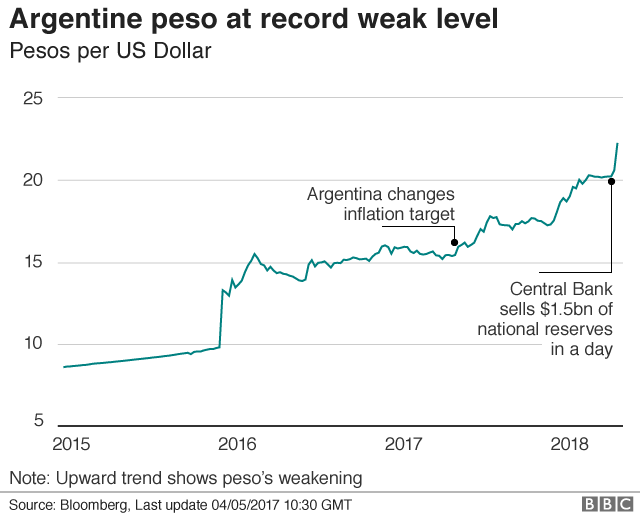
Time Magazine and the Economist Magazine  report that Argentinians smell a rat. When interest rates at at 20%, if no “Austerity,” then what? Image result for argentina protests imf 2018 Things have taken a rather dramatic turn for the worst over the past two weeks. After the central bank hiked rates three times in the space of a week for a total of 1,275 basis points in an effort to arrest the slide in the peso. But that wasn’t enough as the Argentinean Peso (ARS) careened to a new all-time low ahead of another CB rate decision.ARSBloomberg noted, the bid/offer was “very wide with almost no real trades executed.” This crisis goes back to a poorly communicated December CB decision to up the inflation target along with a couple of rate cuts in January. Now the chickens have come home to roost and it’s a bloodbath, both for the currency and for the bonds, which are plunging:ARGBondsNeedless to say, it doesn’t help that U.S. interest rates are rising. Standard results from a Mundell Fleming Monetary Policy expansion…