IMF Is Going All Out — In Argentina

Argentina has been in crisis mode for much of 2018 (see here, here, here, and here). Today the WSJ reports that Argentina received the largest IMF program loan ever. While the IMF recommended a currency board in 1989 (which failed in 2001), it now requires Argentina “to maintaining a floating exchange-rate regime without intervention” and to reduce its fiscal deficit to zero, indeed to a surplus (!) by 2021 (WSJ).

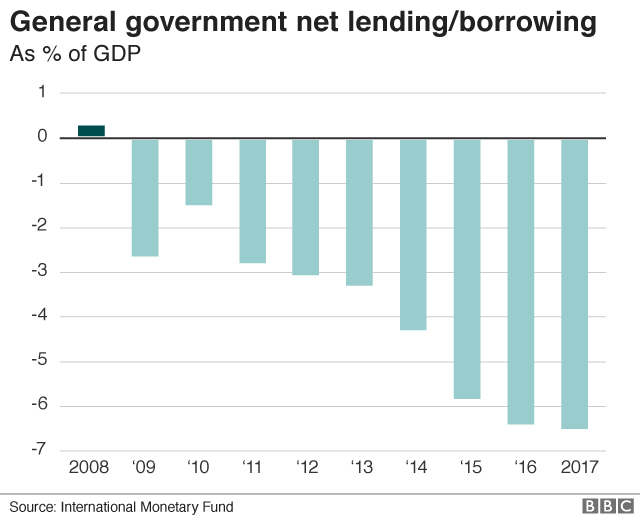
This is a nice application of the TB/Y or the Mundell Fleming Model (as the capital account opened up again recently) to figure out how a huge reduction in government spending (~6.5% of GDP) and a flexible exchange rate will affect Argentina and its reserves vs the currency board medicine which had previously been prescribed by the IMF.Image result for argentina imf cartoonSource:

Trump Tariffs: What’s The Point

By now economists are reasonably confident that Trump Tariffs were never designed to moving manufacturing jobs to the US. If that was the policy target, one would/could have gone about it in an effective fashion. Indeed there are many reasons why Trump Tariffs wont have the promised economic effect.

  1. Trump is obsessed with bilateral trade balances. Even the right wing Cato Institute tried to explain the futility of the concept and elementary trade theory clarifies the point. But that confuses Trumps intentions; his point is not the US trade balance. His point is to blame specific countries for unskilled workers plights in the US. US Commerce Secretary “We are using “trade deficit” as a shorthand way of saying job creation.”
  2. Reducing the trade deficit will not return the US to the manufacturing employment of the 1970s. US wages have increased since then and no one in the US is willing to work for Chinese or Vietnamese wages. So, even if Trump chose prohibitive tariffs (forcing the US to produce certain products in the US), firms would not use the same number of workers as in the 1970s — they would substitute ample capital to increase labor productivity to the point where they would be able to pay the going US wages. Whats next? Prohibiting artificial intelligence in the production processes?
  3. Nicholas Kristof laid out nicely decades ago that tariffs wont reduce the trade deficit. He provides some wonderful examples.
  4. The recent articles about companies moving production from China to (Chinese subsidiaries in) Vietnam show that the jobs won’t return to the US but instead move to lower wage countries. 

Tariffs on Gross Value vs Value Added Exports

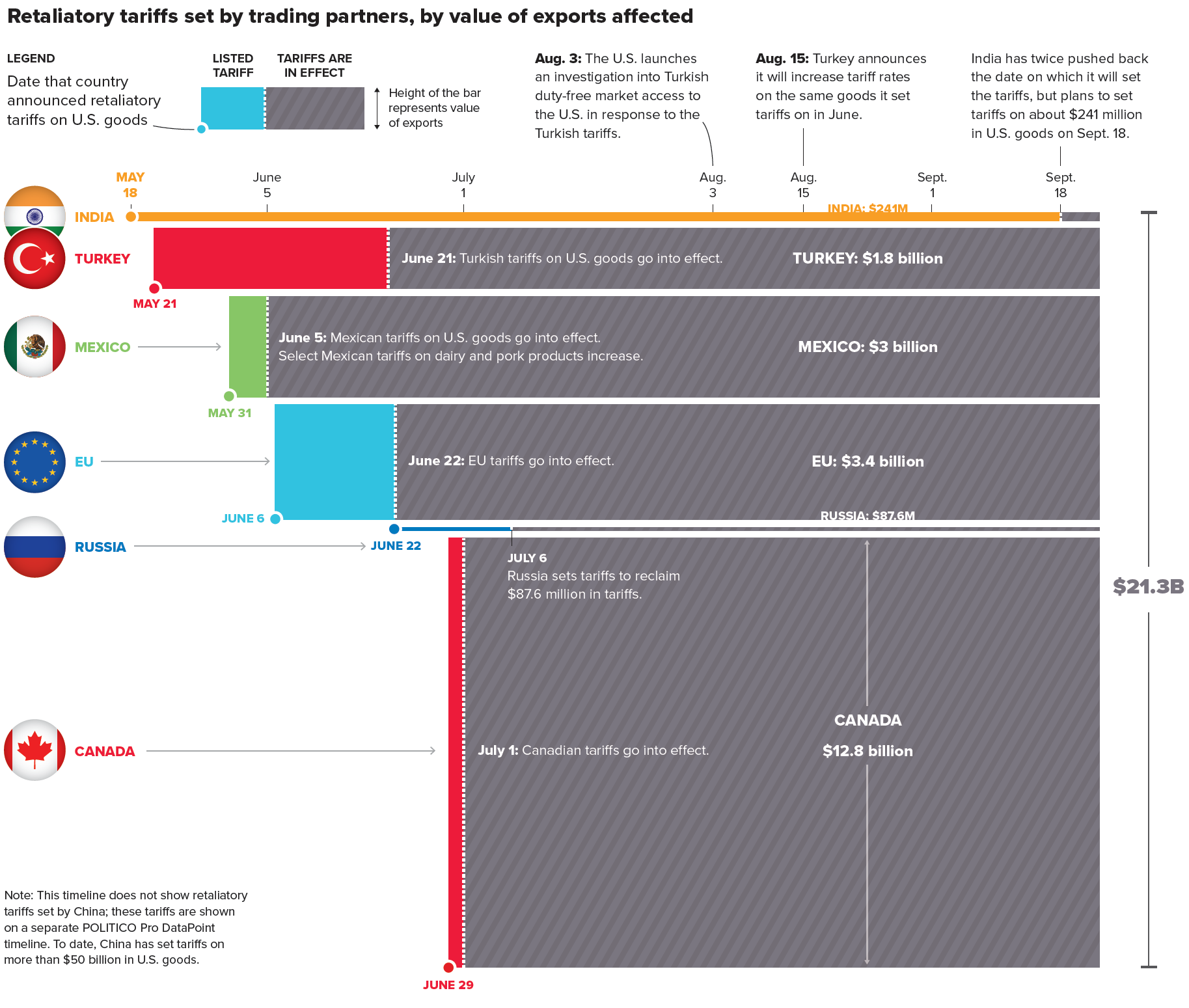
The distinction between Gross Value trade balances and Value Added trade balances is crucial, not only to identify the true trade deficit between countries, but also to assess the impact of tariffs. Take the case of China/US imposing 25% tariffs on each others’ goods. While the dollar amount of traded goods covered by the tariffs is roughly the same (around $50 billion), the effects differ. Menzie Chinn points out that US exports to China are closer to 100% value added (when the entire product is produced with US goods and inputs). However, as noted in this post, roughly 50% of the value of US imports from China is foreign sourced. Taken literally, a 25% tariff the gross value of a Chinese export works out to be a 50% tariff on Chinese value added for Chinese exporters. Generally a tariff on gross value translates into a effective higher tariff for the country whose exports have the lower value added.

Who Says Trade Wars Must Be Fought In Goods Markets?

President Trump is said to have imposed the additional $200 billion in tariffs on China (beyond the initial $50 billion) “because China cannot retaliate” — China only imports $130 billion in US goods. Not so fast, the trade balance is not TB = X – M, but we measure its value (in dollar) as

TB = P[US] * X – E*{P[China]*(1+tariff)}*M, so a devaluation of the Yuan, or an appreciation of the dollar (E decreases) implies that Chinese goods appear cheaper to US consumers (even if prices in the US and China remain constant).  Sufficiently cheaper perhaps to offset a tariff…

Menzie Chinn [you can skip the tariff analysis, if you have not taken econ 471] lays out nicely what that means for Exchange Rate Management: China has a managed exchange rate; so it could unload its Treasury Bills but the capital losses would be large. (Recent estimates of impacts on Treasury yields are here [this link is fyi only, not required).
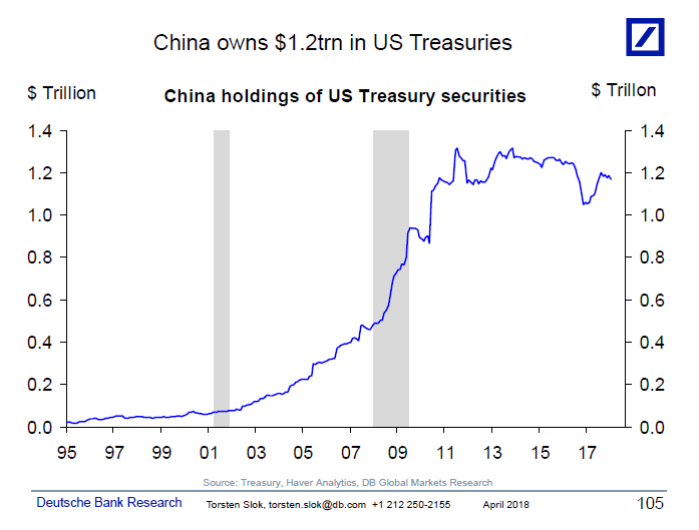
Source: Torsten Slok, April Chartbook, DeutscheBank.

However, China could do the opposite, and buy more Treasury Bills, strengthening the dollar, i.e., weakening the yuan. There is substantial scope for depreciation, as shown in Figure 2. A 25% depreciation (log terms) would restore the CNY to 2011 levels.Figure 2: Log real trade weighted Yuan (blue), nominal (red), 2010=0. March 2018 observation for March 26. Source: BIS.
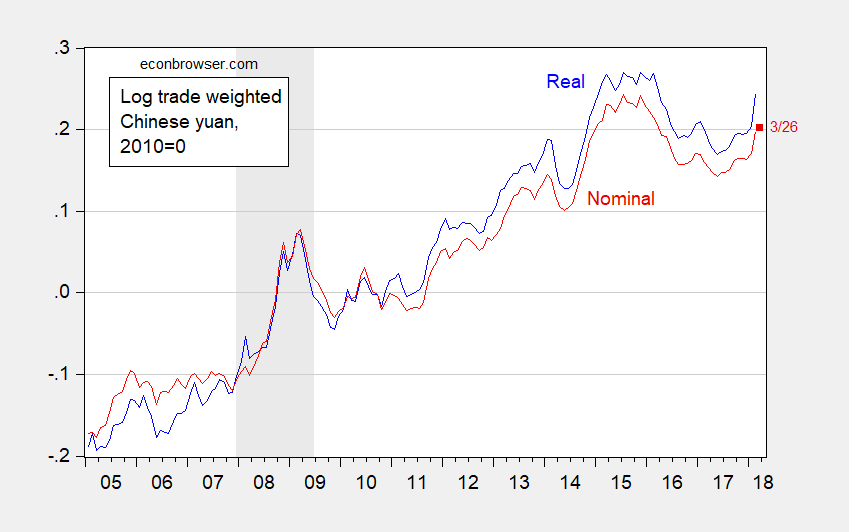
So, in order to restore competitiveness after Trump tariffs, all China needs to do is to engineer a depreciation/rebuild forex reserves. Of course a managed depreciation of the yuan would be declared “currency manipulation” by the Trump administration, who would then be calling the kettle black, since the white house first initiated the “trade manipulation” but imposing tariffs.

Update; 9/7/18 President Trump just announced he is ready to slap tariffs onto another $260 billion in Chinese goods (that’s $50bil + $200bil + $260bil = $510bil) which actually exceeds the current US trade deficit with China ($505billion). Perhaps the White House will come to its senses when it reads the Menzie Chinn post?


Forced Technology Transfer & China

China is a unique case study about technology transfer. While most developing countries have had trouble attracting sophisticated foreign direct investment in the past 200 years, China’s market size is large enough that it can impose rules on firms that seek to enter the Chinese market.

Some of these rules related to the sharing of technology/ownership structure. For example, when foreign firms can enter China only when they establish a joint venture with a Chinese company. The Chinese provide capital/land, the foreigners bring technology. This can be seen as “forced technology transfer.” At this point there are no international rules that guide which conditions countries can impose on foreign investors (in fact there are many such conditions in first world countries, too).

The problem arises, however, if the joint venture leads to misappropriation of foreign technology. For example, if one year after the joint venture has been established, the foreign company finds an exact copy of its product on the market produced by a rogue Chinese firm. Note that this is an intellectual property rights issue, not a “forced technology transfer issue;” the two are is often confused. Technology sharing in a joint venture is voluntary — foreign companies can choose not to enter. Stealing technology is a crime.

Econofact has a great discussion of the issue (based on the 2018 PIIE Brief by Lee Branstetter: “China’s Forced Technology Transfer Problem — And What to Do About It.” which I summarize in edited form:

  • The problem of protection and enforcement of intellectual property rights in China is a longstanding one — and a concern for current and previous U.S. administrations. Weak intellectual property enforcement. Studies by the current and previous U.S. administrations have tried to quantify the financial losses that these practices impose on owners of U.S. intellectual property. The wide-ranging estimates have indicated that losses could be measured in the ten of billions — perhaps even hundreds of billions — of dollars (see for instance U.S. Trade Representative 2018U.S. International Trade Commission 2011, and Commission on the Theft of American Intellectual Property 2017). These estimates mostly reflect the value of intellectual property believed to be infringed by Chinese entities, due to weak enforcement of intellectual property rights (see here).
  • There are plenty of cases when multinationals based in the U.S. or Japan or Europe will voluntarily choose to transfer technology to other firms — even other firms that they do not control. For instance, if a firm has a supplier providing a critical input, it is in the firm’s interest to make sure that that input is of high quality. If it has technology that can help the supplier be more reliable, to produce a higher quality product, or a higher-performing product, it has a strong incentive to provide that technology.
  • First World countries (and their corporations) prefer to let transacting parties work out the degree of technology transfer, without (Chinese) government interference).  That would be a key tenant of economic imperialism: let the advanced country/firm decide how to enter developing markets, vs letting the developing market decide how best to manage entry for its market benefit. The issues is even more preposterous since the first world countries, especially the US, have government rules to its own benefit that prohibit the transfer of certain technologies. The “forced technology transfer” issue in reverse, so to say.

Women In Economics (Not?)

Incredibly frustrating data, shocking annecdotes. Corroborated by

Chen, Kim, and Liuy (AER Conference Paper 2016), who find that, relative to males in the same cohort, female economists are less likely (by 9.6%) to have received tenure and promotion during the first eight years since graduation.

Antecol, Bedard, Stearns (AER 2018), who find that, using data on all(!) assistant professor hires at US top-50 economics departments from 1985-2004, the adoption of gender-neutral tenure clock stopping policies substantially reduced female tenure rates while substantially increasing male tenure rates.

Of course there is also the long legal history between Columbia and Graciela Chichilnisky, that started while I was in NY. At the time the rumor at Columbia was that the University had problems establishing the absence of wage discrimination because there were no other female professors (to establish wage comparisons) at any other Ivy League econ department.

In our department, I very much hope Judy Thornton, an absolute trailblazer of (tenured) women in economics, will write her memoirs to report on the situation starting in the 1950s. She shared with me that at Harvard she had to sit outside the door of Schumpeter’s lecture hall to hear his class (as women were not admitted to sit in class) and upon arriving at the UW in the early 1960s she reports that “one of the full professors patted me on the head and said ‘we needed a cute little instructor’.”

Trump Tariffs Vs Quotas

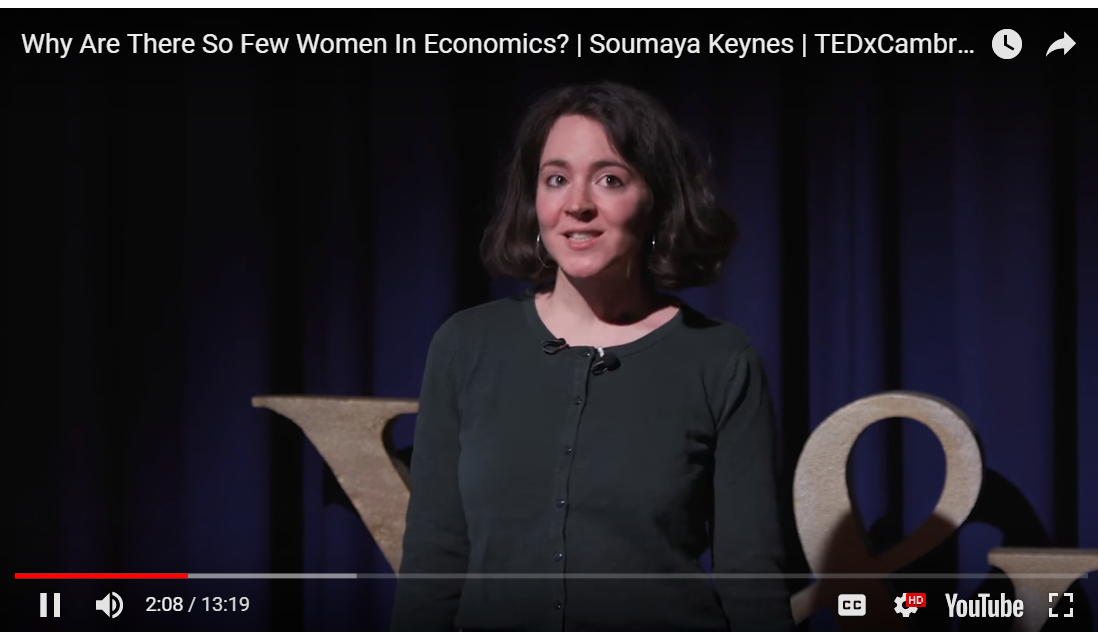
Episode 49 asks if “Trump’s Steel Quotas [are] Worse than His Steel Tariffs?Soumaya Keynes of The Economist and PIIE‘s Chad P. Bown describe how the Trump administration’s quotas imposed on steel imports from South Korea, Brazil and Argentina are different from the simple application of tariffs. They also speak with Jennifer Hillman – former administrator of US quotas for textiles and apparel in the 1990s – and Aaron Padilla (American Petroleum Institute) to explain the structure of Trump’s quotas, the perverse economic incentives and unintended consequences they create, and the new difficulties facing American businesses.


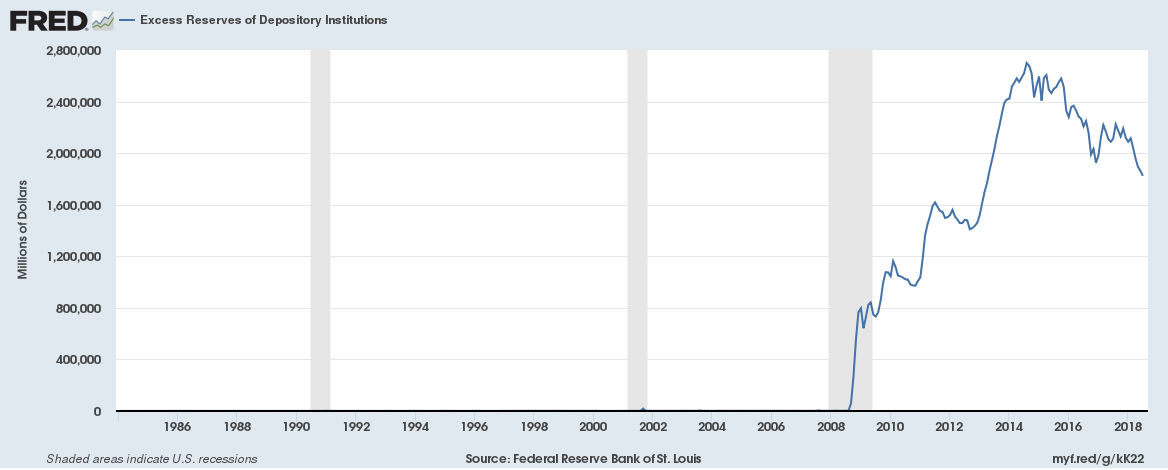
Excess Reserves

Excess Reserves are the amount of money that banks deposit at the Central Bank for safe keeping above and beyond what is necessary under the Reserve Requirement.

I have been fascinated by excess reserves since 2008, given that they reached $2.5 trillion – that is money banks decided not to lend to investors but instead stash away for safe keeping at the FED. Apparently Banks were less interested in the return ON their investment than in the return OF their investment.

Here is a good explanation of some of the reasons for excess reserves, unclear how relevant the explanation it is still today (since excess reserves are still seemingly inexplicably large).


Expenditure Reducing In Argentina (Again)

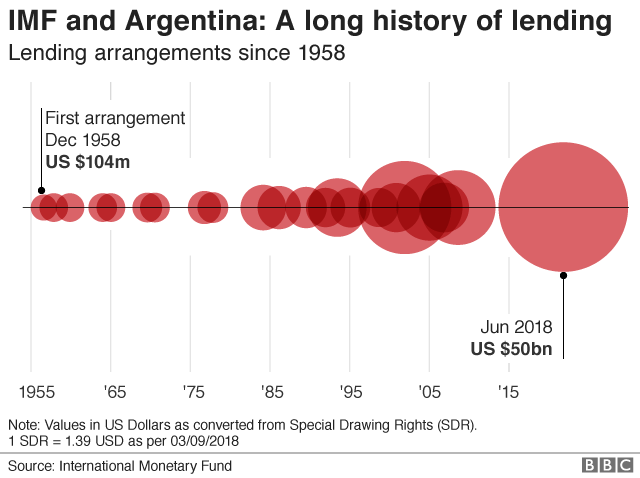
The newest Argentinean Crisis required another trip to the IMF. The BBC details the long sorted history of Argentina and the IMF (here) and (here):IMF and Argentina lending historyThe Expenditure Reducing measures announced (exceeded the IMF requirements) include “taxes on exports of some grains and other products” and “about half of the nation’s government ministries will be abolished” and “half of ministry jobs being axed.” This after January’s cuts that froze government employees’ pay and cut “one out of every four ‘political positions’ appointed by ministers.”
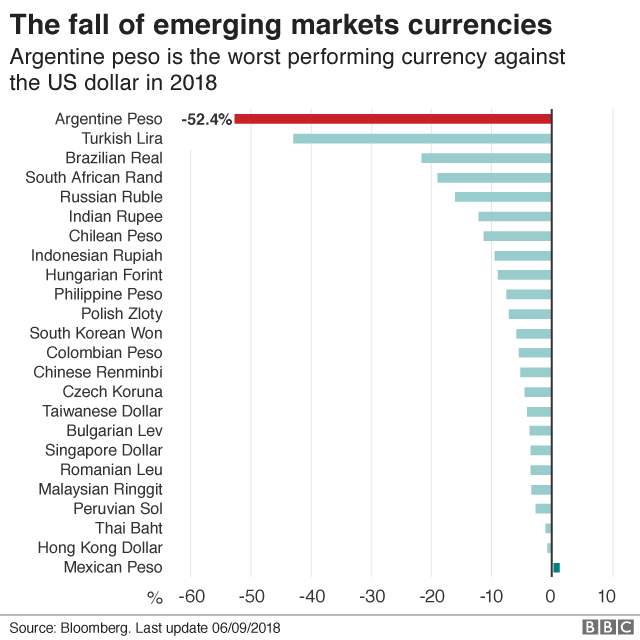
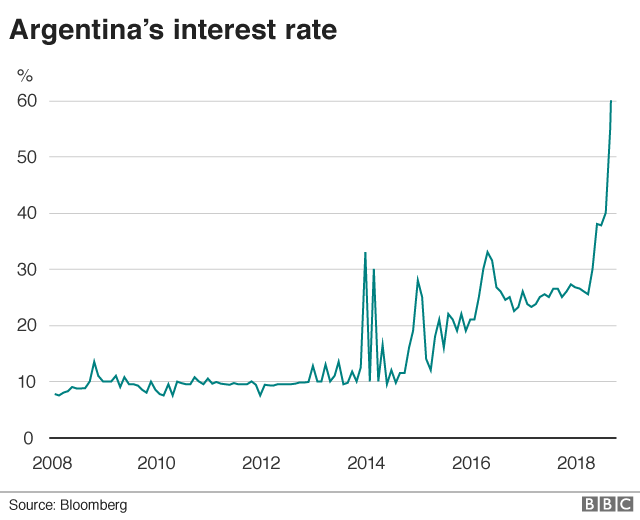
The measures are designed to stabilize the value of Argentina’s currency, which has lost about half its value this year against the US dollar, despite the central bank raising interest rates to 60%(!).

While these measures go beyond the IMF’s conditionality (FMI abbreviated in Spanish), Argentinians learn one thing: call the IMF and the country goes into a real crisis. Why?

As background info, the BBC provides key statisticsEmerging currencies

Government deficit

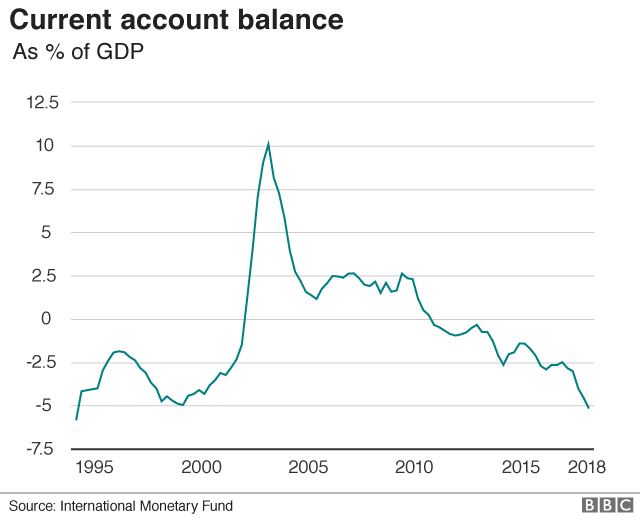
Current account balance

Interest rate

Why do you think the BBC chose these graphs?

A Way To Prop Up Stock Valuations


The WSJ reports that U.S. companies are buying back record amounts of stock this year. S&P 500 companies are on track to repurchase as much as $800 billion in stock this year, a record that would eclipse 2007’s buyback bonanza. The Real Problem With Stock Buybacks is that they transfer wealth from investors to company executives.. Billions of dollars spent to buy back shares could have gone toward investment in new factories or technology that could lead to stronger profit and wage growth in the future.

The S&P 500 Buyback index, which tracks the share performance of the 100 biggest stock repurchasers, has gained just 1.3% this year, well under performing the S&P 500, so buying back stocks does not guarantee higher stock prices. The point of buybacks is simply to make a company’s stock seem more valuable. By mopping up shares, a company shrinks the stock pie, which boosts earnings per share. That, in turn, should push the share price higher.

The strategy is risky, if companies buy their own stock that eventually falls in price. In 2008, Exxon Mobil Corp. Microsoft Corp. MSFT 0.34% and International Business Machine Corp. paid more than $18 billion to repurchase stock at a peak, only to see their share prices slump a year later. These days Oracle has been one of the biggest buyers of its own stock in recent years and spent $11.8 billion on stock repurchases last year, when shares gained nearly 23%.

Why are corporations using their cash to buy back stocks? How do you spell “WINDFALL”? Courtesy of Goldman Sachs, we know where the Trump Tax Cut is really going. Surprise! It’s paying for stock repurchases by corporations, as Corporate America despairs of investing in much other than dividing the pie provided by near-record profitability into fewer and larger pieces. Buyback announcements were up 22% to $67 billion in just six weeks after the tax cut passed.