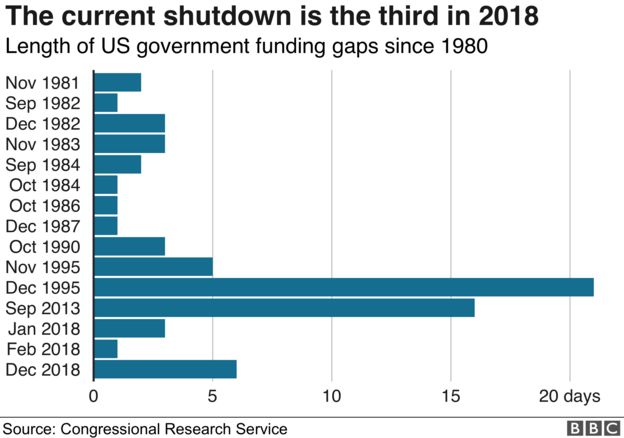
The BBC reports how the 2019 US government shutdown is playing out:
Nine of 15 federal departments, including State, Homeland Security, Transportation, Agriculture and Justice began partially shutting down after funding for them lapsed at midnight (05:00 GMT) last Saturday.
Hundreds of thousands of federal employees will have to work unpaid or are furloughed, a kind of temporary leave.
In practice, this means that:
Customs and border staff will keep working, although their pay will be delayed. Airports will continue operating.
About 80% of National Parks employees will be sent home, and parks could close – although some may stay open with limited staff and facilities.
About 90% of housing department workers will take unpaid leave, which could delay loan processing and approvals.
Most of the Internal Revenue Service (IRS) will be sent on unpaid leave, including those who assist taxpayers with queries.
The Food and Drug Administration will pause routine inspections but “continue vital activities”.
The remaining 75% of the federal government is fully funded until September 2019 – so the defence, veterans affairs, labour and education departments are not affected.
The Guardian reports how parts for the Mini Cooper Car ship back and forth across Europe, several times to and from the same country!
A Mini part’s incredible journey shows how Brexit will hit the UK car industry. Multiple cross-Channel road trips highlight how carmakers and suppliers in Britain and the EU are intertwined.
If there is just one anecdote that succinctly sums up the problems that Brexit and the threat of tariffs pose to the UK car industry, it is this: the story behind the crankshaft used in the BMW Mini, which crosses the Channel three times in a 2,000-mile journey before the finished car rolls off the production line.
A cast of the raw crankshaft – the part of the car that translates the movement of the pistons into the rotational motion required to move the vehicle – is made by a supplier based in France.
From there it is shipped to BMW’s Hams Hall plant in Warwickshire, where it is drilled and milled into shape. When that job is complete, each crankshaft is then sent back across the Channel to Munich, where it inserted into the engine.
From Munich, it is back to the Mini plant in Oxford, where the engine is then “married” with the car.
If the car is to be sold on the continent then the crankshaft, inside the finished motor, will cross the Channel for a fourth time.
How Mini crankshafts cross the Channel during car manufacturing
Another well-travelled car part is the Bentley bumper. It is made in eastern Europe before being sent to Crewe for further work, then on to Germany for finishing and finally back to Crewe where it is added to the luxury vehicle. The UK automotive industry is right at the centre of concerns about what damage Brexit might inflict on the British economy – because the expansion of car plants since the financial crisis is based on remarkable levels of cooperation with suppliers on the continent. The 1.72m cars produced in the UK last year was a 17-year high and by 2020 production is currently expected to top the all-time high of 2m achieved in 1972. But on average, just 41% of the parts used in a car assembled in the UK are actually produced in the country.
Bosses in the automotive industry are not just concerned about the impact of tariffs on vehicles made in the UK that are sold abroad, but on the parts used to make them, and whether they will still be able to move parts across the Channel quickly and affordably. The modern automotive industry supply chain means that some car parts go back and forth across the Channel far more times than a Mini crankshaft before reaching the final assembly line.
“The automotive industry has potentially exploited the single market more than any other sector,” Mike Hawes, chief executive of the Society of Motor Manufacturers and Traders, said.
“There are hundreds and thousands of movements per car. Anything that changes or puts barriers to that free flow of parts will have an effect. It is fundamental to the efficiency in this country.”
The speed at which parts are moved from factory to factory is critical. Most car plants in Britain operate with what is known as “just-in-time” (JIT) production, an idea imported from Japan. This involves components being added straight to the car when they arrive at the factory rather than being stored in a warehouse. The system dramatically improves the productivity of the plant – but any interruption to supply can bring production to an immediate halt.
Tim Lawrence, head of manufacturing at PA Consulting, said: “They schedule components on the production line and sequence it so parts arrive only hours before. You may think that sounds straightforward, but there is quite an art to this JIT supply chain. If you put a customs unit in place [because you are no longer part of a single market] things could be delayed at the border for a couple of day – it really has an impact.”
“There are two ways [for a carmaker] to approach it,” he said. “You could look to bring components into the UK to manufacture, so it could have a positive impact. But the challenge is if you are exporting 80% of the vehicles – like Nissan are or Vauxhall are from Ellesmere Port – you have to question the benefits of that if there will be tariffs on exports.
“The margins are slim for OEMs [original equipment manufacturer] – 5% to 10%. If you add a 10% tariff you could charge the customer more – which is unlikely – or you look at it very quickly and say ‘It’s going to to cost us hundreds of millions of pounds a year or the cost of a new plant is £800m to £1bn, so let’s move manufacturing’.”
The industry – led by Hawes and the SMMT – is lobbying the government heavily about issues including tariff and bureaucracy-free arrangements for the movement of car parts in any agreement with the European Union. But it has also highlighted the need for complex rules around the origin of parts to be recognised.
Existing trade deals between the EU and other countries include rules that products must have a certain proportion of parts built in their home market to avoid tariffs. For example, in the EU’s agreement with South Korea 55% of the parts in a car must be sourced from Europe to qualify for free trade.
These rules are an issue for the UK industry because less than half of parts in cars assembled in the country are sourced domestically. This means the government will need to persuade the EU and other countries with which it wants free-trade agreements that EU-sourced components should be classed as local content.
As Lawrence suggested, UK manufacturers are already attempting to build up the supply chain in Britain and encourage major suppliers to open plants in the country.
The Nissan executive warned that the future of the Sunderland plant will be at risk if the government does not provide £100m towards building the supply chain in Britain.
Nissan’s site – the largest car plant in the UK – uses 5m parts a day on a production line that makes two cars every minute. “We’re talking two, three, four, six minutes’ downtime a day interruption is a disaster,” Lawther said.
The coalition government oversaw a programme to boost the number of component makers in the UK in collaboration with the industry. The Automotive Investment Organisation – part of UK Trade and Investment – is still working to boost investment.
However, Sir Vince Cable, the business secretary between 2010 and 2015, said the progress of the industry since the financial crisis was at risk.
“What is happening now is a shock to the system,” he said. “At the moment it is all bits and pieces [of news] but it adds up to an industry that is unhappy and unsettled.
“There are two things that will happen. Decisions over new models will switch away from the UK and I think when a company is face with tough decisions – like Vauxhall/Opel – the likelihood is it will go against the UK.”
Cable said there is likely to be “intensive lobbying” from the German government to protect jobs at Opel if PSA, the owner of Peugeot, completes a takeover of General Motors’ European business. “Its difficult to see what Britain can offer them [PSA] other than years of uncertainty,” he warned.
The Guardian visualizes the effect of the UK leaving the EU without a new preferential trading agreement in place.
1. Emergency planning costs balloon as the government prepares for medical shortages
The Treasury this week announced a further £2bn in “Brexit preparedness” funding, to cope with the extra costs of a no-deal exit, taking the total to more than £4bn. At the same time, the health secretary, Matt Hancock, said he had “become the world’s No 1 buyer of fridges” as part of a plan to stockpile essential medicines.
“Tariffs will make our country much richer than it is today,” President Trump tweetedin August. So far, there’s not much evidence of that. As the left-hand graphic above shows, U.S. exports to China have plummeted since June—while U.S. imports from China have continued to rise. Meanwhile, U.S. importers (many of whom are exporters) have seen their U.S. tariff bill more than double since May, topping $5 billion in October.
Trump’s tariff war has some clear winners, however—high among them, Russia. As shown in the left-hand graphic, Chinese imports from non-U.S. firms have continued to grow at a robust 18 percent year-over-year rate while those from U.S. firms have fallen. Among the hardest-hit U.S. sectors have been soybeans, autos, and oil. Whereas China had accounted for about 22 percent of U.S. oil exports in the two years to July 2018, it fell to zero thereafter. This has proven a boon to alternative suppliers like Russia, as shown in the right-hand figure. And so, in the ultimate irony, Americans are paying tariffs that boost the profits of Russian firms subject to U.S. sanctions.
115 Percent of Trump’s China Tariff Revenue Goes to Paying Off Angry Farmers
The Blog Post by Steil & Della Rocca from the Council of Foreign Relations highlights that tariffs are income reducing. Trump will be paying out more to compensate farmers than what the US raises in tariff revenue on all Chinese import tariffs:
“Billions of Dollars are pouring into the coffers of the U.S.A.,” tweeted President Trump last month, “because of the Tariffs being charged to China. It would be nice if it were true. But it is, in fact, doubly false.
First, tariffs are not “being charged to China.” They are being charged to American firms importing Chinese goods. As the left-hand bar in the graphic above shows, such firms will pay about $8.4 billion in tariffs on China imports by the end of 2018.
Second, this tariff revenue does not remain in U.S. government “coffers.” As shown in the right-hand bar above, all of it and more is being paid out to American farmers as partial compensation for their losses from Chinese tariff retaliation. The U.S. government has already committed to paying out $1.2 billion more to angry American farmers than it will take in this year from angry American firms.
By launching a trade war with China, therefore, the president has simultaneously raised taxes on U.S. companies and lost the government money. And with the farm constituency critical to his 2020 re-election hopes, the losses are only set to mount going forward.
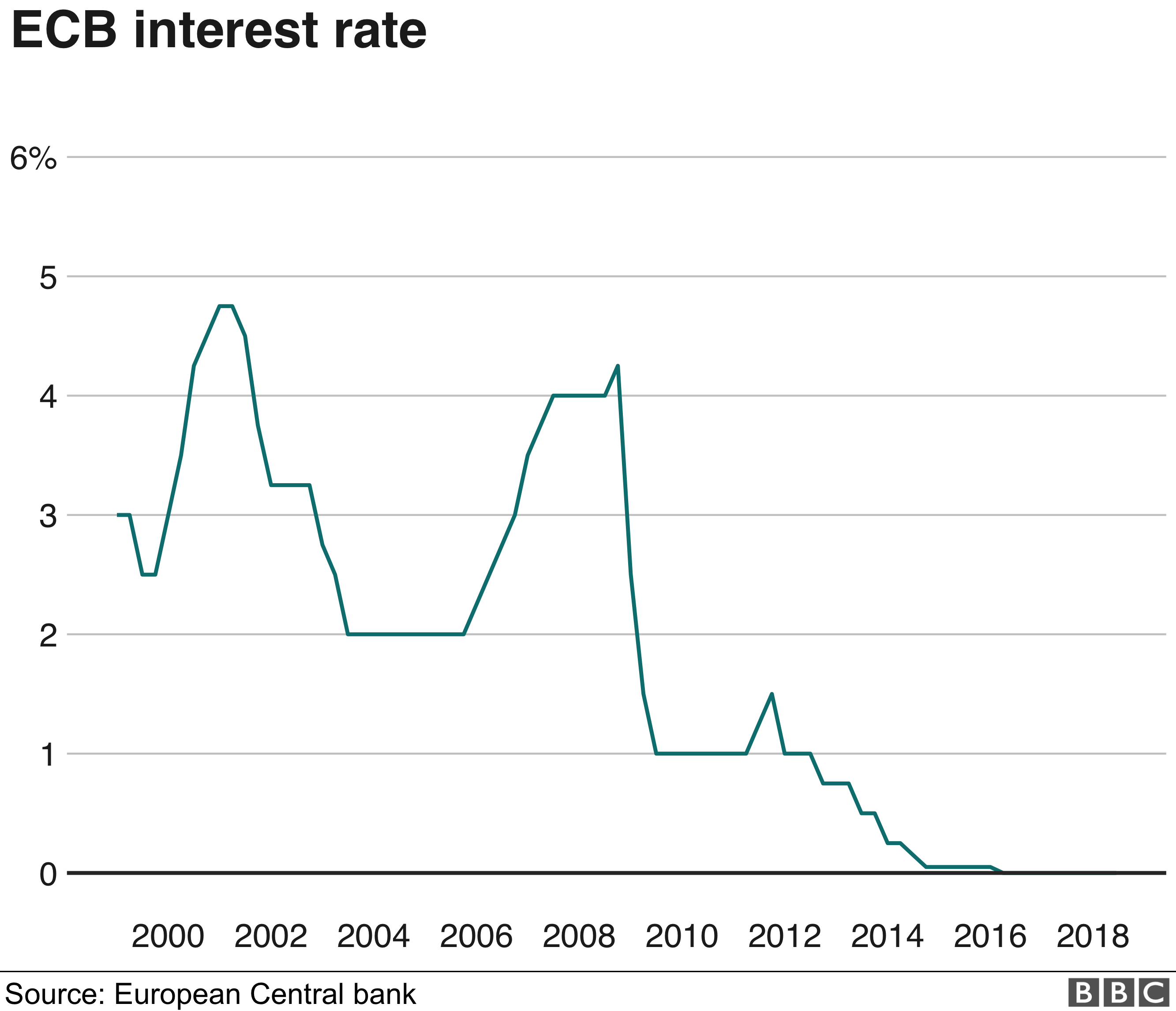
Eurozone inflation finally surpassed the 2% threshold in October 2018 so it was clear EU QE would come to an end sooner rather than later. The 2.5 trillion euro bond purchasing program of the European Central Bank, which was started in 2015 to stimulate economic recovery, has finally done its job. Perhaps. The ECB deposit rate on excess reserves is still negative, and the ECB lending rate is still zero. What do we expect of Eurozone interest rates and the value of the Euro in the future? (Give key determinants of the Euro’s value.)
From the national savings identity we can derive an immediate correlation between the “Trade Deficit ” and the “Fiscal Budget Deficit.” Desmond Lachman connects the dots between “America First” Policy and the “Twin Deficits” [edited version]:
A principal objective of President Trump’s ‘America First’ trade policy is to eliminate the US trade deficit in general and that with China in particular. To that end, President Trump has announced a large increase in steel and aluminium import tariffs as well as higher tariffs on $60bn of Chinese products. In addition, he is demanding that China takes measures to reduce its bilateral trade deficit with the US by $100bn.
While implementing his America First trade policy, President Trump is also pursuing an expansionary budget policy. He is doing so even though the Federal Reserve judges that the US economy is at or beyond full employment. He has introduced an unfunded tax cut that will increase the budget deficit by $1.5tn over the next decade, according to the Congressional Budget Office, and he has gone along with a Congressional bill that will increase public spending by $300bn over the next two years.
The Trump administration seems unaware that a necessary condition for the reduction of the US trade deficit is that the US must raise its savings rate relative to its investment rate. This holds true whatever the government might do regarding import restrictions and exchange rate policy. Overlooking this basic tenet of economics seems to blind the administration to the fundamental inconsistency between its trade policy objectives and its budget proposals.
According to the Committee for a Responsible Federal Budget, a Washington-based non-profit organisation, the tax and spending measures will increase the US budget deficit to more than $1.1tn as early as 2019, from $660bn in 2017. At a time when household saving has sunk to very low levels, the prospective widening in the budget deficit will almost inevitably reduce the overall level of savings. It will also cause the trade deficit to widen as it did in the time of the Reagan twin deficits, when the US experienced both a fiscal and a current account deficit.
Another area in which the administration’s China trade policy conflicts with its budget policy relates to the financing of the US budget deficit. One has to question the wisdom of picking a fight with China, the largest holder of US Treasuries, at a time when the US budget deficit is set to approximately double over the next two years. […The] last thing the Trump administration needs is a spike in long-term government bond rates that could roil US and global financial markets. Rather than being a large buyer of US Treasuries, the Federal Reserve has become a seller in an effort to shrink its bloated balance sheet. And the US is antagonizing the largest holder of Treasuries while government borrowing is set to rise sharply.
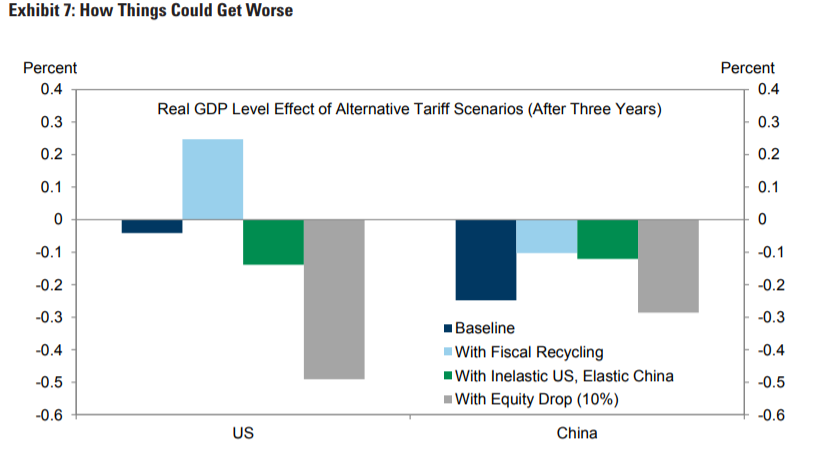
Goldman Sachs estimates the negative impact of the US-Chinese tariff war. They consider not only the straight effects on the Goods trade balance, but also the elasticities of the goods traded and also secondary effects such as a stock market collapse as company profitability declines. Interestingly the second order effect from a stock market decline is estimated to have the largest impact.
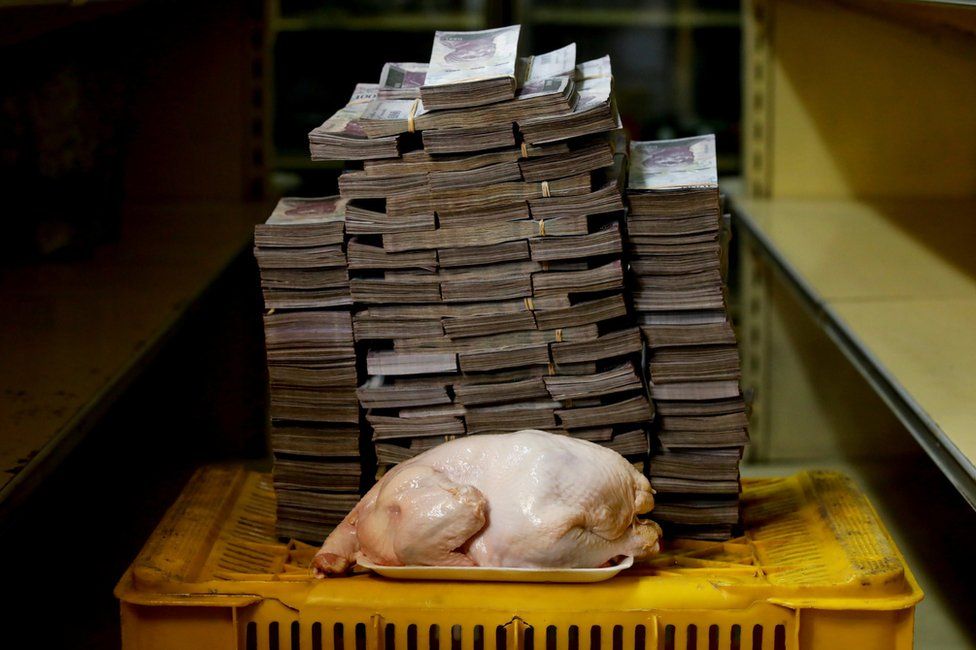
The BBC has a nice feature visualizing hyper inflation. Below is a picture when a chicken cost 14,600,000 bolivars (equivalent to $2.22, or £1.74) in the Venezuelan capital, Caracas.or when a roll of toilet costs 2,600,000 bolivars.This explains pictures circulating on the web asking people NOT to use banknotes as toilet paper… Also, imagine the volume of money needed to buy a car!
And yes, the Venezuelan fiscal deficit is out of control, at about 20% of GDP.
This BBC article shares a history of memorable hyperinflation events.



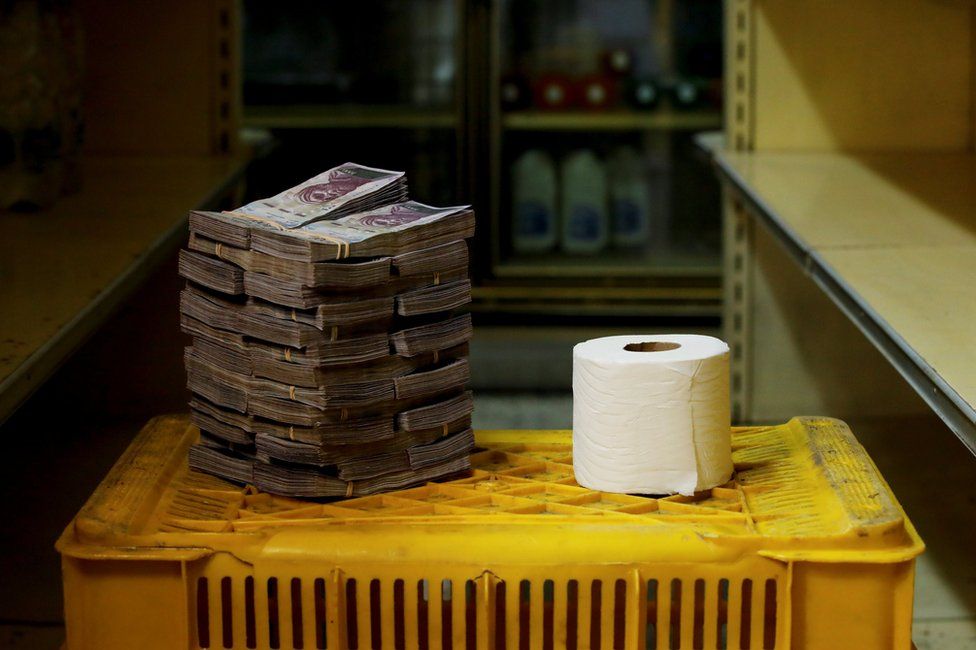 This explains pictures circulating on the web asking people NOT to use banknotes as toilet paper… Also, imagine the volume of money needed to buy a car!