What Happened to the Trump Corporate Tax Cut: Part II?

How much of a stimulus did the economy receive from the 100’s of billions in tax cuts corporations received? Reuters/Yahoo reports that U.S. companies used the money to go on a shopping spree for their own stocks to raise their own share prices.

These stock buybacks were a major factor behind the 2018 bull market. “Companies bought back around 2.8 percent of shares outstanding in 2018. That was a substantial support to the market and bigger than dividends,” said Jack Ablin, chief investment officer at Cresset Wealth Advisors in Chicago. 2018 will go in the books as a record for buybacks. Through the first three quarters of the year companies bought $583.4 billion of their own stock, just shy of 2007’s full-year record of $589.1 billion, according to S&P Dow Jones Indices data.

Strategists say U.S. companies spend heavily on their own shares as they have plenty of cash and tend to favor buybacks over dividends and major capital investments in times of economic and policy uncertainty. Goldman Sachs has forecast a 44 percent jump in buybacks to $770 billion for 2018, with growth slowing to a 22 percent rise to $940 billion for 2019.

After rushing home some $295 billion of foreign profits in the first quarter of 2018, the pace of repatriation by U.S. multinationals has since slowed sharply, Commerce Department data shows. In the third quarter that was down to about $93 billion. About $190 billion, or about a third, of repatriated funds were used on buybacks in the first three quarters of 2018, JPMorgan strategist Nikolaos Panigirtzoglou wrote.

FEEDING THE BULL

Buybacks have been a major support to the bull market that began in March 2009. S&P 500 companies bought roughly $4.5 trillion worth of their own shares, equal to about a third of the benchmark’s $15 trillion gain in value over that time, according to Audrey Kaplan, head of global equity strategy at Wells Fargo in New York. Datatrek Research said U.S. companies tend to spend between 40 percent and 60 percent of operating income on buybacks and only breach the low end in “the direst times.”

What Happened to the Trump Corporate Tax Cut: Part I?

President Trump signed the “Tax Cuts and Jobs Act” into law on Dec. 22., 2017, bringing sweeping changes to the tax code. The tax cut features temporary changes to the individual tax code and permanent changes to corporate taxes. Overall it is a $1.5+ trillion overhaul. Investopedia has the details. The tax cuts permanently remove the “individual mandate,” which was a key provision of the Affordable Care Act; this will raise health care insurance premiums and significantly reduce the number of people with coverage. The highest earners are expected to benefit most from the law, while the lowest earners may actually pay more in taxes once most individual tax provisions expire after 2025.

For the wealthy, banks and other corporations, the tax reform package can be considered a lopsided victory given its significant and permanent tax cuts to corporate profits, investment income, estate tax and more. Financial services companies, especially, stand to see huge gains based on the new, lower corporate rate (35% to 20%) as well as more preferable tax treatment of pass-through companies. Some banks have said that their effective tax rate will drop under 20%.

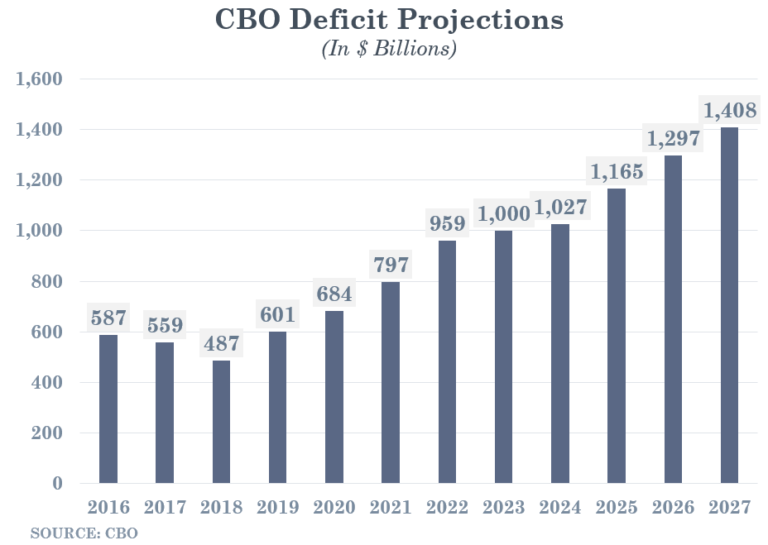
The overhaul is forecast to raise the federal deficit by hundreds of billions of dollars – and perhaps as much as $2.0 trillion – over the coming decade. Estimates vary depending on assumptions about how much economic growth the law will spur, but no independent estimates follow Treasury Secretary Steven Mnuchin, who is by law required to study the impact of the tax change on US dept predicts net reduction to the national debt as a result of the overhaul. The entire study of the trillion dollar overhaul by Mnuchin was a single paragraph.

The Peterson Foundation reports that, on October 15, 2018 the Department of the Treasury released its tally of budget totals for fiscal year 2018. In that report, they showed that corporate income tax receipts fell from $297 billion in 2017 to $205 billion in fiscal year 2018 — a 31 percent drop. Such a large year-over-year drop in corporate income tax revenue is unprecedented in times of economic growth. The 31 percent drop in corporate income tax receipts last year is the second largest since at least 1934, which is the first year for which data are available. Only the 55 percent decline from 2008 to 2009 was larger. While that decrease can be explained by the Great Recession, the drop from 2017 to 2018 can be explained by tax policy decisions.

The falloff in corporate tax collections in 2018 exacerbated the growth in the annual deficit, which rose by $113 billion relative to 2017 (from $665 billion to $779 billion). Looking ahead, deficits are expected to continue rising in the years to come, and diminished corporate tax revenues will be an important contributor to those deficits.Revenues, by Major Source(source)(source)

Getting Tired of Winning

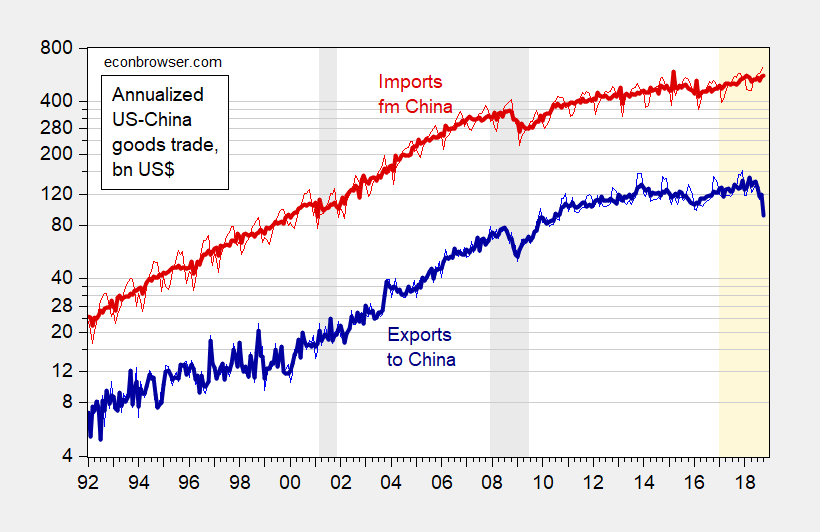
The country might be getting tired of this kind of winning, as Menzi Chinn points out in his update of Trumps fixation of the China-US bilateral trade balance:US merchandise exports to China (blue), and seasonally adjusted using X-13 with lunar new year dummy (bold dark blue), and US merchandise imports from China (red), and seasonally adjusted (bold dark red), both in billions US$, at annual rates. NBER defined recession dates shaded gray. Trump administration shaded light orange. Source: BEA/BuCensus, NBER, and author’s calculations.

Of course, examining any bilateral trade balance is not the right metric (see here). If any trade balance matters, it is the overall, not a bilateral. Also, this is part II of the ongoing series “tired of winning the trade war”


Economists’ Statement on Carbon Dividends

27 Nobel Laureate economists, 3 other former Chairs of the Federal Reserve and 15 former Chairs of the Council of Economic Advisers and thousands of economists from around the country are signatories of the Economists’ Statement below. The statement was released today on the opinion page of the Wall Street Journal. It outlines what we believe is the most cost-effective, equitable and politically-viable national climate solution. Now more than ever, it is critical for economists to point the way forward and coalesce around a bipartisan climate policy.

ECONOMISTS’ STATEMENT ON CARBON DIVIDENDS

Global climate change is a serious problem calling for immediate national action. Guided by sound economic principles, we are united in the following policy recommendations. 

I.          A carbon tax offers the most cost-effective lever to reduce carbon emissions at the scale and speed that is necessary. By correcting a well-known market failure, a carbon tax will send a powerful price signal that harnesses the invisible hand of the marketplace to steer economic actors towards a low-carbon future. 

II.         A carbon tax should increase every year until emissions reductions goals are met and be revenue neutral to avoid debates over the size of government. A consistently rising carbon price will encourage technological innovation and large-scale infrastructure development. It will also accelerate the diffusion of carbon-efficient goods and services. 

III.        A sufficiently robust and gradually rising carbon tax will replace the need for various carbon regulations that are less efficient. Substituting a price signal for cumbersome regulations will promote economic growth and provide the regulatory certainty companies need for long- term investment in clean-energy alternatives. 

IV.        To prevent carbon leakage and to protect U.S. competitiveness, a border carbon adjustment system should be established. This system would enhance the competitiveness of American firms that are more energy-efficient than their global competitors. It would also create an incentive for other nations to adopt similar carbon pricing. 

V.         To maximize the fairness and political viability of a rising carbon tax, all the revenue should be returned directly to U.S. citizens through equal lump-sum rebates. The majority of American families, including the most vulnerable, will benefit financially by receiving more in “carbon dividends” than they pay in increased energy prices.