“Northern Economics Inc” provided an economic impact study of the Washington Shellfish Industry: Over 2500 jobs created, over $250 million in output and labor income. 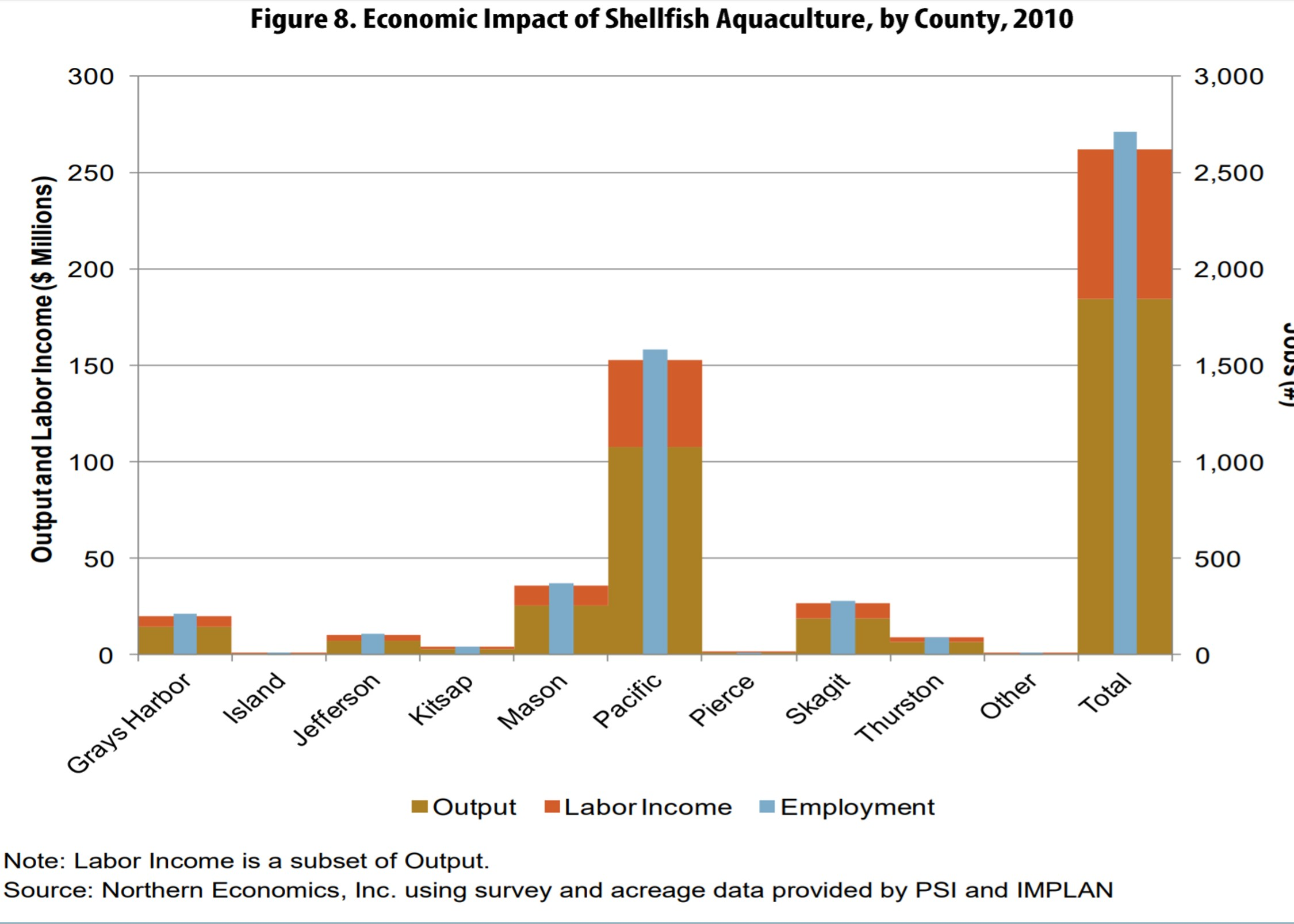
Note that these gains are largely private, that is, they accrue to private individuals such as workers or business proprietors. What the study does not mention are the costs, most of them public. Cliff Mass at the UW, summarizes the harrowing costs outlined in the must-read book “Toxic Pearl” (The Kindle version from Amazon is only $5.99)) ![Toxic Pearl: Pacific Northwest Shellfish Companies' Addiction to Pesticides? by [Perle, M.]](https://images-na.ssl-images-amazon.com/images/I/41yrgTY7ohL.jpg)
Here is the abstract from Mass’ blogpost: The book describes
- Poisoning of Washington State’s shorelines by some members of the shellfish industry.
- Spraying of herbicides and pesticides over State shorelines from Puget Sound to Willapa Bay,
- Spread of plastic pollution,
- Physical destruction of shorelines areas.
- Cooperation of WA Department of Ecology and Natural Resources officials and even the Governor’s office with the shellfish industry, and even the participation of the State’s educational institutions like WSU and the UW. Apparently The WA State Departments of Ecology and Natural Resources have supported the use of pesticides to kill the native burrowing shrimp.
For decades, this industry, sprayed the pesticide Carbaryl, a powerful neurotoxin (also known as Sevin) around Willapa Bay and other local shore areas to kill a Washington State native animal, the burrowing shrimp. Burrowing shrimp are an important food source for many native species including fish, birds, and crabs.
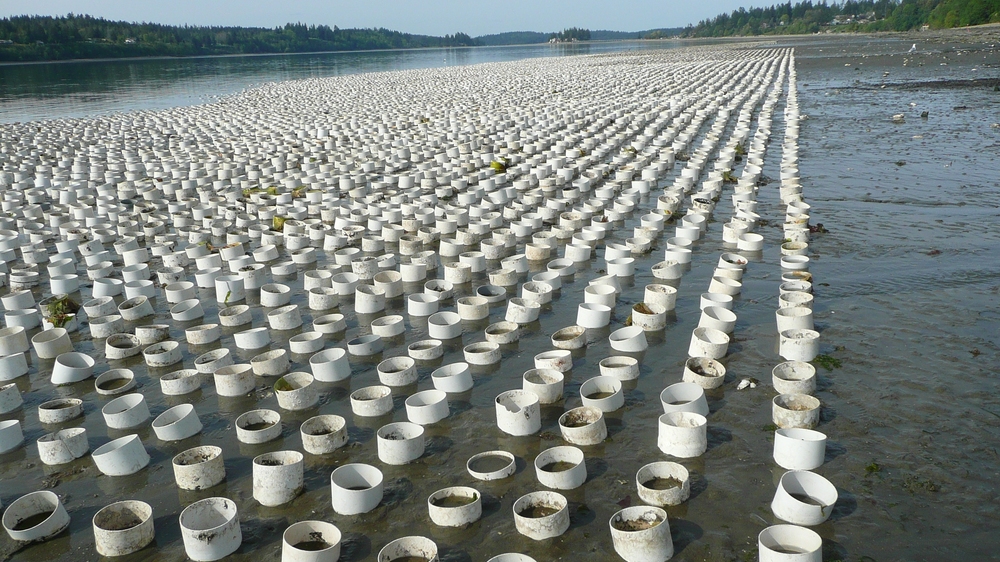
Some members of the shellfish industry are also spraying herbicides such as imazamox over the coastal zone to kill eel grasse to make it easier for the industrial clam and oyster operations. Such grasses are important source of food for wildlife and provide habitat for a wide variety of species. More recently, some in the shellfish industry is pushing to spray ANOTHER neurotoxin (Imidacloprid) over our coastal waters. And, chasing the high-value Chinese market for geoducks, the industry is putting in miles of cut-off plastic tubes with plastic netting over mudflats around the region, resulting in the dispersal of plastic pollution throughout our coastal environment (see picture below).
Toxic Pearl also documents sickness and illness following the spraying, and reviews the association of spraying with a large increase of miscarriages among the Shoalwater Bay Tribe.
In 2015, Danny Westneat of the Seattle Times wrote an important article outlining the herbicide/pesticide spraying by the WA shellfish industry, but some of the clam/oyster folks are still spraying herbicides and pushing to spray Imidacloprid.




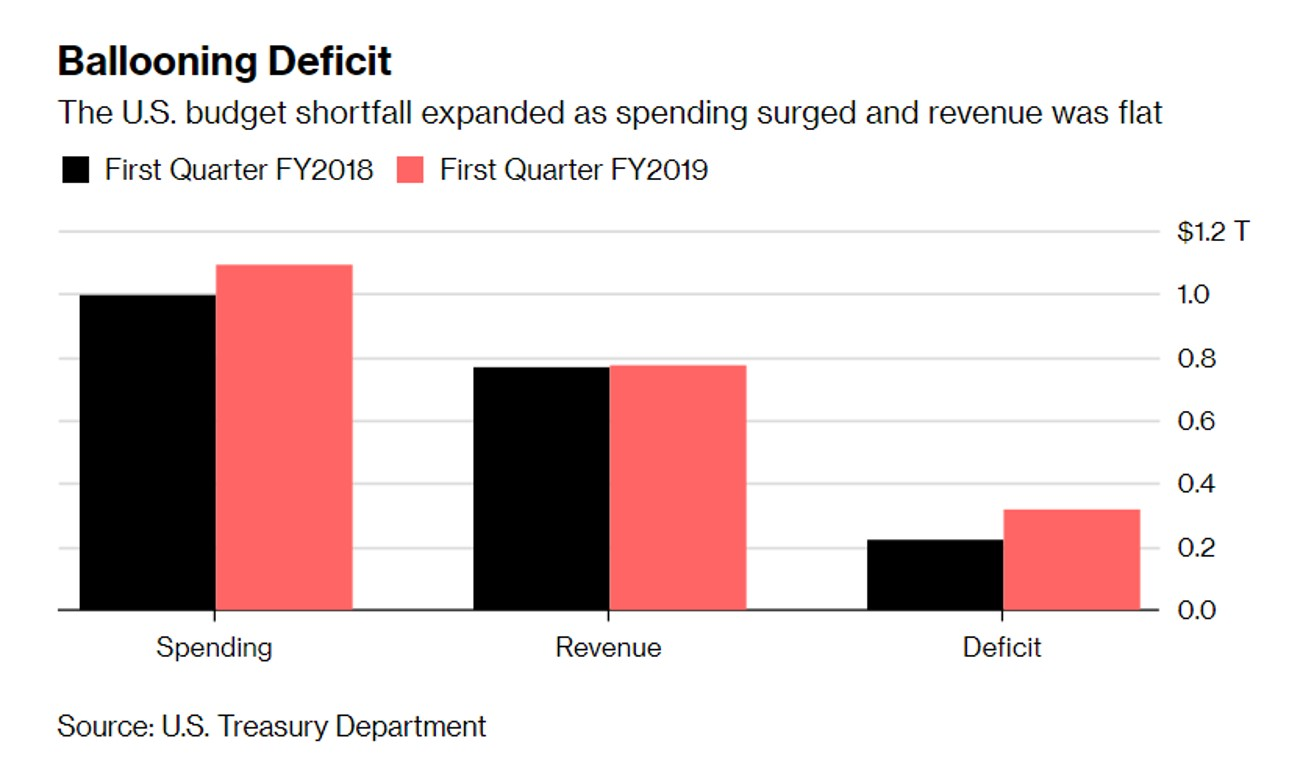
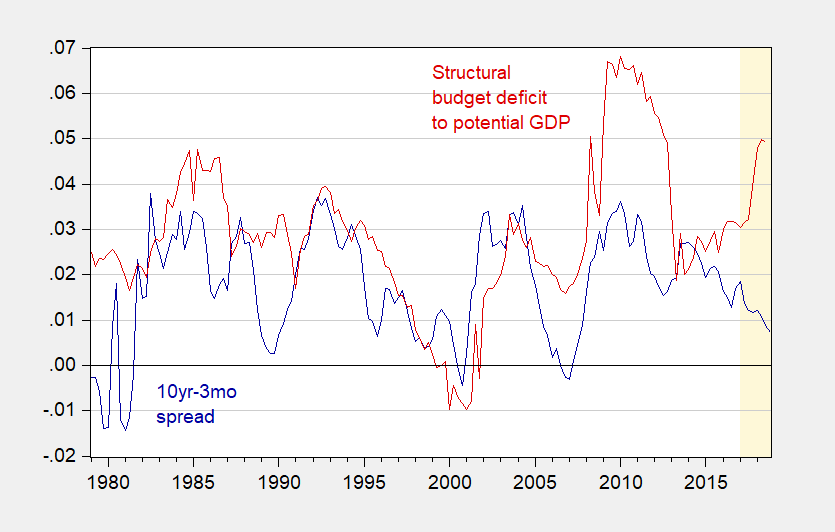 Figure 1: 10 year-3 month Treasury spread (blue), structural budget deficit as a share of potential GDP (red). Orange shading denotes Trump administration. Source: Federal Reserve, CBO, Budget and Economic Outlook, and Chinn’s calculations.
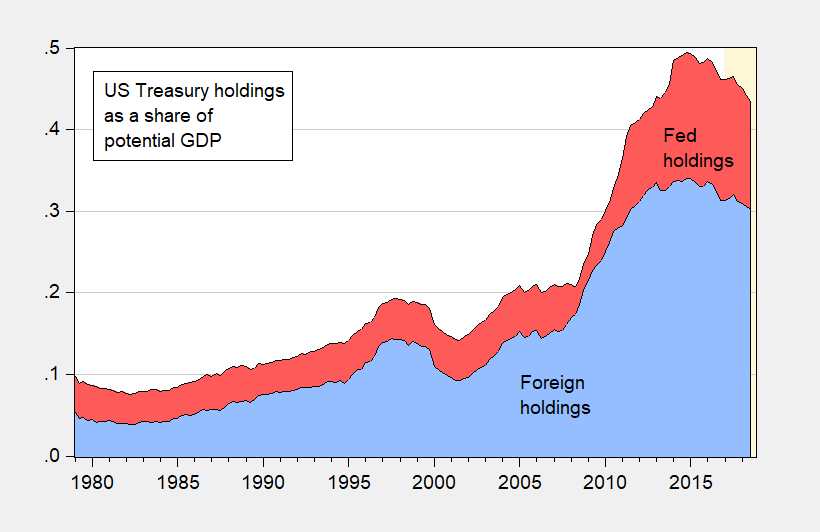 Figure 2: Foreign and international holdings of US Treasurys (blue) and Federal Reserve holdings (red), both as a share of potential GDP. Source: BEA, CBO, and Chinn’s calculations.