My Son Just Bought His College Laptop…

T’was an HP that my son ordered, which was custom built and shipped straight from the factory in China to our doorstep. No notions that there may be any American manufacturing involved (like the Dells computers who first make their way to Texas to be shipped out from an American address). Fortune Magazine reports that

Dell, HP, and Microsoft said they account for about half of the notebooks and detachable tablets sold in the U.S. Prices for laptops and tablets will increase by at least 19%—about $120 for the average retail price of a laptop [and game consoles!] — if the proposed tariffs are implemented, according to a study released this week by the Consumer Technology Association. The companies said they spent a collective $35 billion on research and development in 2018 alone, and tariff costs would divert resources from innovation while providing “a windfall” to manufacturers based outside the U.S. that are less dependent on American sales.”

So the Chinese exporters that Trump is trying to hurt are actually US companies. The profit shifting from China to the US are actually reducing US companies’ profits as the tariff reduces US companies’ profits relative to competitors who ship their computers to non US consumers (from China).

Here are the results from the study: After accounting for new tariff revenue, there is a net $8.1 billion loss for the U.S. economy, from cell phone and laptop tariffs alone, with most of the burden carried by U.S. consumers.

CELL PHONES:

  • Change in Price of Chinese Imports +22.0%
  • Change in Chinese Production -4.8%
  • Change in U.S. Production 0.0%
  • Change in Prices of U.S.-Made Cell Phones 0%
  • Change in U.S. Consumer Prices (from All Sources) +14.0%
  • Impact on Consumption -28.0%
  • Reduction in Consumer Spending Power $8.1 bill.
    Net Impact on U.S. Economy -$4.5 bill.

Laptops and Tablets

  • Change in Price of Chinese Imports +21.0%
  • Change in Chinese Production -7.0%
  • Change in U.S. Production +4.8%
  • Change in Prices of U.S.-Made Laptops/Tablets +6.5%
  • Change in Prices to U.S. Consumers +19.1%
  • Impact on Consumption -35.3%
  • Reduction in Consumer Spending Power $8.2 bill.
    Net Impact on U.S. Economy -$3.6 bill.


More Problems With Bilateral Trade Balance Fixations

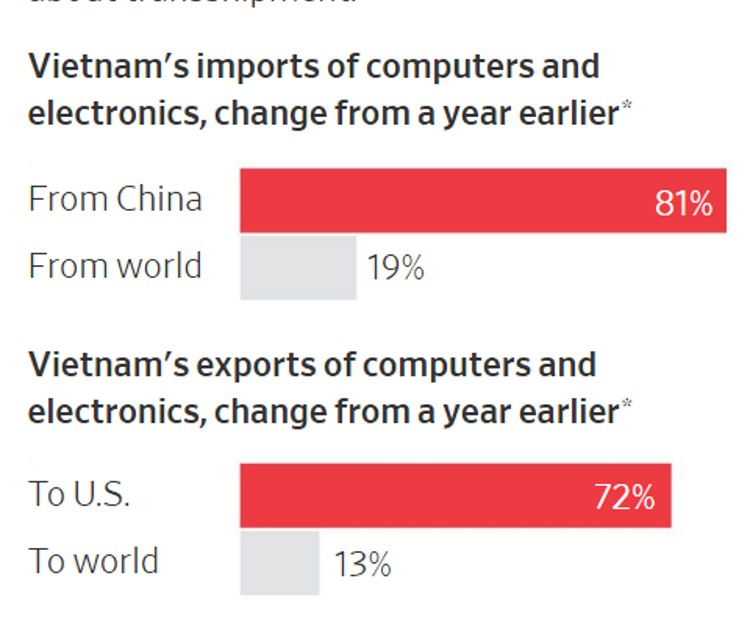
President Trump likes to fight each country individually, each with its own personalized trade war. A quick search of this blogroll highlights how quixotic it is to focus on bilateral trade balances. Aside from the fact that the aggregate trade deficit is determined by factors other than unfair trade measures in any particular country, there is also the issue of “trans-shipments.” Brad Setser documented it for “Chicken Feet” while the WSJ documents the same for computer electronics. Chinese exports to the US now simply have to traverse through a 3rd country to avoid 25% tariff. 

Tariffs and National Security

In May 2018 the US Department of Commerce started to investigate the car industry to determine whether imports created a national security risk. Usually, these investigations are initiated by either firms in the industry or by unions but curiously both opposed the investigation. The Motor and Equipment Manufacturers Association, which represents auto parts suppliers, warned that “tariffs will shrink investment in the United States at a time when the auto industry is already reeling from declining sales, Trump’s tariffs on steel and aluminum, and tariffs on auto parts from ChinaThese tariffs, if applied, could move the development and implementation of new automotive technologies offshore, leaving America behind… Not a single company in the domestic auto industry requested this investigation.”

Safeguard investigations are allowed to last up to 270 days and on February 17, 2019, two (!) hours before the 270 day deadline was up, the US Department of Commerce sent its report to the White House, triggering a 90-day review period for Trump to decide whether to impose tariffs (IF the report found national security issues). These 90 days were supposed to be up on May 17, 2019, but this has not stopped the White House from a) keeping the report secret although it has a statutory legal obligation to make it public, b) threaten car tariffs.

source

Another Trump Victory: China Is Lowering Tariffs – Just Not To The US

While Trump shows other countries nothing but his tariff stick, China has been offering carrots.  Beijing has repeatedly cut its duties on imports from America’s commercial rivals, including Canada, Japan, and Germany.”

In an amazingly researched piece, Chad Brown at the Peterson Institute of International Economics documents that while China is raising its tariffs in retaliation to the US, it is lowering its tariffs to the rest of the world. Probably to limit the negative impact from the Trump Tariff War. So the escalation in tariffs Trump is forcing is only half the bad news for US exporters, the other half is American companies and workers now are at a considerable cost disadvantage relative to both Chinese firms and firms in third countries. The result is one more eerie parallel to the conditions US exporters faced in the 1930s.Figure 1: China’s average tariff rate is climbing on US goods and falling for the rest of the worldFigure 3: China’s tariff rates on US goods vs. the rest of the world’s goods by sector as of June 1, 2019

Addressing Migration Incentives

There are two approaches to addressing migration. 1) Trumps political hostage taking, hoping paramilitary and human rights violations (due to aberrant asylum laws) will solve the issue. 2) Addressing the cause of migration: income inequality.

When the Iron Curtain fell in the early 1990s, migration pressure from Eastern to Western Europe was tremendous. In PPP USD, several former Eastern Bloc countries had per capita incomes that were less than 1/6th of Germany’s. That is similar to the current disparity between the US  and Central American countries that originate most of the migrants. Instead of building new walls, dismantling asylum laws or instituting paramilitary searches, Europe went on a determined program of structural adjustment loans to help developing Europe catch up and provide jobs and reasons from former Eastern Block citizens to stay instead of migrating.  25 years later, migration from Eastern European countries is not an issue. The Peterson Institute makes the same case for Latin America:

Tariffs on Mexican Products Will Not Curb Migration from Guatemala, Honduras, and El Salvador; Prosperity Will

Anabel González (PIIE), June 7, 2019 12:15 PM

President Donald Trump’s threat to impose across-the-board tariffs on Mexican imports is aimed at reversing alleged Mexican inaction in stopping the flow of migrants from Guatemala, Honduras, and El Salvador—known as the Northern Triangle—into the United States. This measure, which would raise the costs of $346 billion in imports, would not only violate international trade obligations, it is also the wrong tool to stop the flow of immigrants. Increasing prosperity in Northern Triangle countries would directly address one of the root causes of migration.

US IMMIGRATION PATTERNS ARE CHANGING

The increased Northern Triangle migration highlights several changes in US immigration trends. First, it takes place in the context of historically low levels of total immigration to the United States. From a 45-year low of approximately 304,000 apprehensions of migrants of all nationalities at the southwest border in 2017, the number increased to 397,000 in 2018, which was comparable to the annual average for the southwest border[1] during 2009–18. Second, the national origins of immigrants are shifting. Immigration from Mexico, which accounted for almost all migration flows to the United States at the beginning of the century, has plummeted (see figure 1). Conversely, immigration from Northern Triangle countries, which started to increase in 2012, reached 52 percent of southwest border apprehensions in 2018 (see figure 2). Third, the type of migrants apprehended has also changed. Whereas in the past, single adult males represented over 90 percent of apprehended migrants, now most of them are families and unaccompanied children, asking for protection from violence and crime.  And fourth, the number of affirmative asylum applications from nationals of Northern Triangle countries has increased from 3,523 in 2012 to 31,066 in 2017, an almost 800 percent increase. More than half of the applications were from unaccompanied minors.Figure 1 Immigration from Mexico has plummeted Figure 2 US Border Patrol apprehensions for Mexicans have dropped, while apprehensions of Northern Triangle citizens have increasedMIGRATION FALLS WHEN INCOMES RISE

Migration is a complex phenomenon. The immigration literature shows that there is an inverse relationship between economic development and migration (Clemens 2014). It is not until countries achieve a certain income per capita, around $8,000, that migration flows begin to cease. Illegal Mexican immigration into the United States fell sharply around 2005, when Mexico’s GDP per capita hit the $8,000 mark.[2]

The Northern Triangle countries still have a long way to catch up with Mexico. In 2017, GDP per capita was $3,889 in El Salvador, $4,471 in Guatemala, and $2,480 in Honduras (see figure 3). This roughly implies that for migration to slow down, El Salvador and Guatemala would need to double their respective per capita incomes, while Honduras would need to more than triple its own. Looking at potential growth trajectories for these countries, this is a tall order.Figure 3 GDP per capita for Northern Triangle countries is far below that of MexicoAccording to the International Monetary Fund (IMF), potential growth for Central American economies is projected to remain at 4 percent on average during 2015–20 (and this estimate includes other countries in the region that have posted higher growth rates in the past and have brighter prospects). So, were the Northern Triangle countries to manage sustained annual growth rates of 4 percent—which is feasible for both Guatemala and Honduras but more challenging for El Salvador—it would take El Salvador and Guatemala some 17 to 18 years to achieve the mark of $8,000 of income per capita and a few more years in the case of Honduras.

INCREASED PROSPERITY FOR NORTHERN TRIANGLE COUNTRIES IS KEY TO TACKLING MIGRATION ISSUES

To accelerate their growth rate, these countries need policy interventions and significant public and private investments in infrastructure, connectivity, and education and skills, among other factors, to increase private sector opportunities. The region furthermore needs to strengthen its ability to cope with and manage its high vulnerability to natural disasters. These interventions must promote inclusive growth in order to create good formal jobs, reduce poverty, and allow for broad-based development. Increased prosperity is only feasible if security challenges associated with illicit drug trafficking and gang violence are addressed in parallel, while strengthened governance, through improved rule of law and anti-corruption actions, takes priority. In tackling these underlying causes of migration, US assistance plays an important role, which is why President Trump’s decision earlier this year to cut off an estimated $700 million in aid to the three countries is worrisome.

A more prosperous, secure, and well-governed Northern Triangle is possible, but that transformation will take time—far more than a decade. Transition measures are thus required to accommodate migration flows as economic development takes place. And Mexico, for sure, has an important role to play. Just last December, the United States and Mexico committed to expand bilateral cooperation to foster development and increase investment in southern Mexico and Central America to create a zone of prosperity. Moreover, President Andrés Manuel López Obrador has been promoting a “Marshall Plan” that would see some $20 billion in private investments directed at the southern part of Mexico and the Northern Triangle countries, which in turn would strengthen Mexico’s capacity to absorb larger immigration flows from its Central American neighbors.

Increased tariffs on Mexican goods will not help. Instead, tariffs will increase trade costs, unravel supply chains, deter investment, and increase prices for US consumers.  Escalating duties will also erode the US negotiating position with other trading partners, as they see the United States renegade on agreed rules. It is possible tariffs may force Mexico into stepping up enforcement actions at its southern border.  But one thing these tariffs will not achieve: stopping migrants from Guatemala, Honduras, and El Salvador. That will only happen when they can find economic opportunity in their own countries.

Capital Controls in China and Vietnam & The Impossible Trinity

“Low ‘k’ ” or limited capital mobility seems like a preposterous concept these days — although it was the global standard from 1044-1972. Most industrial and developing countries have since liberalized their financial accounts, but China and Vietnam still maintain strict controls on the financial account. Here is a comparison courtesy of the Vietnam Investment Review:

Comparison of China’s capital controls with Vietnam’s

Economic theory defines the ‘Impossible Trinity’, also known as ‘the Triangle of Impossibility’, as a nation’s inability to simultaneously pursue three macroeconomic goals: a stable exchange rate, free capital flows, and an independent monetary policy. This theory was named the Mundell-Fleming Model, put forward by Robert Mundell and Marcus Fleming in the 1960s.

Despite similarities with Vietnam in terms of macroeconomic goals, China has greater inbound foreign investment controls.

Vietnam approaches the triangle of impossibility in much the same way as China does. They both implement capital controls in order to pursue their inflation target, while maintaining exchange rate stabilisation. In a previous article, we examined China’s controls regarding inbound foreign direct and indirect investment capital, in order to draw parallels with Vietnam. Today, we review China’s control on inbound foreign indirect investment capital by individuals.

Two currencies are used within Chinese markets: renminbi in mainland China and Hong Kong dollars in the Hong Kong special administrative zone. In accordance with the Impossible Trinity theory mentioned above, the renminbi is controlled at the expense of free capital flows, while Hong Kong dollars are based on free capital flows and an independent money supply.

There are also two types of shares traded in these markets with different rules, namely A-shares and B-shares, both of which are traded on the exchanges at Shanghai and Shenzhen. A-shares are denominated in renminbi. They can only be traded by Chinese citizens and a small number of foreign institutions with Qualified Foreign Institution Investor (QFII) status. China’s foreign exchange management on QFIIs was described in our article posted in VIR dated November 30, 2015.

B-shares are denominated in US dollars on the Shanghai exchange and Hong Kong dollars in Shenzhen. They can be traded by all foreigners and by Chinese citizens with the appropriate foreign currency accounts. The B-shares market is small, contains many poor-quality companies and generally sees little action. In the mainland China market, foreign investors are only allowed to buy B-shares, with prices quoted in US dollars and Hong Kong dollars, which are free-float currencies. In this regard, China’s authorities don’t have to manage foreign exchange on renminbi with foreign portfolio individual investors. 

While B-shares were originally intended to be the main mechanism for foreigners to invest in China, most investors have preferred to focus on shares of mainland Chinese companies listed in Hong Kong, which are available to all investors. These companies fall into three groups: ‘H shares’ are issued by mainland-registered companies in the Hong Kong market (so the same business could have A shares, B shares and H shares outstanding); ‘Red chips’ are state-controlled businesses that are technically registered in Hong Kong, but do the majority of their business in the mainland; and ‘P chips’ are registered in Hong Kong, but are controlled by non-state mainland owners.

The rules on investing in A-shares are likely to be relaxed in the long term, but it will probably take a decade or more for this to take effect. For now, foreign retail investors are confined to the other types of shares.

Recently, some foreign investors have suggested that the State Bank of Vietnam relax the documentation requirements for foreign individual investors to invest in the stock market here.  However, Vietnam’s controls are already much looser for foreign individual investors than China’s. Although foreign ownership limits are still applied in Vietnam, foreign individual investors are allowed to invest in all types of securities companies whose prices are quoted in VND, including both listed and OTC shares.

130% of Trump’s Tariff Revenues Redistributed to Farmers

“A little hyperbole never hurts. People want to believe something is the biggest and the greatest and the most spectacular. I call it truthful hyperbole. It’s an innocent form of exaggeration — and a very effective form of promotion.” (Donald Trump, “The Art of the Deal”)

In his great confusion (or “truthful hyperbole”) about tariff mechanics, President Trump proclaimed that China is paying US tariffs: he tweeted that “I am very happy with over $100 Billion a year in Tariffs filling U.S. coffers… great for the U.S. not good for China.”

Steil and Della Rocca from the Council of Foreign Relations point out that the $100 billion is without foundation and actual tariff revenues are less than $10 billion: “As we pointed out last December, Trump’s tariff claims have a bigger flaw. In 2018, the U.S. government committed to paying American farmers $9.6 billion to offset their losses from Chinese tariff retaliation. This is about $1 billion more than it took in all year from Trump’s China tariffs. Tariffs, therefore, ending up not just harming American companies and consumers, but costing the government money. More money left “U.S. coffers” to offset farm losses than came into them from U.S. importers.”

Since last year, as the graphic above shows, Trump’s “tariff deficit” has only ballooned further. The Department of Agriculture just unveiled a new $16 billion bailout for farmers hit by the trade war. After just ten months of a trade war with China, subsidies to farmers are set to drain over $25 billion from “U.S. coffers” for damage done to date. China tariffs, meanwhile, have so far brought in just over $19 billion in tax payments from U.S. importers—$6 billion less than authorized farmer payments.”

Fixed Exchange s, Open Financial Accounts and Fiscal Deficits

Seven years ago, at the height of the Greek Euro Crisis, Robert Mundell, “father” of the Mundell Fleming model and “father” of the Euro, proclaimed that the biggest threat to the euro is a potential bailout of Italy, which might just be too expensive

Italy is still (again?) teetering on the brink as it risks a $4billion penalty for violating the Euro’s fiscal discipline rules. Why? Use the MF model to explain Italy’s interest in racking up debt.