China Is Back

China is said to have started again started purchased US treasuries, the first time for the emerging country since September 2009.  The Asian giant is once again the largest holder in US debt, passing Japan who took the title during China’s previous six-month sell off.  Concerns about certain European debt situations in countries like Greece, Spain, and Portugal have caused a net return to purchasing the relative safety and security of good-old-fashion American debt, according to the Wall Street Journal.  In a television interview with Bloomberg TV, the chief Asian strategist for Citigroup said, “The concern [with European debt]… is moving from how much it’s going to cost to the effect on growth.” He continued saying, “In Asia, there are clearly some headwinds.” Concerns of this debt have led the Euro to continue it’s dizzying fall today; The currency is now at a four-year low in comparison to the US dollar.  Despite the amazingly large bailout from the Eurozone (nearly $1 trillion dollars), this decline has gone unimpeded for most of the last month. 
Triple Whammy

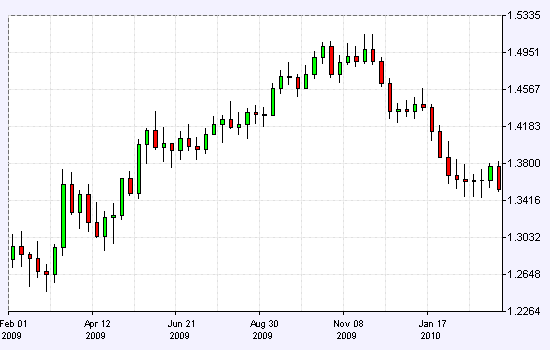
All bad news is packed into one factor: The price of the Euro, which was sent to a 10 month Low

1)  Portugal's credit worthiness has been downgraded, as credit rating agencies worry about the Portuguese government's ability to cut its budget and lower its debt

2) The Eurozone decides not to explicitly support Greece in its debt struggle, which forces Greece into a shotgun wedding with the IMF. Does not look good for Greece, and wont look good for the Eurozone to see one of its members struggle to the international lender of very last resort. 

3) It is now painfully obvious that the Eurozone is deciding to forge ahead without any mechanism for fiscal redistribution, a key ingredient to make a common currency work. Wolfgang Münchau thinks this the beginning of the end of the Euro.


 Euro/Dollar, Weekly Candlesticks

PIGS, PIIGS, PIIIGS, and PIG’D or Politically Correct: GIIIPS

there is some confusion if pigs should have one, two, or three "i"s. The term refers to either 

Portugal

Ireland

Greece,

Spain

or it may also include Italy, Iceland and Dubai (and exclude Spain) – depending on the various authors' assessments how bad the crisis is in the EU, and if it should include Iceland/Dubai as a non EU countries.

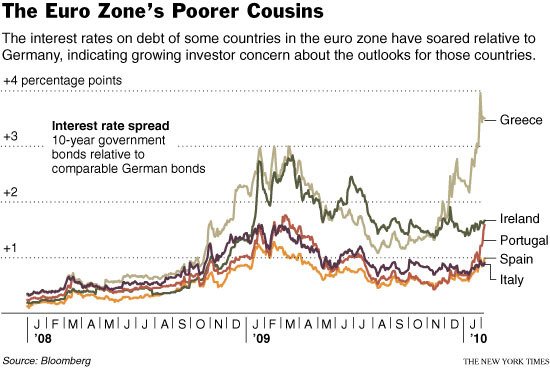
In this case, a picture is worth a thousand words. Floyd Norris from the New York Times outlines how the Greek fiscal crisis has led to contagion and a mild currency crisis in EU land.  


Crisis 2.0? Next Up: Sovereign Debt

First Dubai, now Greece. Just as the last US bank repays its TARP money, bail out funds that tax payers provided to avoid the insolvency of the US financial sector, it seems that trust is wavering in the debt obligations of sovereign countries. For good reasons: financial markets do not look kindly on a country that lies about the size of of its fiscal deficit – for x years!   It turns out the Greeks are not alone with their problems, which raise questions regarding the Eurozone's future. A) Currently all other countries that have adopted the Euro are implicit grantors of Greeks debt – will they officially bail out the Greek government?  B) could this be the end of the Eurozone – if one country leaves, several others are vulnerable. C) Is this the start of a full blown sovereign debt crisis?

Reserve Accumulation Update

International Reserves: An Embarrassment of Riches?

Reza Moghadam updates the reserve currency analysis of the Crisis Chapter 23 of International Economics. The update includes an interesting analysis. 

Once upon a time, those tracking international reserves focused on simple measures of reserve adequacy—enough to cover, say, 3 months of imports or all of the external debt maturing over the next year. However, the relevance of such yardsticks evaporated as a number of countries accumulated reserves that far surpass such levels, partly in reaction to emerging market financial crises of the 1990s and early part of this decade. Brazil’s reserves now exceed $200 billion, while Russia’s are more than $400 billion—and even these numbers are dwarfed by China’s reserves, which top $2,000 billion

Reserves are rising, driven by emerging markets and, increasingly, low-income countries

SPRblog3chart1

SPRblog3chart2

While very high reserves may give comfort in times of crisis, they are not without costs—for the holder of the reserves, and also for the stability of the international monetary system:

  • Reserve accumulation, by resisting currency appreciation, stimulates export-oriented production at the expense of domestic-demand oriented growth. 
  • By investing in foreign reserves, countries invest abroad rather than in their own economies. Countries with large stockpiles of reserves may therefore miss out on high-return domestic investments, like education, health and infrastructure.
  • In the long run, it is difficult to both meet the liquidity needs of the global economy and maintain macroeconomic stability in the reserve issuing country, a problem known as the Triffin dilemma. In effect, to meet the world’s ever-increasing demand for international reserves, reserve issuing countries such as the United States need to run external deficits that eventually undermine confidence in their currencies.

Self-insurance is not the only driver of reserve accumulation (an export-oriented growth strategy might be another factor), but it is an important one, and it is worth considering ways of reducing the need for it:

  • More predictable access to official financing when capital flows are disrupted would help. The IMF’s new crisis prevention tool, the Flexible Credit Line, aims to provide just that for countries with very strong policies. The early experience with this new tool is encouraging—countries that signed up for it saw a marked improvement in market perceptions.
  • Increasing the amount of available official financing would also help. The G-20’s April 2009 commitment to triple the IMF’s resources is a necessary complement to the reforms to our lending practices. The decision to provide these additional funds, which will increase the IMF’s lending resources from $250 billion to $750 billion, is a major step in the right direction. However, even with this increase, the IMF’s balance sheet remains much smaller relative to the global economy and members’ own reserves than it was at the time of the Fund’s creation.
  • Special Drawing Rights (SDRs), a reserve currency issued by the IMF to its member countries, can provide countries with greater access to liquidity, making them a potentially powerful crisis response tool. Of the $283 billion SDRs allocated in August and September, about $110 billion will go to emerging and developing countries, significantly improving their liquidity positions.

While lowering reserve accumulation in some countries would provide benefits to them and to the global monetary system, to do so too quickly could be disruptive for a still-fragile global economy. For now, many countries will want to keep the security that their reserves provide. It is therefore also important to consider how the appeal of alternative reserve assets can be improved, to make the system less dependent on the stability of one currency—the U.S. dollar.