Traders Talk Trumponomics & Trade

The WSJ cites a trader who asserts that

“A shift towards a ‘weak dollar policy’ is at odds with the imposition of tariffs (which tend to lead to exchange-rate appreciation—ignoring for the moment the possibility of retaliation),” said Vasileios Gkionakis, London-based global head of FX strategy at UniCredit Bank, in a note. ”And needless to say, a stronger [U.S. dollar] is difficult to reconcile with the creation and protection of manufacturing jobs domestically. So the market smells political inconsistency…and this is happening at a difficult point for the dollar.”

Use the Mundell Fleming Model to see if you can replicate the trader’s reasoningImage result for trump trade cartoon

Gold Standard and Competitive Devaluations

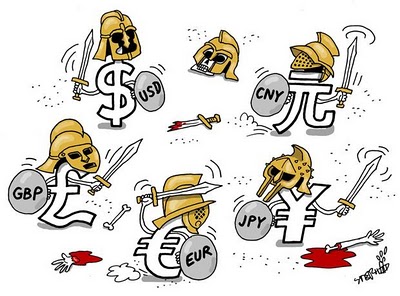
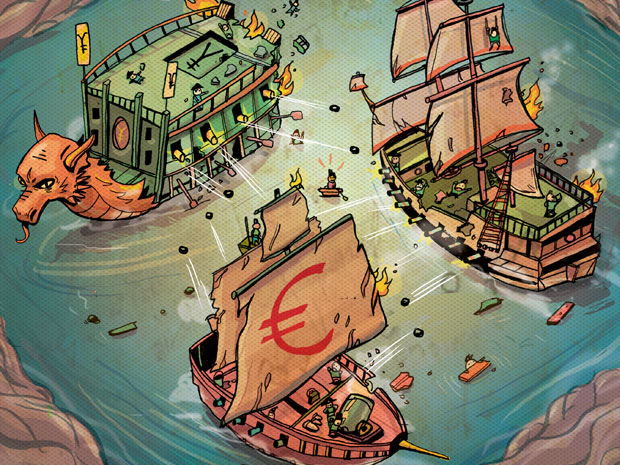
The term "competitive devaluations" or "beggar-thy-neighbor" policies refer to monetary policy designed to lower the exchange rate to increase exports and growth (see IE CH 19). More recently these policies have also been referred to as "currency wars" and even financial "weapons of mass destruction." A recent working paper by the World Bank now equates failures of the gold standard in the 1930s to competitive devaluations. Instead of unilateral devaluations, the World Bank document suggests 

The optimal policy response to the Great Depression, in this view, should have been a coordinated, unsterilized devaluation against gold by all countries suffering deflation. In effect, this would have been a coordinated global monetary easing, but without the beggar-thy-neighbor effects on trade.

– How would "coordinated devaluations" across countries have avoided the beggar-thy-neighbor effects

– Can you see any problems with the World Bank's policy prescription?  


Currency Wars: The Only Thing We Have To Fear Is Fear Itself

Barry Eichengreen and Paul Krugman take down the Currency War Mirage

 Use the Large Open Economy Mundell Fleming Model to show how Currency Wars

a) may have no effect on either country in terms of competitiveness

b) show how two countries – (and hence the world) might benefit from a currency war and give the conditions under which this must be true.  

Beggar Thy Neighbor

The newswires are abuzz with the news of the Japanese Central Bank intervention.  Some commentators realize that the ancient term for "dollar mercantilism", "neo-mercantilism", or "competitive depreciation" is simply "beggar thy neighbor" (see Chapters 19). The Economist Magazine has an interesting take on the issue. IF the Japanese intervention floods the market with dollars and IF this would lead to inflation in Japan – the effect might actually be positive for all!

Extra Credit: How would you use the large open economy Mundell Fleming Model (Chapter 19) to explain how the massive sale of yen by the Japanese Central Bank could benefit not only Japan but also the US (and other countries).  Hint: Think Liquidity Trap, and The Paradox of Thrift

Solution: Combine 12, for an alternative view (see 3, which is the "great vacation" view of the great recession. I contrasted these views before…).

Global Transmission of European Austerity

Here is a nice application of the large-open-economy Mundell Fleming model. The model is a work horse; there are many more sophisticated theories out there but some basic tenants remain helpful for policy analysis. This example is from Paul Krugman (those who read Chapter 19 can draw the diagram…)

Some thoughts on the fiscal austerity mania now sweeping Europe: is anyone thinking seriously about how this affects the rest of the world, the US included?

We do have a framework for thinking about this issue: the Mundell-Fleming model. And according to that model (does anyone still learn this stuff?), fiscal contraction in one country under floating exchange rates is in fact contractionary for the world as a hole. The reason is that fiscal contraction leads to lower interest rates, which leads to currency depreciation, which improves the trade balance of the contracting country — partly offsetting the fiscal contraction, but also imposing a contraction on the rest of the world. (Rudi Dornbusch’s 1976 Brookings Paper went through all this.)

Now, the situation is complicated by the fact that monetary policy is up against the zero lower bound. Nonetheless, something much like this transmission mechanism seems to be happening right now, with the weakness of the euro turning eurozone fiscal contraction into a global problem.

Folks, this is getting ugly. And the US needs to be thinking about how to insulate itself from European masochism.

End Game for Europe

Wage cuts and the battle for exports.

Given fixed exchange rates, or a currency union, currency crises are generated when demand for foreign currency exceeds the demand for the domestic currency. There are really only two ways out, neither are pretty. 1) decrease demand for foreign currency (raising interest rates, and decreasing income and import demand) and increase the demand for domestic currency by becoming more competitive and export more. Rebecca Wilder points out that this generates an interesting problem for the Eurozone:

"Latvia's model: drop wages to increase export income. Greece: drop wages to increase export income. France, Germany, Spain, Portugal, etc., etc. It's impossible that the whole of the Eurozone will drop wages to increase export income. It's especially bad for countries like Latvia or Hungary, where the lion's-share of trade occurs within the boundaries of Europe." 

 [hourly_wage_cuts_chart.png]


Anatomy of a Euromess

who can say it better than Paul Krugman… 

Most press coverage of the eurozone troubles has focused on Greece, which is understandable: Greece is up against the wall to a greater extent than anyone else. But the Greek economy is also very small; in economic terms the heart of the crisis is in Spain, which is much bigger. And as I’ve tried to point out in a number of posts, Spain’s troubles are not, despite what you may have read, the result of fiscal irresponsibility. Instead, they reflect “asymmetric shocks” within the eurozone, which were always known to be a problem, but have turned out to be an even worse problem than the euroskeptics feared.

So I thought it might be useful to lay out, in a handful of pictures, how Spain got into its current state. (All of the data come from the IMF World Economic Outlook Database). There’s a kind of classic simplicity about the story — it’s almost like a textbook example. Unfortunately, millions of people are suffering the consequences.

The story begins with the Spanish real estate bubble. In Spain, as in many countries including our own, real estate prices soared after 2000. This brought massive inflows of capital; within Europe, Germany moved into huge current account surplus while Spain and other peripheral countries moved into huge deficit:
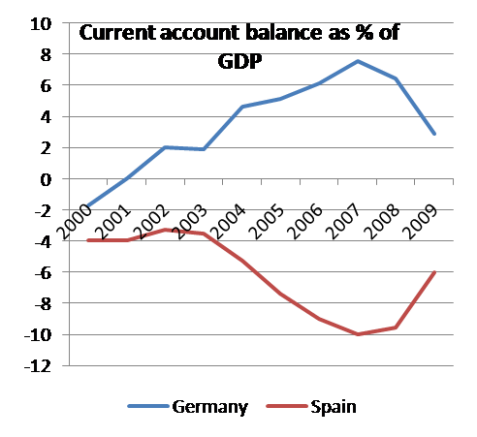
DESCRIPTIONIMF

These big capital inflows produced a classic transfer problem: they raised demand for Spanish goods and services, leading to substantially higher inflation in Spain than in Germany and other surplus countries. Here’s a comparison of GDP deflators (remember, both countries are on the euro, so the divergence reflects a rise in Spain’s relative prices):
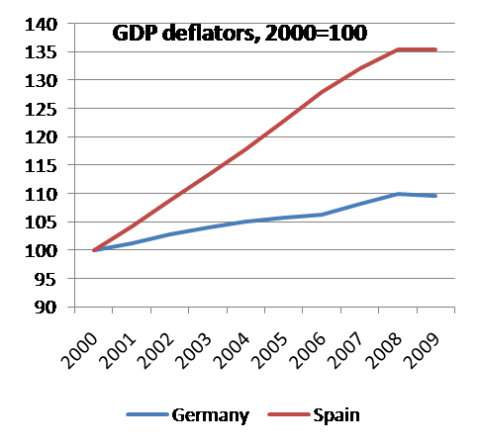
DESCRIPTIONIMF

But then the bubble burst, leaving Spain with much reduced domestic demand — and highly uncompetitive within the euro area thanks to the rise in its prices and labor costs. If Spain had had its own currency, that currency might have appreciated during the real estate boom, then depreciated when the boom was over. Since it didn’t and doesn’t, however, Spain now seems doomed to suffer years of grinding deflation and high unemployment.

Where are budget deficits in all this? Spain’s budget situation looked very good during the boom years. It is running huge deficits now, but that’s a consequence, not a cause, of the crisis: revenue has plunged, and the government has spent some money trying to alleviate unemployment. Here’s the picture:
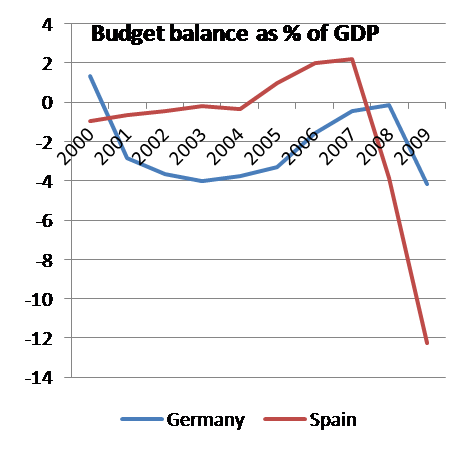
DESCRIPTIONIMF

So, whose fault is all this? Nobody’s, in one sense. In another sense, Europe’s policy elite bears the responsibility: it pushed hard for the single currency, brushing off warnings that exactly this sort of thing might happen (although, as I said, even euroskeptics never imagined it would be this bad).

Am I calling, then, for breakup of the euro. No: the costs of undoing the thing would be immense and hugely disruptive. I think Europe is now stuck with this creation, and needs to move as quickly as possible toward the kind of fiscal and labor market integration that would make it more workable.

But oh, what a mess. 

Eurozone Contraction

Here is a nice application of the Mundell Fleming Model with Flexible Prices 

Falling Prices, Rising Unemployment Buffet Euro Zone

by Nicholas Winning and Christopher Emsden, Wall Street Journal, Aug 01, 2009
From The Wall Street Journal Economics:Macro Weekly Review 
 
SUMMARY: The annual contraction in euro-zone consumer prices accelerated in July. Meanwhile,
the unemployment rate rose to 9.4%, the highest level for a decade in June.
CLASSROOM APPLICATION: There are several interesting topics raised in this article:
deflation versus inflation, the contrast between U.S. and euro-zone economic conditions, and the likely
impact of U.S. economic conditions on the euro-zone through the export channel.
QUESTIONS:
1. (Introductory) What does the latest data indicate about unemployment and inflation in the
euro-zone economies?
2. (Advanced) What are the adverse consequences of deflation? Can you conjecture what the impact on the Euro might be?
4. (Advanced) If inflation is undesirable, shouldn't deflation be desirable? What is the flaw in that logic?
5. (Advanced) How do economic conditions in the United States affect the euro-zone
economies?
Reviewed By: Edward Gamber, Lafayette College 

Don’t Montetize the Debt

From the WSJ Journal-in-Education Program: 

The president of the Dallas Fed speaks about inflation risk and central bank independence 

This is an excellent article to use to illustrate the relationship between fiscal and monetary policies and the inflation risks associated with the Fed's direct purchases of bonds.

QUESTIONS:

1. What is the "perception of risk" that has been created by the Fed's purchases of Treasury bonds, mortgage-backed securities, and Fannie Mae paper?

2. What are the economic consequences of monetizing the debt?

3. According to Dallas Fed President Fisher, what role did the Fed play in contributing to the current crisis?

4. According to Dallas Fed President Fisher, what role did regulators play in contributing to the current crisis?

5. According to Dallas Fed President Fisher, what role did "government-anointed rating agencies" play in contributing to the current crisis?

(suggested by Edward Gamber, Lafayette College)

A New World Order?

Times change: development advice will never be the same again. Why would any country buy the bitter medicine to limit goverment debt or forgo purchases of goverment debt by the country's central bank? Industrialized countries, who have strongly pushed such strong medicine, now instruct their central banks to purchase goverment debt and generate unprecedented fiscal deficits. The justification: extraordinary economic times. I would bet that any finance minister of a country where the majority of citizens lives on a dollar would argue that s/he is facing extraordinary times…  

The response to industrialized countries' policies has been swift. Credit rating agencies warn the UK goverment that it is in danger of loosing its pristene bond rating (because of excessive debt) and the US is being lectured about the dangers of printing money (by a developing country).

Interest parity can help us predict the future value of the British Pound (what is your prediction of the forward premium?). The Mundell Fleming Model (augmented to include price changes, see Chapter 19) or the Dornbush Overshooting Model (Chapter 20) come in handy to understand fluctuations in output, prices, and exchange rates as the US Central Bank engages in purchases of massive amounts of treasury bills to inject liqudity into the US economy. 

Back to development advice: the events remind me of the cafeteria at the IMF's Washington D.C. headquarters in the 1980s, where meals were ridiculously subsidized, but every IMF program advised developing countries against subsidizing food.  

Use, Reuse, Recycle

A wonderful discussion of recent financial flows is provided by Brad Setser. The reserve flow dynamics can be worked out nicely with the aid of a Fixed and Flexible Exchange Rate Mundell Flemming model (Chapter 18 and 19). However, the Setser's piece does have some jargon, so if you have a life and dont want to slug though the IMF report (he criticizes) and his own theory, here are the key paragraphs: 


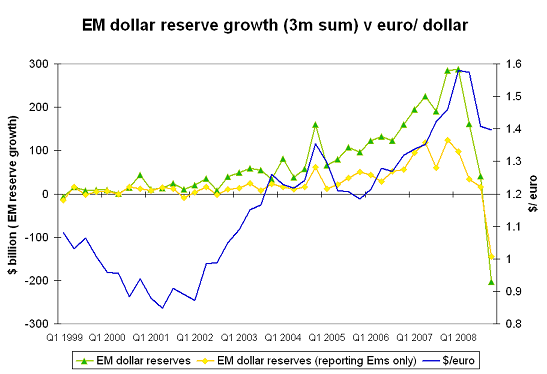
When the US slowed and the global economy (and the European economy) didn’t, private money moved from the slow growing US to the fast growing emerging world in a big way. The IMF’s data suggests that capital flows to the emerging world more than doubled in 2007 – and 2006 wasn’t a shabby year. Net private inflows to emerging economies went from around $200 billion in 2006 to $600 billion in 2007. Private investors wanted to finance deficits in the emerging world, not the US – especially when US rates were below rates globally. Normally, that would force the US to adjust – i.e. reduce its (large) current account deficit. That didn’t really happen. Why? Simple: The money flooding the emerging world was recycled back into the US by emerging market central banks. European countries generally let their currencies float against the dollar. But many emerging economies didn’t let their currencies float freely. A rise in demand for their currency leads to a rise in reserves, not a rise in [the price of the currency]. As a result, there has been a strong correlation between a rise in the euro (i.e. a fall in the dollar) and a rise in the reserves of the world’s emerging economies. Consider this chart – which plots [the 3 months sum of] emerging market [EM] dollar reserve growth from the IMF [official foreign currency reserve] data against the euro. 


If the rise in reserve growth in the emerging world is a sign of the amount of pressure on the dollar, then the dollar was under tremendous pressure from late 2006 on. It central banks had broke – and lost their willingness to add to their dollar holdings then – there likely would have been a dollar crisis. A fall in inflows would have forced the US to adjust well before September 2008… Last week felt a more like the fourth quarter of 2007 than the fourth quarter of 2008. For whatever reason — an end to deleveraging and a rise in the world’s appetite for emerging market risk or concern that the Fed’s desire to avoid deflation would, in the context of a large fiscal deficit, would lead to a rise in inflation and future dollar weakness – demand for US assets fell. In some sense, the dollar’s fall shouldn’t be a surprise. Low interest rates typically help to stimulate an economy is by bringing the value of the currency down and thus helping exports.