Rouble Trouble

Here goes another currency. Let's examine the anatomy of the crisis: 


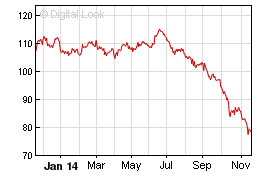
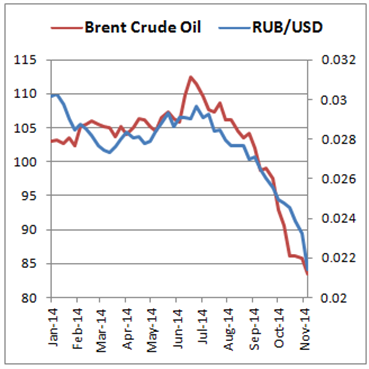
        Brent Crude Oil $/Barrel 

With oil being 40% of exports and oil prices down 30%, one would expect Russian export revenues to decline substantially.
In July Europe and the US imposed sanctions on Russia, in response to the political crisis in Ukraine. Russian state banks can
no longer borrow in Europe, and there is a ban on oil equipment exports to Russia. 
 
 
http://www.dailyfx.com has a great analysis of cause and consequence. 
 
Russia Has Scrapped its Managed FX Regime, Allowing Ruble to Float Freely
  • Policy Change Aimed at Scaring Away RUB Sellers with Threat of Intervention
  • Capital Controls Loom Ahead, Warning of Aggressive Volatility on the Horizon


The Central Bank of Russia (CBR) abandoned the exchange-rate “corridor” containing the Ruble’s value against the Euro and the US Dollar, allowing the unit to float freely. The move marks the latest in policymakers’ attempts to deal with a precipitous drop in the currency that has thus far produced losses of as much as 47.8 percent this year against the greenback.


Why are there risks of more stringent capital controls and potentially significant trading losses on the horizon?


Markets Send Russian Ruble Sharply Lower on Political Turmoil


The Ruble started what would evolve into a near-parabolic plunge in mid-July following the downing of Malaysia Airlines flight MH17 over the Ukraine. The incident marked an escalation of tensions between Moscow and Western powers that began as the toppling of Ukraine’s government amid mass protests early in the year led to the secession of Crimea and its subsequent Russian annexation. The US and the EU unveiled a new round of anti-Russian sanctions by the end of the month.


Geopolitical Risks Spark Capital Flight out of Russia

Russian Ruble Plummets and Forces Policy Change - Capital Controls Next?

Source: Bloomberg

Investors spooked by swelling geopolitical risk began pulling money out of Russia, sending the capital account to lows unseen since 2009 and helping to push the Ruble to record lows against the Euro as well as the US Dollar. Selling pressure was compounded by a sharp reversal in crude oil prices. Energy sales account for close to two-thirds of Russian exports and a deteriorating outlook on that front helped encourage liquidation across the spectrum of assets sensitive to the country’s economic fortunes.


Noteworthy Declines in Crude Oil Prices Worsen Pressure on Russian Ruble
Russian Ruble Plummets and Forces Policy Change - Capital Controls Next?

Source: Bloomberg


The dual headwinds of sanctions and a dimming exports outlook coupled with the sinking currency made for a toxic mix. A survey of analysts polled by Bloomberg reveals increasingly acute “stagflation” expectations as median forecasts for 2015 economic growth and inflation race in opposite directions. This has put the central bank squarely between the proverbial “rock and a hard place”. On one hand, soaring price growth demands tightening; on the other, fading output expansion begs for easing.


Russian Central Bank Put in Difficult Position as Raising Interest Rates Difficult, Ineffective

Russian Ruble Plummets and Forces Policy Change - Capital Controls Next?


Faced with this dilemma, policy officials set about attempting to stem the currency’s slide in an apparent bid to calm the waters before tackling larger issues. Trying to discourage sellers with aggressive interest rate hikes as well as directly fighting the drop by selling FX reserves in exchange for the local unit have proven futile. This has left the central bank with a hard choice: allow the Ruble selloff to run its course or introduce a far more draconian regime of restrictions to squash capital flight.


Bank of Russia Floats Exchange Rate to Stem Ruble’s Decline – Effectiveness Unclear


The Bank of Russia unexpectedly floated its exchange rate in an attempt to control the currency’s freefall, and thus far it looks like a risky move. Allowing the Ruble to run its course and raise the risks of outright intervention in FX markets, and the threat of unpredictable RUB selling makes it far less attractive to sell into the currency’s declines. The Russian Ruble rallied sharply on the CBR’s actions, but the early victory is hardly encouraging.


As history amply demonstrates, the threat of big-splash intervention and even its repeated realization has failed to sustainably deflect investors’ assault on a given currency. One need only look at Japan and New Zealand’s recent attempts at bullying the markets to see how quickly their impact evaporates as traders shake off losses and return to the offensive.


Major Risk to Investors as Continued Ruble Losses Invite More Drastic Action


The punchline is clear: further Ruble declines and broader financial market volatility would force the Bank of Russia into even more drastic measures and threaten real monetary harm to investors. What was arguably unthinkable three months ago is now a distinct possibility: the CBR could halt all speculation and cross-currency investments with the Ruble and force substantial losses on investors and savers.


Sophisticated investors are likely among the first to abandon a given market on the first sign of danger. But the risk is clear – what if this sparks a broader run on the Russian banking system?


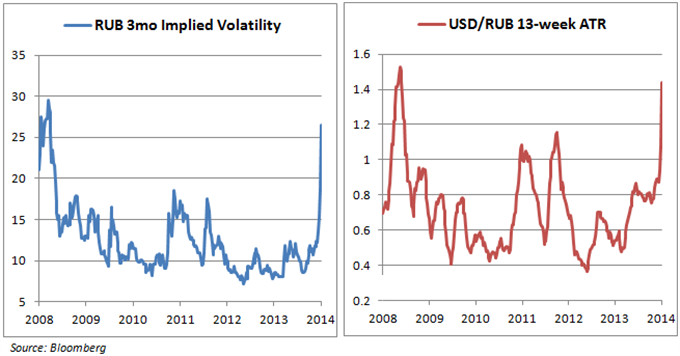
Volatility Prices and Realized Volatility on US Dollar/Russian Ruble at Highest since Financial Crisis
Russian Ruble Plummets and Forces Policy Change - Capital Controls Next?

Russian Financial Crisis of 1998 Offers Clear Warnings


The Russian Financial Crisis of 1998 underlines the potentially substantial effects of further turmoil and risks to the investor. Given a toxic mix of risks to the economy, the Russian government devalued the Ruble, defaulted on domestic debt, and in effect defaulted on payments to foreign creditors. The results were dramatic: the exchange rate plummeted and domestic inflation hit 84 percent as a veritable run on the Russian financial system sent domestic savers and investors scrambling for “hard” currencies. The ensuing political fallout brought now-Russian President Vladimir Putin into power.


Vladimir Putin knows the risks of political regime change are significant, and we would argue he could take even more significant measures to prevent this much.


Capital Controls – Why should Investors Worry?


Putin’s government could in effect subject financial markets to far more stringent controls than in 1998 and for most intents isolate Russia from world financial markets. If a trader is holding a position in theUSD/RUB or any other RUB-based pair, this could mean that trades would be closed at a significantly unfavorable rate—likely causing losses for those on either side of the trade.


Much of this is clearly speculation, and it is impossible to know exactly what the outcome will be. Yet the real takeaway is also sobering: further turmoil makes what was once seen as an insignificant possibility to a real probability. Putin’s actions to date increasingly hint at a policy of outright isolation from the West and even global capital markets.


Even non-Ruble traders should take note; Russia is far from an economic backwater. Its financial links around the world have clearly shrunken in recent months due to sanctions and the flight of capital, but a true rupture of these connections may trigger violent gyrations across the asset spectrum as investors scramble to adjust portfolios.


 

Crisis 3.0: Debt Lies and Videotapes.

In a sequel to my last Crisis & Bailout postCharles Wyplosz is taking another stab at the looking glass. 

The Guardian has a good timeline of Greek Events, starting with the infamous our goverment budget is a "black hole news conference" and chronicling the $240 billion already spent by the "Troika" (EU, ECB, IMF).

While the Greek Prime Minister is "confident" that Greece will return to positive growth in just a couple of months, Wyplosz is not so optimistic: "The situation in Greece is so disastrous that some form of debt relief is likely." Whether to believe the politician or the economist is always an issue, but the data always tells the smoking gun: The Greek programmes haven’t worked

  • GDP has plummeted, and continues to contract to a total of 30% over the last six years of deepening depression (see the figure below).
  • The European Commission forecasted Greek growth of -4.1% for 2013, but it has been -5.5% so far this year according to the IMF.
  • The unemployment rate stands at 27%; youth unemployment is 57% (yes, that’s fifty-seven, not 5.7).

The financial situation is almost as bad:

  • At the end of 2009, on the eve on the crisis, Greek gross public debt stood at 130% of GDP, now it is 175%.
  • Bank deposits have fallen by 30%, partly fleeing abroad, partly the result of strong dissaving by the population.
  • Nonperforming loans to households and corporations have reached the amazing levels of 25% and 31%, respectively.

My personal favorite is the Troika's Debt Restructuring program: Greece could no longer pay the interest on its bonds, so lenders had to accept a "haircut" – which is a reduction in the value of the debt. So if you held a $100 goverment bond, over night your bond was declared to be worth only $47. The haircut lowered the debt-to-GDP ratio by 55 percentage points, but since Greek banks held almost 1/3 of the debt, the banks' capital was wiped out and the Troika need to pay for a bank recapitalisation – added back an additional 25 percentage points to the debt-to-GDP ratio. Lots of smoke screens here. 

With the Greek crisis eventually came contageon, leading to sovereign debt crisie, banking crises and growth/competitiveness crises in several countries all reflected wonderfully in the interest- risk differentials

File:Long-term interest rates (eurozone).png 


Policy and Economics of Optimum Currency Areas

At the 10th anniversary of the British refusal to join the Euro, we have access to first hand accounts and the background research that drove the UK's decision. It is interesting to see how detailed the economic background information was that drove the discussion. Simon Wren-Lewis comments on the academic perspective and David Ramsden discusses the UK treasury view (careful Ramsden's video is looong and wonkish).


(graphic source

This Time Is Different

Its impossible to argue with the numbers; and few can slice and dice numbers like Ed Leamer, who provides his is take on the sources of the 2008- recession. He focusses on an important factoid: The most recent recession is not different: because its similar to the two previous recessions (1990 &2001). And these last three recessions collectively behaved very different from the previous 9 recession.

Is it robots / microprocessors / trade? Some would add a possible liquity trap as the source of the 2008 crisis (but we all agree 1990 & 2001 were no Liquidity Trap efflictions). Personally, for me no story of the 2008- crisis is complete without an explanation of the encredible Excess Reserves: the money banks are depositing with the Federal Reserve for meager interest rate of 0.25% rather than lend it out to business investments for substantially higher rates.   

Eurogeddon?

There are a number of ways to think about Europe's troubles

a) An irresponsible buying spree by the GIPS countries, induced by lower interest rates, due to the Euro was financed by Germany (Sinn)

b) Germany's excess savings sloshed into GIPS countries who were now flush and of course started buying 

c) It's the balance of payments, stupid! (also known as doctrine of immaculate transfer, see Davis)  

Paul Krugman provides the Davis quote and the data. 

It is normal to discuss the sovereign debt problem by focusing on the sustainability of public debt in the peripheral economies. But it can be more informative to view it as a balance of payments problem. Taken together, the four most troubled nations (Italy, Spain, Portugal and Greece) have a combined current account deficit of $183 billion. Most of this deficit is accounted for by the public sector deficits of these countries, since their private sectors are now roughly in financial balance. Offsetting these deficits, Germany has a current account surplus of $182 billion, or about 5 per cent of its GDP.

It’s also worth noting that we’re not talking about imbalances that have been going on forever.The internal imbalances of Europe are a recent development, coinciding with and almost surely caused in large part by the creation of the euro itself (GIPS is Greece, Italy, Portugal, Spain):

And what Davies’s post drives home is that implicitly at least European leaders went in for the doctrine of immaculate transfer — in effect, they wanted to believe that the huge payments imbalances could be ended without major changes in relative prices.

Desperate Measures

110 Billion to rescue Greece in 2010 seemed like a lot. Politicians underestimated the power of capital flows. To counterbalance international capital markets, which can trade $2.6 trillion on a quiet day, the size of the fund has progressively grown.  


The fund is still miniscule compared to the approximately $2 trillion China has in reserves to stablilize its currency. Curious also that Italy and Spain are in it for about a quarter when both countries may soon be in dire need of the funds assests. In the next month economists will learn how the inevitable (the end of the Euro as we know it) can play out politically.  

While We Have Our Eyes On The European Disaster…

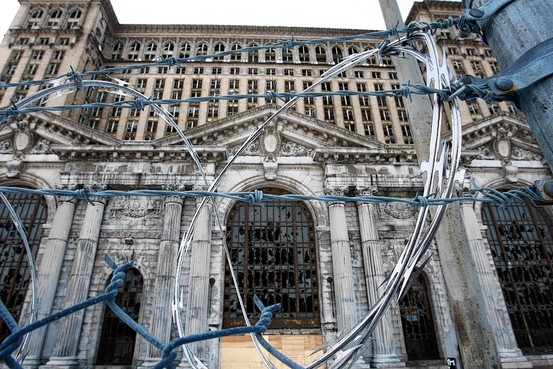
… Mike Shedlock redirects our attention to the fact that only US income but not employment is rising. Not only is the change in income quite diverse and concentrated across the US population but it is also geographically diverse. Some areas gain while others loose (you guessed it largely the geographic gains/losses are correlated with the changes in inequality in the population as a whole)… Here is the sad case of Detroit – unlike Greece it does not have the option to exit a currency union and devalue…:

Please take a look at this link of a 360 degree photo tour of several spots in or around Detroit, including the abandoned Michigan Central Train station. Then there are the images of the Michigan Central Train depot courtesy of the Wall Street Journal article Less Than a Full-Service City

Shedlock has written about Detroit on several occasions:

Staggering Fairy Tales

How much longer will politicians pretend there is a way around restructuring? Mish has the round up:

80
Percent of Greeks Oppose More Austerity; Tens of Thousands Defy Spain's
Protest Ban; Greece, ECB Deny the Obvious; IMF in Denial Regarding
Portugal

The words for today are the same as the words for last week and last month: defy and denial. Let's consider a few examples.

Campers in Spain Defy Protest Ban

The New York Times reports Tens of Thousands in Spain Defy Protest Ban

Tens
of thousands of demonstrators across Spain continued sit-ins and other
protests against the established political parties on Saturday. They did
so in defiance of a ban against such protests and ahead of regional and
municipal elections on Sunday.

About
28,000 people, most of them young, spent Friday night in Puerta del
Sol, a main square in downtown Madrid, the police said. They stayed even
as the protest ban went into effect at midnight under rules that bring
an official end to campaigning before the election in 13 of Spain’s 17
regions and in more than 8,000 municipalities.

Fueling the
demonstrators’ anger is the perceived failure by politicians to
alleviate the hardships imposed on a struggling population. The
unemployment rate in Spain is 21 percent.

Beyond economic
complaints, the protesters’ demands include improving the judiciary,
ending political corruption and overhauling Spain’s electoral structure,
notably by ending the system in which candidates are selected
internally by the parties before an election rather than chosen directly
by voters.

As the campaign ban came into force at midnight, many
of the Madrid protesters stuck tape across their mouths to signal that
they would continue the demonstration, even if ordered to be silent.
“The voice of the people can never be illegal,” read some of the
banners, while others argued, “We are not against the system but the
system is against us.”

Papandreou and ECB Deny Restructuring Under Discussion

No
matter how many times the ECB or the Greek prime minister "reject"
restructuring, the market insists otherwise. Once again, and for the
umpteenth time Greek PM, ECB officials reject debt restructuring with the bond market making fools of both of them every step of the way.

"Debt restructuring is not under discussion," Papandreou said in an interview in Sunday newspaper Ethnos.

Greece
has no other option but to follow through its fiscal plan, ECB
governing council member Ewald Nowotny told Greek newspaper To Vima
Saturday. "For the ECB, the line is one and clear: you have to implement
the commitments you have made."

Greece is considering deeper
cuts in public sector wages and further tax increases on a range of
products and professions to qualify for more aid, Greek newspapers said
Saturday.

The plan may include scrapping bonuses to civil
servants and employees in state-run companies, newspapers Ta Nea and
Isotimia reported, without citing any sources.

The government may
also lower or scrap tax-free thresholds on property holdings and the
self-employed, raise consumption taxes on soft drinks and certain fuel
types or shift a range of products to a higher VAT-bracket, other
newspapers said.

Papandreou vowed Saturday to take any measure
necessary to secure more funding for his country. "Greece must convince
everyone of its determination," he said.

Eighty percent of
respondents told pollster MRB they refused to make any further
sacrifices to get more EU/IMF aid, an MRB poll for paper Realnews
showed.

The same poll shows Papandreou's ruling Socialist PASOK
neck-and-neck with the opposition conservatives, with both parties
scoring 21.5 percent each. In the previous MRB poll in April, PASOK had
an 1.8 point-lead.

But Papandreou warned that any failure to push
through the plan might lead the country straight to default. "At the
moment, it does not seem as if Greece can cover its 2012 borrowing
needs… from the market," he said in the interview.

80 Percent of Greeks Oppose More Austerity

The
party that wins the next Greek election just may be the party that
rejects more austerity measures. Regardless, it is not mathematically
possible for Greece to grow its way out of this problem soon if ever, by
more austerity measures.

Greece is in recession now, Italy is
headed there, and as much as Greece needs serious reforms in it public
service sector, the short-term effect of taking those measures would be
rising unemployment and more capital flight.

Moreover, Greece has
a huge productivity disadvantage with Germany and France and to fix
that disadvantage would require lower wages. To top it off, Papandreou
wants to raise property taxes, consumption taxes, and self-employment
taxes.

Papandreou's 7-Point Proposal

  1. Higher property taxes
  2. Higher value-added (consumption) taxes
  3. Higher taxes on self-employed
  4. Still lower government spending
  5. Still lower wages
  6. Still lower benefits
  7. Selling Greek assets

Bear
in mind Greece is already in recession. Yet somehow that proposal is
supposed to get Greece out of trouble and growing again in 2 years.
Quite frankly it is preposterous to suggest such nonsense and the bond
market knows it.

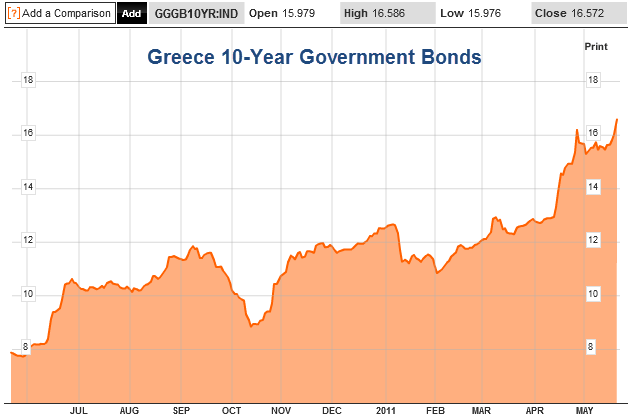
Greece 10-Year Government Bonds

Greek 10-year government bond yield hit a new high on Friday, 16.57%.


Exit – again?

The significant event would not be a Greek exit. The significance of a Greek exit is that Germany's bailout stance would thus have changed and Chancellor Merkel closed the Tap probably not only for Greece, but also for Ireland (whose deficit is trice that of Greece), Spain and all other PIIGS

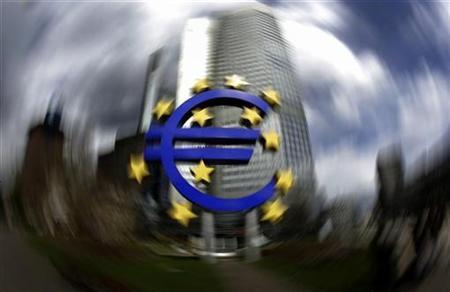
The logo of the European currency Euro stands in front of the European Central Bank in Frankfurt

Euro falls on rumours Greece is to quit the eurozone
Greece has vigorously denied rumours that it is has raised the idea of quitting the euro. The
euro has fallen by more than 1% against the dollar, following a report
that Greece had raised the possibility of leaving the single currency. German magazine Der Spiegel said eurozone finance ministers were holding a crisis meeting in Luxembourg. The report has been denied vigorously by eurozone countries, including Greece and Germany. However, the BBC has learned that ministers from four eurozone countries are indeed meeting in Luxembourg. The countries – France, Germany, Finland and Netherlands –
are said to be discussing EU issues, including the financial situation
of Portugal, Ireland and Greece. "The report about Greece leaving the eurozone is untrue," the Greek deputy finance minister Filippos Sachinidis told Reuters. "Such reports undermine Greece and the euro and serve market speculation games. "For (Greece) to leave the euro is
very complicated. It's not like they can just wake up tomorrow and say
we're not in the euro anymore”Ron Leven
Currency strategist

said

Denials

A source told Reuters that some EU ministers were meeting in
Luxembourg on Friday to review issues such as Portugal, Greece and
European Central Bank leadership, "but nothing more".German Finance Minister Wolfgang Schaeuble and his deputy Joerg Asmussen were at the meeting, according to Reuters.But the head of the Eurogroup, Luxembourg Prime Minister
Jean-Claude Juncker, has denied that crisis eurozone talks were being
staged that could see Greece exit the euro, his spokesman told AFP. "This information is totally false," his spokesman Guy Schueller told AFP. "There is no Eurogroup meeting taking place or planned this weekend," Mr Schueller underlined.Despite dismissals from officials, the story "does seem to be
having a market effect," said Ron Leven, a currency strategist at
Morgan Stanley in New York. But he played down the significance of the report. "For
(Greece) to leave the euro is very complicated. It's not like they can
just wake up tomorrow and say we're not in the euro anymore."

Police secure a street in Athens, 15 December, 2010
Protesters demonstrated in Athens in December 2010 against government austerity measures. 
 

Bailout

Greece became the twelfth country to join the single currency, when it ditched its own currency, the drachma, in 2002. Over the past decade the Greek government borrowed heavily –
public spending soared and money flowed out of the government's coffers. However, the revenues the government generated through tax
were not enough to counterbalance this, mainly as a result of widespread
income tax evasion. The result was a bulging budget deficit, more than four times the limit under eurozone rules. In the end, almost twelve months to the day, Greece was
forced to accept a multi-billion euro bailout, by the EU and the IMF, to
finance its huge deficit. The 110bn-euro ($136bn; £94bn) loan was designed to prevent Greece from defaulting on its massive debt. But despite a programme of government spending cuts and other reforms, its economy has struggled to keep its head above water. In recent weeks, there has been increased speculation that Athens could default and will need to restructure its debts. Yields on Greek government 10-year bonds have leapt to over
15 percent, a sign that investors are becoming increasingly sceptical
that they will be repaid.

Greek Tragedy: Act 2

The Greek rescue package that the EU provided last year required massive cuts, which led many economists to doubt whether the package would actually cure the patient or induce a coma. Coma it is. This years budget shows the effects of the large austerity measures (afterall G is part of Y!), so the fall in Greek national income depressed goverment revenues to jack up the deficit. The ill designed package from a year ago, now leaves Europe where exactly in the same spot it was in last year: negotiating either a Greek exit, or more cash infusions to keep the patient alive. The BBC has the story


Greece budget deficit worse than thought

Greek anti-austerity protestor
Greece's austerity measures have sparked anger in the country. 
 
Greece's budget deficit for 2010 has been revised up to 10.5% of its annual economic output. The figure is even worse than a previous estimate of 9.6%,
and far above the 8% target agreed by Athens as part of the country's
financial rescue. The data comes as Eurostat unveils official debt statistics for the EU. In Greece, debt levels jumped to 142.8% of the country's gross domestic product from 127.1% previously.
 

Select counties' debt statistics


Country

Deficit

Debt

Rep of Ireland

32.4%

96%

Greece

10.5%

143%

UK

10.4%

80%

Spain

9.2%

60%

Portugal

9.1%

93%

France

7.0%

82%

Italy

4.6%

119%

Germany

3.3%

83%

Estonia

surplus: 0.1%

7%

Eurozone

6.0%

85%

EU

6.4%

80%

Data for 2010. Source: Eurostat

The Greek government has brought
in a string of draconian spending cuts and tax rises demanded by
European peers and the International Monetary Fund as part of its
bail-out last year. The measures succeeded in bringing the government's deficit
down from 15.4% of GDP in 2009, but still fell well short of what was
hoped. Greece's two-year cost of borrowing rose further in bond markets to more than 23% per annum following the data release. The level indicates that markets believe the country's debts
are unmanageable and Athens is very likely to impose losses on
bondholders when its existing bail-out loans expire in 2013. The Greek government blamed the excess borrowing on the country's recession, which has proved deeper than expected. "The Greek government remains committed to achieving its deficit targets," said the finance ministry in a statement. "All necessary measures in that direction are accounted for
in the context of the medium-term fiscal strategy which will be
submitted to parliament by 15 May." Many economists point to the vicious circle Greece is caught
in, whereby government austerity is worsening the recession, which in
turn is increasing the government deficit.

Meanwhile, Eurostat data also painted a bleak picture at the
Irish Republic, whose 2010 deficit was confirmed at an unprecedented
32.4% of GDP. The level of new borrowing – double what was recorded the year before – was largely due losses at the nationalised Irish banks. Like Greece, Portugal – which is set to become the third
eurozone member to receive a bail-out – also overshot its 7.3% target,
with a 2010 deficit of 9.1%. Also like Greece, both Portugal and the Irish Republic saw
their borrowing costs increase after deficit data was announced, each
seeing yields on five-year bonds increase to about 11.5%. However, there was good news for Spain, which many see as next in line to become stuck in the eurozone debt quagmire. Madrid succeeded in cutting its deficit to 9.2% of GDP, beating the 9.3% target it had set itself.


Straight From the Oracle: Italy Is The Threat

Ok, Portugal is a done deal, now people start hand wringing whether Spain is next. Bob Mundell, "Father of the Euro" or better known as the creater of the "Mundell Fleming Model" has been warning for a while that Greece, Ireland, Portugal, and Spain are trivial compared to a potential crisis in Italy. Let's start watching the risk premium on Italian goverment debt. It sounded far out in 2010, today it is an uncomfortable reality.

Portugal’s $99 Billion

From Bloomberg: Portugal Said to Need as Much as $99 Billion in Bailout

A bailout for Portugal may total as much as 70 billion euros
($99 billion), said two European officials with direct knowledge of the
matter. A financial lifeline would be between 50 billion euros and 70 billion euros … Portugal has not yet asked for a bailout.

It appears a bailout is inevitable and imminent. Here are the 2 year (6.7%), 5 year (8.2%) and 10 year (7.7%) yields on Portuguese government debt – all at new highs.

Watch Ireland too – the Irish ten year yield is near 10%.

The Barber of Athens

Ready for a Haircut?  EU STARTED WORK ON BRADY PLAN FOR GREECE


The Financial Times thinks this story from To Vimain Greece is true. It contains a lot detail about discussions currently under way for a future Greek debt restructuring. The paper says that the EU, IMF and the ECB have reached basic agreement that a debt restructuring for Greece is inevitable, with the following concrete options being discussed. 1. A haircut of 35%. Technically, this will be an exchange of existing bonds with bonds of 65% of their value. 2. A bond swap to 30-year bonds with low interest rates. 3. A new loan package of 25% of the previous volume. The paper recalls the Brady plan, under which the US organised a similar debt swap for Latin American debt, with the help of a Fed guarantee. The paper also quotes Greek sources as confirming that they no longer expect the rebound of growth to happen immediately.


EU ready to stretch Greek and Irish loans to 30 years

Paul Taylor of Reuters has the story that EU officials are considering an extension of the emergency loans from 3 years in the case of Greece and 7 years of Ireland to 30 years, hoping to draw a line under the debt crisis. He quotes sources saying that Axel Weber had made such a suggestion, and it was part of a discussion among EU finance ministers. (So there is plenty of action. Officials are finally doing all those things that they swore they would never do not too long ago. )


First Sovereign Default of 2011

Ivory Coast Defaults on Eurobonds, Pledges to Pay

From Bloomberg:


Ivory Coast reneged on $2.3 billion of Eurobonds, becoming the first nation to default in a year. PresidentLaurent Gbagbo’s government pledged to pay creditors, without specifying a date. “We will be making the payment,” Alcide Djedje, foreign affairs minister in Gbagbo’s administration, said in an interview in Addis Ababa, where he’s attending an African Union meeting. “We do have the money of course. We have been paying civil servants. I don’t have a date yet but we will definitely pay.”

The $29 million of interest that was due by midnight in New York after a 30-day grace period hasn’t been received, constituting an “event of default,” Thierry Desjardins, the Paris-based chairman of the London Club group of commercial bank creditors and vice president of sovereign debt restructuring at BNP Paribas SA, said in an e-mail today. The trustee is responsible for the official confirmation of default, he said.

Brady Bonds

Ivory Coast reneged in 2000 on $3.5 billion of Brady bonds, securities created as part of a debt restructuring plan for developing countries and named after former U.S. Treasury Secretary Nicholas Brady. “They’re going to have to build up their credibility” after the political crisis is over, Yvonne Mhango, a Johannesburg-based economist at Renaissance Capital, said in a Jan. 28 phone interview. The country “keeps taking a step backwards. In terms of both of foreign direct investment and portfolio inflows that’s a concern going forward,” Mhango said.

Debt Restructuring

Ivory Coast issued Eurobonds last April as part of its debt restructuring at a yield of 10.181 percent, according to the London Club’s Desjardins, and data compiled by Bloomberg. Duncan Smith, a London-based spokesman for Citigroup Inc., the paying agent on the bonds, declined to comment and referred questions to the issuer, in an e-mail today. Ivory Coast produces a third of the global supply of cocoa and depends on the chocolate ingredient for more than 25 percent of its export earnings. The economy has expanded 1.7 percent a year on average since the civil war ended in 2002, according to the Africa Economic Outlook report. In October, the IMF forecast that gross domestic product would increase 4 percent this year. Cocoa production is expected to expand to 1.3 million metric tons percent this year, from 1.2 million tons last year according to a Dec. 6 Macquarie Group Ltd. report.

Cocoa Prices

Cocoa prices have hit one-year highs on concern the political crisis is disrupting exports after the European Cocoa Association and Federation of Cocoa Commerce Ltd. said there is a “significant slowdown” in flows from the country.

The last country to default was Jamaica on its domestic bonds in January 2010, after the island nation was hurt by a drop in tourism and remittances because of the worst global recession since World War II, according to Moody’s Investors Service.


Denial Tracker II (Very Funny)

The Wall Street Journal is very funny:

Portugal Bailout Denial: Sure Sign One Is Coming Soon?

Portugal’s prime minister said Tuesday that the country won’t need a
bailout. If history does in fact repeat itself, this means Portugal’s
probably going to be asking for help in a matter of days.

During the debt crisis that’s plagued Europe for nearly a year,
government leaders have made a habit of publicly declaring that their
countries can fight their own battles shortly before asking for help.

A look at what happened when Ireland and Greece officials made
similar statements last year shows that when those two European
sovereigns declared they were fine on their own, it took less than a
week for them to start sounding a different tune. Within a month of
their statements, both had done full about-faces and sought financial
aid from the European Union and International Monetary Fund.

Ireland’s minister for European affairs, Dick Roche,
said Nov. 15 that “there is no need for us to trigger any [financial
support] mechanism; we haven’t triggered any mechanism; there’s been no
political discussions about triggering a mechanism.”

It was exactly six days later that Irish Prime Minister Brian Cowen formally applied for aid from the EU and IMF bailout fund.

Greece set the trend eight months earlier, when Greek Prime Minister George Papandreou
said March 18 that “we want to do it ourselves and, for that reason, we
are not seeking financial help.” Five days later, Finance Minister George Papkonstantinou
said, “There must be some sort of mechanism to ensure stability,” a
statement that some saw as an about-face. By mid-April, Greece had
formally requested the European Union-IMF bailout.

So, don’t be surprised if Portugal is asking for help next week, even as Portuguese Prime Minister Jose Socrates
said Tuesday that the country “won’t ask for any financial help because
it’s not necessary.” Indeed, spreads on Portuguese sovereign debt swaps
reached record-wide levels Tuesday — an indication that fears about the
country’s fiscal health were running high — before bond-buying by the European Central Bank helped calm down the market.

Just don’t assume that these sudden stance shifts are unique to
Europe. Remember how many U.S. financial institutions proudly said they
didn’t need help from the U.S. government in 2008? We all know how that
ended.

Denial Tracker I

The yield on the Portugal 10-year bond is at 7.1%…

From Marcus Walker at the WSJ: Portugal's Test of Debt Market Looms This Week

Portugal hopes to raise new funds in a bond auction on
Wednesday … European Union governments including Germany and France
have for weeks been urging Portugal to apply for rescue loans from the
joint EU-International Monetary Fund bailout facility …

the EU's deliberations over Portugal haven't reached the intensity seen
ahead of the Greek and Irish rescues … That could change quickly,
however, should Portugal's borrowing costs continue to rise. Euro-zone
finance ministers are set to meet Jan. 17, by which time the market's
appetite for Portuguese debt should be clear.

And here is the FT round up:

Portugal and the EFSF: déjà vu all over again

Reuters reports this morning that discussions have
started for Portugal to seek fund under the EFSF/IMF scheme, as
pressure on Portuguese and other eurozone peripheral bonds increased on
Friday. According to the Reuters report, preliminary discussions have
taken place since July about a scheme totalling between €50bn and
€100bn, according to an unnamed source. Merkel’s spokesman officially
denies that any pressure has been brought on Portugal (which is
obviously not true). The article also said the EU was expecting a
“battle of Spain”, which would be the real test of the system.

The official Portuguese reaction continues to be one
of denial. Portuguese Prime Minister José Socrates reiterated that the
government is doing its homework and that his government will meet its
2010 budget target. Jornal de Negocios
quotes Socrates saying: “We have better results in terms of receipts,
better results in terms of expenses and this provides the strongest
signal of confidence to the international markets that we can provide”.
 We heard the same messages before Greece and Ireland were bailed out.
Pedro Passos Coelho, the leader of the opposition, is quoted by Reuters
as saying with that, with an EU bailout, the government would not be in a
position to continue ruling as its policies would have failed. In
Portugal, the opposition is obviously using the threat of a bailout for
political point scoring.

In its attempt to alleviate the pressure of the
markets, the Portuguese government is looking into alternatives to debt
auctions. Diario Publico (hat tip El Pais) reported that the Finance Ministry will proceed with a direct sales operation, possibly towards with China.

Spanish newspapers reported that Portugal would
inevitably have to seek international financial help. (To contain
contagion, Spain wants Portugal to tap the funds sooner rather than
later.)

Spain is nervously awaiting its first bond issue of 5 year bonds, El Pais reports. Italy will also launch a bond that same day.

Bloomberg
cites an article in today’s Handelsblatt saying that Germany might be
ready to discuss expanding the €750bn rescue facility at the next EU
summit. Der Spiegel
reported that this could coincide with an agreement on aid for
Portgual. “No decision has been taken about widening the rescue fund,”
Steffen Seibert, Merkel’s chief spokesman told.

Denial Ain’t Just A River In Egypt II


We've had part I of the saga, and now – like night follows day – we have the Portuguise version (via Reuters):

Germany and France
want Portugal
to accept aid


Reuters, (by Brian Rohan; Editing by Alison Birrane)


Fri, Jan 7 2011


BERLIN
(Reuters) – Germany and France want Portugal to accept an international
bailout as soon as possible in order to prevent its debt crisis spreading to
other countries, German magazine Der Spiegel reported on Saturday.


Without citing its sources, the magazine said
government experts from both European heavyweights were concerned Lisbon will soon not be
able to finance its debt at reasonable rates, after its borrowing costs rose at
the end of last year.

Berlin and Paris also want euro zone
countries to publicly commit to do whatever it takes to protect the bloc's
single currency, including topping up a 750 billion euro ($968 billion) rescue
fund if necessary.

Portugal
is viewed by many economists as the peripheral euro zone country that is most
likely to follow Ireland and
Greece
to seek an international bailout as it grapples to cut its debts and borrowing
costs. It holds its first bond auction of the year next week.

 
Unlikely the Chinese will be able to help. Although I am sure they are interested of averting a euro disaster (aka depreciation) and have plenty of cash to buy the euro to keep the yuan cheap. There are only two questions: how long will it take until Portuguise debt is being "restructured" in a European aid program, and how many times do we need to hear the Portuguise finance minister deny that such a program is needed. 


European Myths

A scary reminder how little the 2008 US banking crisis taught Europe:

This is not, in fact, an Irish bailout. It's a bailout of the European (including British) banks that lent a lot of money to the Irish government and Irish banks. If European governments want to bail out their banks, let them do so directly and openly—not via the subterfuge of country bailouts. Then they should face the music: How is it that two years after the great financial crisis, European banks make so-called systemically dangerous sovereign bets, earn nice yields, and then get bailed out again and again? Source


Euro Crisis: Is It Half Time Yet?


First it was panic, then hype, and now it is conventional wisdom: Portugal & Spain will have to restructure and its just a question when. How these packages turn out politically and economically will likely determine if the Euro will go into "over time" – a package for Italy… 

Here is Ken Rogoff:

Now that the European Union and the International Monetary Fund have committed €67.5 billion to rescue Ireland’s troubled banks, is the eurozone’s debt crisis finally nearing a conclusion?

Unfortunately, no. In fact, we are probably only at the mid-point of the crisis. To be sure, a huge, sustained burst of growth could still cure all of Europe’s debt problems – as it would anyone’s. But that halcyon scenario looks increasingly improbable. The endgame is far more likely to entail a wave of debt write-downs, similar to the one that finally wound up the Latin American debt crisis of the 1980’s.

For starters, there are more bailouts to come, with Portugal at the top of the list. With an average growth rate of less than 1% over the past decade, and arguably the most sclerotic labor market in Europe, it is hard to see how Portugal can grow out of its massive debt burden…

Paul Krugman provides the pertinent data…

DESCRIPTION

Italian 10 Year bond rates 

Here is the story in an interactive chart and video from the WSJ 


Ireland Is Punting

The EU/IMF program stole Ireland's Christmas. Just like in Greece, the people are on the streets to protest. Paul Krugman outlines nicely how the Irish Crisis is – just like the Greek Crisis – a botched goverment action that citizens now have to finance with dramatic spending cuts (and tax increases). 

Just like in Greece, the simple solution would be to give up on the Euro, devalue dramatically and bring back the old Irish currency, the Punt. The costs keeping the Euro a clear – they are outlined in the new EU/IMF package. What are the costs of bringing back the Punt? 


Another Shot Gun Wedding

The Irish Times reports that the EU and IMF have approved the Irish rescue package. Irish Prime Minister Cowen confirmed the European Union has agreed to Irish Government's request for financial aid package from the European Union and the International Monetary Fund. While the package is approved, its size is still undetermined (although the Financial Times thinks its around $100-$120 bn). Even Prime Minister Cowan does not seem to know how large the program will be – but he does know it will be smaller than the Greek bailout package

As predicted the arrival of the IMF team and the resulting austerity measures are no marriage made in heaven (see here)  

A woman walks past graffiti at Donnybrook bus station in Dublin today. Photograph: Eric Luke/The Irish Times 

·        The EU/IMF program calls for

                 – corporation tax rate to remain unchanged at 12.5%

·                                 – 10bn euros (£8.5bn) of spending cuts between 2011-2014, and 5bneuros in tax rises

·                                 – minimum wage to be cut by one euro to 7.65 euros per hour

·                                 – 3bn euros of cuts in public investment by 2014

·                                 – 2.8bn euros of welfare cuts by 2014, returning spending to 2007levels

·                                 – reduction of public sector pay bill by 1.2bn euros by 2014

·                                 – the reform of public sector pensions for new entrants with paycut by 10%

·                                 – 24,750 public sector jobs to be cut, back to 2005 level

·                                 – VAT up from 21% to 22% in 2013, then 23% in 2014

·                                 – raise an extra 1.9bn euros from income tax

·                                 – abolition of some tax reliefs worth 755m euros

·                                 – real GDP to grow by an average of 2.75% from 2011 to 2014

            –  unemployment to fall from 13.5% to below 10% in 2014 

Denial Ain’t Just A River In Egypt

Bank Run In Ireland

The Irish government is still playing hard to get. Until yesterday, it  refused to concede that a bail out was needed – and that's remarkable given that the EU/ECB/IMF delegations were already on their way to Dublin. 

This morning the FT reports that that corporate customers have been pulling out their deposits from Irish banks, amid signs of fading confidence in the banking system. Irish Life & Permanent said corporate customers had withdrawn €600m, more than 11% of total deposits, during August and September. The FT report says there is evidence that another deposit crunch is happening right now, as confidence faded that the Irish banking sector is able to fund itself if, and when the ECB scales backs its emergency funding.  But even the  ECB funding had not been sufficient as Irish central bank had to provide €20bn in exceptional liquidity assistance outside the ECB programme. And, wait for it, Brian Lenihan, the Irish finance ministers, tells the world that the Irish banks had no funding difficulties.

EU Crisis Over Red Hering

 Wolfgang Munchau of the Financial Times has the best analysis of the recent policy dispute in Euroland. 

Why the stability pact is irrelevant

That was in 1998. Not much has changed. The French and the Germans have once again been discussing whether sanctions should be automatic or not. And central bankers are just as furious. For Jean-Claude Trichet to issue an official note of disagreement – after European Union finance ministers last week drafted a watered-down sanctions package – is extraordinary on several levels. The president of the European Central Bank had demanded a great leap forward. But the French and the Germans are not leaping. They go round in circles. Since the start of the euro, the world has suffered its worst financial crisis ever and the worst recession in 70 years – and the eurozone’s political leaders are still obsessed with the minutiae of the stability pact, which is supposed to police government debt and budget deficit levels.

The real irony is that the pact, in whatever form, is not even relevant to the eurozone’s future. This may be a shocking statement. But look at the evidence. Contrary to popular narrative, fiscal profligacy played only a minor role in the eurozone’s sovereign debt crisis. Successive Greek governments cheated, but on my information, this occurred with at least partial knowledge of the senior European officials involved in the process. They chose not to apply the pact for political reasons. When the full extent of the Greek deficit became public in the autumn of 2009, EU leaders did not want to impose sanctions on a newly elected government. Everybody wanted to give George Papandreou, the Greek prime minister, a last chance. That turned out to be a good decision.

As for Spain and Ireland, they did not breach the rules ever, and would thus never have been subject to sanctions, automatic or otherwise. Even Ireland’s shockingly large projected deficit of 32 per cent of gross domestic product this year will not be a breach. Ireland’s bank bail-out is considered an exceptional circumstance, and not subject to the pact’s sanctions procedure.

Portugal exhibited persistent bouts of fiscal profligacy, but the real problem, again, was the banks. In all three countries, the crisis was caused by private sector imbalances, which far outweigh the relatively small discrepancies between national budgets. Germany may appear a paragon of virtue, but its debt-to-GDP ratio is close to that of France. It is larger than Spain’s and only a little lower than Portugal’s. But Germany’s pre-crisis 8 per cent current account surplus and Spain’s 10 per cent current account deficit were large and real. They have improved, but on the projections I have seen, are deteriorating again.

So if you really want to fix the eurozone’s problem, the pact is not the place to start. Obsession with it does not come out of concern for the eurozone’s future, but from an inter-institutional battle in Brussels.

What about the various proposals on macroeconomic surveillance, including that of the task force chaired by Herman van Rompuy, president of the European Council? He is proposing an early warning system, in addition to the already agreed European Systemic Risk Board. At the very least, one would expect all those new rules and institutions to pass the hindsight test. Had they been there 10 years ago, would they have prevented the Spanish or the Irish housing bubble? I cannot see how. Would José Luis Rodríguez Zapatero, Spain’s prime minister, have really imposed bubble-bursting real-estate taxes, after receiving a high-level delegation from Brussels or Frankfurt? Of course not. There can be only two explanations for Mr van Rompuy’s hubris about his macroeconomic surveillance proposals. Either he is naive, or he has a different agenda.

What about the proposed crisis resolution mechanism? When Angela Merkel, the German chancellor, gave ground last week on automatic sanctions, she gained the concession from Nicolas Sarkozy, the French president, that he would support Germany on crisis resolution.So the €440bn European Financial Stability Facility, set up in May to support eurozone countries with funding difficulties, will not be renewed. In 2013, it will be replaced by a tough crisis resolution mechanism to address the logical inconsistency of a system that rules out exit, default, and bail-out. The Germans continue to support the no bail-out principle; and have accepted that you cannot force a state to exit against its will. This leaves default. Having been very pessimistic on the default-probability of eurozone states, global investors may now be too optimistic again. If Ms Merkel gets her way – and I think she will – this means the eurozone’s future crisis resolution mechanism will be based on default.

The eurozone thus ends up with tough rules, poor implementation, no effective framework to deal with private sector imbalances, and an officially instituted mechanism that encourages default. The crisis was obviously not big enough to bring about genuine policy change. If, or rather when, that next crisis comes, it will probably be too late.


The Price of Austerity

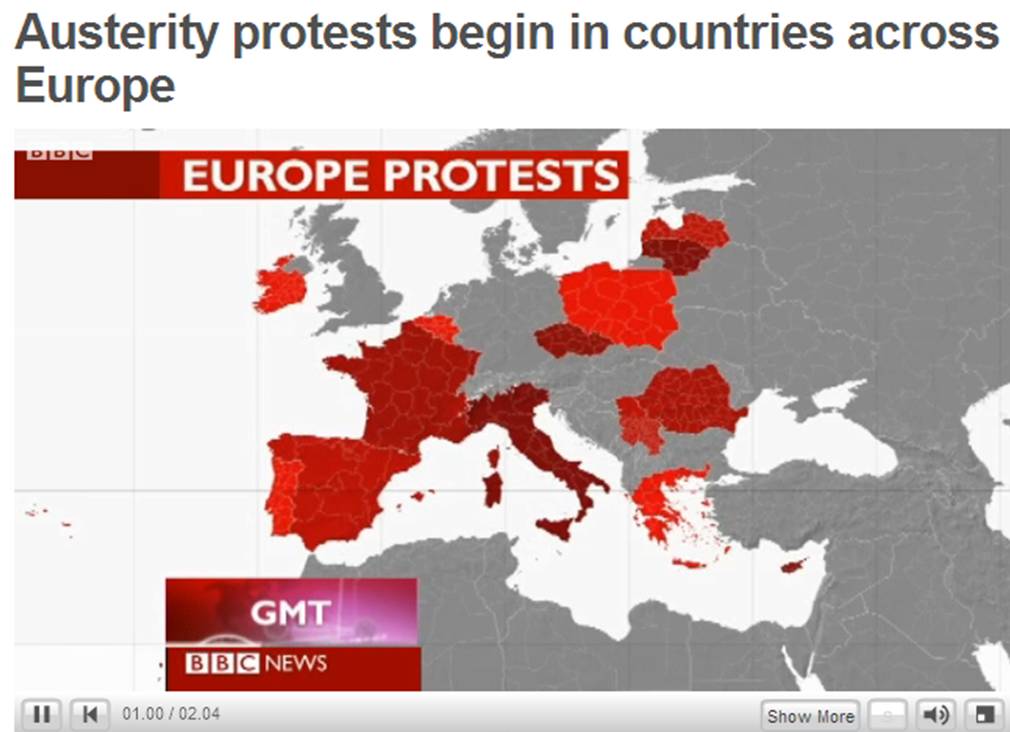
Austerity protests are growing violent in Europe, and we are not just talking about Greece. Here is a summary of Austerity measures that European countries have instituted to avoid debt crises (spiraling public deficits that increase country risk). Its the cost of maintaining membership in the Eurozone. Other countries "simply" devalue – not that devaluation is without costs, they are just not that obvious. Here is a good exercise: lists the costs and benefits of staying in the Eurozone, and the costs and benefits of a devaluation. 

Currency Wars

The world at war; the weapon: depreciation. Brazilian Finance Minister Guido Mantega has warned in remarks reported from Sao Paulo. "We're in the midst of an international currency war, a general weakening of currency," he said in remarks reported by the Financial Times newspaper. "This threatens us because it takes away our competitiveness." Japan, South Korea and Taiwan have intervened recently to pull down the value of their currencies, the newspaper noted, and the dollar has fallen by about 25 percent so far this year against the Brazilian real. Such a decline increases the price of Brazilian exports on the US market. 

Barry Eichengreen provides a summary of the economic implications of currency wars. Here are a few study questions


  • Why is China keeping its exchange rate artifically low?
  • Why are the US and Europe contemplating weaker currencies?
  • How are these policies related to beggar-thy-neighbor effects?
  • What are the alternatives to beggar-thy-neighbor policies?
  • Is it the currency war itself the source of the tensions between the US, Japan, and Europe,
    or is it the execution of the currency war the real problem? Explain
    . 
  • Who is the winner in this war? 


The Great Divide

The divide between political rhetoric and economic reality in Europe is growing. Former IMF chief economist Simon Johnson along with Peter Boone have the summary:


As usual, Nouriel Roubini tells us how deep Europe could side in all different dimensions. (Remember, Roubini earned only hearty laughs when he predicted the 2008 financial crisis in 12 easy steps too scary for anyone to take seriously – then it all came true, just worse than even he had predicted…

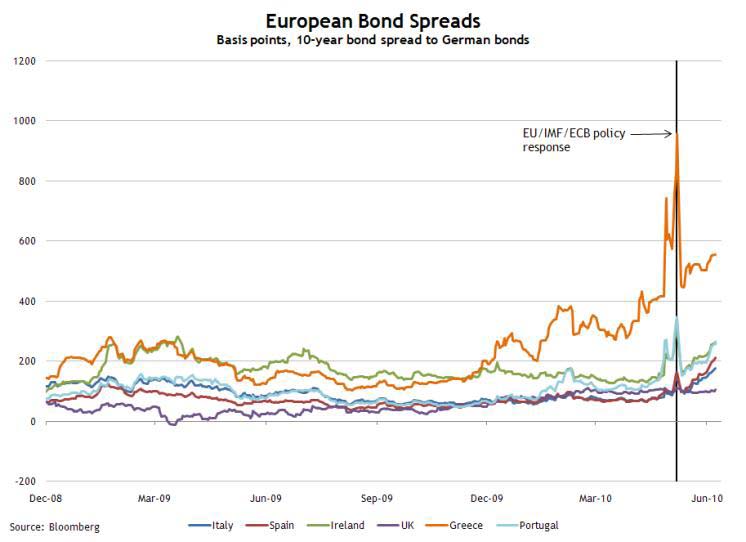
Here is the update on Euro Bond Spreads. Looks like markets are getting quite confident about default – then why is the Euro so strong? – Because US interest rates are zero… Try Interest Parity…

European Bond Spreads, Sept 15, 2010 


V-Shaped Dreams

Dr. Doom is back. His claim to fame is that he was one of the very few economists who accurately predicted the 2008 crash. (When I say "accurately predicted" I mean accurately not just in terms of timing, since there are x yahoos out there at any given time who predict the next month's next financial armageddon. But accurately in terms of the predicted mechanics of the collapse). Today, Roubini dissects the economy and summarizes what I fear is by now the economists' consensus: The recovery is at best U shaped, with a long flat line before we see take off again. Here is Ken Rogoff, making the same argument, and Christina Romer (Ex Chair of the U.S. Council of Economic Advisers). 
 
There is also a lot of hoopla about the rapid recovery in Germany. German output roared ahead at a 9% pace during the second three months of the year. And as a result, we learn today, the euro zone economy grew by 1% in the quarter (not an annual rate), which was a better performance than either America or Japan turned in. piece in the new edition of The Economist puts the burst of growth in the proper perspective:

If Not Now Then When

This graph from Paul Swartz at the Council of Foreign Relations shows the time structure of Greek default probabilities for three different dates: The market oracles thus that default will occur sometime around 24 months from now… 

 Greece: Default Probabilities

These probabilities are based on risk spreads between German (aka "risk free") and Greek bonds. The IMF, does not seem to have a subscription to the same data. Greek debt default is unlikely according to IMF… Debt default by an advanced economy such as Greece is “unnecessary, undesirable and unlikely”, according to an IMF paper released yesterday.

This runs against market sentiment according to which  Greece will eventually restructure its debts, writes the FT. I guess the story is that "once Greece has cut its deficit to zero, it will not need any new borrowing to finance its budget. Examples in the past 20 years, like Belgium in 1984 or Italy in 1991,showed that when these advanced economies cut their deficit none of went on to default."  Time will tell…

Final Exit

In 1998, the financial times reported that the Argentinian finance minister compared the country's peg to the dollar with a marriage to a pretty Hollywood actress:  Foreign investors often ask Argentine officials if they have an exit route from convertibility, the currency board system that links the peso at par to the dollar. "When you are married to Sharon Stone, you do not require an exit route."

"Plan B" does turn out to be important, in the world of Hollywood divorces as well as in currency markets.  These are important lessons for European nations that are currently contemplating to drop the euro to depreciate (and probably also) deflate their way out of the massive country debt. Bleyer and Levy Yeyati have the story.

Reckoning: The Spanish End Game

It is just uncanny how financial crises always evolve much like soap operas. At each stage you think "who's lying" and "you cannot make this one up." Here is today's news…


Spain angrily denies rumors of a bailout

The Spanish government was yesterday trying to deny German media reports according to which the EU was getting ready to finalize another bailout plan. [Prime Minister] Zapatero was yesterday busying trying to establish the facts behind the story in Berlin and Brussels, but nobody seems to have claimed responsibility. El Pais quoted the spokesman for economic affairs, Amadeu Altafaj, not only as denying that the Commission was negotiating a bailout, but also blaming Germany for inciting the rumors.


and the… in the same edition of the same Spain's national news paper, on the same day, we find:


Spain cut off from international financial markets

The crisis has now reached a new dramatic momentum, as Spain is now effectively cut off from international capital markets. El Pais has some interesting statistics showing the reliance of the Spanish banking system on the ECB. While Spain’s share in the ECB is 9%, Spanish banks now accounts for 16.5% of direct ECB borrowing. The amounts borrowed represent a 26.5% increase over May. The paper quotes the chairman of BBVA Bank as saying that for the majority of companies and financial firms, the international capital market was closed. He said that the country urgently needed to tackle three issues simultaneously: sustainability of public finances, growth, and financial sector reform.

Who is Bailing Whom?

Some German economists think that bailing out foreign countries is not good policy. I wish they'd check the Bank of International Settlements' report on foreign exposures to the contagion countries. Below is the graph. Germany and France have two options: bail out another sovereign country, or bail out their own banks. It is either or -all else is empty rhetoric.


BIS: Exposures to PIGS by Nationality of Banks 

Source BIS and Calculated Risk 

If It Leaks, Get Ready To Bail

The previous post  suggested a leak in the EU containment system. That is, the announcement of a $ trillion bailout fund did not stop interest rates from rising in possible contagion countries. 

Today German papers report that Spain's bail out is imminent.  Here is the scoop via Euro Intelligence 

Frankfurter Allgemeine reports this morning that EU officials will start talks about a bail out for Spain, citing unnamed sourced in Berlin. The paper said the situation had deteriorated so much that they did not want wait until the EU summit on Thursday. It also said neither the European Commission nor the ECB excluded an aid package. The paper quoted Spanish officials as denying that they are about to ask for EU aid, and immediatedly pointed out that Greek officials made the same claims before. The trigger is the freeze in the inter-banking market last week as the markets have lost confidence in the Spanish banking sector.


In a separate news report, Frankfurter Allgemeine writes that Barroso and Trichet were worried about the state of Spanish banks, and pleaded for aid. The paper also cites the latest statistics from the BIS, according to which German banks had given credits to Spain of $202bn, more than half of which to Spanish banks. The exposure of French banks is $248bn – mostly to companies and households. The Spanish central bank estimates the extent of the bad loans to be €166bn, of which only a quarter has been written off so far.  The Spanish bank bailout fund is €99bn. One of the problems now is that Spain has immediate finance needs at a time when market interest rates are rising sharply.


The paper also reports that France is getting nervous about the effect of the crisis on its own liquidity. In a short comment, the paper makes the point that the €750bn rescue umbrella is just another bank bailout package.


There is no whiff of any of this in the Spanish press this morning. El Pais reports on the latest BIS statistics, citing that the total exposure of European banks to Spain is €600bn (enough to bring the house down). Spain has been the beneficiary of intra-EU credit flows to a much larger extent than Greece, Portugal, and Ireland. Last week, the inter-banking market froze again in parts. The articles quotes that BIS as saying that while the single currency brought a greater diversification of risk, it warned of a contagion if any of the countries were facing solvency problems.


Containment Leak

This post is not about the Gulf of Mexico. Calculated Risk alerts us the the Euro crisis is far from over. Something seems to be brewing in the financial markets… Quote of the day via Bloomberg (ht Bob_in_MA):

We do believe the recovery is strong,” Dominique Strauss-Kahn said in an interview with Bloomberg HT television in Istanbul. While rising debt levels are a risk to growth, mainly in Europe, authorities in the region “are now really committed to solve it” and “the problem has been contained,” he said.

And this reminds us of Fed Chairman Bernanke's testimony on March 28, 2007:

"[T]he impact on the broader economy and financial markets of the problems in the subprime market seems likely to be contained."


Uh oh, not another problem "contained"! This just in from the Atlanta Fed:

Following a decline after the initial reports of the EU/IMF €750 billion package and ECB bond purchases, peripheral euro area bond spreads (over German bonds) have widened. In particular, the bond spreads for Italy and Spain have widened the most relative to their levels before the rescue package was unveiled.

After initially declining four weeks ago, sovereign debt spreads have begun widening for peripheral euro area countries. As of June 9, the 10-year bond spread stands at 554 basis points (bps) for Greece, 258 bps for Ireland, 265 bps for Portugal, and 211 bps for Spain. 

The spread to Italian bonds has increased 76 bps since May 11, from 1% to 1.75%, while Portuguese bond spreads are 112 bps higher during the same period. U.K. bond spreads are essentially unchanged.

 Euro Bond Spreads June 9, 2010


Euro Craters. Hungary Also Cooked The Books

Bloomberg breaks the sad news: Hungary also deceived the capital markets: 

Sovereign Credit-Default Swaps Surge on Hungarian Debt Crisis


June 4 (Bloomberg) — Credit-default swaps on sovereign bonds surged to a record on speculation Europe’s debt crisis is worsening after Hungary said it’s in a “very grave situation” because a previous government lied about the economy.

The cost of insuring against losses on Hungarian sovereign debt rose 63 basis points to 371, according to CMA DataVision at 3:30 p.m. in London, after earlier reaching 416 basis points. Swaps on France, Austria, Belgium and Germany also rose, sending the Markit iTraxx SovX Western Europe Index of contracts on 15 governments as high as a record 174.4 basis points.

Hungary’s bonds fell after a spokesman for Prime Minister Viktor Orban said talk of a default is “not an exaggeration” because a previous administration “manipulated” figures. The country was bailed out with a 20 billion-euro ($24 billion) aid package from the European Union and International Monetary Fund in 2008.

The euro dropped below $1.21 for the first time since April 2006, stocks tumbled and the cost of insuring against corporate default rose on speculation Hungary will weaken the EU’s willingness to rescue the region’s indebted nations.

Swaps on Spanish government debt were up 22 basis points at 278, after earlier reaching a record 295.5, according to CMA. Contracts on Portugal were 26 basis points wider at 364.8, while Ireland was up 32 basis points at 292, and Italy climbed 30 basis points to an all-time high of 264, before retreating to 253. Contracts on Greece were 57 basis points higher at 783, down from 798 earlier.

“Are we on the brink of something more serious?” Deutsche Bank AG strategist Jim Reid wrote in a note to clients today. “We’ve little doubt that the authorities have no appetite for imminent peripheral defaults but we do see the situation getting worse before it gets better. This leaves markets vulnerable until there is more certainty surrounding the structure of the peripheral funding bail-out.”

Credit-default swaps pay the buyer face value in exchange for the underlying securities or the cash equivalent should a borrower fail to adhere to its debt agreements. A basis point on a contract protecting $10 million of debt from default for five years is equivalent to $1,000 a year.


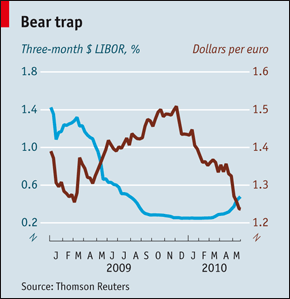
Bear Trap

Is there a problem?

Economist May 20th 2010

Watch it snap… 


IT HASN'T been the best couple of weeks for the global economy. China is officially in a bear equity market. Europe appears to be headed toward financial crisis or years of sluggish growth, or possibly both. America's housing market stalled out right through the first quarter, despite substantial government support (most of which has now been withdrawn). Leading economic indicators in America unexpectedly faltered in April. American stock markets have dropped over 10% in the space of just a few weeks. (On Thursday alone, the Dow fell nearly 4%.) Commodity prices are flashing a growth warning; oil prices have fallen nearly 20% over the last month. And America's labour market stubbornly refuses to right itself. Initial jobless claims rose by 25,000 last week, leaving the picture of filings looking like this:

Meanwhile, we get statements like this from European Central Bank president Jean-Claude Trichet:

The European Central Bank’s present monetary policy stance remains “appropriate” after the ECB’s decision to purchase debt issued by governments in the euro zone, ECB President Jean-Claude Trichet said Thursday.

“Our decisions on May 9 have confirmed it: We are not engaging in any form of quantitative easing,” Trichet said at an event in honor of ECB Vice President Lucas Papademos, who will leave the central bank at the end of May.

This despite the fact that annual core euro zone inflation (excluding energy) was just 0.7% in April, down from 0.8% in March and 1.7% the previous April. And despite the fact that the euro zone is forecast to see growth of just 1% in 2010, and just 1.5% in 2011. And despite the looming catastrophe in southern Europe. One doesn't want to get gloomier than the facts warrant. But the outlook for the economy looks materially worse today than it did just a few weeks ago. Markets seem quite convinced that events in Europe are likely to have a negative effect on global economic activity. It's debatable whether policy positions in Europe and America were appropriate back in April, given persistent signs of weakness. But if they were appropriate then, they're certainly too tight now. Europe has no fiscal room to boost the economy. America has some, but no appetite for new stimulus. The burden of action falls to central bankers. Unfortunately, central bankers seem to be too busy guarding their independence to handle their missions. 

Doomsday Machine Can Now Predict Crises

Every crisis has its heroes: the economists who "correctly" forecast the crash.

Since there are a few economists who forecasts financial armageddon at any given time, the simple test whether the heroes of the last crash were lucky or omniscient is to see if they can repeat. 

Dr. Doom, the hero of the last crash is trying to step into the spotlight again (here).  Not to remind us that he predicted the current crisis, but to announce his book. Crisis Economics, "which covers not only the recent crisis, but also dozens of others throughout history and across both advanced economies and emerging markets – I show that financial crises are, instead, predictable “white swan” events." 

Aside from tall claims of prescience, the articles is a tour de force. It as an excellent working definition to identify a financial crisis:

"An event that forces policy officials to spend a long weekend trying desperately to announce a new bailout package in order to avoid national and global panic before the markets open on Monday. In the past years, such weekend all-nighters dealt with the needed bailouts of private firms – Bear Stearns, Fannie Mae and Freddie Mac, Lehman Brothers, AIG, bank rescues, etc."

and it reminds us of the scale of the "new normal" 

The scale of these bailouts is mushrooming. During the Asian financial crisis of 1997-1998, South Korea – a relatively large emerging-market economy – received what was then considered a very large IMF rescue package – $10 billion. But, after the rescues of Bear Sterns ($40 billion), Fannie Mae and Freddie Mac ($200 billion), AIG (up to $250 billion), the Troubled Asset Relief Program for banks ($700 billion), we now have the mother of all bailouts: the $1 trillion European Union-International Monetary Fund rescue of troubled eurozone members. A billion dollars used to be a lot of money; now one trillion is the “new normal”… Governments that bailed out private firms now are in need of bailouts themselves. But what happens when the political willingness of Germany and other disciplined creditors – many now in emerging markets – to fund such bailouts fizzles? Who will then bail out governments that bailed out private banks and financial institutions? Our global debt mechanics are looking increasingly like a Ponzi scheme.

Absent is, however, a simple, lucid analysis of what we can expect in the future as the Eurozone crisis unfolds. Paul Krugman and Milton Friedman provide that insight succinctly.   

Political Trilemma

Dani Rodrik's fascinating hypothesis:  “the political trilemma of the world economy”: economic globalization, political democracy, and the nation-state are mutually irreconcilable. We can have at most two at one time. Democracy is compatible with national sovereignty only if we restrict globalization. If we push for globalization while retaining the nation-state, we must jettison democracy. And if we want democracy along with globalization, we must shove the nation-state aside and strive for greater international governance. 

The EU Picture That’s Worth A $Trillion

I am amazed how optimistic markets have been as to the success of the EU rescue package. And sure enough the first reports are coming in that "Euphoria ends as investors suspect another shameless EU confidence trick."

This time around the creative accounting is that Less than 10% of the funds actually existed and the rest were plans to establish facilities to raise the rest of the money. Those are a lot of hoops and ifs… Here is the rescue rackage (in euros) in a snapshot (via Econbrowser): 

11assessgfc.jpg 

Graphic from Thomas and Ewing, NYT, May 11, 2010; link here. 


Note: Jean Claude Trichet clarified yesterday how the bond purchasing programme is likely to work. To sterilise the bond purchase, the ECB is considering term deposit, compulsory deposits banks would have to hold at the ECB, which has the effect of withdrawing liquidity from the system. 

Euro Endgame

Economists aren't political scientists, but they aren't stupid. They learn quickly from their mistakes. 

The $150 billion program was economically sufficient, but politically untenable.  Now that this is understood, there is talk is of "restructuring" Greek debt, which is nothing other than to say that the Eurozone will allow Greece to default on part of its debt (to reduce the pain of the austerity measures over the next 10 years). The question is, what comes first: the German elections (next week) or the Greek implosion. It's tough for German Chancellor Merkel to "restructure" Greek debt since Germans aren't inclined to pay for Greek transgressions. 

And that is exactly the problem with the Euro, no fiscal mechanism to buffer ideosyncratic shocks, as Joe Stiglitz forcefully explains.

In this instance I have always been with Joe Stiglitz (aka, the Euro was ill designed to work only in good times), and I am with Paul Krugman who highlights that there is really no way around Greece exiting the Euro. What I cannot figure out right now (since I am not a political scientist) is how important it is for EU politicians (especially those in France and Germany) to maintain the Eurozone status quo and how disasterous it will be for Greece to exit the EU in terms of contagion for Portugal and Spain. 

Political Economy of Bailouts

While the economics of the Greek bailout may be sound, political economy realities seem to have been entirely forgotten in the design of the package. Jean-Paul Fitoussi (via the New York times) reminds us of the obvious: Greece is a democracy and the economic policies to not square with political realities. More to the point, Fitoussi said “unfortunately for economists, there is democracy,” Mr. Fitoussi said. “If you impose too strict a program, the population will refuse.”

Our book introduces a parallel example, when England tried to return to the gold standard in the mid 1920s. It is instructive to work out the similarities in the situations that Greece and the UK (then) faced. Maybe the Greek economy survives the austerity measures in the Eurozone, but its government likely won't. 


€110/$146 Billion

Greece agreed on a rescue package, and it is now clear why the IMF needed to be involved. The previous, 25 billion ($40 billion) line of credit just wasn't near enough. What's worse, already the day after, it is becoming clear that the bailout may not be large enough, as it is based on the crucial assumption that starting next (!!!) year Greece will be able to borrow again from international capital markets. That may be too optimistic, say bond-market specialists. 

The Wall Street Journal reports that with the aid come the austerity measures:

The Greek government has promised to slash and then freeze public-sector wages, raise sin taxes, increase value-added taxes, impose a new levy on businesses, cut pension payments and raise retirement ages for some public-sector workers. Greece also promised to meet budget and debt goals:

  • Cut budget deficit by 11% of GDP by 2013, through spending cuts valued at 7% of GDP and revenue increases valued at 4% of GDP.
  • Reduce budget deficit to 'well below' 3% of GDP by 2014.
  • Reduce debt-to-GDP ratio from 2013, with primary budget surpluses of at least 5% of GDP up to 2020.
  • Cut public-sector pay and pensions.
  • Raise average retirement age.
  • Increase value-added taxes and excise duties.
  • Deregulate the labor market and industries.
  • Privatize some state industries.
  • Cut public investment.
  • Crack down on tax evasion.

But even these high drama austerity measures will only save about €30 billion through 2013, meaning the Greek public debt will rise from  115% of GDP to more than  140% by 2014. Part of that is due to the predicted decline in output of – 4% this year

Actually these numbers are no surprise, as I (via The Economist) already laid out these figures 6 weeks ago

Virtues of Flexible Exchange Rates

Why the UK is not Greece 

Gordon Brown, the current prime minister in the UK was staunchly against adopting the euro when he served as chancellor of the exchequer. He designed 5 economic tests that the UK would have to pass to even think about adopting the euro. These conditions were, of course, in addition to the Maastricht Criteria, which were the EU's conditions for countries to join the euro. As a result the UK never joined.

This decision seems like a brilliant move now (although its unlikely to help Brown win his upcoming election). The Financial Times  has a great summary of how the ability to depreciate its currency has helped the UK maintain its economic footing. Neil Hume adds his thoughts here, Paul Krugman adds his thoughts here

Of course whenever economists start arguing why a country is NOT going to be hit by contagion, you have to think about why they were contemplating the issue in the first place…

The 13th & 14th Salary

In most countries the year only has 12 months. Not so in Greece. Greek government employees receive a 13th and 14th month salary. Such hand outs are now on the table to reduce the Greek budget deficit. But that's not popular. May 5th will see the closure of all shops and businesses in Greece to protest the austerity measures — even the Journalists will be on strike

If you don't get the 13th and 14th month salary from the government, its seems popular to simply take it. Time Magazine reports

In Greece, doctors, lawyers, accountants and other self-employed professionals are among the worst offenders, says Georgakopoulos, the tax head. To prove the point, the ministry released tax information last November about doctors in the wealthy Athens neighborhood of Kolonaki, where the streets are lined with shops selling brands like Prada and Louis Vuitton. Nearly a third of registered doctors there declared annual incomes of less than $22,000. In all of Greece — a country of 11 million people — only 3,125 people declared incomes more than $280,000. "Everyone who can avoid paying taxes does," says Georgakopoulos. "The only ones who don't are the ones who can't — wage earners and pensioners whose incomes are taxed at source." Widespread evasion feeds the Greek attitude that only the stupid pay taxes. Little wonder that Greece's tax revenue is among the lowest in the European Union, 19.8% of GDP (excluding social security) compared to an E.U. average of 26.1%. (Italy's take is 29.1%, Portugal's 24.5%, Spain's 20.7%). Only a handful of E.U. countries — the Czech Republic, Slovakia and Romania — do worse. And none of them use the euro.

Boulevard of Broken Rules

Here are the key euro convergence criteria (relating to government finance) that must be met for European Union member states to enter the Economic and Monetary Union and adopt the euro as their currency.

Annual government deficit:
The ratio of the annual government deficit to gross domestic product (GDP) must not exceed 3% at the end of the preceding fiscal year. If not, it is at least required to reach a level close to 3%. Only exceptional and temporary excesses would be granted for exceptional cases.
Government Debt:
The ratio of gross government debt to GDP must not exceed 60% at the end of the preceding fiscal year. Even if the target cannot be achieved due to the specific conditions, the ratio must have sufficiently diminished and must be approaching the reference value at a satisfactory pace.
 
No Bail-Out 
And then there is the famous "no bail-out" rule. Article 103, section 1, says that "the community shall not be liable for the debt of governments…"
 
Aside from Greece, just about every other Eurozone country violated the deficit/debt rules


Source 

A New Blueprint For Europe

In a parallel universe, Greece does not default. Willem Buiter (chief economist of Citigroup) provides a compelling scenario:

“the only plausible outcome is where Greece does not default unilaterally but adjusts, most likely with restructuring of its debt, where the euro area offers financial support with tough conditionality”. And a "European Monetary Fund" should provide "fiscal insurance" and "financial recapitalisation" for financial institutions. 

I can see a bailout, but cross border fiscal insurance is going to be a stretch, I think. 

Krugman’s Duck And Cover

He's the "father" of the first model of speculative attacks… Now he is asking whether the Euro is reversible. The unthinkable is getting more thinkable, says Paul Krugman on his blog:

For a long time my view on the euro has been that it may well have been a mistake, but that bygones were bygones — it could not be undone. I was strongly influenced by the view expressed by Barry Eichengreen in a classic 2007 article (although I had heard that argument — maybe from Barry? — long before that piece was published): as Eichengreen argued, any move to leave the euro would require time and preparation, and during the transition period there would be devastating bank runs. So the idea of a euro breakup was a non-starter.

But now I’m reconsidering, for a simple reason: the Eichengreen argument is a reason not to plan on leaving the euro — but what if the bank runs and financial crisis happen anyway? In that case the marginal cost of leaving falls dramatically, and in fact the decision may effectively be taken out of policymakers’ hands.

Actually, Argentina’s departure from the convertibility law had some of that aspect. A deliberate decision to change the law would have triggered a banking crisis; but by 2001 a banking crisis was already in full swing, as were emergency restrictions on bank withdrawals. So the infeasible became feasible.

Think of it this way: the Greek government cannot announce a policy of leaving the euro — and I’m sure it has no intention of doing that. But at this point it’s all too easy to imagine a default on debt, triggering a crisis of confidence, which forces the government to impose a banking holiday — and at that point the logic of hanging on to the common currency come hell or high water becomes a lot less compelling.

And if Greece is in effect forced out of the euro, what happens to other shaky members?

I think I’ll go hide under the table now.

Europe’s Big Fat Greek Default

It seems tough to avoid.

First the facts,

1) The New York Times reports that "Eurostat, the European statistics agency, raised its estimate of the country’s budget deficit for last year to 13.6 percent of gross domestic product, above the Greek government’s recent estimate of 12.9 percent. The ratio of debt to G.D.P. stood at 115.1 percent, compared with the government’s estimate of 113.4 percent."

If the Greeks lost track of their accounts and this was an honest mistake that only Eurostat's forensic accounting uncovered, is is quite an indictment that the Greeks cannot even keep track of their debt. If they actually tried to hide more debts the situation is even worse. Either way, this turn of events does not look good. 

2)  The large debt immediately led to a lower debt rating. The same day "Moody’s Investors Service downgraded its assessment of Greek debt and suggested that more cuts might be on the way." Sure enough, only four days later Greek Bonds were downgraded to junk bond status and warned investors that "bondholders could face losses of up to 50 percent of their holdings" of Greek bonds. Government bonds as junk bonds is a novel concept in Europe. Lets just remind ourselves, a junk bond is a "non-investment grade, speculative grade bond. It has a high risk of default and pays a high interest rate to compensate speculators (not investors) to take on the extra risk. Stage 1 of a sovereign country's default is to have your bonds rated "junk" and be priced out of the normal investment asset market.  

3) Greece desperately needs a cash infusion. But there are two key problems: other countries, or even the IMF, are unwilling to help if they has a sense they'll never see their money again.  On the other hand strikes are shutting down the capital of Greece, as public services, schools and even hospitals were shut down to protest potential budget cuts or tax increases. While the airport is still open, the port near Athens is closed for days now. Not good for trade…

4) that was not the only news, Eurostat also reported that it has to correct its estimate of the Irish government deficit to 14.3 percent, compared with the 11.7 percent figure submitted by Dublin in December… The Spanish deficit for 2009 was projected to be in line with estimates earlier this year, at 11.2 percent of G.D.P., while the forecast for Portugal’s deficit was 9.4 percent. Another New York Times report suggests that "increasingly, investors wonder if Portugal, Spain and even Ireland may not be able to borrow the billions of dollars they need to finance their government spending." "As the European Union and the I.M.F. debate the politics of Greece’s laying off civil servants or persuading its doctors to pay income tax, it is becoming apparent that the international community may need to come up with a much larger sum to backstop not just Greece, but also Portugal and Spain. The number would be huge,” said Piero Ghezzi, an economist at Barclays Capital. “Ninety billion euros for Greece, 40 billion for Portugal and 350 billion for Spain — now we are talking real money. Mr. Rogoff says that the I.M.F. could commit as much as $200 billion to aid Greece, Portugal and Spain, but acknowledges that sum alone would not be enough."

5) Not having enough cash on hand for a bail out would signal the end of the Euro as we know it… 

Update 1: Martin Feldstein is willing to take bets

Update 2: Greek yields are through the roof. Here's the Financial Time quote:

Greece’s two-year borrowing costs are now higher than those of Argentina, at 8.8 per cent, and Venezuela, at 11 per cent, two countries that have been shunned by many international investors because of the mismanagement of their economies.

Investors said that the Greek bond market was now in effect pricing in a government default as two-year bond yields were trading more than 12 percentage points higher than German Bunds, Europe’s benchmark market. 

Greek Deal After All

A deal is better than no deal, but what are the terms? Here is an old surgeon's saying for you: "operation successful, but the patient died." 

The Eurozone has agreed out package and the Economist Magazine ran the numbers.  The cost of Greek financial survival is negative GDP growth for for the next 5 years, an increase in its Debt/Equity ratio from 113% to 152(!) percent. The Eurozone thinks all that's needed is Euro 25billion, but the Economist Magazine calculates the cost to be at least three times as high. How can estimates differ so sharply? Easy, the assumptions on how markets will react to the deal and how high the Greek interest rates will soar as the Greece's debt to equity ratio explodes.    

The deal is a good exercise to use the Mundell Fleming model with fixed exchange rates to predict interest rates and output in Greece as it reduces its budget deficit from 12% to 2% of GDP. Don't forget about endogenous Risk, R, in the Financial Account! 

Source: Economist 

Triple Whammy

All bad news is packed into one factor: The price of the Euro, which was sent to a 10 month Low

1)  Portugal's credit worthiness has been downgraded, as credit rating agencies worry about the Portuguese government's ability to cut its budget and lower its debt

2) The Eurozone decides not to explicitly support Greece in its debt struggle, which forces Greece into a shotgun wedding with the IMF. Does not look good for Greece, and wont look good for the Eurozone to see one of its members struggle to the international lender of very last resort. 

3) It is now painfully obvious that the Eurozone is deciding to forge ahead without any mechanism for fiscal redistribution, a key ingredient to make a common currency work. Wolfgang Münchau thinks this the beginning of the end of the Euro.


 Euro/Dollar, Weekly Candlesticks

Greece: A Lost Cause?

There is a lot of discussion if Europe should help Greece, now that Athens has announced a dramatic austerity plan that cuts spending to reduce its deficit and debt accumulation.  

It is shocking to me that none of the discussion actually provides the actual costs of such a bail out, or presents the probabilities associated with the likelihood that the announced Greek reforms will actually be undertaken. 

Marty Feldstein usually does the numbers before he talks. So this is unsettling:

BusinessWeek LogoFeldstein Sees Greek Euro-Exit Pressure as Austerity Plan Fails

Nein…

…says German Chancellor Merkel to at Greek bailout. No bail out of Greece, no bailout of anybody. Greece should go the IMF.


That means the rumors that circulated just a few days ago (and significantly aided the value of the Euro) were false. Oh it will be a record bailout, but it looks like it will be IMF money. 


On the other hand, the IMF option was dismissed by French President Nicolas Sarkozy and European Central Bank President Jean-Claude Trichet, who said it would show the EU can’t solve its own crises. Ahh, the shame of a politician more important to the politicians than the economic plight of millions of Greek citizens who will suffer as the crisis explodes. 


The Eurozone is deeply split over the issue. While an IMF solution would find support with the Netherlands, Finland and Italy, but the majority is still against it. 


The decision (or the lack of resolution) provoked strong reactions and unsettled markets. The euro dropped as much as 1.1 percent to $1.3587,  and the extra yield that investors demand to hold Greek 10year bond rose 18 basis points, CDS rose to 295bp. Bloomberg quotes George Papandreou saying that Greece can’t afford to hold out much longer at current market rates. His government still needs to raise another €20bn to repay bonds maturing on April 20 and May 19. Oh my.


Gentlemen, Start Your Engines…

Top US hedge fund managers plot killings from eurowoes at "idea dinner" in Manhattan. See also this descriptions how hedge funds bet against euro.

Use the Mundell Fleming Model, augmented to account for risk and debt,  to analyze why George Soros [aka the man who broke the Bank of England] says: "the euro's construction is patently flawed" as he argued that "a fully fledged currency requires both a central bank and a Treasury."


George Soros at the World Economic ForumAnnual Meeting 2010 

Contagion

Here comes the European version of a financial H1N1: (link requires WSJ subscription).

This may only be the start. There are a few more letters in the term “PIIGS” … It is interesting that it hits Spain first; after all, this is the one country among the PIIGS that has the least of the debt problems. This is a nice way of highlighting that country risk, R = R[debt/GDP], is is a function of both debt and income. So as Spain’s income tanked, its risk rose although its debt accumulation may not have accelerated…

[SPAIN_p1]

Source: WSJ

Given the definition of Risk above, use the Mundell Fleming model with fixed exchange rates to identify the effects of a contraction (assume government expenditures declined) in Spain. Note that not only the IS but also the BP=0 line must shift when R =R[debt/GDP].

Inventory of Greek Transgressions

Hans-Werner Sinn outlines the Greek deceptions and their consequences with his patented clairvoyance.

Here are his highlights in slightly edited format:  

  • At 14% of GDP, Greece’s latest current-account deficit was the largest of the euro-zone countries after Cyprus.

  • The Greek debt-to-GDP ratio stood at 113% by the end of 2009. By the end of 2010 it is projected to soar above 125% (the highest in the Eurozone).

  • To avoid large capital outflows, Greece had to offer investors higher and higher interest rates to stay put.

  • In January, the interest premium was 2.73 percentage points relative to German public debt. This means Greece will have to pay €7.4 billion more in interest per year than it would have to pay if it could finance its deficit at the German interest.

  • The real problem is not the risk premium, but default.  Greece may not be able to find the €53 billion it needs to service its debt that is due in 2010, let alone the estimated additional €30 billion to finance the new debt resulting from its projected 2010 budget deficit. 

  • The Greek disaster became possible when its government deceived its European partners for years with faked statistics. In order to qualify for the euro, the Greek government asserted that its budget deficit stood at 1.8% of GDP in 1999, when it is now believed to have been closer to 12.7% (no one really knows how large the deficits have been…). 

  • So what Greece got exactly is what it sought to avoid with its dodgy data: the rise in interest-rate spreads for Greek state bonds. 

  • How did the deficit explode? Since entering the euro zone in 2001, Greek social-welfare expenditures increased at an annual rate that was 3.6 percentage points higher than that of GDP growth. Pensions in Greece, available after only 15 years of work, reach an incredible 111% of average net incomes. By contrast, in Germany the average pension level is about 61% of average net earnings for people who have worked at least 35 years. 

  • If no support comes from abroad, Greece will have to announce a formal debt moratorium, thereby declaring that it will only service part of its debt, as was done by Mexico and Brazil in 1982 and Germany in 1923 and 1948. 

Japan: Greek Tragedy, Second Act?

It is impressive that creditors worry about Greece but Japan's debt to GDP is TWICE as large. In addition, Japan's growth in past 20 years has been anemic, while income in Greece just about doubled…  


Here is some additional information from Credit Suisse. Their research department crunches the numbers and finds that while private savings might be able to cover the fiscal deficit in the short run, in the long run their simulations suggest: 

a 50% cut in public pensions and healthcare is necessary in the next 45 years, along with a 15% sales tax increase, or a massive public debt monetization (underwriting of government bonds by the Central Bank of Japan)  would be needed.The Bank of Japan would be required to buy almost all of the outstanding public debt (180% of GDP) today to achieve fiscal sustainability. Scary Stuff.

Then Again, You Can’t Put Lipstick on THESE PIGS:


(careful, this is not an apples-to-apples comparison. Below are annual deficits for prominent US states (b
udget gaps as % of total budgets) while the above numbers referred to the total accumulated debt for countries.) 

California: 

22%, or

$22.2 billion

Florida: 19.9%, or $5.1 billion

Arizona: 19.9%, or $2 billion

Nevada: 16%, or $1.2 billion

New York: 9.8%, or $5.5 billion

New Jersey: 7.7%, or $2.5 billion

All data for fiscal year 2008, Source BusinessweekBarry Rieholtz points out that 43 (!) states in the US are in some form of financial distress.  All by itself, the insolvent nation-state of California is the 8th largest economy in the world (it is the size of France…) According to the CIA Factbook, Greece is number 34. That is a lot of hyperventilating about a relatively small impact to global GDP. Italy is 11, Spain is 13, Portugal is 50, and Ireland is 56.


Here is the Wall Street Journal's take on the issue (from the The Wall Street Journal Economics: Macro Weekly Review)


by: Yuka Hayashi, Mar 01, 2010

SUMMARY: Bond traders have been relatively sanguine about Tokyo's massive pile of debt, but that attitude could be tested over the next three months.

QUESTIONS:

1. Why is it important to measure debt relative to GDP?

2. What are the potential adverse consequences that Japan will face if its debt continues to increase in size?

3. What fiscal policy measures is Japan considering to reduce the size of its debt? 

4. What difference will it make if Japan decides to increase taxes gradually rather than all at once?

5. What difference does it make that most of Japan's debt is held by domestic rather than foreign investors?

Greece as California

Greece and California do share some similarities: Sun and Deficits. Why is Greece such a big problem for the eurozone when the arguably far-worse financial plight of California is not raising similar concerns about the US or the dollar?


The question seems pertinent given the relative insignificance of the Greek economy – it accounts for less than 3 per cent of eurozone GDP (California provides about 13.5 per cent of US GDP). Could it be that the California is treated differently because the US  allows fiscal transfers between states, to help the weakest, while the eurozone might just let Greece fall into an abyss, whatever the consequences? In effect the Financial Times notices that Not only California is in deep trouble. While the Greek fiscal deficit is "only" 13.8%, some US states can easily beat that number… 

1) How can we explain why financial markets go wild about Greece, but seem uninterested in the probability of a Californian default? Hint 
2) What kind of adjustment can you predict for Greece, which is on a fixed exchange rate with the rest of its major trading partners in the the eurozone