Failure of Burgernomics

The Economist Magazine has create a whole industry devoted to sizzling the Big Mac Index. Its unhealthy, as the concept has very little to do with the law of one price or purchasing power parity (see chapter 20). Bloomberg's Billy Bookshelf Index is more informative, but it also lacks a crucial arbitrage component, since the item is not freely traded, but only available from one supplier, who might still price discriminate in different markets. A good visualization of the failure of the law of one price is given by a recent Wall Street Journal article that  highlights how the change in the value of the Loonie (the Canadian dollar) is simply not reflected in US/Canadian prices of goods such as DVD players or fridges, causing major headaches for multinational retailers. 

File:MEGA MAC Set-1.jpg

MegaMac. Source 

Dollar Appreciation: Time to Cover Your Shorts?

The technical analysis site Fxstreet surmises that the reason for the recent dollar appreciation is that

Investors this week have been covering shorts and closing down losing positions ahead of the New Year. A short position is one which you have sold the asset, and look to profit by buying back the asset at a later date, for a lower price than you sold it. Thin markets and low volumes make balancing books difficult for market players and liquidity providers, and as such wide spreads and enhanced swings in prices can often result. 

It remains to be see in the new year if the dollar can maintain its strength, of if January will see a return to carry trading that will lower the value of the dollar. 

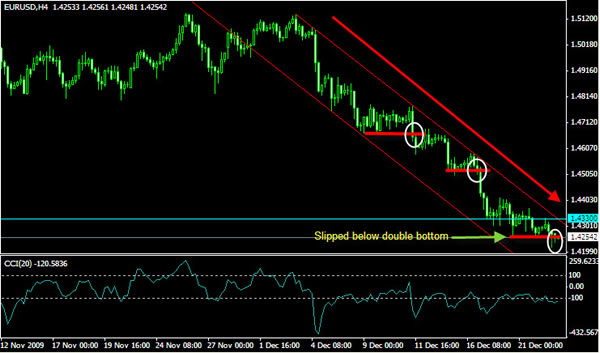
Daily Technical Analysis shows that the depreciation of the Euro has been incredibly orderly, following exactly within the boundaries of a simple channel.  


A New World Order?

Times change: development advice will never be the same again. Why would any country buy the bitter medicine to limit goverment debt or forgo purchases of goverment debt by the country's central bank? Industrialized countries, who have strongly pushed such strong medicine, now instruct their central banks to purchase goverment debt and generate unprecedented fiscal deficits. The justification: extraordinary economic times. I would bet that any finance minister of a country where the majority of citizens lives on a dollar would argue that s/he is facing extraordinary times…  

The response to industrialized countries' policies has been swift. Credit rating agencies warn the UK goverment that it is in danger of loosing its pristene bond rating (because of excessive debt) and the US is being lectured about the dangers of printing money (by a developing country).

Interest parity can help us predict the future value of the British Pound (what is your prediction of the forward premium?). The Mundell Fleming Model (augmented to include price changes, see Chapter 19) or the Dornbush Overshooting Model (Chapter 20) come in handy to understand fluctuations in output, prices, and exchange rates as the US Central Bank engages in purchases of massive amounts of treasury bills to inject liqudity into the US economy. 

Back to development advice: the events remind me of the cafeteria at the IMF's Washington D.C. headquarters in the 1980s, where meals were ridiculously subsidized, but every IMF program advised developing countries against subsidizing food.