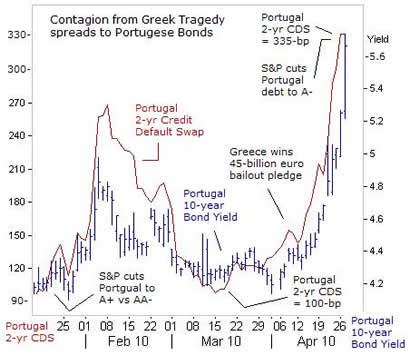
Here is a nice summary of the contagion factors in Europe.
Contagion: Looking Ahead to Spain and Italy
crisis will soon spread to other countries. Ireland and Portugal have
long been seen as susceptible to going the same way as Greece, but
recently Italy has joined the group of countries seen to be potentially
vulnerable.
So like many, I’ve been thinking a lot about
contagion this week. But even though it seems to be common knowledge in
the business press that if and when Greece defaults the crisis will
immediately deepen for other countries, cogent explanations for why that
might happen have been scarce. So I think it’s helpful to try to get
more specific about why we think the crisis might or might not spread
further to Spain or Italy. That will help us better understand whether
those fears are real or overblown.
Most of the economic
literature about contagion has focused on its applicability to currency
crises, such as the EMU crisis of 1992-3 or the “Asian Flu” of 1998.
However, the logic is similar when applied to sovereign debt crises. As
a reminder, here’s a list of some of the explanations that have been
put forward to explain previous episodes where financial crises spread
from country X to nearby and similar country Y:
- a common external shock: whatever factor originally tipped country X into crisis has the same effect on country Y, so it will also push Y into crisis.
- the “wake up call”: when
country X enters a crisis investors suddenly reevaluate their
portfolios for risk, and sell off assets related to any country similar
to X, thereby precipitating a crisis for country Y. - liquidity concerns among common creditors: crisis
in country X causes creditors (e.g. banks) to suffer losses that force
them to sell off assets in country Y, precipitating a crisis in Y. - cross-market hedging among common creditors: crisis
in country X means that the portfolio of creditors (e.g. banks) has
suddenly become more risky on average, so they respond by reducing their
risk exposure elsewhere in their portfolio, in part by selling off the
assets of any similar country also seen as risky, such as Y. - political contagion: the
actions taken to deal with the crisis in country X (e.g. dropping a
fixed exchange rate, or in this case, default) make it less costly for
country Y to do the same thing, and investors realize this, sell off the
assets of country Y, and thus precipitate a crisis for country Y as
well.
The thing that these mechanisms have in common is that
they all create a process of self-fulfilling expectations, where a loss
of investor demand or confidence causes a sell-off of assets, which
causes a crisis, which validates the original loss of confidence.
But
in the case of Greece, I don’t think that most of these sources of
contagion are of real concern, simply because the crisis has been drawn
out over such a long period of time now that investors and creditors
have all had plenty of time to expect and plan for a Greek default. So I
think that the only one of these possible sources of contagion that
might apply in this case is the last one, which for convenience I’ve
labeled “political contagion”.
If Greece is seen to default (and
it seems likely that however the EU chooses to package and label the
terms of the new Greek bailout, it will involve some sort of "soft
default"), then investors will have been provided a demonstration of how
a limited default could work for other euro countries. This poses an
enormous problem for European policymakers. Whatever new bailout and
debt restructuring they agree to for Greece — especially if it
substantially reduces the Greek debt burden going forward — could
prompt Ireland and Portugal to ask for the same terms. On the other
hand, if the terms of the Greek deal do not sufficiently reduce Greece’s
debt burden then the deal will have done nothing to resolve the
fundamental issue of insolvency, and policymakers will be right back
where they started at some point down the road.
But developments
in the financial markets over the past week have reminded everyone that
policymakers may need to worry less about Ireland and Portugal, and
instead be more far-sighted and consider first and foremost the impact
on Spain and Italy. Because when it comes to those two countries, it is
clear to everyone that if the debt crisis takes serious hold on them
then a financial crisis will become a financial catastrophe.
Paradoxically,
one way to help cut off the speculation in the financial markets that
Spain and Italy could at some point be candidates for bailouts and/or
debt restructuring would be for the EU and ECB to be relatively generous
with Greece. If the transfers to Greece from the core euro countries
are large – so large that they are difficult for France and Germany to
agree to – then investors will have to draw the conclusion that such a
deal could never, ever be applicable to Spain and Italy. Spain and
Italy are just too big, and the aid packages that worked for Greece
would never be feasible for them. While that wouldn’t necessarily stop
speculation that Spain and/or Italy might someday be unable to service
their debts, it would definitely stop speculation that they would ever
be candidates for a Greek-style managed default. And that might be
enough to help.