Trump Tariffs Vs Quotas

Episode 49 asks if “Trump’s Steel Quotas [are] Worse than His Steel Tariffs?Soumaya Keynes of The Economist and PIIE‘s Chad P. Bown describe how the Trump administration’s quotas imposed on steel imports from South Korea, Brazil and Argentina are different from the simple application of tariffs. They also speak with Jennifer Hillman – former administrator of US quotas for textiles and apparel in the 1990s – and Aaron Padilla (American Petroleum Institute) to explain the structure of Trump’s quotas, the perverse economic incentives and unintended consequences they create, and the new difficulties facing American businesses.


Trump Tariffs: German BMW Cuts Jobs & Investment — In The US

Reuters reports that Donald Trump threatened to pursue German carmakers until there their cars are no longer rolling down New York’s Fifth Avenue. He thinks that imported cars pose a threat to national security.

In response, BMW declared that its South Carolina plant will see job cuts and investment cuts. The South Carolina plant is BMW’s largest globally, with 70 percent of its production going to other export markets. Chinese tariffs on U.S. passenger cars, imposed in retaliation for U.S. duties on Chinese goods, have already hiked up the cost of exporting to China, BMW said. Any U.S. tariffs would likely lead to further retaliatory measures from China and the European Union.  And… the top three US auto exports to China are German branded (BMW X5 and Mercedes GLE/GLS).

To add insult to injury: foreign branded car manufacturers are now making more cars In U.S. than U.S. car companies, and BMW is the largest US car exporter.

Higher tariffs on car components imported to the United States would make other production locations outside the country more competitive. “All of these factors would substantially increase the costs of exporting passenger cars to these markets from the United States and deteriorate the market access for BMW in these jurisdictions, potentially leading to strongly reduced export volumes and negative effects on investment and employment in the United States,” BMW said in the letter.

Two major US auto trade groups had earlier this week said that imposing up to 25 percent tariffs on imported vehicles would cost hundreds of thousands of jobs and dramatically hike prices on vehicles.
Image result for bmw plant south carolina

Tariff Jumping FDI: Harley Davidson Not Made in the USA

There is an entire strand in the trade literature called “Tariff Jumping Foreign Direct Investment.” The idea is that, instead of exporting, firms may move production locations to avoid high tariffs. This literature is equally well known as the Tariff-Retaliation literature, which outlines that tariffs are seldom imposed unilaterally, but followed by retaliation from countries that are hard hit.

Donald Trump has just provided two new case studies. His tariffs on European Steel produced retaliatory tariffs from the EU — The EU tariffs then induced Harley Davidson to move production out of the US and abroad to avoid the tariffs. As theory predicts, trade restrictions reduce national income and employment.  No one but Trump is surprised. perhaps with the exception of Peter Navarro.

In keeping with Trump’s previous attempts to micromanage multinational investment decisions, he  threatened  to tax Harley-Davidson “like never before.” His statements that “A Harley-Davidson should never be built in another country-never!” implies he is unaware that Harley Davidson is already a multinational company with factories in Brazil, India and Australia.

Winning The Trade War Part I: S. Korea

The US is finally on its way to win its trade war with the rest of the world. Forbes Magazine reports “Koreans agreed to allow U.S. automakers to export 50,000 cars per year to Korea, up from 25,000.” Finally, victory! But wait there is more: “The Koreans also agreed to limit their annual steel exports to the U.S. to [a self administered quota of] 70% of their average over the last three years.” That’s the stuff that the news cycle loves, as Trump promised, the US “is gonna win so much you may even get tired of winning.”

Then there are the pesky details:

  1. The agreement with S. Korea to “allow 50,000 US car into its market is utterly meaningless, because U.S. automakers have never exported anything close to 25,000 cars to South Korea in any year. They exported 16,400 passenger vehicles there in 2016 and that included golf carts. In 2017, they exported 7,000 cars and golf carts.”
  2. The agreement on self administered steel tariffs is going to be expensive, since World Trade Organization rules expressly forbid voluntary export restraints (VERs)…  Other countries will challenge the agreement at the WTO, which will then result in compensation that has to be paid.
  3. And all this is to reduce the bilateral US – S. Korea Trade deficit, although focusing on bilateral trade deficits is futile. 

Self Initiated Trade Wars: Aluminum & National Security

Today the Commerce Department launched an antidumping case against Chinese aluminum imports. The reason: Aluminum is [supposed to be] crucial for national security. Well…

The New York Times clarifies: Aluminum production has been declining before Chinese Imports ever started. Why? Because electricity, a key input in the production of  aluminium, is cheapest in Iceland. Also, only 10% of US aluminum imports come from China,

(source: US ALUMINUM ASSOCIATION)

Since electricity is expensive in the US, aluminum production plants plants that still operate in the US must be heavily subsidized (such as the NY Massena plant which receives subsidies to the tune of $73 million) or they are located near hydropower (as in Pacific Northwest, which used to supply about 40% of the nations aluminum) . Of note is that at its height, the aluminum industry employed only 1000 workers (to produce 40% of US aluminum!!) in the Pacific Northwest and now that computer server farms compete for hydroelectricity so that Alcoa, the main aluminum supplier is now moving production to Iceland.

How about National Security? The commerce department cites gives as its reason for the antidumping case a “Section 232 Investigation on the Effect of Imports of Aluminum on U.S. National Security.” It turns out that there is only 1 plant in the US producing aluminum for the US military… which produces 5% of US aluminum

Well, producers will be ecstatic, while Forbes Magazine notes that producers can then raise the prices they charge to those American consumers. That being the very damage that such tariffs do to consumer interests. What we end up with is a transfer of money from consumers to domestic producers, exactly the reason why domestic producers so like such tariffs.

Some of this is just straight textbook international trade. The politics are confusing, however, given that Trump proclaimed just a couple of weeks ago that “he does not blame China for the “unfair” trade relationship between the countries, despite long railing against the economic imbalance. He gave China “credit” for working to benefit its citizens by taking advantage of the US.” (BBC)

Finally, in a twist that comes across stranger than fiction, the Commerce Department is “self initiating” the antidumping investigation. Generally US administrations respond to requests by the industry or labor to investigate trade related matters, but every now and then presidents become eager to make their points without a mention that the industry has been injured. This is historic, the last time this happened was under President Bush (Sr) 25 years ago.

 

MERCOSUR Telenovela

MERCOUR is the Latin American “NAFTA” or EU. Except its not really functioning… Here is the latest installment: While BREXIT is expected to take years, one MERCOSUR member was just summarily ejected… The article claims its because of democracy and human rights violations, but it turns out the reason is actually economic “Three years after joining Mercosur, Venezuela still has not met most of its obligations and accession commitments. The apparent reluctance to adapt to common standards strengthens the view that Caracas has always bet more on the South American bloc as a political platform than as an area of free movement of goods, services and people. Venezuela’s Treaty of Accession…,

Fear of Free Trade

Japanese farmers enjoy a 777.7% tariff on imported rice. Some say its a matter of national security. The new Trans Pacific Partnership would unhinge these tariffs in exchange for unfettered Japanese car and television exports… They should talk to the Indonesian farmersKorean farmers, or even those European farmers whose livelihoods are protected by subsidies…

IWAMIZAWA, Japan — Atsushi Kono considers it the gravest threat to his family’s farm in a century of rice-growing: a free-trade initiative that could dismantle Japan’s sky-high protective farming tariffs, finally opening up the country to cheap, foreign produce.  In a move pitting Japanese farmers against the nation’s export industries, Prime Minister Naoto Kan is pushing to join negotiations for an American-backed free-trade zone called the Trans-Pacific Partnership that would span the Pacific Rim.

The new zone would give Japanese exporters of cars, televisions and other manufactured goods greater access to the United States and other markets. But a trade agreement could dismantle the generous protections that have sustained Japanese farms for years — most notably, Japan’s 777.7 percent tariff on imported rice.


Trade Deficit As A Popularity Contest

WSJ/NBC poll shows that most Americans now think free trade agreements hurt the US.


Forbes thinks it is simply the media bias. But USA Today makes a good point, From 2000 to 2009, America’s trade deficit with China surged nearly 300%. During that same time, 5.4 million American jobs in manufacturing were eliminated. It’s tough for U.S. manufacturers to compete against China’s lower wages, looser regulations and cheaper currency.

In a way the public sentiment is understandable. Nobel laureate Paul Samuelson (1969) was once challenged by the mathematician Stanislaw Ulam to "name me one proposition in all of the social sciences which is both true and non-trivial." It was several years later than he thought of the correct response: comparative advantage. "That it is logically true need not be argued before a mathematician; that is is not trivial is attested by the thousands of important and intelligent men who have never been able to grasp the doctrine for themselves or to believe it after it was explained to them." 


Mercantilism in a Large Open Economy

Dani Rodrik expounds the virtues and pitfalls of the Chinese exchange rate manipulation. For a change, he does not focus on US-Chinese economics, but on the impact of the undervalued Yuan on poor countries. 

a) use the large open economy diagram to show how the absence of FX intervention no the part of the Chinese Central Bank, and the associated one-time depreciation of the Chinese yuan, would affect China and poor countries

b) explain why the artificially weak Yuan is equivalent to Mercantilism or Neo-Mercantilism

c) If China implements high tariffs on imported goods, do you think that its propensity to import is big or small?

d) What would such a tariff mean for output in poor countries that reply on China as a trading partner?and How does this relate to Rodrik's point abou the poor countries' core problem? 


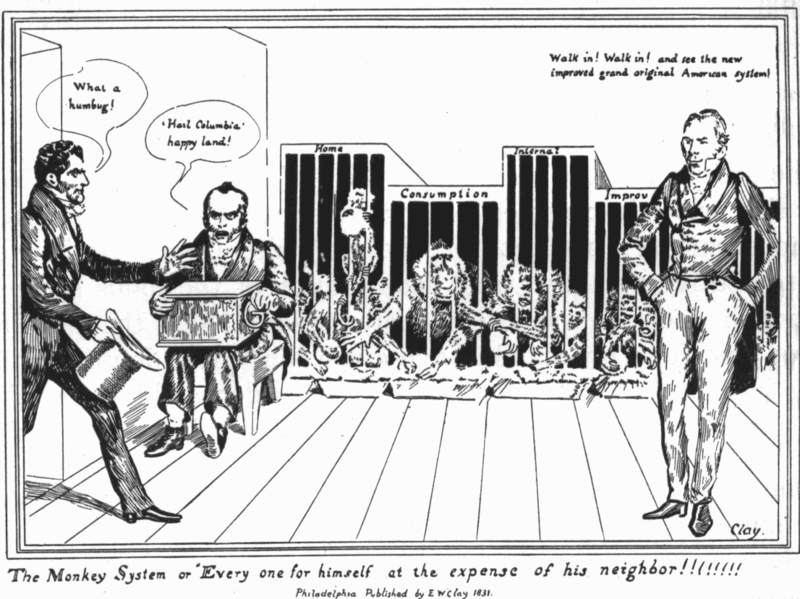
It turns out the US has its own history of trade manipulation. Cartoonist E.W. Clay published the below cartoon in 1831 to lampoon the "American System" of Protection as a "Monkey System" where "Every one for himself at the expense of his neighbor!" 

File:Henry Clay - Project Gutenberg eText 16960.png 

(Source)


 The “American System,” was the first US government-sponsored attempt to invigorate
the national economy through trade manipulation.  It implemented Alexander Hamilton’s ideas, as outlined in his 1792 “Report on Manufacturers.” At the time he  proposed a protective tariff of 20-25 percent on imported goods – such as woolens, cottons, leather, fur,
hats, paper, sugar and candy, to protect the nation’s fledgling
industries from foreign competition.  Congress finally passed the  tariff in 1816. 

The Banana War is Over!

Now here is a beautiful story of Trade Creation and Trade Diversion:

Brent Borrell  has the story how Bananarama started; the UN CONFERENCE ON TRADE AND DEVELOPMENT (UNCTAD) has its own report on the Banana Split, an the  BBC supplies the video documenting the happy end. 


That's how I came to grow up in Germany without ever eating a really good banana. That (and the artificially higher cost of European bananas) was the cost of trade diversion. When the EU was formed, a common tariff was imposed to favor consumption of bananas from southern European EU members, rather than Africa and Latin American. The justification was (I am not making this up) EU officials have conceded that their banana program violates free-trade rules, but have defended it as the by-product of historical and moral obligations to struggling nations dependent on access to the European market."  

This line of reasoning is always a slippery slope – one can easily rewrite the above sentence and replace the term "EU" with the name of any other country in the world, if that argument stuck (and the WTO agreedmanymany times).  Sanctions were imposed (on French handbags, British bed linens !??), to no avail. But then again, the WTO is quite busy investigating all the other free trade infractions (I was stunned to find this website that provides an index of all WTO disputes). 

Global Trade Alert

Global Trade Alert doesn't actually cover global trade but global trade restrictions. Its an incredibly informative database

on anything and everything that could impede trade.

Its most recent report documents that the global recession not only decreased demand for imports but also increased the supply of trade restrictions. "Since the first G20 crisis-related summit in November 2008, the governments of world have together implemented 297 beggar-thy-neighbour policy measures; that is, more than one for every working day of the year. Add another 56 implemented measures that are likely to have harmed some foreign commercial interests, the total reaches 353." 

and

"During the past three months the number of state measures announced which–if implemented would likely harm foreign commercial interests–has expanded from 134 to 188. The protectionism in the pipeline keeps growing–there is no respite here. This protectionist overhang could limit the contribution of exports to economic recovery. "


Economic and Political Realities

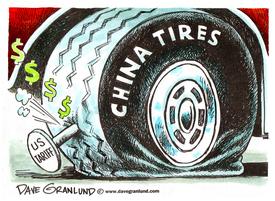
Economists, even those staunchly in the Obama camp, are up in arms about his decision to levy tariffs on tires from China. Here is the most simplistic economists view on these tariffs (assuming partial equilibrium and that the US is a "small open economy"). This is certainly the easiest way to indicate the negative impact of a tire tariff, but its not the full story. 

Doug Irvin, an eminent economic historian, reminds us that no matter how enlightened, independent, or ideological a president may have been, "regardless of party, every president, at some point, and often for political reasons, has imposed restrictions on imports."

Chapter 7 in International Economics clearly outlines that once politicians are maximizing not only economic welfare, but also political political objectives, it is actually the absence of tariffs that should surprise us.  

What does endogenous protection imply about President Obama's objective function? Who are the key pressure groups in the US?  

Frozen Finance

More applications of Large Open Economy interactions, this time from the WTO.

The collapse of world trade is partly due to insufficient trade credit financing. The global market for trade finance (credit and insurance) represents approximately 80% of 2008 trade flows, valued at $15 trillion. The World Bank estimates that the fall in the supply of trade finance has contributed some 10% to 15% of the decrease in world trade since the second half of 2008.  

This would imply a $2.25 trillion (15% of $15 trillion) decline in trade since June 08.

There are green shoots, however, which can be confirmed using the Baltic Dry Index. The WTO writes

The most recent information indicates that the situation seems to have eased a bit in Asia, particularly in China, although some countries see their access to finance still very restricted (Philippines, Vietnam). In Africa, the situation remains tense, and active banks are seeking support from international financial institutions. In Latin America, credit rates have somewhat eased up since the fall of 2008, but are still higher than usual both in small Latin American states, and increasingly in larger countries such as Mexico and Argentina. 

The End Of Free Fall – Now What?

 "The economy appeared to be in free fall, much like a ball rolling off the side of a table,in October. Today, no one will describe the economy in that way" Larry Summers 4/9/09 (President Obama's Top Economic Advisor).

At first sight, the quote does seem to instill hope. Here are a couple of thoughts:

1) do we know (or care) how far the ball dropped?

2) Is it time to celebrate — or do we care how the ball gets back up onto the table?

Today there are some answers: Floyd Norris reports that, as of May 21, 2009, it is now official: the US has entered the worst recessionin five decades (this is how as long as we happen to have data).

Jeff Frankel notes that, as of April 29, 2009, the current recession is also tied for the longest recession since the great depression.  On the other hand, another economic measure (the index of leading indicators) reversed its downward trend for the first time in about a year. Time to pop the champagne?

Not so fast: Barry Eichengreen and Kevin H. O’Rourke document that even during the great depression, the ride was never monotonically down hill. Their report (especially their figure/discussion on global tradeflows) is well worth reading.

Paul Krugman explains lucidly why the news that we may havehit bottom is probably only an "inventory bounce." That not the type of data we associate with "getting the ball back up onto the table."

Export Contagion

Stunning: has any industrialized country ever experienced income reductions of -14% and -15% (annualized) in successive quarters?

But now the good news (from Bloomberg): The consensus forecast had been a 16% reduction in Japanese income… This gives a whole new meaning to the Brad Sester's comment that the US is exporting the crisis by not importing. Below is a picture from GCaptain's blog. Of course, all this is captured succinctly by the Baltic Dry Index that shows the collapse of shipping as the price for container capacity has tanked in the face of huge excess capacity. A wonderful application of the locomotive effect discussed in Chapter 15. It is an interesting exercise to work through Figure 15.9, how a drop in imports hurts the rest of the world.  


Deja Vu All Over Again.

The great depression brought us the American Smoot-Hawley Tariff Act (enacted June 17, 1930). Most nations reciprocated and imposed their own trade restrictions, raised existing ones, or set quotas on foreign imports. The effect of these measures was to greatly reduce the volume of international trade: by 1932 the total value of world trade had fallen by more than half. Try the simplest open economy trade model you can write down (see chapter 14) to see if you can reproduce the effects and identify the effect on output…

The Stimulus Package (aka “the American Recovery and Reinvestment Act” passed on Tuesday February 17, 2009) has a whole new set of “Buy American” expenditure switching provisions (chapter 15)…