The Ass End of the Donkey

Ed Lazowska’s assessment of education in Washington State.

“Unfortunately for the state, the University of Washington Seattle is one of the few bright spots amidst an otherwise struggling education system with regard to producing tech talent. While Washington ranks fourth in the nation for tech-related companies, the state comes in a disappointing 46th for participation in science and engineering graduate programs.”

But this goes way beyond science and engineering: “Washington has “pipeline issues” from secondary to postsecondary education. One-third of the kids in Washington who are eligible forHead Start or other Pre-K programs are denied access because the state doesn’t provide adequate funding. Among tech states, Washington has the highest dropout rate from 9th-grade to college. And depending on what you count, Lazowska said, the state ranks somewhere between 35th and 49th in the country in bachelors education participation rate per capita.” Here is a visualWashington has pipeline issues from secondary to postsecondary education. I wrote about this back in 2005, but Governor Gregoir at the time had no interest in addressing the issue.

China As The World’s Biggest Economy – Qualified

The Economist Magazine documents that China is now the worlds largest economy. Their chart is intriguing but deceptive (click on the link to enjoy the presentation)

Drama sells magazine subscrptions, but drama is also likely to involve hyperbole The presentation actually tells us NOTHING about how rich people in these economies are. A week later the Economist Magazine relented and produced the relevant chart:

China has a long way to go… 

Why Logs?

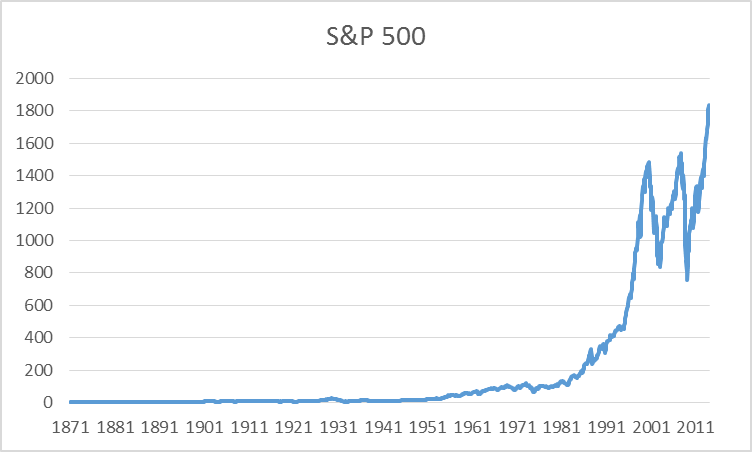
James Hamilton has a great post on why economists use logarithms: S– it’s usually a much more meaningful and robust way to display and examine dataS&P 500 stock price index, 1871:M1 - 2014:M2.  Data source: Robert Shiller.

S&P 500 stock price index, 1871:M1 – 2014:M2. Data source: Robert Shiller.


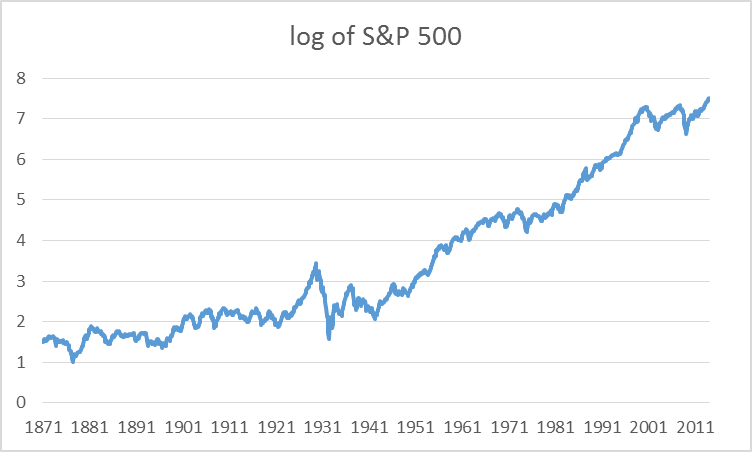
On the other hand, if you plot these same data on a log scale, a vertical move of 0.01 corresponds to a 1% change at any point in the figure. Plotted this way, it’s clear that, in percentage terms, the recent volatility of stock prices is actually modest relative to what happened in the Great Depression in the 1930′s.

Natural log of U.S. stock prices.

Natural log of U.S. stock prices.


other helpful sites are 

http://people.virginia.edu/~rwm3n/pdf/Notes%20on%20logarithms.pdf 

The Impossible Trinity

A central result in open economy macroeconomics, first clarified by Mundell and Fleming, is that a country cannot simultaneously opt for 

1) open financial markets (Free Capital Mobility)

2) fixed exchange rates (Peg)

3) effective monetary policy (Monetary Autonomy)


Rather, the country is constrained to choosing two of these three.  The Impossible Trinity is also sometimes called the "Trilemma" since it is a choice among three favourable options, only two of which are possible at the same time.   

In the real world policy this simply means "a country must pick two out of three. It can fix its exchange rate without emasculating its central bank, but only by maintaining controls on capital flows (like China today); it can leave capital movement free but retain monetary autonomy, but only by letting the exchange rate fluctuate (like Britain or Canada); or it can choose to leave capital free and stabilize the currency, but only by abandoning any ability to adjust interest rates to fight inflation or recession (like [the currency board regimes in Hong Kong today or Argentina in the 1990s]). Source 

The Case For The Liquidity Trap

From Paul Krugman's "All Banked Up With Nowhere to Go"

First, I really, really don’t understand people who deny that we’re in a liquidity trap. As I’ve tried to explain in various ways,
the hallmark of such a trap is that at the margin people hold money not
for its moneyness but simply as a store of value, and that therefore
conventional monetary policy — which involves swapping money for
non-money assets like Treasury bills — has no effect, because it’s just
replacing one zero-interest asset with another.

As confirmation, consider this LA Times report on surging bank deposits;
basically, people are holding monetary assets simply as a safe place to
park their wealth, and the banks have no desire to put those funds to
work.

You can also see this in the data. Look at the velocity of
M2 — the ratio of nominal GDP to Milton Friedman’s preferred measure of
the money supply. Monetarism rested on the assumption that there was a
reasonably stable relationship between M2 and GDP; what’s happening now
is that deposits are piling up but going nowhere, so velocity (which
rose in the 90s thanks to the rise of shadow banking) has plunged:

What
about inflation? First of all, the inflation question is to some extent
separate from the liquidity trap issue: you can be in a liquidity trap,
with conventional monetary policy ineffective, while still having some
inflation due to cost pressures.

That said, is inflation running
higher than I expected? Yes. Am I worried that this might be the
beginning of a runaway inflation process? No. Do I sound like Donald
Rumsfeld? Yes.

The IMF study of PLOGs
— prolonged large output gaps — pretty much summarizes my own views.
You expect a persistently depressed economy to have falling inflation,
although it tends to level out at a small positive number. There can be
episodes of rising inflation along the way, however, but these normally
reflect special and temporary factors, usually oil prices and/or
currency devaluation.

US experience mostly fits this pattern,
although I now believe that there’s an additional special factor that
isn’t typical: the prolonged slump in home construction has now created a
bit of a shortage, so rents are rising — and since implicit owners’
rent is a major part of core inflation, that’s causing a pickup over and
above the effects of oil prices.

But there remains no sign of a wage-price spiral — wages remain very weak:

I expect inflation to subside; so do investors.

However, fear of inflation remains a powerful factor among people with a strong influence on policy — as witness Paul Volcker’s op-ed today, which is a clear demonstration of just how hard it is to break out of this trap.

In
principle, monetary policy can still be effective even in a liquidity
trap — hey, I sort of wrote the book on that back in 1998. But that
effectiveness depends on expectations, on credibly promising higher
inflation over the medium term, so that sitting on cash becomes less
attractive. And that credibility is hard to achieve when even good guys —
and they don’t come much better than Volcker — insist on partying like
it’s 1979; not to mention the likes of Rick Perry threatening the Fed
with mob justice.

The belief that it would be hard to gain the kind of credibility we need for monetary effectiveness is why I and others, notably Mike Woodford, believed that a strong fiscal stimulus was the option most likely to work in clawing our way out of a liquidity trap.

Of
course, that didn’t happen either. So now people are once again hoping
that the Fed will save the day — even as it’s more likely, as Tim Duy says, that we’ll get some deck-chair rearrangement.

What Does ‘Economic Growth’ Mean for Americans?

A fascinating paper by Anthony Atkinson, Thomas Piketty and Emmanuel Saez in the Journal of Economic Literature, condensed and interpreted by Uwe E. Reinhardt @ the NYT Economix:


its a good exercise to figure out why median and mean income diverged so dramatically while per capital GDP kept growing. The answer is on Reinhardt's blog, and its depressing.

Grade Inflation

From Stuart Rojstaczer and Christopher Healy, grade inflation chroniclers extraordinaire (via Economix):

Here is   historical data on letter grades awarded by more
than 200 four-year colleges and universities, confirming that the share of A grades awarded has skyrocketed over the
years: 

DESCRIPTION
Stuart Rojstaczer and Christopher Healy Note:
1940 and 1950 (nonconnected data points in figure) represent averages
from 1935 to 1944 and 1945 to 1954, respectively. Data from 1960 onward
represent annual averages in their database, smoothed with a three-year
centered moving average.

Most recently, about 43 percent
of all letter grades given were A’s, an increase of 28 percentage points
since 1960 and 12 percentage points since 1988. The distribution of B’s
has stayed relatively constant; the growing share of A’s instead comes
at the expense of a shrinking share of C’s, D’s and F’s. In fact, only
about 10 percent of grades awarded are D’s and F’s.

Private colleges and universities are by far the biggest offenders on
grade inflation, even when you compare private schools to equally
selective public schools. Here’s another chart showing the grading
curves for public versus private schools in the years 1960, 1980 and
2007:

DESCRIPTION
Stuart Rojstaczer and Christopher Healy Note: 1960 and 1980 data represent averages from 1959–1961 and 1979–1981, respectively.

As
you can see, public and private school grading curves started out as
relatively similar, and gradually pulled further apart. Both types of
institutions made their curves easier over time, but private schools
made their grades much easier.

What accounts for the higher G.P.A.’s over the last few decades?

The authors don’t attribute steep grade inflation to higher-quality or harder-working students. In fact, one recent study found that students spend significantly less time studying today than they did in the past. In the last couple of
decades to a more “consumer-based approach” to education may be to blame, which they say
“has created both external and internal incentives for the faculty to
grade more generously.” More generous grading can produce better
instructor reviews, for example, and can help students be more
competitive candidates for graduate schools and the job market.

More disturbing, they argue, are the potential effects on educational outcomes. “When
college students perceive that the average grade in a class will be an
A, they do not try to excel,” they write. “It is likely that the decline
in student study hours, student engagement, and literacy are partly the
result of diminished academic expectations.”

All this jives with Cliff Mass's report that the University of Washington simply watered down its math assessment for Freshmen to reverse the trend of falling math scores in the 1990s.  


To Cut Or Not To Cut – The 1932 Version

Same discussion, same situation, issues, just 80 years ago

The Pain Caucus of 1932

Tyler Cowen sends us to Friedrich August von Hayek, T.E. Gregory, Arnold Plant, and Lionel Robbins on October 18, 1932.

I'm trying to get Ryan Avent to let Hayek represent the Pain Caucus on the Economist's
"By Invitation" feature: he's more articulate than most members of
today's pain caucus, and also more upfront in what he wants to see.

Hayek et al.:

Sound familiar?:
We are of the opinion that many of the troubles of the world at the
present are due to imprudent borrowing and spending on the part of the
public authorities. We do not desire to see a renewal of such practices.
At best they mortgage the Budgets of the future, and they tend to drive
up the rate of interest–a process which is surely particularly
undesirable at this juncture, when the revival of the supply of capital
to private industry is an admittedly urgent necessity. The depression
has abundantly shown that the existence of public debt on a large scale
imposes frictions and obstacles to readjustment very much greater than
the frictions an dobstacles imposed by the existence of private debt.

Hence we cannot agree with the signatories of the letter that this
is a time for new municipal swimming baths, etc., merely because "people
feel they want" such amenities.

If the Government wish to help revival, the right way for them to
proceed is, not to revert to their old habits of lavish expenditure, but
to abolish those restrictions on trade and the free movement of capital
(including restrictions on new issues) which are at present impeding
even the beginning of recovery.

And a little fact-checking. Barrie Wigmore points out:

The low point in government bonds was in January 1932, when the
U.S. Treasury 4 1/4 percent bonds due in 1952 hit $99… thereafter
prices rose… reduced U.S. government bond yields from an average of
3.92% in March 1932 to 3.76% in June…

U.S. debt-to-GDP was to more than quadruple from its 1932 value in
the New Deal and World War II, with no signs at all that such borrowing
was in any way "imprudent."

To Cut Or Not To Cut


Here is a good discussion about the proposal to cut the massive US government deficit. In a nutshell, its about inequity aversion: spend now to reduce unemployment, or start saving now to reduce the largest fiscal deficit in US history. The below is all from Mark Thoma, who provides the readers digest version (read the links if you want the full load)

Former CEA Chairs and the Unsustainable Budget Deficit


Unsustainable budget threatens U.S., by 10 ex-chairs of the president's Council of Economic Advisers, Politico:
… As former chairmen and chairwomen of the Council of Economic
Advisers, who have served in Republican and Democratic administrations,
we urge that the Bowles-Simpson report, “The Moment of Truth,” be the
starting point of an active legislative process that involves intense
negotiations between both parties.

There are many issues on which we don’t agree. Yet we find
ourselves in remarkable unanimity about the long-run federal budget
deficit: It is a severe threat that calls for serious and prompt
attention. …


It is tempting to act as if the long-run budget imbalance
could be fixed by just cutting wasteful government spending or raising
taxes on the wealthy. But the facts belie such easy answers. …


To be sure, we don’t all support every proposal here. Each
one of us could probably come up with a deficit reduction plan we like
better. Some of us already have. Many of us might prefer one of the
comprehensive alternative proposals offered in recent months.


Yet we all strongly support prompt consideration of the
commission’s proposals. The unsustainable long-run budget outlook is a
growing threat to our well-being. Further stalemate and inaction would
be irresponsible.


We know the measures to deal with the long-run deficit are
politically difficult. The only way to accomplish them is for members
of both parties to accept the political risks together. That is what
the Republicans and Democrats on the commission who voted for the
bipartisan proposal did.


We urge Congress and the president to do the same. Martin N. Baily, Martin S. Feldstein, R. Glenn Hubbard, Edward P. Lazear, N. Gregory Mankiw, Christina D. Romer, Harvey S. Rosen, Charles L. Schultze, Laura D. Tyson, Murray L. Weidenbaum, 


Reading the names on the list, and noting the staunch opposition to tax increases by some, this came to mind:
Back in 2000, the U.S. government's long-term  budget was out
of balance–although not by all that much. The government had, you
see, made promises–very popular promises–for Medicare, Medicaid, and
Social Security without proposing sufficient funding streams to pay for
those promises. So back in 2000, looking forward, we had a choice:
raise taxes, or "bend the curve" by cutting the growth of spending. Instead of doing either of these, we elected George W. Bush.
Two wars. A big (and ill-advised) defense buildup that is very
unsuited to protecting us from Al Qaeda and company. A huge unfunded
expansion of Medicare. Plans for the unfunded expansion of Social
Security that came to nothing. However, instead of raising taxes George
W. Bush reduced them. Taxes are going up over the next decade–barring cuts of 1/3
to Medicare, etc. They can either go up smartly or we can pretend they
don't have to go up, in which case they go up stupidly. The argument
for small government was lost long ago, and was lost again and anew in
the past decade with Medicare Part D and the wars of George W. Bush. The time to stand up to the budget busting was when it happened, and
when members of the list had the power to affect policy, not many years
later in an article at Politico. Many on the list were either part of
the decision making team in the 2000s that opened the hole in the
budget, or supported what the team did. I suppose it's possible to argue
things were different in 2000 — there was a wide expectation that
budget surpluses would be the "problem" at that time. But if the
forecasts by members of the list were so bad then — and they were —
why should we listen now? The long-run budget problem does need to be addressed, but the
standing of some on the list to make this claim can certainly be called
into question.


So much for  Thoma's analysis, Each CEA  Chair is an intellectual power house in his/her own right. In the other corner are two nobel laureates (Stiglitz and Krugman) to create alively debate:

Why I didn't sign deficit letter, by Joseph E. Stiglitz: I was asked to sign the letter
from a bipartisan group of former chairmen and chairwomen of the
Council of Economic Advisers that stresses the importance of deficit
reduction and urges the use of the Bowles Simpson Deficit Commission’s
recommendations as the basis for compromise. … I did not sign.
I believe the Bowles Simpson recommendations represent, to
too large an extent, a set of unprincipled political compromises that
would lead to a weaker America — with slower growth and a more divided
society.
Deficit reduction is important. But it is a means to
an end — not an end in itself. We need to think about what kind of
economy, and what kind of society, we want to create; and how tax and
expenditure programs can help achieve those goals.Bowles-Simpson confuses means with ends, and would take us off in
directions which would likely be counterproductive. Fortunately, there
are alternatives that could do more for deficit reduction, more for
putting America back to work now and more for creating the kind of
economy and society we should be striving for in the future.
There's quite a bit more in the link.

Yep, It’s Regressive, says Paul Krugman: 

Jon Chait takes another look at Bowles-Simpson, this time with numbers from the Tax Policy Center, and is disillusioned. As I surmised,
it redistributes income upward: the bottom 80 percent of families
would pay higher taxes than they did in the Clinton years, while the
top 20 percent — and especially the top 5 percent — would pay less; not
what you’d call shared sacrifice.
The only twist here is that the ultra-rich, the top 0.1
percent, who get a lot of their income from dividends and capital
gains, would be hit by having these gains taxed as ordinary income.
Even so, they would face a smaller tax increase than the bottom 60
percent.
This wasn’t the plan we’ve been looking for; on taxes, what on earth were they thinking? One third of of the deficit reduction under Bowles-Simpson is from
revenue increases, and two thirds is from spending cuts. The above is
about tax cuts, but the spending cuts will, in the end, likely hit lower income households harder and end up being regressive as well.
Here is Krugma's summary of the Pain Caucuses shortcomings:


The $4 Trillion Day

The Bank of International Settlements reports that the DAILY foreign exchange volume has just about cracked the $4 trillion mark. Up from $3.3 trillion in 2007. To get an idea of the unbelievable scale of these flows, the DAILY turnover is thus larger than the total ANNUAL income of any European economy (for example, FX turnover is twice the size of the UK's ANNUAL income) and DAILY FX flows are about 1/3 of the ANNUAL income in the US. Or, to ballpark it, ANNUAL FX flows are about 70 times larger than ANNUAL US GDP…

Interestingly, the dollar maintains its status as the worlds reserve currency, despite the subprime crisis, despite quantitative easing (rounds I and II), despite record fiscal deficits, and despite the zero interest rates policy of the Fed.   


15 Months

That's how long it took for a the NBER Eggheads to locate the bottom of the recent economic downturn – which is also associated with the end of the recession. As we know by now, the patient is recovering but much slower than we have seen after previous recessions. That's because this is the only recession that involved (or indeed was started by) a banking crisis — other than the great depression. In "Diminished expectations, double dips, and external shocks: The decade after the fall," Reinhart and Reinhart outline why the 2008 collapse of the US banking sector makes this recovery special.

Credit Suisse tells us in a few pictures why the the past year since the end of the recession is still not feeling like a "Recovery."  

Brilliant Titbit: Small EU Country 4 Sale

Can I interest you in a small Mediterranean country?

The government will sell 49 percent of the state railroad, list ports and airports on the stock market and privatize the country's casinos, the Finance Ministry said after a cabinet meeting in Athens. The government will also sell stakes in water utilities serving Athens and Thessaloniki, sell 39 percent of the post office, and combine its vast real estate assets into a holding company to be listed on the stock market… The state will maintain its stakes in Hellenic Telecom and the electrical utility Public Power.

This has to be one of the saddest paragraphs I've read in a while:

NATO figures show that Greece spent 2.8 percent of G.D.P. on its armed forces in 2008, or about €6.9 billion. That makes it the most expensive military budget in Europe in per capita terms, and second only to the United States in the alliance. Athens has justified such spending as necessary to keep up with its regional rival, Turkey, also a NATO member.

The military budget would seem to be a bit of low-hanging budget fruit, if only silly regional rivalries could be set aside.

Titbit: Blue/Red States And Public Sector Size

At times I read economic material that is off topic (in terms of the actual International Economics textbook), but I cannot help but share. So I am starting a new category, titbits, referencing the dictionary definition of the term: a tasty small piece of food for thought…

Who'd have thought it (from the New York Times):

Conservative states tend to employ larger shares of state and local government workers in the US

DESCRIPTION

Source: Report on public sector wages, Center for Economic and Policy Research, using Labor Department data; U.S. National Archives and Records Administration

The more dominated a state is by public-sector workers, the less likely that state was to vote for the Democratic presidential candidate. Any theories? Catherine Campell suggests two potential explanation:

1) Liberal states tend to be more urban, and big cities have a lot of private industry that can dwarf the size of state and local governments.

2) Maybe this is not “big government” versus “small government,” but federal vs local government – since these data refer to a very specific segment of the government: non-federal workers. Maybe, Jeffersonian-style, it’s not such a big contradiction for states to be hostile to candidates perceived to be expanding the size of the federal government, and to still employ lots of workers at the state and local levels.