The Unusual Mechanics of the Euro Central Bank(s)

One would think a Euro is a Euro is a Euro. The same piece of paper in Athens is issued and administered in a common fashion across the eurozone. But not so. The Wall Street Journal has a great article summarizing the European system of Central Banks, administering and issuing currency and debt” 

How Does the Eurosystem Work?

By Charles Forelle6:17 AM EST JUL 10, 2015

A Greek exit from the eurozone would be a social, political and economic cataclysm. It would also make a mess of the Eurosystem, the carefully constructed central-banking arrangement that underpins the 19-nation currency union. What would happen to it if one country fell out? We’ll step through the implications, including for Target2, the transnational payment system that has caused a huge fuss in Germany.

How are central banks set up in the eurozone?

What we think of as the European Central Bank is really the “Eurosystem”: the 19 central banks of eurozone countries plus the ECB itself. The vast bulk of ECB’s balance sheet—its assets and its liabilities—is held by the national central banks. They function as sort of branches of the broader ECB. This is a consequence of Europe’s imperfect union: All the eurozone countries retain their own central banks and their own banking systems, even though the system’s policies and rules are set centrally.

In normal times, this is a distinction without a difference. But when one country is on the cusp of leaving, it starts to matter.

How do commercial banks operate in the eurozone?

They interact and transact with the central bank of their home country.

Commercial banks have their own deposit accounts with the local central bank. When they need central-bank loans, they turn to the local central bank. That means that, say, Piraeus Bank (a Greek bank) gets funding from the Bank of Greece.

A customer’s deposit in a commercial bank is simply an amount the bank owes the customer. When a customer of Piraeus Bank transfers €1,000 ($1,117) to another Piraeus Bank customer, Piraeus notes in its ledger that it now owes €1,000 less to Customer A and €1,000 more to Customer B.

When the Piraeus customer transfers €1,000 to a customer of Alpha Bank (another Greek bank), the Bank of Greece gets involved.

Just as a customer deposit with Piraeus is an amount Piraeus owes the customer, Piraeus itself has a deposit account with the Bank of Greece that shows how much the Bank of Greece owes it.

In the transfer from a Piraeus customer to an Alpha customer, the Bank of Greece notes in its ledgers that it now owes Piraeus €1,000 less and Alpha €1,000 more. Piraeus notes that it owes its customer €1,000 less and Alpha that it owes its customer €1,000 more.

(This, incidentially, is why electronic transfers within Greece are permitted by the capital controls.)

OK, so what happens if a Piraeus customer transfers €1,000 to, say, an account in Germany with DeuTsche Bank?

Well, the customer can’t anymore because of capital controls, but let’s go back to a time when he or she could.

Piraeus deals with the Bank of Greece and Deutsche Bank with the Bundesbank, Germany’s central bank. That makes the transfer more complicated. The central banks themselves don’t have a “master” central bank with which they both have deposit accounts. Instead, the Eurosystem operates a system called Target2 to handle the payment.

The €1,000 transfer works like this: Piraeus notes that it owes the customer €1,000 less. The Bank of Greece notes that it owes Piraeus €1,000 less. The Bundesbank notes that it owes Deutsche Bank €1,000 more. Deutsche Bank notes that it owes the customer €1,000 more.

In between the Bank of Greece and the Bundesbank sits Target2. The Target2 system notes that the Eurosystem owes the Bank of Greece €1,000 less and the Bundesbank €1,000 more.

Target2 operates every business day; over time these credits and debits add up, and every central bank has either a positive or negative balance toward the Eurosystem.

How big are these balances?

In precrisis times they were pretty small. That’s because banks in the eurozone used to lend money to each other quite readily. If a Piraeus customer transferred €1,000 to a Deutsche Bank customer, that might have been offset by a loan from Deutsche Bank to Piraeus (or another German bank to another Greek bank)—which is money moving the other way. Thus the Target2 flows cancelled each other out.

How about now?

Now, not so much. Greek banks have been cut off from international markets for months; in order to get €1,000 to transfer to a German bank, a Greek bank would’ve had to borrow it from the Bank of Greece. The outgoing flows have not been offset by incoming flows, and so the Bank of Greece’s Target2 balance has ballooned. It was minus €100 billion at the end of May. By contrast, the Bundesbank’s balance was positive €526 billion at the same time.

So Germany is lending money to Greece through the central banks?

Not exactly. Let’s get philosophical. We need to understand the nature of a euro.

Where do euros come from?

Banks make them. Loans create deposits. If the bank lends you €200,000 for a mortgage, it notes in its ledgers that it you owe it €200,000 (that’s an asset to the bank) and credits your deposit account with €200,000 (that’s a liability for the bank). Voila, some new euros are born. You transfer them to the house seller, and off they go into the financial system.

Banks can’t make euros like this infinitely: Regulatory constraints bind how much risk they can take (a loan is risky), and the central bank requires that they hold an amount equal to a certain fraction of their loans as deposits with the central bank.

Since the central bank controls how much of this central-bank money exists for these deposits, the central bank controls the ability of the commercial banks to make loans and create euros.

In effect, there are 19 systems creating euros—”French euros,” “Spanish euros,” “German euros,” “Greek euros” and so on. What makes all of these euros euros is that Target2 works: a euro in one place can be sent, through the central banks, to another place, where it is still a euro.

But don’t the central banks make euros, too?

Yes, and it is this central-bank money that is “moved” between central banks via Target2. Central banks make euros the same way commercial banks do, by making loans. (They also buy bonds, as in quantitative easing.)

The central bank makes a loan to a commercial bank. It records in its ledger a loan to the bank (an asset) and a deposit to the bank’s account (a liability). In normal times, the central bank doesn’t need to do very much of this: banks can get loans from other banks if they need funds. But since the onset of the crisis, the ECB has let banks have as much funding from the central bank as they need, on generous terms, so long as they can put up some assets as collateral to secure the loan.

And in a pinch, the central bank gives emergency funding in this way—as the Bank of Greece has been doing for Greek banks—against less-secure collateral.

So have all the central banks been creating euros like this?

Some much more than others. The Bank of Greece, as of May, has created €116 billion through lending to its banks, both regular and emergency. The Bundesbank has created just €35 billion.

It is this outsized creation of euros that allows the buildup of the Target2 balance: In essence, the Greek central bank has been creating euros that its banks can send elsewhere.

Does the Bank of Greece ‘owe’ this sum to the Eurosystem?

In an accounting sense, yes. It pays interest on its Target2 balance, though it never has to be repaid. (A similar thing happens with banknotes; a central bank that issues excess banknotes pays interest to the Eurosystem. The Bundesbank is a big excess issuer of banknotes.)

So if Greece leaves the euro, does the Eurosystem have a €100 billion loss?

Not necessarily. Let’s look at the Eurosystem’s balance sheet. Its balance sheet is the sum of all the balance sheets of the 19 national central banks and the ECB itself. The Eurosystem’s assets are mostly gold, foreign reserves, loans to eurozone banks and bonds it has bought under various bond-buying programs including quantitative easing.

Its liabilities are mostly banknotes and the deposit accounts maintained by eurozone banks.

Hidden in the Eurosystem’s balance sheet are the amounts that the central banks owe each other; they sum to zero. The Bank of Greece owes €116 billion (€100 billion for Target2, €18 billion for excess banknotes, minus €2 billion for other stuff it is owed). It has a liability of €116 billion.

Because all these claims balance each other out, the rest of the Eurosystem has an asset of €116 billion: a claim on the Bank of Greece. Thus, if the Bank of Greece were simply chopped out of the Eurosystem, the new Eurosystem’s balance sheet would record that claim as an asset.

But surely that asset isn’t worth €116 billion?

Maybe not, but it possibly doesn’t matter. If the post-Grexit Bank of Greece repudiated that claim, the post-Grexit Eurosystem might have to take a writedown and book a loss. A loss would be shared among the central banks and could lead countries to recapitalize the system.

The economist Karl Whelan makes the point, in a comprehensive paper on Target2, that Greece wouldn’t necessarily have to, or want to, repudiate the claim. Being able to transact payments in euros is useful, and Greece could remain part of Target2 even if it exits the eurozone: several noneuro EU countries are part of it. “The claims can be honoured simply by making the necessary interest payments,” Prof. Whelan writes. At the current rate of 0.05%, the annual bill would be around €50 million.

What about the rest of the Eurosystem’s balance sheet?

The imperfect union of Europe actually helps in a divorce: because all the Greek banks transact with the Bank of Greece, the Greek system could be more easily hived off.

One sticky point is banknotes. Greek banks’ electronic deposits with the Bank of Greece could be switched into drachma at the press of a button. But the euro banknotes it has issued to commercial banks can’t be pulled back. The Bank of Greece has issued €45 billion in banknotes—its regular allocation of €27 billion plus an additional €18 billion.

It’s not clear what would happen. One solution is to consider a post-exit Greece’s regular allocation of banknotes to be 0 instead of €27 billion—it’s not in the eurozone, after all.

Then, that €27 billion gets added to Greece’s excess issuance, and becomes part of its liability to the new Eurosystem, taking it from €116 billion to €143 billion.

Will it ever pay that back?

Maybe, eventually. Target2 liabilities and banknote liabilities don’t have to be repaid—they exist in perpetuity, fluctuating over time. But if Greece leaves the eurozone, its Target2 and banknote liabilities won’t soar again, because it can no longer print euro banknotes and it can no longer create euros by lending them to its banks.

China Currency Manipulation Update

Menzie Chinn is reviewing recent developments. Here are the pertinent aspects (October 25, 2012)

(1) the Chinese currency has
appreciated considerably since 2005 to arguably near equilibrium levels, and

(2) Chinese reserve accumulation has
tailed off; in particular accumulation of USD has stabilized. 

First, to the point of Chinese
currency appreciation. Figure 1 shows the nominal bilateral USD/CNY exchange
rate, with Deutsche Bank forecasts, and the trade weighted real CNY exchange
rate.

romneystrikes1.gif 

Figure 1: Log trade weighted real (CPI deflated, broad basket, 2010=0) CNY index (blue, left scale), nominal USD/CNY exchange rate (dark red), as of 10/24 (dark red triangle), and forecasts from Deutsche Bank (Oct. 3) (red +). Sources: BIS, St. Louis Fed FRED, and Deutsche Bank, Exchange Rate Perspectives(October 3, 2012).
Figure 4. Source: “Capital Inflows Become Outflows in China, WSJ Analysis Shows,” WSJ Real Time Economics (October 16, 2012).


In general, the trade weighted real exchange rate (blue line) is the most relevant one for assessing China’s role in the world economy; it has appreciated substantially since the end of the Great Recession. The BIS (and IMF) trade weighted exchange rates are CPI-deflated. One might reasonably argue that this measure of competitiveness (see Chinn (2006)for definitions) is not the most appropriate. It turns out that using unit labor costs does not change the conclusion considerably. Figure 2 shows that the IMF CPI deflated measure and the unit labor cost deflated to do not differ substantially (and in fact has exhibited greater appreciation since 2009Q2). 

 romneystrikes2.gif 

Figure 2: Excerpt from Figure 4 of IMF, Staff Report for Article IV Consultation: People’s Report of China (July 2012).


[Some argue] China is keeping the exchange rate weak in order to gain competitive advantage, presumably by intervening in foreign exchange markets. However, the evidence for massive intervention is quite limited, insofar as we can infer from the data. 

 romneystrikes3.gif 

Figure 16 from Deutsche Bank, Exchange Rate Perspectives (October 3, 2012).


Total reserves are barely rising, while the share of reserves held in US dollar assets is estimated by DB to be declining over time. Moreover, it is not quite right to equate reserve accumulation with the trade surplus, as shown in the below figure from the Wall Street Journal Real Time Economics: 


romneystrikes4.png 

Would it be better for the U.S. and world economy if the Chinese allowed the currency to appreciate more rapidly? Most likely; as I’ve argued, this would help re-allocate aggregate demand away from China and to the rest-of-the-world. 

The China Syndrom

China is learning about the basic principles of open economy macro: Sterilize the balance of payments surplus or experience increases in output that eventually lead to inflation. Use the TB/Y diagram or the Fixed Exchange Rate MF model to show how the undervaluation of a currency leads to massive reserve accumulations that must, eventually, be sterilized. It will be an interesting case study to count the ways in which China will try to maintain control of its money supply, and how follow effective each measure is going to be.   

Who or Hu Is In Charge?

Floyd Norris of the New York Times outlines (in two parts) the US/Chinese Dilemma:

November 12, 2010, 12:00 PM

Who Sets China’s Monetary Policy?

My column this morning mentions how upset the Chinese are with the Federal Reserve, but it does not discuss one very good reason they have to be upset:Ben Bernanke’s monetary policy is not what China needs these days. It needs to tighten, as is shown by rising inflation there.

So what? China can adopt its own monetary policy, can’t it?

Actually, that is not so easy. Having decided to tie its currency to the dollar, China has effectively allowed the Fed to set monetary policy there as well. But the Fed’s mandate does not extend to protecting the Chinese economy.

The impact of that is muted to some extent by the fact China’s economy is far from open. You and I cannot invest there as easily as we can in, say, Germany. If we could, there would be a surge of capital into China, driving up the value of the Chinese currency. But there is not an impenetrable wall between China and the West, and money does get in. China’s money supply has been rising rapidly. And that is likely to continue as long as it insists on ridiculous undervaluation of the currency.

In the long run, China may have to choose. Its currency can become more reasonably valued by rising against the dollar (and the euro, and the yen, andthe pound, and the won and so on and on) or it can become more reasonably valued through inflation and rising costs that reduce China’s competitiveness. 

and 


Who's in Charge of Determining U.S. Interest Rates? It May Be Beijing

May 19, 2005 | May 13, 2005

IN Washington these days, complaining about China has become standard operating procedure. The Bush administration calls on China to allow its currency to rise and Congress talks of punishment if China does not do so.

Be careful what you wish for.

As speeches of low-level Chinese bureaucrats are read with care for hints as to just when China will allow its currency to rise, perhaps it would be better for Americans to ponder the impact of China's current policies. Some might wonder just why the American politicians are upset. The way things work now, China sells to the world most everything the world wants and then buys United States Treasury securities. That helps hold down interest rates and stimulates consumer spending.

You can understand why China might not like to keep doing that forever. Those Treasury securities do not pay much interest, and they are sure to decline in value, measured in Chinese yuan, when that currency rises. But the largest vendor financing program ever has stimulated both the Chinese and American economies. In Washington, the theory is that China's keeping the yuan low increases America's trade deficit. But the benefits to United States exporters from a modest rise in the Chinese currency would most likely be small, while the effect of higher interest rates could be larger if China cut back on its purchases, particularly if other Asian central banks decided that they, too, wanted to sell dollars.

If that were to happen, the impact could be acute in the housing market. Investors in housing stocks have been nervous for some time, happy to see ever-higher profits but worried that the good times must end someday and fearful that they could be left holding the bag when that happens. One stock where those conflicting emotions have played out is Pulte Homes, a home builder active in 27 states. Last fall, its share price fell when it reported problems in Las Vegas, which was perhaps the most overheated market in America. But price cuts there got homes selling again, and the stock has resumed its ascent. Pulte filed its quarterly report with the Securities and Exchange Commission last week, disclosing that its inventory of land continues to grow. Some of that land is owned, while the rest is controlled via purchase options that give Pulte the right to walk away – forfeiting what it paid for the option – if home sales soften.

Kathleen Shanley, a bond analyst at Gimme Credit, points out that Pulte's inventory of land is concentrated in areas where home prices have been rising rapidly and that the company's cash flow is negative, even as profits soar, because of all the land it is buying. Pulte has been borrowing money even as it buys back stock at high prices. When things were at their worst in Las Vegas, Pulte was seeing cancellations of home purchases that amounted to 75 percent of new sales. "The risk of similar, and perhaps more prolonged, regional downturns should not be ignored," Ms. Shanley wrote in a note to clients. Rising interest rates could be a cause of such downturns. Homeowners with fixed-rate mortgages would be relatively immune, although they could find it harder to sell if they needed to, and the flow of cash from mortgage refinancings would dry up.

But many buyers, particularly in some of the hottest markets, have resorted to floating-rate mortgages, some of them paying only interest. Alan Greenspan, the Federal Reserve chairman, has less power over interest rates than he once did. Perhaps the real decision maker will be Hu Jintao, the Chinese president, as he weighs the pressures to free his currency and stop accumulating Treasury securities. In the words of Robert J. Barbera, the chief economist of ITG/Hoenig, "Hu's in charge here."


China’s Rate Hike In The Mundell Fleming Model

Analysis provided by Menzie Chinn on the occasion of China's last rate hike, March 18, 2007.

Attaining Internal and External Equilibrium in China

China raises rates again. What will higher rates do?

From Bloomberg:

China Cools Investment, Fails to Tame Trade Surplus (Update1)

By Nipa Piboontanasawat

March 19 (Bloomberg) — China, which raised interest rates for a third time in 11 months this weekend, is discovering that solving one of its two main economic problems makes the other one worse.

The interest rate increases and other measures are cooling investment in factories, real estate and other fixed assets, allowing Premier Wen Jiabao to claim partial victory in a fight against wasteful spending. At the same time, the trade surplus — which has pumped cash into the economy, fueling inflation and asset bubbles — is ballooning.

The People's Bank of China raised interest rates to the highest in almost eight years on March 17. By curbing investment, Wen has reduced demand for imported steel and cement for factories, exacerbating the trade imbalance and straining ties with the U.S.

"It's difficult to reduce both investment and the trade surplus," said Huang Yiping, chief Asia economist at Citigroup Inc. in Hong Kong. "You can do one but you'll see a rebound in the other."

Wen is concerned that building too many factories will leave the world's fastest-growing major economy vulnerable in a slowdown. The central bank has increased the amount of money lenders must set aside as reserves five times in eight months, sold bills to soak up cash, and restricted property investment.

See also coverage here: FTWSJ, and Macroblog.

Interestingly, the increase in the nominal interest rate is only offsetting, to a certain degree, accelerating inflation. This point is made in Figure 1.

chinamf1.gif 
Figure 1: Nominal (blue) and real one year lending rates (green). Real rates calculated by subtracting off lagged one year CPI inflation rates (quarterly averages of monthly year-on-year inflation rates). Source: IMF, International Financial Statistics, and author's calculations.

I find it interesting to think about this issue in the context of the Mundell-Fleming model with low capital mobility. "Low capital mobility" is modeled as a small value for the parameter linking capital flows to interest differentials vis a vis developed market economies. I'll depict this characterization as a "BP=0 schedule" steeper than the LM curve.

winning1.gif

chinamf2.jpg 
Figure 2: Tightening of monetary policy.

Just to review, this is an demand side model, with prices assumed fixed (or sticky) for the period of analysis. The IS curve summarizes the relationship between interest rates and income for which income equals aggregate demand, for a given level of autonomous spending and real exchange rate. The LM curves summarizes the combinations of interest rates and incomes for which a given money supply equals money demand. The BP=0 curve includes all combinations of interest rates and income for which the current account and private capital account sum to zero, for a given real exchange rate. YFE is full employment output. As drawn, under quasi-pegged exchange rates, the country experiences a substantial balance of payments surplus; the LM is held in place by sterilization of reserve accumulation through the sales of monetary stabilization bonds.

The increase in the domestic interest rate (and the imposition of restrictive administrative measures) could be interpreted as a shift inward of the LM schedule. This leads to a reduced GDP at Y1 (or in dynamic terms, a slower growth rate), as desired by the authorities. But at the same time, the combination of reduced output and higher interest rates (now at i1) leads to an exacerbation of the external disequilibrium (a bigger balance of payments surplus, through an increase in the trade balance, and higher capital inflows), thereby illustrating Huang Yiping's assertion.

As many observers have noted, a more rapid appreciation of Chinese yuan — as shown in Figure 3 — could accomplish both aims of slower growth and less external imbalance more efficaciously.

chinamf3.jpg 
Figure 3: Accelerated real exchange rate appreciation.

A stronger yuan shifts up the BP=0 schedule and shifts in the IS schedule due to expenditure switching toward foreign goods (although the strength of this effect is subject to great uncertainty — see Marquez and SchindlerThorbecke and Chinn). Output is reduced down to full employment levels, while equilibrium interest rates fall to i2.

This then poses an interesting question: Why is it the Chinese authorities choose this route? The exchange rate route leads to a larger investment expenditure share, and smaller export sector, while the monetary tightening route leads to a smaller investment share and larger export base. It therefore appears that they value the export sector more than domestic investment. To the extent that Chinese authorities are wary about the quality Chinese capital investment, this might make sense. However, to justify the current (costly) approach, Chinese investment must be very low productivity indeed (which may be true — see Dollar and Wei). Or alternatively a yuan's worth of foreign demand might be perceived as inducing more employment than a yuan's worth of domestic investment.

On the other hand, maybe Chinese authorities are coming around to the need for more drastic appreciation. From Daily News and Analysis:

HONG KONG: Economic policy circles in China and Hong Kong are abuzz with speculation that Chinese authorities are preparing for a one-off 10% appreciation of the renminbi later this year as a "shock treatment" procedure to rein in the country’s soaring trade surplus and beat back currency speculators.

"The intriguing possibility that the authorities might be preparing for a second renminbi revaluation in the 10% range is gaining traction in policy circles," notes UBS chief Asia economist Jonathan Anderson.

How realistic, though?

"In the current environment, it's a small but rising possibility," notes Anderson. However, he acknowledges, this is an "unlikely scenario" – not only because there isn't sufficient political support for such a large discrete move but also because it's not clear that carrying out another revaluation would solve China's trade problem or end the currency speculation. …

So perhaps we may still have to wait a while more for "rebalancing".


China Is Putting On The Breaks

TUESDAY, OCT 19, 2010 13:48 ET BY ANDREW LEONARD


Currency Wars

The world at war; the weapon: depreciation. Brazilian Finance Minister Guido Mantega has warned in remarks reported from Sao Paulo. "We're in the midst of an international currency war, a general weakening of currency," he said in remarks reported by the Financial Times newspaper. "This threatens us because it takes away our competitiveness." Japan, South Korea and Taiwan have intervened recently to pull down the value of their currencies, the newspaper noted, and the dollar has fallen by about 25 percent so far this year against the Brazilian real. Such a decline increases the price of Brazilian exports on the US market. 

Barry Eichengreen provides a summary of the economic implications of currency wars. Here are a few study questions


  • Why is China keeping its exchange rate artifically low?
  • Why are the US and Europe contemplating weaker currencies?
  • How are these policies related to beggar-thy-neighbor effects?
  • What are the alternatives to beggar-thy-neighbor policies?
  • Is it the currency war itself the source of the tensions between the US, Japan, and Europe,
    or is it the execution of the currency war the real problem? Explain
    . 
  • Who is the winner in this war? 


The Actual Value Of The Yuan

There is a lot of hype that the Chinese are manipulating their exchange rate. Unfortunately the discussion usually involves the nominal exchange rate – which does not indicate the real value of the currency. Nor does it indicate the actual competitive edge that the Chinese exchange rate policy is actually creating. Menzie Chinn has the whole story, here are his is his post:

The debate over the yuan's value is heating up again. [Free Exchange/RA] [WSJ RTE/Talley] [WSJ RTE]Here is a plot of two relevant time series.


cny0.gif 

Figure 1: Real trade-weighted value of CNY from BIS (blue, left axis), and nominal CNY/USD exchange rate (monthly average of daily rates). + denotes 9/15/2010 observation. Dashed line at de-pegging in July 2005. Source: BIS, and St. Louis Fed FREDII.

Two quick observations. First, the Chinese trade weighted real exchange rate is the relevant one for the world economy; the USD/CNY nominal exchange rate has some importance for the US-China trade balance, but less so for the US overall trade balance — which is the relevant aggregate.

Second, the trade weighted CNY was appreciating before the crisis, and the CNY has largely reverted to that trend over the past few months, after a detour associated with the dollar appreciation during the financial crisis and flight to safety. This observation, however, does not speak to whether the level of the rate is appropriate for moving the Chinese current account to a sustainable level. Additional (relevant) graphs in this post. 

Chinese Dollar Mercantilism

Time for a short list of links to Chinese Mercantilism, which is blamed for an annual loss of 1.4 million jobs in the US.

The mechanics of "Dollar Mercantilism" – why China is buying $ 

Effects of Dollar Mercantilism on the US  

Krugman's back of the envelope US job-loss calculation  

Krugman's "Taking On China", calling for a 25% tariff against Chinese goods

Ralph Gomeroy "Jobs, Trade, Mercantilism" Part 1 & Part 2 

Peter Morici's Currency Conversion Tax to End Mercantilism 

Fred Bergsten's "Correcting the Chinese Exchange Rate: An Action Plan"  

Levy, Philip “U.S. Policy Options in Response to Chinese Currency Practices”  


Love (Hate) Triangle

Today the Japanese Central Bank intervened (for the first time in 6 years in international currency markets). BBC has the story:

Japan moves to combat rising yen 

The Japanese central bank stepped in to sell yen and buy dollars, a day after the yen hit a 15-year high against the dollar.

It is the first time in six years that the Bank of Japan has intervened, and further action has not been ruled out. A strong yen makes Japanese exports more expensive, and reduces profits when earnings are repatriated.

In early trading on Wednesday, the dollar rose to 85 yen, after hitting 83.09 yen on Tuesday. Investors welcomed the intervention, sending Japan's Nikkei share index up by 2.9% at first, with the index eventually closing 2.34%higher at 9,516.56.

Economic harm

But in a brief news conference, Finance Minister Yoshihiko Noda said: "We have conducted an intervention in order to suppress excessive fluctuations in the currency market. "We will closely monitor currency developments, and take firm action including intervention… The yen's rapid appreciation "harms the stability of the economy and finances. We cannot tolerate it."

Japanese exporters praised the intervention. "From the standpoint of aiding the competitiveness of Japan's manufacturing industry, we applaud the move by the government and the Bank of Japan to correct the yen's strength," carmaker Honda said in a statement. Honda's shares closed up4%, while Sony, another big exporter, ended 4.2% higher…  A recent government survey suggested many companies were considering moving production overseas if the yen stayed high.

The record low for the dollar is 79.75 yen, reached in April 1995. Mr Noda did not reveal the size of the intervention, although the Dow Jones news agency reported that Japan's Ministry of Finance had initially sold between 200bn and 300bn yen ($2.4bn-$3.6bn).

But who is buying the Yen? The Japanese economy has been anemic since the early 1990s (the Japanese stock index has fallen by roughly 66% in the last 20 years).


Source 

Ok, so the Chinese government has been buying Japanese bonds, but their $20 billion purchases this year, cannot be the whole story.  Reuter's makes an attempt to explain the recent movements using interest parity (yield spreads) and sterilization – none of it convincing.  The one interesting piece is that the REER has actually not moved much less than the nominal exchange rate because of Japanese deflation.


Here is a final thought: when will we hear about Japanese "Mercantilism?" 

The Wall Street Journal spells out the Love (Hate) triangle all its juicy details:

China has been diversifying its $2.5 trillion reserves away from the dollar, causing some to worry that less Chinese buying of Treasurys would cause U.S. interest rates to and make it more difficult for the government to borrow.

But Japan’s dollar buying in currency markets Wednesday shows Chinese reserve diversification might actually lead to even more demand for Treasurys.

Here’s how. As China diversifies out of U.S. dollar-denominated assets such as Treasurys, it is buying debt denominated in the currencies of some of its biggest trading partners. Not wanting to lose competitiveness themselves, those trading partners in turn buy dollars to keep their currencies cheap.

As part of the diversification push, China has been a major buyer of yen, snapping up $27 billion in yen so far this year according to Japanese Ministry of Finance. Analysts say China’s buying has helped an already strong yen get stronger.

Now, Japan, feeling under pressure to weaken its currency, turned around and bought dollars, most likely in the form of Treasurys. It isn’t clear exactly how much dollar buying Japan will have to do to protect the yen from getting stronger, but it’s likely to more than offset China’s diversification into the yen. If the past is a guide, Japan spent $320 billion in its last intervention from 2003 to 2004. And this time the currency markets are 73% far larger, with $568 billion dollar-yen trading a day,  according to the Bank for International Settlements.

Japan is not alone in this phenomenon. China has also bought South Korea’s currency, the won. And South Korea routinely intervenes in currency markets, buying dollars to keep its currency from rising too quickly, again offsetting China’s move out of the dollar. 

Yuan On The Move – Or Not

Yesterday China announced it would move to a more flexible exchange rate regime. The move was hailed by those who didn't notice that the statement lacked any details. Sure enough, Monday morning the yuan was unchanged in value. Below are estimates of how much the yuan is undervalued, and Mark Thoma provides a roundup of the responses:

 Is China's announcement that it intends to increase the RMB exchange rate flexibility "more smoke than fire"?:

China Moves. Or Not., by Tim Duy: Futures markets are abuzz with excitement over the Chinese currency proclamation issued this weekend. The announcement was quickly hailed by observers worldwide as a major policy shift, yet I am inclined to side with the analysis provided by Yves Smith – the statement leaves plenty of wiggle room, and never really promises to do much of anything. At the moment, the Chinese announcement feels like more smoke than fire.

The Wall Street Journal's initial reporting was just want the Bejing and Washington wanted you to believe:

China's decision to abandon its currency peg is a victory of pragmatism over divisive politics, the result of careful diplomacy by leaders in Beijing and in Washington, each side vulnerable to powerful domestic lobbies.

In the end, both sides agreed that a more flexible exchange rate was good for China, good for the U.S. and good for the global economy. Yet timing was everything.

The implication is that hard-working policymakers on both sides of the Pacific have risked all to foster the greater good. But what exactly has changed? From the Chinese statement:

It is desirable to proceed further with reform of the RMB exchange rate regime and increase the RMB exchange rate flexibility.

In further proceeding with reform of the RMB exchange rate regime, continued emphasis would be placed to reflecting market supply and demand with reference to a basket of currencies. The exchange rate floating bands will remain the same as previously announced in the inter-bank foreign exchange market

What exactly will be the basket of currencies? On what timetable? Is this really a change? And why not widen the floating bands? I see no commitments here, vague or otherwise. Of course, there are not meant to be. From the Wall Street Journal:

Yet, by returning the yuan to a managed float against a basket of currencies, Beijing won't have to cede too much in the near term when it comes to the bilateral dollar/yuan rate. The euro's weakness-the yuan is up 14% against the euro this year-should mitigate the speed of any yuan appreciation against the dollar.

Looks like China is picking a policy direction that requires little deviation from current policy. Nor do they even admit there is a need for significant change. The Chinese announcement appears to preclude the possibility of meaningful adjustments.

China´s external trade is steadily becoming more balanced. The ratio of current account surplus to GDP, after a notable reduction in 2009, has been declining since the beginning of 2010. With the BOP account moving closer to equilibrium, the basis for large-scale appreciation of the RMB exchange rate does not exist.

Is "large-scale" 5%? 10%? 20%? The tone of subsequent reporting changed as journalists not sourced directly by Washington and Bejing began to realize the thinness of the Chinese announcement. From the Wall Street Journal:

China's announcement that it will let its currency appreciate puts it in a strong position going into a summit of the Group of 20 on Saturday, but does little to ease pressure from the U.S. Congress.

…But China's announcement was short on details about how much it would let the yuan appreciate. In Brazil, the central bank governor, Henrique Meirelles, said he welcomed the Chinese announcement, but wanted to see results. "It is necessary to await further developments," he said in a statement.

Is the Chinese announcement anything more than an effort to buy time ahead of next weekend's G-20 meeting? The yuan was likely to be a primary topic, but the announcement now provides cover for Chinese officials, pushing the attention on fiscal policy in Germany and Japan. A clever diplomatic trick, but will China follow through with anything more than a token rate change? They need to, as Congress will not be held at bay much longer:

In the U.S., New York Democratic Sen. Charles Schumer, who has spent a decade ramping up pressure on China over currency issues, remains skeptical that Beijing's announcement will make an appreciable difference. On Sunday, reacting to Chinese suggestions that change would be gradual, Mr. Schumer said he would move forward on legislation to penalize China for undervaluing its currency.

"Just a day after there was much hoopla about the Chinese finally changing their policy, they are already backing off," he said in a statement.

Schumer's skepticism is justified. Where is the yuan going, and how quickly will it get there? Estimates are all over the map. From Bloomberg:

The yuan’s appreciation may be limited to 1.9 percent against the dollar this year, a survey of economists showed. The currency will climb to 6.7 per dollar by Dec. 31, according to the median estimate of 14 analysts.

Later in the same article:

“We can’t exclude the possibility of yuan depreciation,” said Shen Jianguang, Mizuho Securities Asia Ltd.’s chief economist for Greater China, who said a 2.5 percent drop is possible this year if the dollar-euro rate is unchanged.

From the Wall Street Journal:

U.S. government officials expect a slow, steady increase, similar to the way China boosted the value of the yuan between 2005 and 2008.

Another opinion from the same article:

Eswar Prasad, a Cornell University economist who was formerly the IMF's top China expert, said the size of the increase during the coming month will give a hint at the "trajectory" Beijing is anticipating.

He says that in periods of economic calm, China "is comfortable with" an increase in the value of the yuan of about 10% to 15% a year.

Congress will be closely watching for any signs of foot dragging on the part of China. I am not confident they will tolerate anything less than a 15% move this year. Note too that China is not the only one buying time with this announcement. US Treasury Secretary Timothy Geithner can now release the delayed report on currency practices, which will surely not label China a manipulator. That hot potato can go back into the oven for another six months. Geithner is clearly betting the Chinese will have shown enough results between now and then to placate Congress. If not, Congress will start sharpening the knives; the tolerance for Chinese resistance will be almost negligible of this announcement is revealed to be nothing more than smoke and mirrors.

Bottom Line: On the surface, the Chinese announcement looks like just what the doctor ordered – a step toward a meaningful effort at rebalancing global activity. But the details are thin, very, very thin. Thin enough that one can reasonably look straight through the statement and conclude it is little more than an effort to keep China off the hot seat at the next G20 meeting. Time will tell if China actually intends a substantial change in currency policy. I hope this is in fact their intention, as the probability of a disastrous trade war will skyrocket if Congress believes they have been the victim of a classic bait and switch.

Update: Reality sets in quickly. From the Wall Street Journal:

China kept the yuan's exchange rate unchanged against the dollar Monday, surprising markets after announcing over the weekend it was unhitching its de facto peg.

Underscoring its vow to move gradually in liberalizing its rigid foreign-exchange regime, the central bank set the yuan's central parity rate, an official reference level for daily trading, at 6.8275 yuan to the dollar, exactly the same as Friday's central parity rate. The fixing put the yuan slightly weaker than Friday's close in over-the-counter trading of 6.8262 yuan to the dollar.


Euro Collapse, What’s it to the US?

Applications of Expenditure Switching and the Real Effective Exchange Rate changes, via Menzie Chinn

The euro has been depreciating against the dollar over the past few weeks. The implications of this development for the US depend critically on (1) the extent of the depreciation, (2) the duration, and (3) the source of the depreciation. (See Jim's post for other links.)

eurodepn1.gif 
Figure 1: EUR/USD exchange rate, monthly averages (blue line), and value as of 5/14; and trade weighted value of USD against broad basket of currencies (red line), and value as of 5/14. NBER defined recessions shaded gray. Source: Federal Reserve Board via FRED II, NBER.

The euro has depreciated since the 2009M11 average, by about 10.5% in log terms, and about 16.1% versus 2008M07, just before the Lehman bankruptcy. What the graph makes clear is that the first flight-to-safety induced dollar appreciation faded after about a year. This second dollar appreciation might be construed as another flight-to-safety. How lasting will this appreciation be? Much depends upon how and whether the euro area governments resolve the current crisis. It also depends upon the desirability of US dollar denominated assets, including Federal government debt.

Since I am less pessimistic than some others regarding the short to medium term deficit outlook for the US [0], I think that the upward appreciation of the dollar against the euro might be fairly persistent. That being said, Figure 1 also highlights the fact that euro movements do not translate one-for-one into dollar value movements. At the monthly to annual frequency, the elasticity is about 0.4 to 0.45 (calculated as log-changes on log-changes).

It's difficult to evaluate the impact of exchange rate depreciation on GDP, and other variables, without taking a stand on what causes the exchange rate movements. The OECD has recently released documentation on their new macroeconometric model. One of the experiments implemented involves a 10% euro depreciation against a basket of currencies. From Karine Hervé, Nigel Pain, Pete Richardson, Franck Sédillot and Pierre-Olivier Beffy, The OECD's New Global Model, Economics Department Working Papers No. 768 (May 2010) (h/t Torsten Slok):

eurodepn2.gif

The simulations are conducted in the following fashion:

The exchange rate simulations assume sustained 10% nominal effective depreciations, individually for US dollar, yen and euro rates, against all other currencies, assuming that monetary policy follows a standard Taylor rule and that fiscal policy is set by endogenous rule. Following depreciation in the first quarter, the exchange rate is assumed to remain at the new level throughout the simulation period with the sustained shift assumed to be exogenous, coming from unexplained movements in markets expectations, rather than being policy induced or reflecting an identifiable change in economic fundamentals. The possible endogenous influence of simulated changes in interest rates on exchange rates, which might tend to offset the original shock, is therefore not taken into account. For this reason, these shocks are not particularly realistic, but serve rather to illustrate the role and transmission channels of exchange rates in the model.

The key channel is expenditure switching; a depreciation induces more spending on euro area goods, and less on those of the RoW. However, the table indicates the effect of a 10% euro depreciation would only have a modest impact on US GDP — a 0.2 percentage point deviation relative to baseline two years out, if sustained. The historical correlation between the euro/dollar rate and the BIS trade weighted value of the euro is about 0.5 (that is, the elasticity is about 0.5), so the euro depreciation since the April average is only about 5%, and hence the negative impact about half that indicated in the table.

There are other channels incorporated in the model, including valuation effects from exchange rate changes (see this post for discussion).

Part of the reason that the effect on the US is modest is that changes in the euro/dollar exchange rate are not the same as changes in the USD value. This is illustrated in Figure 1. The short run elasticity of (broad) trade weighted exchange rate with respect to the euro/dollar exchange rate is about 0.4-0.45 (at the one month to one year horizon).

The model is fairly conventional in terms of macroeconomics — in the short run output is largely demand determined, while in the long run it is supply determined (in other words, pretty much like in most standard macro textbooks). The key distinction is econometric; the key macro relationships are estimated using error correction models.

One channel that is not included (and would not be included in a open economy RBC [1] or a standardDSGE) is the effect coming from cross-border propagation of equity price declines. For that, one might need to appeal to financial stress indicators, as discussed in this post.

Interesting side point: the government spending multipliers are substantially greater than unity.

eurodepn3.gif

The multiplier, defined as the five year cumulative deviation from baseline for a one percentage point of GDP increase in government spending is 2.0; this multiplier assumes a Taylor rule for monetary policy. Presumably, with interest rates set at zero, the multiplier would be bigger. 

Global Arbitrage

The WSJ reports that while bond yields soar across Western Europe, other countries once considered "much riskier" than an industrialized nation in the Eurozone are issuing debt at among their lowest interest rates ever.  Take Russia, for instance. It recently returned to the market for the first time since defaulting on its debt in 1998, to sell 10-year bonds with a yield of 5%. Investors charged Egypt 5.75% on its 10-year bonds. In contrast, Portuguese bonds are yielding 6% and Ireland's are yielding 5.8%.


Reserves Up, Dollar Down

Foreign currency reserves keep increasing, after taking a short breather during the crisis.

But the dollar share of global foreign currency reserves is declining, and at a rate that is faster than expected (via Menzie Chin and the IMF)

Reserves Are Revised Upward, the Dollar Share Declines by 

Perhaps the most startling thing about the new COFER (Currency Composition of Official Foreign Exchange Reserves) data on reserves released by the IMF is not the declining dollar share in total reserves, but rather the fact that reserves have risen….

The change is entirely due to the upward revision in unallocated reserves by emerging market and LDC central banks. This point is shown in Figure 1.

coferrev1.gif 
Figure 1: Total reserves, in millions of US dollars (black), emerging market central banks from December 30 (bold blue), from September 30 (teal); emerging market unallocated reserves from December 30 (bold red), from September 30 (purple). NBER defined recession dates shaded gray, assumes recession ends 09Q2. Source:COFER, September 30 and December 30, 2009, and NBER.

Total reserves were revised up $381 billion in 2009Q2, as were total emerging market/LDC reserves, and unallocated emerging market/LDC reserves. The revision in total reserves constituted a 5.5% change – quite substantial.

A straightforward interpretation of the data also reveals a continued — and exacerbated — decline in the identified US dollar share of total reserves.

coferrev2.gif 
Figure 2: US dollar share out of total reserves from September 30 (red), and from December 30 (blue). Source:COFER, September 30, and December 30, 2009, and NBER.
 
Question: How would you predict the fortunes of the dollar, it it likely to appreciate or depreciate, when global foreign currency reserves are up but the dollar share of the reserves is down?   

The Dollar Drama

The world is coming to the dollar rescue – or is it self interest?

The Wall Street Journal reports that the World Tries to Buck Up Dollar as  Thailand, Korea, Russia Seen Buying U.S. Currency; Pressure on China to Boost Yuan 


SUMMARY: Governments stepped up efforts to stem the dollar's slide amid increasing concern about the impact of its weakness on their economic recoveries.

QUESTIONS (from the Journal-in-Education program):

1. What determines the value of the dollar on foreign exchange markets?

2. What accounts for the recent slide in the value of the dollar?

3. What are the economic consequences of the depreciating dollar?

4. What can the government do, if anything, to mitigate the fall in the value of the dollar?

5. What are the implications of the depreciation of the dollar on monetary policy? Does the

fall in the value of the dollar affect the Fed's ability to achieve it's goals?

ECB Bailout of Sweden/Latvia

Today the Swedish Central bank was forced to take out an emergency loan from the European Central Bank (ECB). The ECB is not in the habit of issuing such loans to non-members (or members alike). The Guardian reports that the Swedish central bank borrowed €3bn from the ECB as the Latvian emergency causedripple effects.

What on earth could Latvia have to do with foreign currency troubles at the Swedish Central Bank?  Here is a possible answer: the very same day, the very same newspaper (Financial Times) reports that 

a) The ECB intervened to avert a Baltic financial crisis, since Swedish banks dominate the the Baltic financial sector. 

and 

b) Swedish banking shares rose sharply after the Swedish Central Bank announced that the nation's banks would be able to weather "extreme" pressures domestically and abroad.

Nouriel Roubini provides his assessment of the Lativan crisis and solution.  Mary Stokes focusses on contageon.

1) Outline how the Latvian Crisis is undermining the Swedish Economy 

2) Discuss why either the term "extreme" or "abroad" seems to be inconsistent with the message. 

3) Use the Mundell Flemming model to trace Roubini's fear of overshooting. 

4) Why would contageon justify the ECB's intervention to aid Swedish banks that are overexposed in Latvia?


Text in Latvian:
[EU driver] Hop in! We are taking the same route!

[Latvian cyclist] No! Can do it myself! 

Cartoon: Gatis Šļūka 

Geithner in Beijing

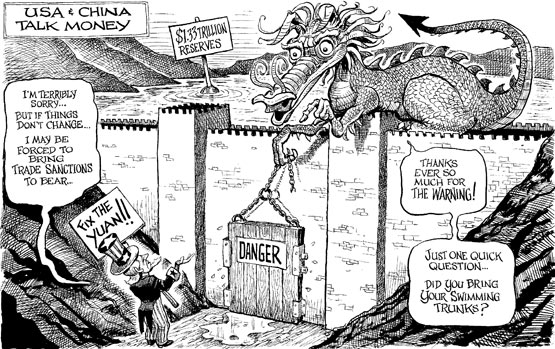
As a general proposition, it is somewhat obtuse to make strident demands on one’s biggest creditor without taking any consideration of the change in the power relationship that debtor status entails. It is astoundingly obtuse to make the demand that the Chinese stop buying dollars, at the same time as we depend on them continuing to buy dollars to finance our deficits. But demanding that they stop buying dollars is precisely what we have been doing for six years, every time we respond to trade concerns by demanding that they stop intervening to prevent the RMB from rising.

From Jeff Frankel's "Telling China to stop buying dollars now would be even more foolish than before".


 [Source: KAL’s cartoon From The Economist print edition – Aug 9th 2007 – Illustration by Kevin Kallaugher 

http://media.economist.com/images/20070811/D3207WW0.jpg] 

China Is Back On The Dollar

China's move towards a revaluation of the yuan were announced with much fanfare in 2005. Just as the People's Daily declared that reform towards a market based exchange rate had been successful, Jeff Frankel identifies that the Chinese exchange rate has returned to a full fledged dollar peg again (starting September 2008, see this link is to the technical paper, and this link is for the updated estimates). Did the Chinese Monetary Authority worry that the appreciation of the yuan might be  too strong as the global crisis spread and the move was to protects Chinese exports?