China’s Trilemma

Here is a great article that tries to nail Chinese “off-shore” capital in the presence of Chinese capital controls:

Achieving the goal of autonomous monetary policy (in order to sustain growth) can be accomplished by either further currency depreciation, or tightening capital controls. The extent to which a combination of these policies will have to be pursued depends in part on how much capital outflow persist, with some observers holding apocalyptic views (e.g., “people are panicked”). On this count, McCauley and Shu provide a more nuanced view of the source of outflows.

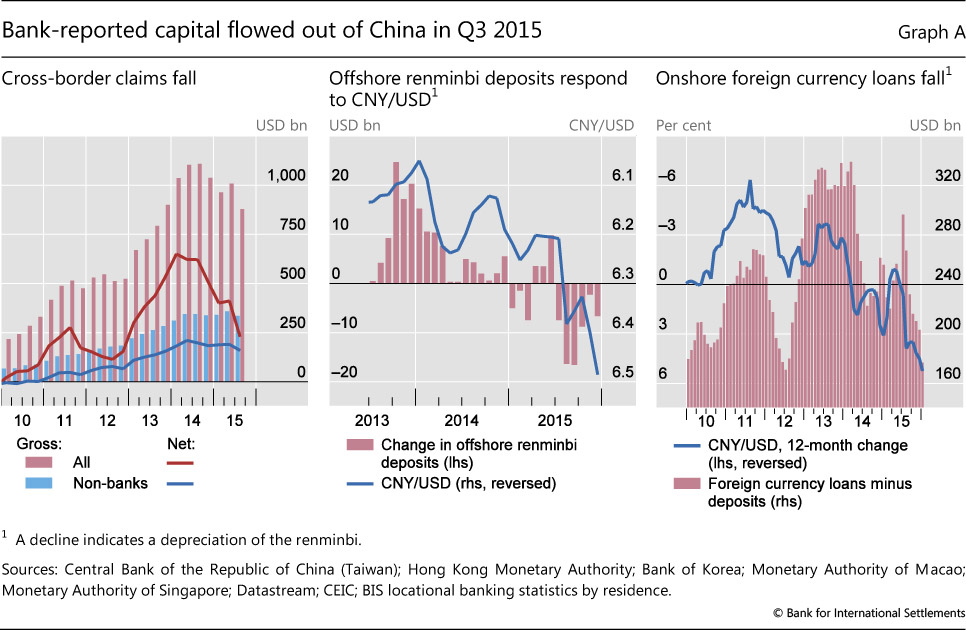
Persistent private capital outflows from China since June 2014 have led to two different narratives. One tells a story of investors selling mainland assets en masse; the other of Chinese firms paying down their dollar debt. Our analysis favours the second view, but also points to what both narratives miss – the shrinkage of offshore renminbi deposits. grap2-A

China Is Back

China is said to have started again started purchased US treasuries, the first time for the emerging country since September 2009.  The Asian giant is once again the largest holder in US debt, passing Japan who took the title during China’s previous six-month sell off.  Concerns about certain European debt situations in countries like Greece, Spain, and Portugal have caused a net return to purchasing the relative safety and security of good-old-fashion American debt, according to the Wall Street Journal.  In a television interview with Bloomberg TV, the chief Asian strategist for Citigroup said, “The concern [with European debt]… is moving from how much it’s going to cost to the effect on growth.” He continued saying, “In Asia, there are clearly some headwinds.” Concerns of this debt have led the Euro to continue it’s dizzying fall today; The currency is now at a four-year low in comparison to the US dollar.  Despite the amazingly large bailout from the Eurozone (nearly $1 trillion dollars), this decline has gone unimpeded for most of the last month. 

The Demise of the Dollar (Euro=$1.45)

This may just be the beginning of a long line of posts on the faltering fortunes of the dollar…


In a wonderful application of interest arbitrage, the dollar has been falling ever since deleveraging ended earlier this year. Today's WSJ outlines the key reasons

– risk appetite is up as people bet on the end of the global recession. 

– investors are leaving the safe heaven of US treasury bills that they bought during the crisis

– where is the money going? China, Japan, Brazil of Europe

But wait there is more: deleveraging and changing risk perceptions are just one part of the interest arbitrage equation. On top of this 

"the dollar is now cheaper to borrow then the yen. Low US interest rates and easing of credit markets

have caused a reversal for the first time in 16 years."

These two reports feed straight into the interest arbitrage equation to explain the falling dollar. 

Here is the puzzle: the same day the dollar hit its low, gold topped the $1000/oz sound barrier. Usually gold is a safe haven, just like the dollar was during the crisis. Why the divergence?  


Use, Reuse, Recycle

A wonderful discussion of recent financial flows is provided by Brad Setser. The reserve flow dynamics can be worked out nicely with the aid of a Fixed and Flexible Exchange Rate Mundell Flemming model (Chapter 18 and 19). However, the Setser's piece does have some jargon, so if you have a life and dont want to slug though the IMF report (he criticizes) and his own theory, here are the key paragraphs: 


When the US slowed and the global economy (and the European economy) didn’t, private money moved from the slow growing US to the fast growing emerging world in a big way. The IMF’s data suggests that capital flows to the emerging world more than doubled in 2007 – and 2006 wasn’t a shabby year. Net private inflows to emerging economies went from around $200 billion in 2006 to $600 billion in 2007. Private investors wanted to finance deficits in the emerging world, not the US – especially when US rates were below rates globally. Normally, that would force the US to adjust – i.e. reduce its (large) current account deficit. That didn’t really happen. Why? Simple: The money flooding the emerging world was recycled back into the US by emerging market central banks. European countries generally let their currencies float against the dollar. But many emerging economies didn’t let their currencies float freely. A rise in demand for their currency leads to a rise in reserves, not a rise in [the price of the currency]. As a result, there has been a strong correlation between a rise in the euro (i.e. a fall in the dollar) and a rise in the reserves of the world’s emerging economies. Consider this chart – which plots [the 3 months sum of] emerging market [EM] dollar reserve growth from the IMF [official foreign currency reserve] data against the euro. 
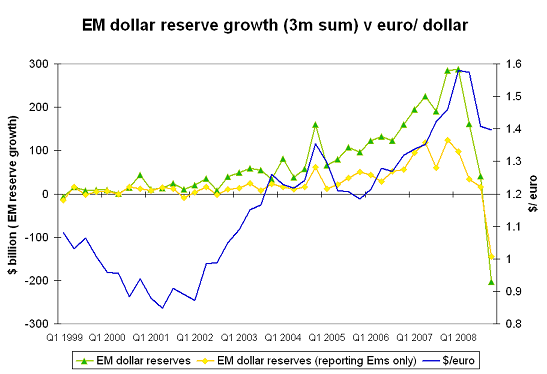


If the rise in reserve growth in the emerging world is a sign of the amount of pressure on the dollar, then the dollar was under tremendous pressure from late 2006 on. It central banks had broke – and lost their willingness to add to their dollar holdings then – there likely would have been a dollar crisis. A fall in inflows would have forced the US to adjust well before September 2008… Last week felt a more like the fourth quarter of 2007 than the fourth quarter of 2008. For whatever reason — an end to deleveraging and a rise in the world’s appetite for emerging market risk or concern that the Fed’s desire to avoid deflation would, in the context of a large fiscal deficit, would lead to a rise in inflation and future dollar weakness – demand for US assets fell. In some sense, the dollar’s fall shouldn’t be a surprise. Low interest rates typically help to stimulate an economy is by bringing the value of the currency down and thus helping exports.