The New New Thing: Fiscal Devaluation

An Extenal Devaluation is simply lowering the value of a currency. An Internal Devaluation is trickier, it implies that domestic prices fall (and hence exports become more competitive abroad). Hailed as the the new form of expenditure switching and reducing, we now also have Fiscal Devaluations if internal devaluations are not feasible. 

source 


1. Describe the major
thesis, the central idea, or set of ideas in the reading.

2. Use the TB/Y diagram to outline how a fiscal devaluation would work (assume lower prices shift the x-m curve only).  


New Perspective on the Large Open Economy Model

The East Grows only because the West Consumes. Bitch Please.

Danny Quah – 23rd October 2012

The East grows only because the West consumes.

An abiding belief held by many about the global economy is that the East is one gigantic Foxconn-shaped, steroid-boosted manufacturing facility, pumping out iPhones, shoes, clothing, refrigerators, air-conditioners, and defective toys that its own people could never afford. In this narrative, the only reason that measured Eastern GDP shows any kind of life is because the Western consumer steps into the breach to buy up these manufactures.

The confirming natural experiment would then be what was sure to occur post-2008, when Western imports collapsed. Here is what actually happened:

China became the single largest contributor to world economic growth, adding to the global economy 3 times what the US did. Since this chart shows GDP at market exchange rates, those who have long argued China’s RMB is undervalued must be standing up now to say that China’s real contribution is likely even larger. Sure, China undertook a massive fiscal expansion beginning November 2008. But, hey, everyone fiscal-expanded.

In number two position among the contributors to global growth is Japan. Yes, “Lost Decades” Japan helped stabilize the global economy more than did the US. Among the other top 10 contributors are the other BRIC economies, and Indonesia.

How is East Asian or emerging economy growth merely derivative when they had nothing among Western economies from which to derive?

Here’s the other interesting fact:

(German exports to the rest of the world. Source: IMF Direction of Trade Statistics, 2011)

This chart addresses the question: How has Germany remained a successful export-oriented growing economy when its domestic demand is weak, the Eurozone is buying hardly anything these days, and German exports to the US have collapsed in the wake of the 2008 Global Financial Crisis? The chart shows that today Germany exports 30% more to Developing Asia than it does to the US. And this is not just a China effect: German exports to China account for just two-thirds of exports to Developing Asia overall. Also notice how as late as 2005, German exports to the US were still double those to Developing Asia.

The East grows only because the West consumes. Bitch please.

1. Describe the
major thesis, the central idea, or set of ideas in
the reading.

2. Identify a
concept presented in the article, define or describe it, and compare or
contrast it to an idea that you have read about in any other article. Discuss
how they are similar or different, and how they are related to each other.

3. Write a one
paragraph critical perspective on some aspect of
 the
article, citing evidence that prompts you to agree or disagree with
 the
author’s perspective.


IMF breaks off talks with Hungary

Deficits, Elections & The IMF 

Why have Hungary and the IMF been chatting in the first place? A previous post highlights Hungary's fiscal deficit problem, which led to increased country risk and foreign reluctance to finance the Hungarian external deficit.   As Chapter 15 and this post by Simon Johnson outline, this is a classic case for the IMF — especially if elections are coming up. Here is the story from the Financial Times:

IMF breaks off talks with Hungary

This is a story we used to see a lot more ten or twenty years ago. Hungary and IMF have  broken off talks, as the new Hungarian government refuses to accept further austerity measures. The FT reports that the message is not entirely clear, as the economy minister later accepted that Hungary would cut its budget deficit to 3% of GDP by 2011. It looks as though the government is mindful of the local elections, which could see the rise of a far-right party that opposes foreign capital. The election are held in October. The EU also criticised the Hungarian policies, as well as attempt to undermine the independence of the central bank. Hungary currently does not need to draw on the €20bn standby facility, but the article says the country’s financial position remains precarious. The forint fell by over 3% against the euro after the news of the breakdown of talks came out. 

Update 7/23/2010: When It Rains, It Pours

From Bloomberg: Hungary Credit Rating May Be Cut to Junk After IMF Talks Fail

Standard & Poor’s said it is reviewing Hungary’s credit rating for possible downgrade after the collapse of negotiations with the International Monetary Fund and European Union. A cut would give Hungary’s debt a junk rating.

From Reuters: Ratings agencies threaten Hungary with downgrade

Moody's placed Hungary's Baa1 local and foreign currency government bond ratings on review, citing increased fiscal risks after the International Monetary Fund and the European Union suspended talks over their 20 billion euro ($25 billion) financing deal at the weekend.

ECB Sterilization Attempt Flops

Chapter 15 outlines why and when a Central Bank might want to Sterilize the effects of Balance of Payments imbalances.

The case seldom considered is that such sterilization might actually fail, because the public is simply not willing to lend to the central bank at the prevailing interest rates. This just happened in Europe at a grand scale. Perhaps that is not surprising, the markets are clearly predicting an imminent Greek default (aka "restructuring" or "haircut").

CRISIS IS BACK WITH A VENGEANCE AS ECB’S STERILISATION AUCTION FLOPS

After a brief lull, during which the crisis seemed almost forgotten, the financial market reverted to crisis…

One of the reasons for the panic was concern about the state of the European banking system, and the surprising news was that the ECB’s €55bn fixed-term deposit flopped spectacularly, as it managed to managed to raise only €31.866bn at an average interest rate of 0.54%. This means that financial institutions continue to hog liquidity.

The  FT reports on new turbulences in financial markets, as the ECB’s decision not to renew one-year loans to financial institutions spooked investors and prompted concerns about the ability of some eurozone banks to access interbank borrowing markets for funding.  Financial shares dropped 4.5%, European interbank borrowing rates jumped to the highest level for nine months and the euro reached lowest exchange rate level against the yen for the last eight years.

The cost of insuring Greek government debt is now second only to that of Venezuela,Bloomberg reports. Credit swaps signal there’s a more than 67 percent chance Greece won’t meet its commitments within the next five years. Greek government bonds have now overtaken Argentina. Greek debt was 115% of GDP last year, compared to 60% for Argentina when it defaulted. 

Europe widens stress tests

The Wall Street Journal’s Brussels blog reports that some more details on the stress tests for European banks have now been settled. The scope of the tests will be widened from 26 banks to 60-120 banks, including Landesbanken and Cajas. The tests will incorporate banks in all countries. The results will be released on a bank-by-bank basis. The banks will be tested for sovereign default. All tests to be completed by mid-July. Last year’s forecast mistakes will be taken into account.

The Great Contraction

International Feedback Mechanisms are detailed in Chapter 15. Except here, the locomotive effect is going the wrong direction… 

Extra EU 27 Trade Falls by 20 % In 2009 – and that is before the upcoming EU austerity measures

Source: WSJ


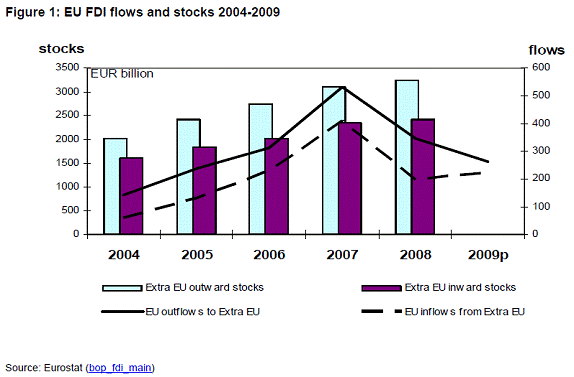
To round out the balance of payment information, here is the news on EU financial flows:

EU Foreign Direct Investment (FDI) flows have been severely affected by the global economic and financial crisis. They …dropped sharply in 2008, for both inward and outward FDI flows (34 % for outflows, 52 % for inflows).