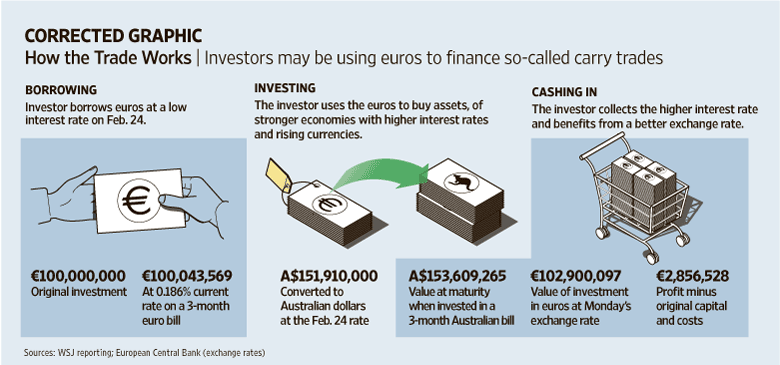
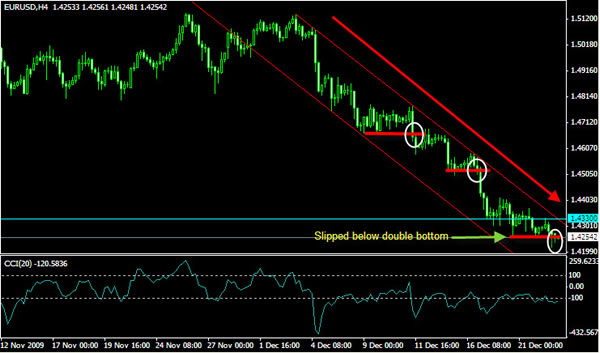
The New York Times reports that Mexican exports are hurting, because the peso is appreciating. With industrialized countries in crises, and the US in a liquidity trap, Mexico has become a high yielding currency – ripe for carry trade…. But then again, in the big picture, the peso may simply be returning to its pre-crisis value.

By ELISABETH MALKIN, NYT, February 8, 2011
MEXICO CITY— Six years ago, Benjamín Hernández turned his family’s small metal-stampingcompany into an exporter. Although the firm barely survived the global economiccrisis, it bounced back last year. But now he has a new worry. Mexico’s peso is rapidly rising against the United States dollar, which means that the costof producing in Mexicofor the American market is climbing in dollar terms. But because Mr. Hernandezfaces global competition for his plant’s fire extinguisher brackets,“increasing our price isn’t an option,” he said. So Mr. Hernández keepsreinvesting in the company, called Bicar, and praying for the United States economic recovery tocontinue, to stimulate his sales. “We just have to make a better effort to bemore efficient,” he said.
That seems to be the business attitude of Mexico rightnow, as the rising peso puts pressure on its exports even as Mexican policymakers are reluctant to intervene. “We decided many years ago to bet on a free-floating peso,”the Mexican finance minister, Ernesto Cordero, said in a radio interview lastweek. “It has given us good results, and we are convinced of this.”
As the exchange rate has dipped below 12 pesos to thedollar, the local press is full of speculation over what it calls “thesuperpeso.” The reasons behind the increase are the same as those pushing upcurrencies in other emerging markets. Facing low yields in developed countries,investors have bought securities in Latin America and Asiawhere returns are higher. “To any foreign investor in securities, thisgovernment is signaling that it is going to hang on to a very strong currency,”said Rogelio Ramírez de la O, an economist, who argues that the governmentprefers a strong peso because it brings stability. “It is a no-brainer to buythe peso.”
But the risk, he said, is that “you are inviting speculatorsto give you a capital outflow whenever something changes in the United States, particularly if U.S. interestrates rise.” Export figures suggest that the strong peso has not caused anyharm yet. Although the currency is now at its strongest level since October2008, Mexicoregistered blistering growth in exports, which drove an economic expansionabove 5 percent last year. Mexican exports rose almost 30 percent in 2010. Thestandout was the auto industry, where exports grew 52 percent to a record. Inpart the export boom is a rebound from a disastrous 2009, when the economyshrank by 6 percent as the recession caused demand in the United Statesfor Mexican products to dry up.
Nicolas M. Guillet, the president of Salzgitter MannesmannPrecisión, the Mexican subsidiary of a German supplier, said the steel tubeshis plants produced for the auto industry were priced in dollars. But thestronger peso means that his costs for labor, gas and electricity are allrising in dollar terms. Since he cannot pass the increases on to his customers,the impact is on the bottom line. “It has eaten a significant chunk of mymargin,” he said. The company, which set up production in 2007 outside Guadalajara, has beenstudying how to hedge against the stronger peso. “This creates an extra layerof complexity,” Mr. Guillet said. “Our strength and skills are in producinggood parts at a competitive cost, not in managing currencies.” Still, even withthe pressure from the rising peso, he expects sales to increase 60 percent thisyear, on top of a 100 percent increase in 2010.


 Argentina needs some $30bn in standby funds, perhaps more.
 Source: IIF