Global Trade Alert

Global Trade Alert doesn't actually cover global trade but global trade restrictions. Its an incredibly informative database

on anything and everything that could impede trade.

Its most recent report documents that the global recession not only decreased demand for imports but also increased the supply of trade restrictions. "Since the first G20 crisis-related summit in November 2008, the governments of world have together implemented 297 beggar-thy-neighbour policy measures; that is, more than one for every working day of the year. Add another 56 implemented measures that are likely to have harmed some foreign commercial interests, the total reaches 353." 

and

"During the past three months the number of state measures announced which–if implemented would likely harm foreign commercial interests–has expanded from 134 to 188. The protectionism in the pipeline keeps growing–there is no respite here. This protectionist overhang could limit the contribution of exports to economic recovery. "


21st Century Tariffs

Crude trade measures are tariffs, that are clearly observed and easiest to administer.

Then come quotas, whose implied tariff equivalent is not always easy to calculate in the real world, but quotas are still in-your-face trade restrictions that are easily picked up by the World Trade Organization

By the 1970s non-tariff barriers became the trade restriction of choice, the most promising of which are anti dumping measures and countervailing duties. Simply accusing foreign steel exporters to swamp the US market with low priced steel could deliver protection. Technically, dumping occurs only if the foreign producer sells below cost and engages in predatory pricing – but what are the foreign firm's costs, how can they be measured? Since these costs are often difficult to determine, governments often started to impose tariffs (see the 2002 US Steel Tariff) to counter supposed dumping – and then wait years for the WTO to sort out whether dumping actually occurred.  

The new non-tariff barriers that are in vogue, involve "regulations"Staiger and Sykes provide a graduate level analysis, although the intro is informative. The most prominent example of such regulations is – you guessed it – China. The Chinese government recently introduced a new procurement measure which would give priority preference to products deemed to meet “indigenous innovation accreditation criteria", creating serious market access barriers to a large portion of the China market for foreign firms. Here is the US chamber of commerce news release. Here is the US Information Technology Sector's lobbying piece on the topic.

Students with a background in open economy macro will appreciate Dani Rodrik's point that China's WTO accession has tied China's hands and it is left with only one effective measure to fuel its export led growth: undervaluing its currency

1) outline the Chinese policy options to fuel economic growth – use the TB/Y diagram, or the MF model

2) Show how an appreciation would affect the Chinese economy

Economic and Political Realities

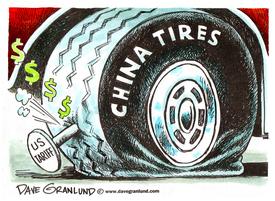
Economists, even those staunchly in the Obama camp, are up in arms about his decision to levy tariffs on tires from China. Here is the most simplistic economists view on these tariffs (assuming partial equilibrium and that the US is a "small open economy"). This is certainly the easiest way to indicate the negative impact of a tire tariff, but its not the full story. 

Doug Irvin, an eminent economic historian, reminds us that no matter how enlightened, independent, or ideological a president may have been, "regardless of party, every president, at some point, and often for political reasons, has imposed restrictions on imports."

Chapter 7 in International Economics clearly outlines that once politicians are maximizing not only economic welfare, but also political political objectives, it is actually the absence of tariffs that should surprise us.  

What does endogenous protection imply about President Obama's objective function? Who are the key pressure groups in the US?  

How slippery is the slippery slope of protectionism?

The sharp downturn in economic activity and world trade has caused many economists to frame analogies with the descending spiral of trade and protectionism in the 1930s.  Under the WTO countries do have flexibility to impose safeguard restrictions, as well as duties to offset unfair trade practices.  Reliance on these policies does seem to rise during economic declines, as shown by the following table presented by Roberta Roberta Piermartini of the WTO.  Nevertheless, the existence of such flexibility may make countries more willing to accept greater liberalization in WTO negotiations.


Figure 1. Anti-dumping measures and business cycle

Read her discussion of these measures,  and compare that analysis to the commentary by Chad Bown, who cautions against the long lives of such intervention. Also, consider the prescription for additional steps to avoid a downward spiral suggested by Simon J Evenett and Bernard Hoekman.