The Peterson Institute – widely acknowledged to be the highest quality international economics policy think tank in the US, estimates that WTO sanctioned global retaliation to the border tax could add up to $385 billion “almost immediately upon implementing the tax, through the imposition of countervailing duties by trading partners.
Oliver Blanchard, former chief economist at the IMF and top econ professor at MIT, analyzed the long run impact of the tax. His assessment in a paper with Jason Furman: THE CATCH: BORDER ADJUSTMENT ACTUALLY RAISES NO REVENUE IN THE LONG RUN. IT ONLY BORROWS FROM THE FUTURE.” In other words, the great border tax revenues that the US will surely trump around early on ($1.2 trillion over 10 years) the price Americans have to pay in the future. This reveals the sad truth about the border adjustment tax: “Who Pays for Border Adjustment? Sooner or Later, Americans Do”
Here is the Blanchard’s intuition:
Net revenues from border adjustment taxes and subsidies will be positive so long as the United States runs a trade deficit. But if foreign debt is not to explode, trade deficits must eventually be offset by trade surpluses in the future. Net revenues that are positive today will eventually have to turn negative. Indeed, any positive net revenues today must be offset by an equal discounted value of negative net revenues in the future. As trade deficits eventually turn into trade surpluses, and thus border adjustment net revenues turn from positive to negative. Sooner or later, taxes will have to increase to make up for the lost border tax revenue.
Econ students should be fundamentally familiar with this line of reasoning. It is akin to a decrease in taxes today financed by new debt issues today (perhaps to win an election). When the government issues debt, taxpayers get a break now, but they will have to repay the cost of the debt eventually in the future.
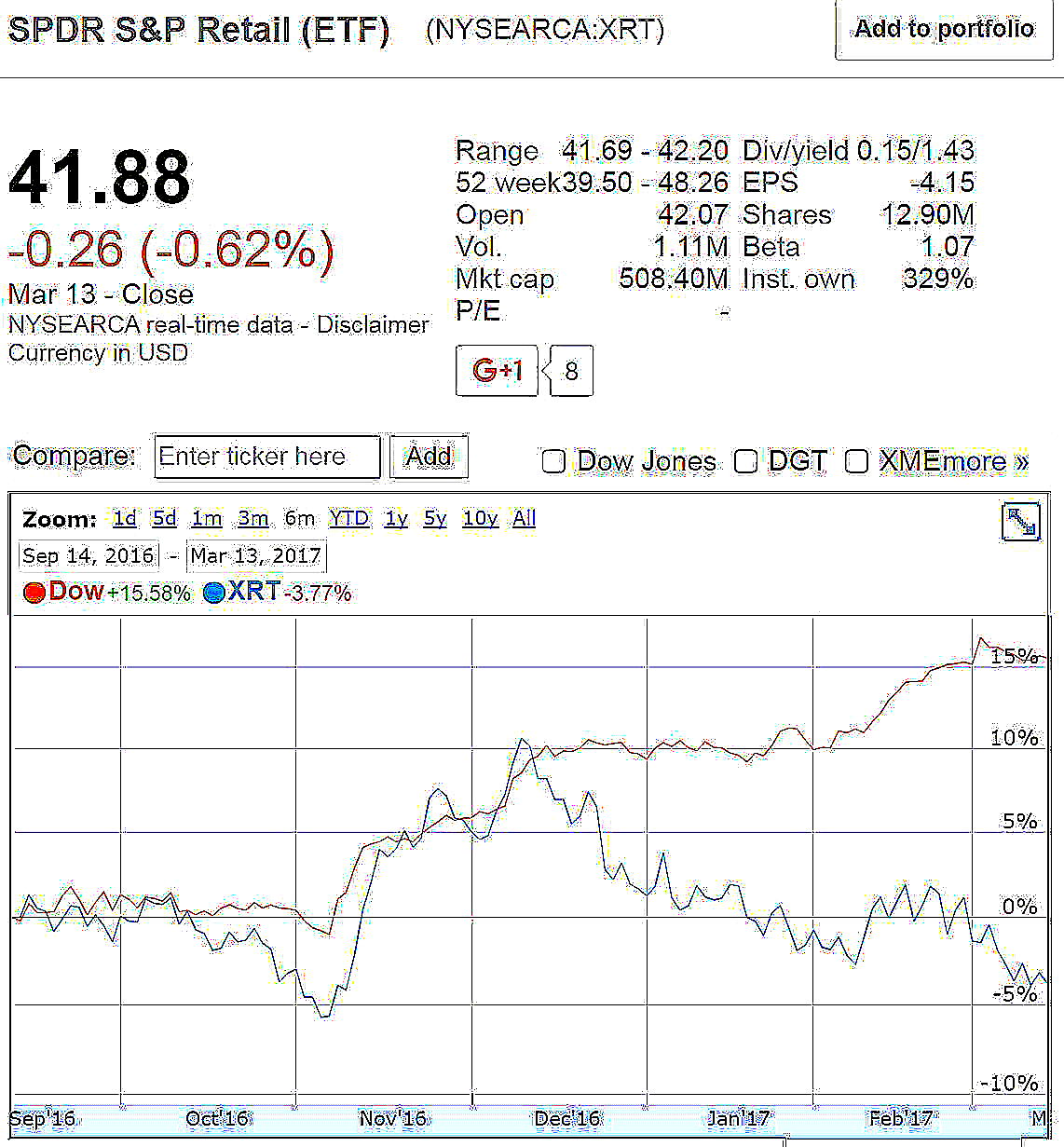
While the border tax may be “intertemporally zero sum”, that is it wont generate more revnues in the long run, Robert Reich highlights the distributional issues with the border adjustment tax. Ok, Reich was labor secretary under Clinton, so he has a slant. If that makes his analysis suspect to you, simply check out what happened to the stock price index for major US retailers since the border tax was first mentioned in December: