How slippery is the slippery slope of protectionism?

The sharp downturn in economic activity and world trade has caused many economists to frame analogies with the descending spiral of trade and protectionism in the 1930s.  Under the WTO countries do have flexibility to impose safeguard restrictions, as well as duties to offset unfair trade practices.  Reliance on these policies does seem to rise during economic declines, as shown by the following table presented by Roberta Roberta Piermartini of the WTO.  Nevertheless, the existence of such flexibility may make countries more willing to accept greater liberalization in WTO negotiations.


Figure 1. Anti-dumping measures and business cycle

Read her discussion of these measures,  and compare that analysis to the commentary by Chad Bown, who cautions against the long lives of such intervention. Also, consider the prescription for additional steps to avoid a downward spiral suggested by Simon J Evenett and Bernard Hoekman.

Did China’s entry into world trade de-industrialize others?

The opening of China to the rest of the world that started under the reforms of Deng Xiaoping has been characterized by some as the awakening of the sleeping giant.  Indeed, China is a big country, and the addition of its abundant endowment of unskilled labor to world factor supplies might easily have had a negative effect on other providers of unskilled-labor intensive goods.  Nevertheless, the effects on individual countries may be complex, because China not only created a greater supply of labor intensive goods but also created greater demand for many commodities produced by other developing countries.  A study by Jörg Mayer and Adrian Wood calculate that as big as China is, the balance of these effect on others was not substantial. 

What factors can you suggest that would explain the regional pattern of effects that they report?

Table 1. Changes in logged ratios of
labour-intensive manufacturing to primary output and exports,
1980-2000, unweighted regional averages

  Output (33 countries) Exports (differences)
  1980-1990 1990-2000 Difference For 33 countries For 70 countries
All developing countries 0.14 0.08 -0.06 -0.21 0.07
East Asia (except China)  0.43  0.24  -0.19  -0.45  -0.34
South Asia  0.00  0.29  0.29  0.04  -0.05
Latin America and Caribb  0.10  -0.07  -0.17  0.69  0.39
Middle East and N. Africa  0.21  0.07  -0.14  -1.00  -1.19
Sub-Saharan Africa  -0.08  0.08  016  -0.59  0.45

Source: Wood and Mayer (2009), Table 5.


Liberalizing trade in services – how might it happen?

The claim of mutual benefits from trade liberalization has been particularly difficult to achieve in the case of trade in services. A recent contribution by Patrick Messerlin and Erik van der Marel suggests that if the US and the EU were to initiate negoatiations in this area, that would provide a useful catalyst to broader plurilateral negotiations with a manageable group of eight other major market participants.  Their table below indicates which services might be most amenable to this approach.  Given the large share of the market accounted for by the eight leading countries, the likelihood of inefficient diversion of service trade away from more efficient sources is less likely to occur.  

 Figure 1. Going plurilateral: How many countries make a critical mass?


Source: Messerlin and van der Marel (2009).

Cash for Clunkers and the Environment

Various countries have adopted incentive programs for automobile owners to trade in their old, fuel inefficient vehicles for more environmentally friendly models.  At the same time, these programs may shift consumption into the current year, when demand is depressed, and thereby help stimulate an economic recovery.  As with any policy initiative, however, there may be unexpected side effects.  In this case, we might wonder what would have been done with those vehicles that are being taken out of service.  Two authors at UCLA and Berkeley suggest that trade in used cars will decline.  If these used cars previously were exported to Mexico, and if they were more fuel efficient that those being driven in Mexico, then US emissions may decline, but Mexican emissions may rise.  When the relevant externality is global, both effects need to be considered.

Immigration – benign or problematic?

The worldwide economic downturn has caused a backlash against immigration in many countries.  The UK has proposed a new citizenship law, that would require prospective citizens to earn points based on their integration into the community.  Yet, the immediate concerns over the burdens imposed by immigrants often is ill founded.  A recent study by economists at University College London finds that immigration to Britain from the Central and Eastern European accession countries are net contributors to the budget!  Even though their wages on average are lower than native workers, their higher labor force participation and lower propensity to claim benefits results in this positive balance. 

Eurozone Contraction

Here is a nice application of the Mundell Fleming Model with Flexible Prices 

Falling Prices, Rising Unemployment Buffet Euro Zone

by Nicholas Winning and Christopher Emsden, Wall Street Journal, Aug 01, 2009
From The Wall Street Journal Economics:Macro Weekly Review 
 
SUMMARY: The annual contraction in euro-zone consumer prices accelerated in July. Meanwhile,
the unemployment rate rose to 9.4%, the highest level for a decade in June.
CLASSROOM APPLICATION: There are several interesting topics raised in this article:
deflation versus inflation, the contrast between U.S. and euro-zone economic conditions, and the likely
impact of U.S. economic conditions on the euro-zone through the export channel.
QUESTIONS:
1. (Introductory) What does the latest data indicate about unemployment and inflation in the
euro-zone economies?
2. (Advanced) What are the adverse consequences of deflation? Can you conjecture what the impact on the Euro might be?
4. (Advanced) If inflation is undesirable, shouldn't deflation be desirable? What is the flaw in that logic?
5. (Advanced) How do economic conditions in the United States affect the euro-zone
economies?
Reviewed By: Edward Gamber, Lafayette College 

New World Order Part II

Part I of the New World Order was concerned with the chasm between the policies that rich countries prescribe to others vs. themselves to weather the great recession.

Part II in this saga is a sad example from the European Commission. It has gotten into the IMF's business of handing out short term loans to countries with balance of payment crises, specifically "Non-Euro Currency EU Countries." The Memorandum of Understanding is another testimony prescribe bitter medicine that they themselves are smart enough not to drink: specifically

"The disbursement of each further installment shall be made on the basis of a satisfactory implementation of the economic programme of the Romanian Government. Specific economic policy criteria for each disbursement are specified in Annex 1. The overall objectives of the programme are the following : a. Fiscal consolidation is a cornerstone of the adjustment programme… a gradual reduction of the fiscal deficit is envisaged, from 5.4% of GDP in 2008 to 5.1% of GDP in 2009, 4.1% of GDP in 2010 and below 3% of GDP in 2011 [emphasis added]. The adjustment will be mainly expenditure-driven, by reducing the public sector wage bill, cutting expenditure on goods and services…"

Ok, and now lets look what other major countries have done to weather the crisis. To quote Christina Romer (Head of the US Council of Economic Advisors) "Virtually every major country has enacted fiscal expansions during the current crisis. They have done so … because it works."  Here are the numbers:


So while all major nations benefit from the stimulus, Romania will have to cut expenditures dramatically to get the EU funds.
 
How does a reduction in G generate an improvement in the Balance of Payments for a country with high capital mobility and fixed exchange rates? That can be worked out using the Mundell Fleming model in Chapter 17.  

Case Study: NS-I / The Savings Paradox.

Just Say No To Say's Law

Jean Baptiste Say's notion that "supply creates its own demand" (A Treatise on Political Economy, Book I Chapter XVwas first disputed by J. M. Robertson in "The Fallacy of Saving" (New York, 1892). John Maynard Keynes and Paul Samuelson later fleshed out the argument that underconsumption is detrimental in recessions. Here is how Paul Krugman reworks the argument: 

The paradox of thrift is one of those Keynesian insights that largely dropped out of economic discourse as economists grew increasingly (and wrongly) confident that central bankers could always stabilize the economy. Now it’s back as a concept. But is it actually visible in the data? 

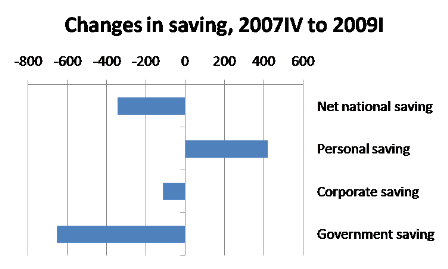
The story behind the paradox of thrift goes like this. Suppose a large group of people decides to save more. You might think that this would necessarily mean a rise in national savings. But if falling consumption causes the economy to fall into a recession, incomes will fall, and so will savings, other things equal. This induced fall in savings can largely or completely offset the initial rise.

Which way it goes depends on what happens to investment, since savings are always equal to investment. If the central bank can cut interest rates, investment and hence savings may rise. But if the central bank can’t cut rates — say, because they’re already zero — investment is likely to fall, not rise, because of lower capacity utilization. And this means that GDP and hence incomes have to fall so much that when people try to save more, the nation actually ends up saving less. If you add in imports and exports, the paradox of thrift becomes less likely, because you country’s reduced consumption comes partly at the expense of imports rather than domestic GDP. So I wasn’t sure what it would look like for the United States.

 Sure enough, the sharp increase in personal saving has been accompanied by a decline in overall national saving — partly via reduced corporate savings, largely via increased public deficits… One key implication of the fact that we’re living in a paradox of thrift world is the folly of demands that we reduce budget deficits in the near term. 

Use the basic open economy model in chapter 14 to predict the change in the US trade deficit (and correlate your answer with actual data from the US Bureau of Economic Analysis. Does the model fit the data? Now extend the model the large open economy in chapter 15, assuming that the US recession is actually a global phenomenon. Does the model help explain the data? 

ECB Bailout of Sweden/Latvia

Today the Swedish Central bank was forced to take out an emergency loan from the European Central Bank (ECB). The ECB is not in the habit of issuing such loans to non-members (or members alike). The Guardian reports that the Swedish central bank borrowed €3bn from the ECB as the Latvian emergency causedripple effects.

What on earth could Latvia have to do with foreign currency troubles at the Swedish Central Bank?  Here is a possible answer: the very same day, the very same newspaper (Financial Times) reports that 

a) The ECB intervened to avert a Baltic financial crisis, since Swedish banks dominate the the Baltic financial sector. 

and 

b) Swedish banking shares rose sharply after the Swedish Central Bank announced that the nation's banks would be able to weather "extreme" pressures domestically and abroad.

Nouriel Roubini provides his assessment of the Lativan crisis and solution.  Mary Stokes focusses on contageon.

1) Outline how the Latvian Crisis is undermining the Swedish Economy 

2) Discuss why either the term "extreme" or "abroad" seems to be inconsistent with the message. 

3) Use the Mundell Flemming model to trace Roubini's fear of overshooting. 

4) Why would contageon justify the ECB's intervention to aid Swedish banks that are overexposed in Latvia?


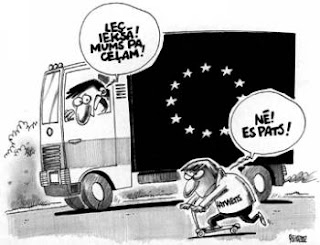
Text in Latvian:
[EU driver] Hop in! We are taking the same route!

[Latvian cyclist] No! Can do it myself! 

Cartoon: Gatis Šļūka 

Self Fulfilling Expecations?

Pegged to the Euro, Latvia is teetering

Questions:

1) Without any knowledge of the Latvian economy, give two reasons why the country may have to devalue.

2) Relate the analyst's quote that "expectations of a devaluation can sometimes be self-fulfilling" to Krugman's model of speculative attacks (Chapter 23)

3) Explain the relationship between "look-alike issues" and "contagion".  

Here are two additional pieces to provide additional background information for those interested in the Baltic Blues.   

Frozen Finance

More applications of Large Open Economy interactions, this time from the WTO.

The collapse of world trade is partly due to insufficient trade credit financing. The global market for trade finance (credit and insurance) represents approximately 80% of 2008 trade flows, valued at $15 trillion. The World Bank estimates that the fall in the supply of trade finance has contributed some 10% to 15% of the decrease in world trade since the second half of 2008.  

This would imply a $2.25 trillion (15% of $15 trillion) decline in trade since June 08.

There are green shoots, however, which can be confirmed using the Baltic Dry Index. The WTO writes

The most recent information indicates that the situation seems to have eased a bit in Asia, particularly in China, although some countries see their access to finance still very restricted (Philippines, Vietnam). In Africa, the situation remains tense, and active banks are seeking support from international financial institutions. In Latin America, credit rates have somewhat eased up since the fall of 2008, but are still higher than usual both in small Latin American states, and increasingly in larger countries such as Mexico and Argentina. 

China’s New Economic Spokesman

From the WSJ Journal-in-Education Program:  
 
SUMMARY: Geithner said he believed Chinese leaders are confident in the U.S. economy, and praised China's own stimulus measures.
CLASSROOM APPLICATION: This article highlights the relationship between the Chinese and U.S. economies. If China looses confidence in the U.S. economy it may curtail purchasing U.S. government debt which would lead to higher interest rates. Another interesting point for discussion is China's currency policy. Why is the U.S. urging China to adopt a more market-determined currency policy? How would movement toward a freely-floating currency impact the U.S. and Chinese economies?
QUESTIONS:
1. Why does it matter that Beijing has confidence in the U.S.?
2. How would the Chinese economy be affected if the Fed fails to keep inflation low and Congress fails to bring budget deficits down over time? Use the Large open Economy Mundell Fleming Model
3. What is China's role in (de)stabilizing the international financial system?
4. What is China's current currency policy? What changes is the U.S. urging China to make to its currency policy? What impact would those changes have on the U.S. and Chinese economies?

Strong Support For An Overvalued Dollar

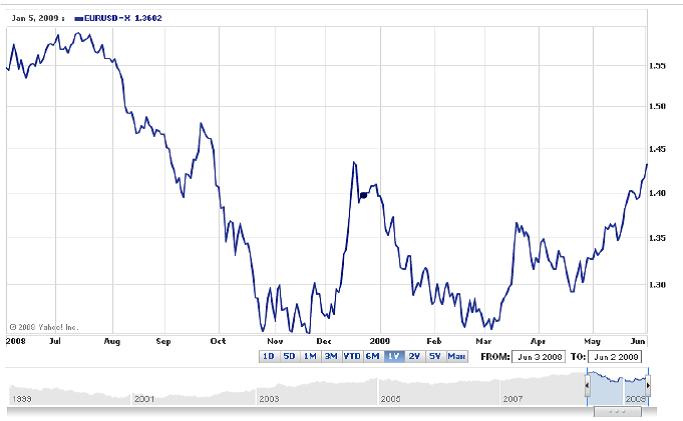
On June 2, 2009, the dollar fell to 1.42 against the euro, which represents a 14% depreciation in the past 3 months, after it had risen to 1.25 on March 5. (BTW, the dollar tested 1.25 about 5 times in the last 8 months — how is that for a strong support level! (See Chapter 16). 


Nevertheless, the Institute for International Economics judged the dollar to be still substantially overvalued. They expect the dollar at 1.53. The institute bases its findings on fundamentals — and we know how irrelevant those are to exchange rates… I cannot find one technical analysis that is willing to predicting more than a week out (althought there seems to be uniformity among analysis that there is an "upward bias the dollar, see the attached file) 


USD.pdf (69.85 kb)

Geithner in Beijing

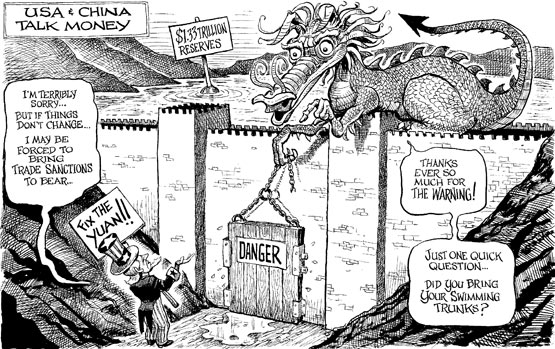
As a general proposition, it is somewhat obtuse to make strident demands on one’s biggest creditor without taking any consideration of the change in the power relationship that debtor status entails. It is astoundingly obtuse to make the demand that the Chinese stop buying dollars, at the same time as we depend on them continuing to buy dollars to finance our deficits. But demanding that they stop buying dollars is precisely what we have been doing for six years, every time we respond to trade concerns by demanding that they stop intervening to prevent the RMB from rising.

From Jeff Frankel's "Telling China to stop buying dollars now would be even more foolish than before".


 [Source: KAL’s cartoon From The Economist print edition – Aug 9th 2007 – Illustration by Kevin Kallaugher 

http://media.economist.com/images/20070811/D3207WW0.jpg] 

China Is Back On The Dollar

China's move towards a revaluation of the yuan were announced with much fanfare in 2005. Just as the People's Daily declared that reform towards a market based exchange rate had been successful, Jeff Frankel identifies that the Chinese exchange rate has returned to a full fledged dollar peg again (starting September 2008, see this link is to the technical paper, and this link is for the updated estimates). Did the Chinese Monetary Authority worry that the appreciation of the yuan might be  too strong as the global crisis spread and the move was to protects Chinese exports? 

Crowding Out?

The US treasury will be financing an epic fiscal deficit of about $1.8 trillion in 2009. The large fiscal deficit has cause a slight panic in some circles that the US may not be able to raise all this money (which would lead to higher interest rates). Perhaps.

Brad Sester provides an insightful discussion based on the national income and national savings identities discussed in Chapter 14 (the derivation of eq. 14.1a). His point is that if you use the relationship between the trade balance (TB) and the national savings gap (SN-1), it becomes apparent that the US as a whole is actually borrowing a lot less than in the past: 

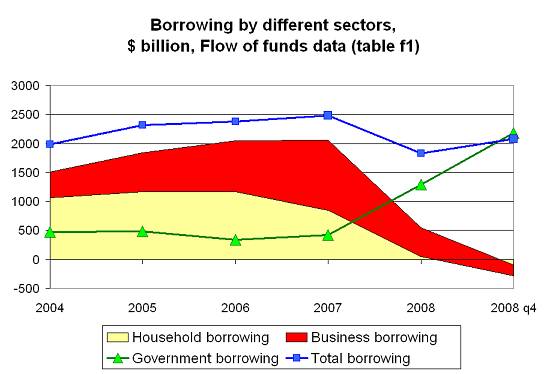
The United States is borrowing less from the rest of the world than it was. That is true even though the US Treasury is borrowing more from everyone, including more from the rest of the world. The amount the US borrows from the world is the gap between the amount that Americans save and the amount that Americans invest at home. That turns out to be equal to the current account deficit. And for the US, it so happens that the current account deficit is about equal to the (goods and services) trade deficit. The trade deficit — at least in the first quarter of 2009 — was way down. In dollar terms, it was about half as big as it was in the first quarter of 2008. That implies that the US is borrowing far less from the world now than at this time last year.

Why hasn’t the expansion of the fiscal deficit pushed the amount the US borrows from the world up? Simple. American households and businesses are borrowing a lot less, so the total amount of money that Americans are borrowing isn’t rising. A picture is generally more effective than words. The following chart shows borrowing by various sectors of the economy — households, firms and the government.** All data comes from the Fed’s flow of funds, table F1

As the chartshows, the rise in government borrowing came even as other sectors of theeconomy were borrowing a lot less. Household borrowing peaked in 2006.Borrowing by firms actually peaked in 2007 — remember all the leveraged buyoutsthen. Borrowing by both households and firms fell precipitously in 2008. As aresult, total borrowing by households, firms and the government fell in 2008.

Don’t Montetize the Debt

From the WSJ Journal-in-Education Program: 

The president of the Dallas Fed speaks about inflation risk and central bank independence 

This is an excellent article to use to illustrate the relationship between fiscal and monetary policies and the inflation risks associated with the Fed's direct purchases of bonds.

QUESTIONS:

1. What is the "perception of risk" that has been created by the Fed's purchases of Treasury bonds, mortgage-backed securities, and Fannie Mae paper?

2. What are the economic consequences of monetizing the debt?

3. According to Dallas Fed President Fisher, what role did the Fed play in contributing to the current crisis?

4. According to Dallas Fed President Fisher, what role did regulators play in contributing to the current crisis?

5. According to Dallas Fed President Fisher, what role did "government-anointed rating agencies" play in contributing to the current crisis?

(suggested by Edward Gamber, Lafayette College)

A New World Order?

Times change: development advice will never be the same again. Why would any country buy the bitter medicine to limit goverment debt or forgo purchases of goverment debt by the country's central bank? Industrialized countries, who have strongly pushed such strong medicine, now instruct their central banks to purchase goverment debt and generate unprecedented fiscal deficits. The justification: extraordinary economic times. I would bet that any finance minister of a country where the majority of citizens lives on a dollar would argue that s/he is facing extraordinary times…  

The response to industrialized countries' policies has been swift. Credit rating agencies warn the UK goverment that it is in danger of loosing its pristene bond rating (because of excessive debt) and the US is being lectured about the dangers of printing money (by a developing country).

Interest parity can help us predict the future value of the British Pound (what is your prediction of the forward premium?). The Mundell Fleming Model (augmented to include price changes, see Chapter 19) or the Dornbush Overshooting Model (Chapter 20) come in handy to understand fluctuations in output, prices, and exchange rates as the US Central Bank engages in purchases of massive amounts of treasury bills to inject liqudity into the US economy. 

Back to development advice: the events remind me of the cafeteria at the IMF's Washington D.C. headquarters in the 1980s, where meals were ridiculously subsidized, but every IMF program advised developing countries against subsidizing food.  

Use, Reuse, Recycle

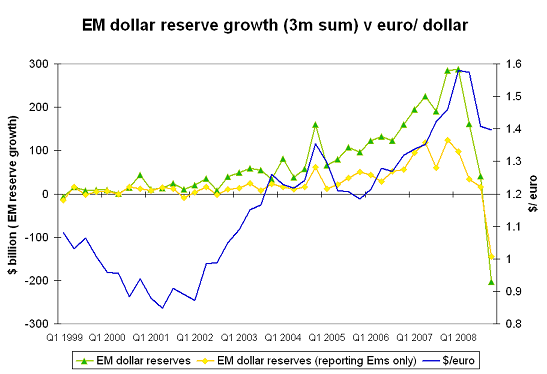
A wonderful discussion of recent financial flows is provided by Brad Setser. The reserve flow dynamics can be worked out nicely with the aid of a Fixed and Flexible Exchange Rate Mundell Flemming model (Chapter 18 and 19). However, the Setser's piece does have some jargon, so if you have a life and dont want to slug though the IMF report (he criticizes) and his own theory, here are the key paragraphs: 


When the US slowed and the global economy (and the European economy) didn’t, private money moved from the slow growing US to the fast growing emerging world in a big way. The IMF’s data suggests that capital flows to the emerging world more than doubled in 2007 – and 2006 wasn’t a shabby year. Net private inflows to emerging economies went from around $200 billion in 2006 to $600 billion in 2007. Private investors wanted to finance deficits in the emerging world, not the US – especially when US rates were below rates globally. Normally, that would force the US to adjust – i.e. reduce its (large) current account deficit. That didn’t really happen. Why? Simple: The money flooding the emerging world was recycled back into the US by emerging market central banks. European countries generally let their currencies float against the dollar. But many emerging economies didn’t let their currencies float freely. A rise in demand for their currency leads to a rise in reserves, not a rise in [the price of the currency]. As a result, there has been a strong correlation between a rise in the euro (i.e. a fall in the dollar) and a rise in the reserves of the world’s emerging economies. Consider this chart – which plots [the 3 months sum of] emerging market [EM] dollar reserve growth from the IMF [official foreign currency reserve] data against the euro. 


If the rise in reserve growth in the emerging world is a sign of the amount of pressure on the dollar, then the dollar was under tremendous pressure from late 2006 on. It central banks had broke – and lost their willingness to add to their dollar holdings then – there likely would have been a dollar crisis. A fall in inflows would have forced the US to adjust well before September 2008… Last week felt a more like the fourth quarter of 2007 than the fourth quarter of 2008. For whatever reason — an end to deleveraging and a rise in the world’s appetite for emerging market risk or concern that the Fed’s desire to avoid deflation would, in the context of a large fiscal deficit, would lead to a rise in inflation and future dollar weakness – demand for US assets fell. In some sense, the dollar’s fall shouldn’t be a surprise. Low interest rates typically help to stimulate an economy is by bringing the value of the currency down and thus helping exports. 


Thawing Dollars

There is some evidence that international financial markets are thawing.

– The "Ted Spread" (the difference between interest rates on interbank loans and U.S. goverment debt) is declining. The financial crisis had driven up the Ted Spread as investors cared most about the return of their investment and the panic induced a flight to quality

So much for the good news.

The 10% decline of the dollar in the past 5 weeks signals that carry trade is back again in full force since it weakens the target currency (in this case the dollar) when investors sell domestic currency to purchase foreign assets (The Fed also provides an assessment of carry trading). As recently as 6 months ago, carry trades unraveled at lightening speed (driving up the Ted Spread) as financial institutions were force to deleverage to meet their capital requirements. 

What is Deleveraging?

Lets start with the definition of financial leverage,  which is simply a fancy expression that says you borrow funds against your existing assets to invest. Essentially you load up your company with debt because presumably you know a great way to make money and easily pay back the loan in years to come. So your proceeds from financial leverage better earn a greater rate of return than the cost of interest.

Leverage allows greater potential returns to the investor because it allows for an increase in the size of the investment. On the other hand, the potential for loss is also greater because if the investment becomes worthless, the loan principal and all accrued interest on the loan still need to be repaid.

Deleveraging is then simply the reduction of debt, in the context of the crisis, it is associated with rapid repayment of existing deb. Of course that implies that banks can no longer use these funds to make new loans… Here are example of the leverage ratios (assets/capital).


 hatziusetal1.jpg

From David Greenlaw, Jan Hatzius, Anil K Kashyap, Hyun Song Shin  

The End Of Free Fall – Now What?

 "The economy appeared to be in free fall, much like a ball rolling off the side of a table,in October. Today, no one will describe the economy in that way" Larry Summers 4/9/09 (President Obama's Top Economic Advisor).

At first sight, the quote does seem to instill hope. Here are a couple of thoughts:

1) do we know (or care) how far the ball dropped?

2) Is it time to celebrate — or do we care how the ball gets back up onto the table?

Today there are some answers: Floyd Norris reports that, as of May 21, 2009, it is now official: the US has entered the worst recessionin five decades (this is how as long as we happen to have data).

Jeff Frankel notes that, as of April 29, 2009, the current recession is also tied for the longest recession since the great depression.  On the other hand, another economic measure (the index of leading indicators) reversed its downward trend for the first time in about a year. Time to pop the champagne?

Not so fast: Barry Eichengreen and Kevin H. O’Rourke document that even during the great depression, the ride was never monotonically down hill. Their report (especially their figure/discussion on global tradeflows) is well worth reading.

Paul Krugman explains lucidly why the news that we may havehit bottom is probably only an "inventory bounce." That not the type of data we associate with "getting the ball back up onto the table."

Export Contagion

Stunning: has any industrialized country ever experienced income reductions of -14% and -15% (annualized) in successive quarters?

But now the good news (from Bloomberg): The consensus forecast had been a 16% reduction in Japanese income… This gives a whole new meaning to the Brad Sester's comment that the US is exporting the crisis by not importing. Below is a picture from GCaptain's blog. Of course, all this is captured succinctly by the Baltic Dry Index that shows the collapse of shipping as the price for container capacity has tanked in the face of huge excess capacity. A wonderful application of the locomotive effect discussed in Chapter 15. It is an interesting exercise to work through Figure 15.9, how a drop in imports hurts the rest of the world.  


Deja Vu All Over Again.

The great depression brought us the American Smoot-Hawley Tariff Act (enacted June 17, 1930). Most nations reciprocated and imposed their own trade restrictions, raised existing ones, or set quotas on foreign imports. The effect of these measures was to greatly reduce the volume of international trade: by 1932 the total value of world trade had fallen by more than half. Try the simplest open economy trade model you can write down (see chapter 14) to see if you can reproduce the effects and identify the effect on output…

The Stimulus Package (aka “the American Recovery and Reinvestment Act” passed on Tuesday February 17, 2009) has a whole new set of “Buy American” expenditure switching provisions (chapter 15)…

Stressed but Healthy?

Only yesterday did the Fed announce that the 19 major banks are basically ok. Well, half of them have to raise capital, but they won’t be allowed to fail, and with the stroke of some accounting trick (converting preferred stock to common stock) the top 20 banks would be not-so-stressed.  

Bad timing. Today's labor report shows that over 500,000jobs were lost in April. This raises the unemployment rate to 8.9% from 8.4%,and there are no signs that future months will generate significantly smaller job losses. Here is the issue: 8.9% was already the worst case scenario assumed by the "Stress Test" administered by the Fed to the Banks. The FED guidelines are in Table 1 

Table 1: Economic Scenarios: Baseline and More Adverse Alternatives


2009   


2010   

Real  GDP  1)  

Average  Baseline2

2.0  

2.1    

     Consensus  Forecasts   

2.1  

2.0    

     Blue  Chip   

1.9  

2.1    

     Survey  of  Professional  Forecasters  

2.0  

2.2    

Alternative  More  Adverse   

3.3  

0.5    

Civilian  unemployment  rate3)

Average  Baseline2)

8.4    

8.8    

    Consensus  Forecasts   

8.4    

9.0    

    Blue  Chip   

8.3    

8.7    

    Survey  of  Professional  Forecasters  

8.4    

8.8    

Alternative  More  Adverse   

8.9    

10.3    

House  prices4)

Baseline   

14  

4  

Alternative  More  Adverse    

22  

7  

 Notes: 1)  Percent  change  in  annual  average.   2) Baseline  forecasts  for  real  GDP and  the  unemployment  rate  equal  the average  of  projections  released  by  Consensus Forecasts,  Blue  Chip,  and  Survey  of Professional  Forecasters  in  February.   3) Annual  average.   4) CaseShiller  10City  Composite,  percent  change,  fourth quarter  of  the  previous  year  to fourth  quarter  of  the  year  indicated.  

 It is a bit worrysome that practitioners, who are required to do do stress tests on a regular basis, judge the whole exercise was more like a spa treatment than a workout.