Krugman classified economics into three kinds of writing in economics: Greek-letter, up-and-down, and airport.
Greek-letter writing formal, theoretical, mathematical is how professors communicate… using the specialized language of the discipline [Greek Letters] as an efficient way to express deep insights….
Up-and-down economics is what one encounters on the business pages of newspapers, or for that matter on TV. It is preoccupied with the latest news and the latest numbers, hence its name. […]
Airport economics is the language of economics bestsellers. These books are most prominently displayed at airport bookstores, where the delayed business traveler is likely to buy them. Most of these books predict disaster: a new great depression, the evisceration of our economy by Japanese multinationals, the collapse of our money. A minority have the opposite view, a boundless optimism. Whether pessimistic or optimistic, airport economics is usually fun, rarely well informed, and never serious.”
Never serious? Well, that was the 1990s… These days Airport economics is the stuff that White House economics is made of.
Here is the White House Director of the National Trade Council, Peter Navarro’s most recent book: Death by China” 
Navarro’s theories have not been received kindly by Greek Letter Economists: A New Yorker reporter described Navarro’s views on trade and China as so radical “that, even with his assistance, I was unable to find another economist who fully agrees with them.“[34] University of Michigan economist Justin Wolfers described Navarro’s views as “far outside the mainstream,” noting that “he endorses few of the key tenets of” the economics profession.[36] According to Lee Branstetter, economics professor at Carnegie Mellon, Navarro “was never a part of the group of economists who ever studied the global free-trade system … He doesn’t publish in journals. What he’s writing and saying right now has nothing to do with what he got his Harvard Ph.D. in … he doesn’t do research that would meet the scientific standards of that community.”[37] Marcus Noland, an economist at the Peterson Institute for International Economics, described a tax and trade paper written by Navarro and Wilbur Ross for Trump as “a complete misunderstanding of international trade, on their part.”[22]
Next up, billionaire Commerce Secretary Wilbur Ross. Without economics background, his specialty is leverage buyouts (buying distressed companies, chopping them up and selling them at a premium a few years later). Wilbur Ross is unencumbered by the facts or data as top Greek Letter Trade Economist Jeff Frankel at Harvard points out. Frankel described Wilbur Ross’ Financial Times column “not economically literate or coherent. This judgement is not based on economic theories, but rather definitions and facts. For example, he says three or four times that American productivity has fallen. It has not; it continues to rise. Okay, what he means is the rate of productivity growth, which has indeed fallen since the turn of the century, and is indeed a problem. But what numbers does he choose to cite to measure the productivity slowdown? “During the 1970s growth in US unit labour costs was 6.8 per cent a year but it dropped…to 1.2 per cent so far this century.” What a bizarre thing to say! Growth in unit labor costs (ULC) equals the rate of wage increase minus the rate of productivity growth. Other things equal, the productivity slowdown would show up as a higher rate of increase in ULC, not lower. Does he know that higher ULC is usually considered a bad thing (by hurting competitiveness)? Is he trying to say something about wages, and if so, what? Is he agreeing with Trump’s statement about wages being too high or not? It is impossible to tell. There are other mistakes as well. For example, the continent of Europe does not “run massive and chronic trade deficits.” To the contrary. He seems to imply manufacturing employment shares in Germany and Japan have not declined. They have. And so on. It appears that definitions, logic and facts are no more important to Trump’s adviser than to the candidate himself.”
The most recent nominee to the Trump “Team Econ” is Kevin Hassett as the Head of the President”s Council of Economic Advisors. His claim to fame is THE epitome of Airport Economics: a 1999 book entitled “the Dow at 36000” (at that time the Dow Jones Industrial Index index was at 10,000…)
Nobel laureate Paul Krugman pointed out basic arithmetic errors in the book and statistician and blogger Nate Silver described the book as “charlatanic..”[9][10]
An then there is the president himself. He recently gave his first in depth economics interview to the Economist Magazine. Public Radio International summarizes the article
This week, The Economist published an in-depth interview with Donald Trump about his economic policy. The piece, which described Trump’s economic strategy as “unimaginative and incoherent,” picked up a lot of attention. The president’s speech was riddled with falsehoods and confusion, drawing critics and social media commentators out of the woodwork. The Economist’s own analysis was even more scalding…
“Contrary to the Trump team’s assertions, there is little evidence that either the global trading system or individual trade deals have been systematically biased against America (see article). Instead, America’s trade deficit—Mr Trump’s main gauge of the unfairness of trade deals—is better understood as the gap between how much Americans save and how much they invest (see article)… A deeper problem is that Trumponomics draws on a blinkered view of America’s economy. Mr Trump and his advisers are obsessed with the effect of trade on manufacturing jobs, even though manufacturing employs only 8.5% of America’s workers and accounts for only 12% of GDP. Service industries barely seem to register. This blinds Trumponomics to today’s biggest economic worry: the turbulence being created by new technologies. Yet technology, not trade, is ravaging American retailing, an industry that employs more people than manufacturing (see article). And economic nationalism will speed automation: firms unable to outsource jobs to Mexico will stay competitive by investing in machines at home. Productivity and profits may rise, but this may not help the less-skilled factory workers who Mr Trump claims are his priority.”
And finally the Economist Magazine clarifies how the capriciousness with which policy is being made at the White House:
We asked him about the whole saga of how he was on the very point of withdrawing from NAFTA. He told us the back story, that he’d been ready to do it, but then he’d had a nice phone call from the prime minister of Canada and the president of Mexico. And they asked him “could you think again? Maybe we should renegotiate instead of withdraw completely?” And so out of respect for them, he agreed to do that.
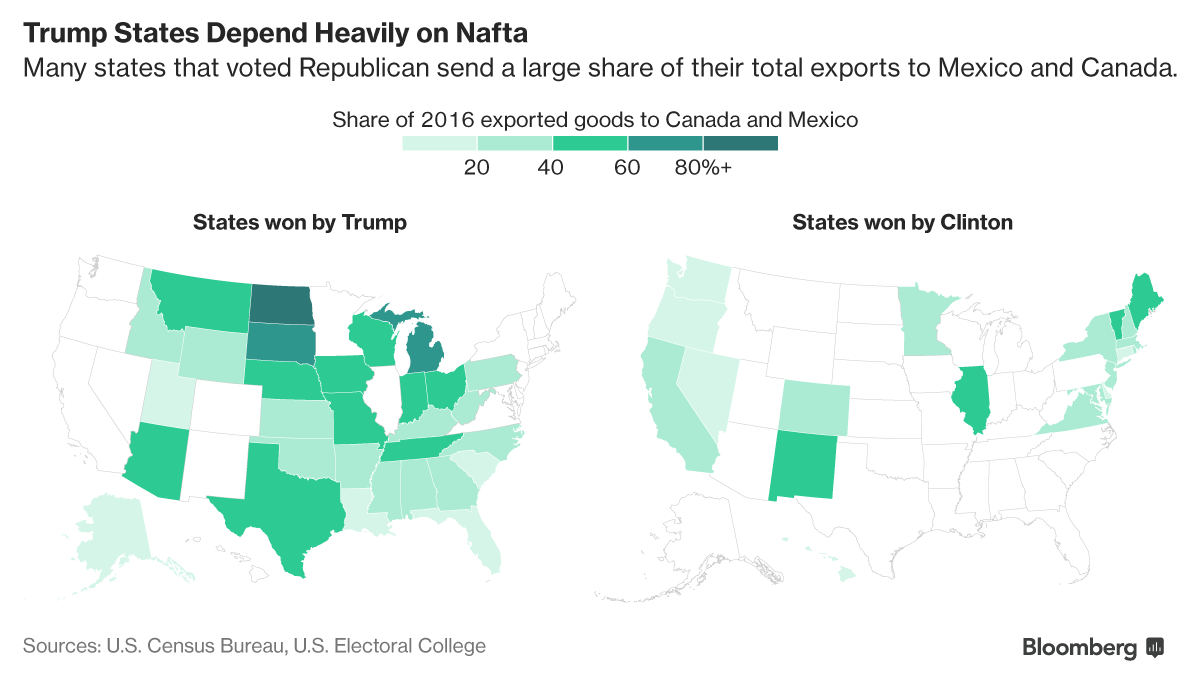
Now that’s actually slightly different from the story that we heard from people in the inner circle who said it was a lot more chaotic as a process. We heard some fairly startling stories that the reason the Canadians and the Mexicans called the president was that people in the inner circle of team Trump were very anxious about what was about to go down. They called [Canada and Mexico] and said, “You need to call [the president]. Right now.” People inside the White House also called the new Agriculture Secretary Sonny Perdue. Perdue who had only been confirmed a day or two earlier. And they called him in, [saying], “You need to come over here now! You need to! He’s about to withdraw from NAFTA.” So Sonny Perdue literally asked his staff to draw up a map of the bits of America that had voted for Donald Trump and the bits of America that do well from exporting grain and corn through NAFTA. [The map] showed how these two areas often overlap. So he went in, said to Donald Trump, “Actually, Trump America, your voters, they do pretty well out of NAFTA.” And the president said, “Oh. Then maybe I won’t withdraw from NAFTA.”