
The purpose of the WTO is to facilitate multilateral trade liberalizations. Its elementary international economics to show why it is helpful to entice large countries with substantial market power to agree on trade liberalizations. Both countries win.
Countries that violate WTO agreements are taken to WTO court and eventually, they have to pay compensation to those countries that were injured. That is why the Trump administration has been trying to stifle any further WTO judicial processes — too many complaints have been filed against the US in response to Trump tariffs.
While the WTO judicial panel is still active, it has found for the US in part I of the Airbus-Boeing dispute and the US is now allowed to collect compensation. Politico reports that the won the right to collect a total of €7.5 billion, somewhat of a disappointment to the White House, which had prepared a list of EU export tariffs worth $21 billion.”
Part II of the Airbus-Boeing case is still pending at the WTO, which has already decided against the US in part II of the dispute, but the compensation is still being worked out. Are the US and Europe better off collecting compensation in this two-part conflict?
Bloomberg has the scoop: “Here’s how the international trading system is supposed to work: If a country gets upset with another country’s trade practices, it can file a dispute at the WTO where a panel of experts offers a judgment. If the losing country doesn’t comply with that ruling, the WTO allows the winning country to retaliate. For most of his first term in office Trump has preferred to cut to the chase and levy tariffs that he says are exempt from WTO oversight because they are necessary to protect America’s “public morals” and national security. But in the instance of Airbus, Trump and his predecessors have pursued and succeeded in a landmark case against the EU that’s been a decade-and-a-half in the
making.
Last year the WTO ruled that the EU hasn’t ended its illegal subsidies, which Boeing and the U.S. claim give Airbus an unfair advantage, and the WTO will soon green-light new U.S. tariffs on billions of dollars worth of European goods.
But the other shoe has yet to drop. In a similar action that’s still winding through the Geneva-based WTO, the European Commission is readying its own tariffs on
U.S. exports in retaliation for unfair subsidies given to Boeing. EU Trade Commissioner Cecilia Malmstrom summed up the situation on Monday by saying “both we and the U.S. have sinned” and the time has come to settle the dispute rather than resort to tit-for-tat tariffs. The multi-billion dollar question now: Will Trump see an opportunity to forge a comprehensive aerospace accord with the EU or kick off a transatlantic trade war of epic proportions instead?”
Finally, while the tariff/retaliation-compensation may be “justified” under WTO rules to “keep the peace” and enforce multilateralism, there are also the usual unintended consequences. Bloomberg reports that a substantial share of Airbus parts is sourced in the US…
Charting the Trade War
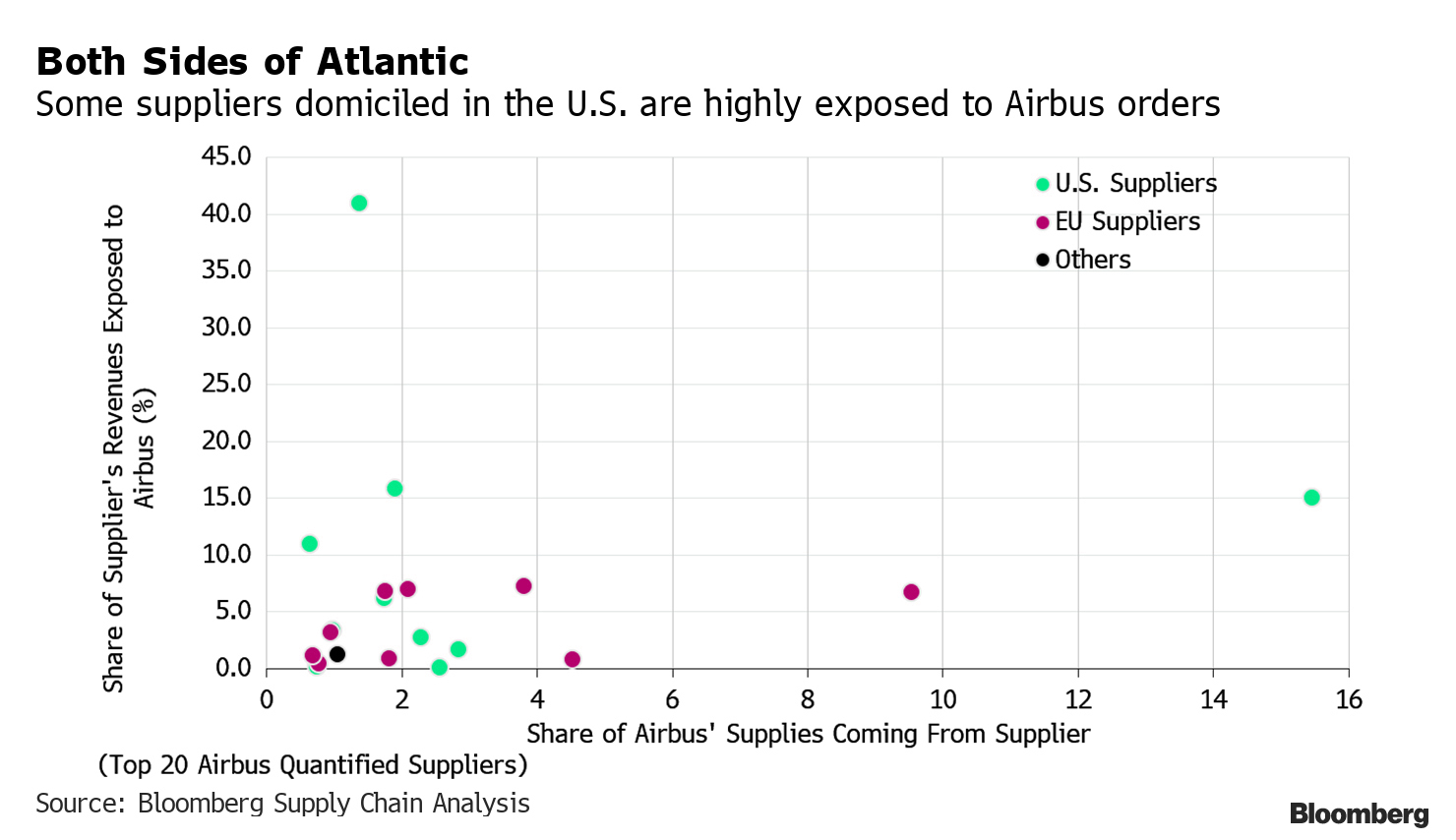 World Trade Organization authorized $7.5 billion in U.S. duties against the EU would hit export orders for U.S. manufacturers, according to Bloomberg Economics.
UPDATE 10/4/2019:
The US just released its tariff list, targeting among other things European whiskey, most likely to compensate US whiskey producer for their market loss in China, which retaliated by reducing market access for Kentucky Burbon/Whiskey produced in the Senate Majority leader’s home state… Other than that we have tariffs that help US agriculture (olive oil, cheese, meat, wool) which already received a $28 billion bailout when China stopped buying US goods.