Environmental Forensics: Identification and Characterization of E. coli and other Bacterial Species in Wetland Water on UWB Campus
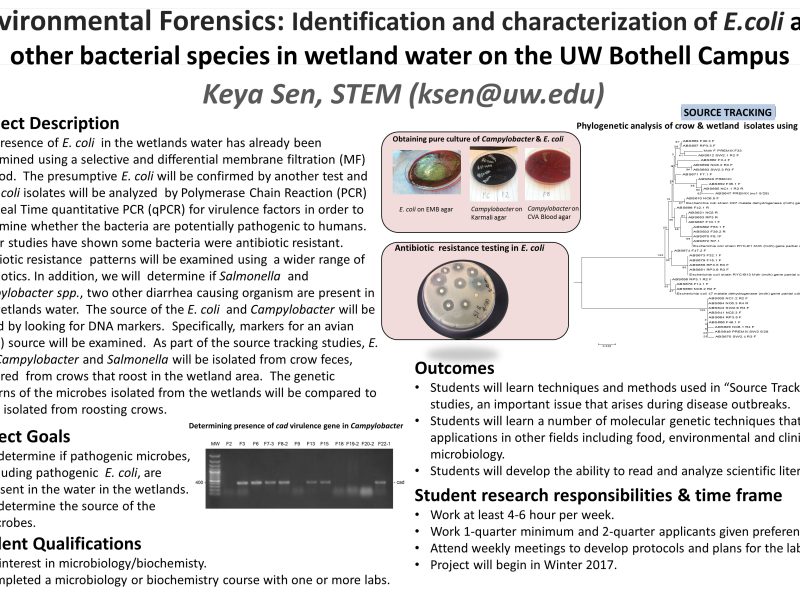
The presence of E. coli in the water of the wetlands has already been determined using a selective and differential membrane filtration (MF) method. The presumptive E. coli will be confirmed by another test and the E.coli isolates will be analyzed by Polymerase Chain Reaction (PCR) and Real-Time quantitative PCR (qPCR) for virulence factors in order to determine whether the bacteria are potentially pathogenic to humans. Earlier studies have shown some bacteria were antibiotic resistant. Antibiotic resistance patterns will be examined using a wider range of antibiotics. In addition, we will determine if Salmonella and Campylobacter spp., two other diarrhea-causing organisms are present in the water of the wetlands. The source of the E. coli and Campylobacter will be traced by looking for DNA markers. Specifically, markers for an avian (crow) source will be examined. As part of the source tracking studies, E. coli, Campylobacter, and Salmonella will be isolated from crow feces, gathered from crows that roost in the wetland area. The genetic patterns of the microbes isolated from the wetlands will be compared to those isolated from roosting crows.
Goals: To determine if pathogenic microbes, including pathogenic E. coli, are present in the water in the wetlands. To determine the source of the microbes.
Student Outcomes:
- Students will learn techniques and methods used in “Source Tracking” studies, an important issue that arises during disease outbreaks.
- Students will learn several molecular genetic techniques that have applications in other fields including food, environmental and clinical microbiology.
- Students will develop the ability to read and analyze scientific literature.
Requirements: Students must have an interest in microbiology/biochemistry and have completed a microbiology or biochemistry course with one or more labs
Time commitment:
- Work at least 4-6 hours per week.
- Work 1-quarter minimum; 2-quarter applicants given preference.
- Attend weekly meetings to develop protocols and plans for the lab.
Schools or Related Disciplines:
Interdisciplinary Arts and Sciences (IAS)
Nursing and Health Studies (NHS)
Science, Technology, Engineering and Math (STEM)
STEM – Biological Sciences
Category: Research and Creative Projects
Time: estimated hours per week is 1hr – 3hrs
Credit/Compensation Notes: This is a volunteer or unpaid position
Contact: Keya Sen, Ph.D., ksen@uw.edu
Go to project or opportunity website for more information