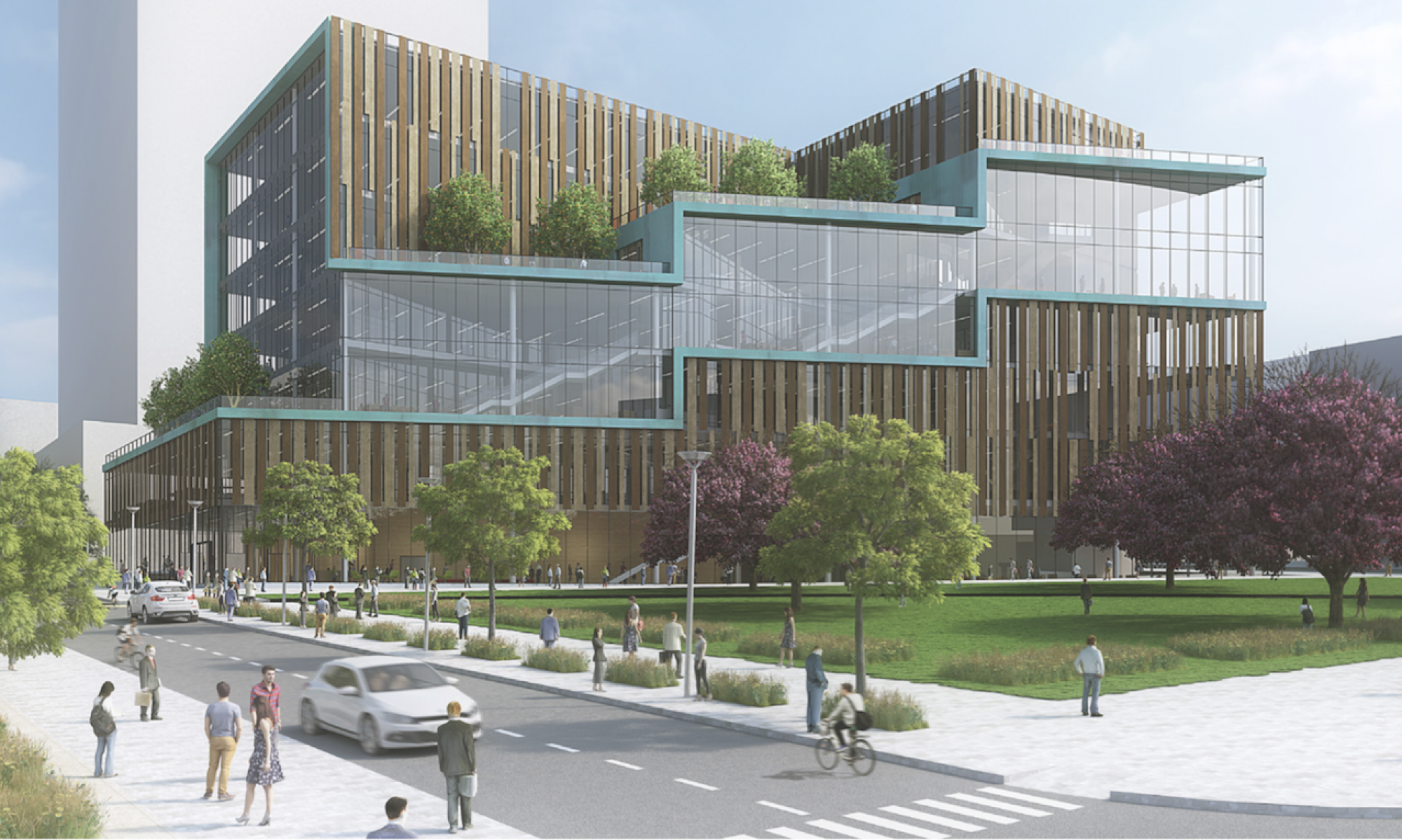
As a regional center of excellence located in UW’s Innovation District, the Center for Advanced Materials and Clean Energy Technology (CAMCET) will connect a vibrant Washington clean technology research and innovation ecosystem to the world. CAMCET is designed to catalyze partnerships between research, education, business, and government to accelerate solutions and impact in the clean technology sector.
Building
CAMCET will be the world’s premier cleantech innovation building. Students, researchers, and industry partners will be able to interact continuously, with the ability to seamlessly move from labs to meeting and social spaces. Modular programming and vertical zoning will allow the building to respond to dynamic needs while avoiding future renovation.
Learning space is dedicated to active learning spaces, STEM project teaching labs and collaborative social learning spaces. Research space includes wet, dry, and computational research lab modules, and significant space for shared instrumentation and equipment. Industry space includes the Washington Clean Energy Testbeds, the scale up facilities that allow prototype technologies to be manufactured and tested, as well as start up lab modules and hot desks. Lastly, Public space includes venues for events, conferences, and K-12 and public outreach.
Program
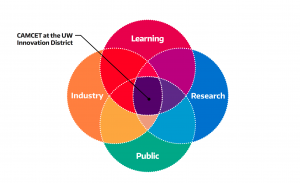
CAMCET will create impact across four sectors: Learning, Research, Industry, and Public.
CAMCET will foster collaborative research that accelerates solutions for a healthy planet.
CAMCET will increase STEM degree production and provide students with innovative STEM learning environments.
CAMCET will catalyze partnerships.
CAMCET will convene the clean tech community, and incubate start-up companies that succeed in the marketplace.
CAMCET will accommodate FTE growth and relieve some critical campus classroom needs.
CAMCET will kickstart the UW Innovation District.
Innovation District
The University of Washington is embarking on a bold new plan that will dramatically accelerate the way it translates knowledge discovery into solutions for the greatest needs of society. Founded on the premise that direct and deliberate integration of UW research with industry, civic and non-profit partners will catalyze solutions and amplify global impact, UW will develop the West Campus (west of 15th Avenue NE and south of NE Campus Parkway) as an Innovation District that brings together partners across a wide spectrum of influence.
CAMCET will be the flagship building of the new District, guided by five principles that will foster a culture of innovation.

At CAMCET, these five principles will allow UW research, learning, and technology activities to collaborate with industry and government and create groundbreaking impact in the cleantech sector.
UW, the Pacific Northwest National Laboratory (PNNL), and Washington state are highly-ranked in terms of R&D expenditures, innovation, and energy science, all pillars of a regional infrastructure for inventing disruptive new cleantech solutions. However, Seattle has room to grow in terms of energy innovation, and CAMCET will serve to connect these dots.
Timeline
Master plans will be finalized in late 2018-early 2019. Construction activities are planned to begin in 2020.