|
||
| Gradually
Canadian artists began to develop new strategies for working with cultural
as well as geographic boundaries. The artist moved from observer to catalyst
of change. We can see this transition throughout the modernist period
in Québéc. Artists such as, Rose Marie Arbour, Paul Emile Borduas, poet
Gilles Hénault, John Lyman and Alfred Pellan developed Canada's new avant
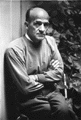
garde. In 1939, John Lyman started the Contemporary Art Society in Montreal; Alfred Pellan a French Canadian artist previously living in Paris returned to Montreal and introduceds concepts of abstract expressionism. Paul Émile Borduas, started to write theories about his work and modernism. For example, in an address to the Societe d’etudes et de Conferences he described his work as "an art form entirely devoted to the exploration of the internal world, and one that marked the end of the attempt, followed up until this point, to represent the external world."(6) In 1946, Borduas formed the Automatistes, an avant-garde movement pivotal to the secularization of French culture. Although not widely accepted at the time, Borduas’s Manifesto "Refus Global", (meaning: altogether "NO" or "refusal to obey") attacks the conformism and traditionalism of the church and order of government in Québéc. A decade after the manifesto was written, social scientists and historians begain to reevaluate their past and present interpretations of Québéc as a distinct culture. The academic and art worlds began to accept the concept of French cultural secularization. The nation began to recognize French-Canadian culture as "different" but it was not yet understood as distinct. Circle! in my brain, me I define you: REVOLUTION. Morning, first morning of the world, Still virgin from knowledge, this fertile fever, Genius of progress from which all flesh suffers Exiled! O sadness in our centuries of iron Morning carrier of the evening, I suspect at your prow The initial sign of conquest: the WHEEL (7) Poem by Gilles Hénault translated by Natalie Boisseau. |