|
||
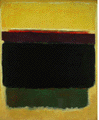
| In
the 1950’s, Anglo Canadian modernists went through a period of mirroring
their neighbors to the south. Influenced by New York painters such as
Mark Rothko and Jackson Pollock they employed concepts of universalism
and minimalize the content of art production. As Sugi Gablik states
in her essay Connective Aesthetics: Art After Individualism "; within
the modernist era, art was defined by autonomy and self-sufficiency,
and by its isolation from the rest of society. Exposing the radical
autonomy of aesthetics as something not "neutral" but as an active participant
in capitalist ideology has been a primary accomplishment of the aggressive
ground-clearing work of destruction." Collectors, museums and dealers
developed a market for the production of culture. A culture that wiped
out the tradition, identity and geography of a sense of place. During the 60’s, political theorists helped to engineer the nation’s policy of multiculturalism. This movement marked a distinct break in the country’s identity from the United States. Canada officially built the framework to represent a mosaic, rather then the American model of a melting pot. Although these policies were created to repair relations with Anglo and French Canadians, they later developed to include all people. The Multicultural Act of 1971 officially designated Canada as a country that is "multicultural in a bilingual framework". In the policy announcement to parliament, the government declared, "We believe that cultural pluralism is the very essence of the Canadian identity. Every ethnic group has the right to reserve and develop its own culture and values within the Canadian context. To say that we have two official languages and no particular culture is more official than another. A policy of multiculturalism must be a policy for all people." (8) Although the government adopted a policy of multiculturalism, the people implementing the policy still upheld established prejudice. Confusion grew over what pluralism really meant within a national framework. Artists, social activists, feminist and post modern theorists began to challenge and review dominant ideologies. |