Project Overview: This project leverages recent research into the socio-emotional mechanics of online collaboration and multi-player game development, and the existing social networking structure of BuddyPress, to create an educational game that incorporates bioinformatics and cyberinfrastructure (CI) concepts aimed at high school students. We are interested in the uptake of concepts of cyber problem solving specifically among young underrepresented minorities and women, and the production of conceptual models that will help us to better understand the larger relationships between people, educational games, and infrastructural computational technologies. Collaboration and creative strategies will be encouraged and integrated into the gameplay mechanics.
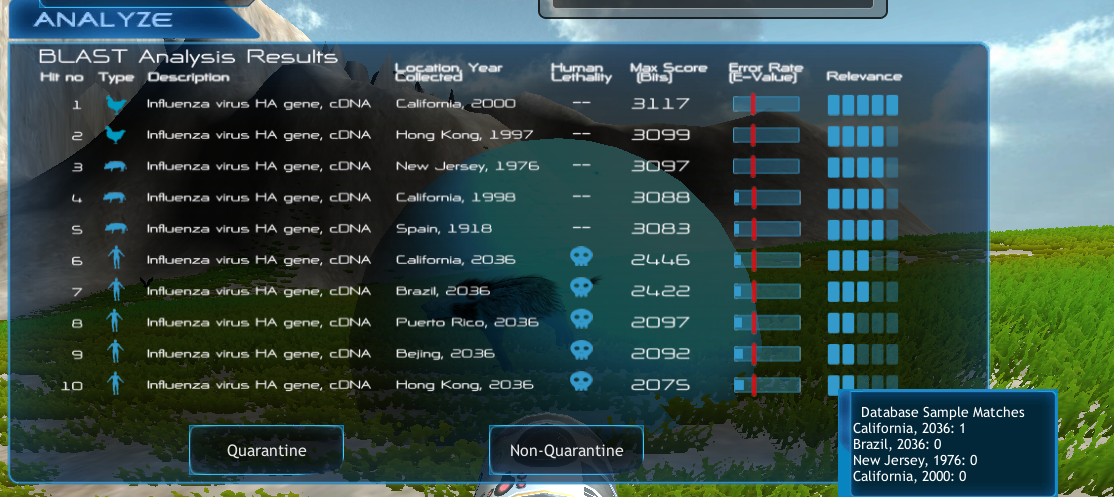
About the Game: Max Five is a game based around a futuristic crime scene investigation scenario in which players must collaborate in teams and take on the roles of forensics experts, computing experts, and scientists to solve clues and recover data from a top-secret research project that has gone awry. The game integrates bioinformatic concepts with programming hacks, where players can use real code to modify game objects and character behavior. You can track our latest development updates at gamestem.com .
Student & School Partnerships: We are currently in the development phase of the game and are actively building partnerships with Seattle area public schools to involve student designers. If you would like further information about how students can become involved in game design or development, please contact Daniel Perry at dbperry[at]uw.edu.
About the Research Team
The research team for this project includes Professor Cecilia Aragon, Affiliate Professor Suzanne Brainard, Jeanne Chowning, Brian Glanz, Daniel Perry and Dr. Mette Peters.
Cecilia Aragon (PhD, UC Berkeley) is the director of the SCCL and an associate professor in the Department of Human Centered Design & Engineering and the eScience Institute at the University of Washington, with adjunct appointments in Computer Science and Engineering and the Information School. Her current research focuses on computer-supported cooperative work, visualization, and creativity for scientific collaborations, including the socio-technical aspects of CI and the role of socio-emotional content in online communication among technical collaborations.
Suzanne Brainard (PhD, Ohio State University) is the Executive Director of the Center for Workforce Development (CWD) at the University of Washington. Brainard is also an Affiliate Professor in both Human Centered Design & Engineering and Women Studies at the University of Washington. CWD will serve as the internal evaluators on this demonstration project. CWD has served as an internal or external evaluator on several NSF-funded projects including LSAMP, STEP, ADVANCE, and a MESA STEP.
Jeanne Chowning is the Director of Education for the Northwest Association for Biomedical Research (NWABR), a non-profit educational organization established in 1988 to promote the public understanding of biomedical research and its ethical conduct. NWABR’s work centers on outreach, including supporting excellence in science teaching, building connections between scientists and students, and strengthening the research community. Chowning leads Bio-ITEST, an NSF science education grant focused on bioinformatics. Chowning earned her BA in Biology from Cornell University and an MS in Biology at the University of Washington.
Brian Glanz is a software engineer at NWABR and expert consultant on BuddyPress. Glanz architected a publishing and social networking platform for science based on WordPress. He will develop software, serve as a technical consultant, and coordinate the social network aspects of the project, bringing his expertise in the BuddyPress platform to the development of the game.
Daniel Perry is a PhD student in Human Centered Design & Engineering at the University of Washington and a researcher in the Scientific Collaboration and Creativity Lab at UW. He has previously worked as a graduate researcher at Lawrence Berkeley National Lab in the Computational Research Division and as a researcher at UC Berkeley’s Center for Next Generation Teaching and Learning. He holds a BA from Brown University and a Master of Information Management & Systems from UC Berkeley.
Mette A. Peters, PhD, has experience from the pharmaceutical industry and academia in the areas of cell and molecular biology, genetics, genomics, and bioinformatics with respect to discovery, commercial development, and education. She was previously the Director of the Technologies and Resources group at the University of Washington. Peters is currently at Sage Bionetworks, a non-profit biomedical research organization with a mission to coordinate and link academic and commercial biomedical researchers through a Commons that represents a new paradigm for genomics intellectual property, researcher cooperation, and contributor-evolved resources.


[...] Collaborative Games for Bioinformatics Education [...]